
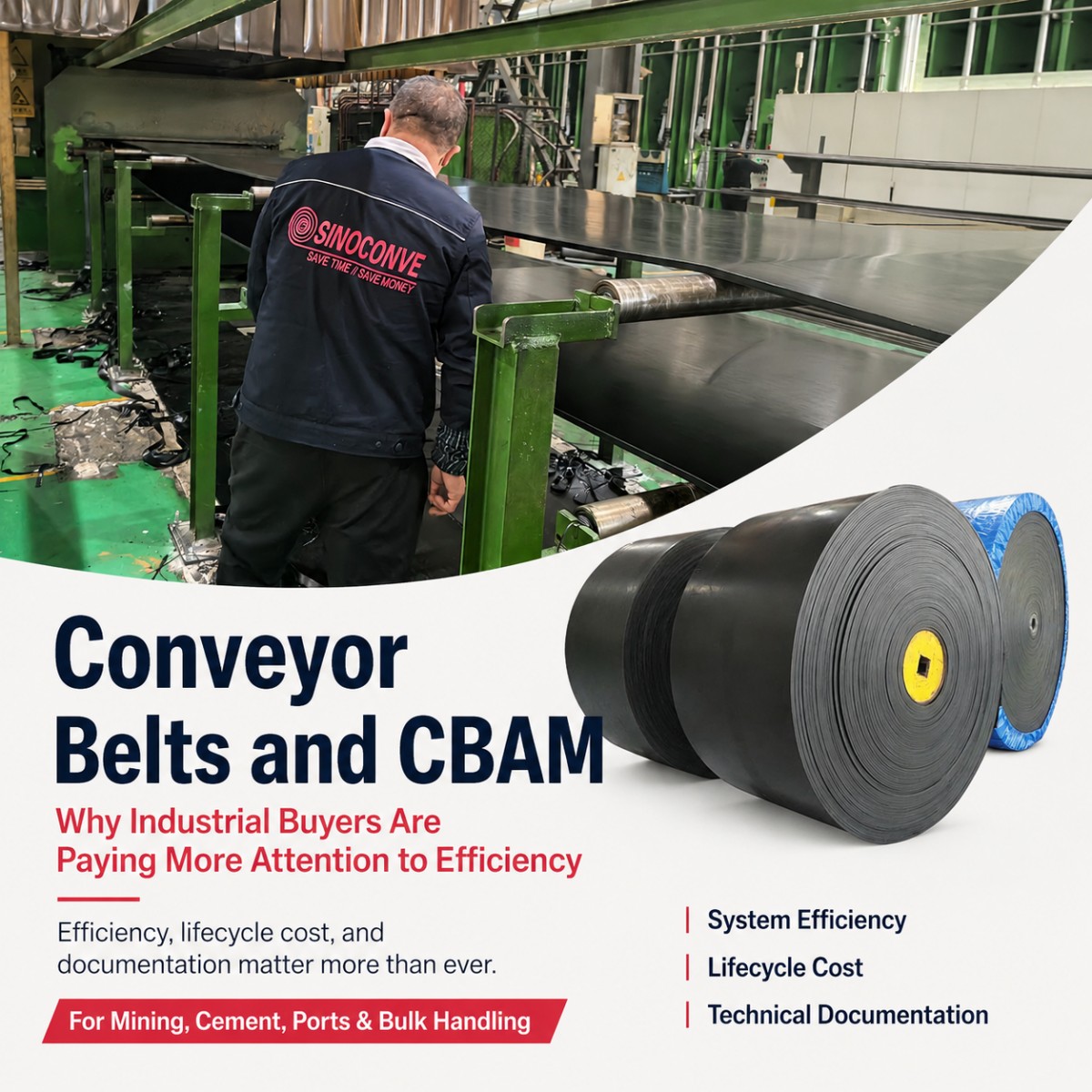
CBAM and Conveyor Belt Efficiency for Industrial BuyersCBAM is not a conveyor belt regulation. The EU Carbon Border Adjustment Mechanism currently applies to selected goods in carbon-intensive sectors including cement, iron and steel, aluminium, fertilisers, electricity, and hydrogen. Industrial conveyor belts are not one of those core product groups.
Yet CBAM is changing the questions procurement teams ask. Since the definitive regime began in 2026, carbon cost, production data, and documentation have become more visible in industrial trade. For plants moving large volumes of raw materials, energy use in conveying systems is therefore receiving closer commercial scrutiny—even when the belt itself is outside the direct scope of CBAM.
For buyers, the useful question is not whether a supplier can put a “low-carbon” label on a belt. It is whether the selected industrial conveyor belt fits the duty, runs with reasonable resistance, avoids preventable maintenance, and comes with documentation that explains what has actually been specified.
CBAM Changes the Procurement Conversation, Not Conveyor Physics
The current CBAM framework prices embedded emissions in covered imported goods. It does not create a special efficiency requirement for rubber conveyor belts. A steel mill, cement producer, aluminium processor, or fertiliser plant may nevertheless have stronger reasons to review electricity use, maintenance waste, spare-part consumption, and data quality across its operations.
That makes conveyor belt efficiency relevant to a wider low-carbon manufacturing program. The link needs careful wording: reducing conveyor energy consumption can lower operating energy demand, but it should not automatically be claimed as a direct CBAM credit. Whether electricity use affects reportable embedded emissions depends on the covered product and applicable methodology.
|
Procurement question |
Practical meaning |
|
Is the belt itself covered by CBAM? |
Generally no under the current six-sector scope. |
|
Can belt efficiency still matter? |
Yes, through plant energy use, lifecycle cost, and internal decarbonisation targets. |
|
Does lower power demand equal lower CBAM liability? |
Not automatically; CBAM calculations follow sector-specific rules. |
|
Why does documentation matter? |
Buyers increasingly need traceable technical information, not unsupported sustainability claims. |
What “Conveyor Belt Efficiency” Should Mean to a Buyer
Efficiency is not one number printed on a quotation. Drive power is affected by material load, lift, belt speed, idler condition, alignment, tension, belt construction, rolling resistance, and other system resistances. ISO 5048 addresses calculation of operating power and tensile forces for belt conveyors with carrying idlers, reinforcing an important point: energy demand is a system result.
For long or heavily loaded conveyors, interaction between the bottom cover and idlers can matter. Rubber deforms as the belt passes over each idler and then recovers. Compounds designed for lower rolling resistance can reduce the force required to move the belt, but the result depends on conveyor layout and operating conditions.
Lower rolling resistance is not a universal upgrade
A low-rolling-resistance bottom cover can be attractive on long horizontal or low-incline conveyors. It is not automatically the right choice for severe impact, sharp material, hot product, oil contamination, flame-resistance requirements, or difficult incline geometry. In those duties, other compound properties may take priority.
The better question is: “Which part of this belt construction is intended to reduce resistance, and what trade-offs does that create for my service condition?”
Heavier does not always mean better
Specifying a thicker cover, heavier carcass, or higher tensile rating can feel safer. Sometimes it is necessary; sometimes it adds moving mass and stiffness without solving the real failure mode. A belt that is too stiff for the conveyor may also trough or track poorly, while an under-specified carcass may not handle tension, impact, or splice loads.
Selection therefore needs load data, pulley diameters, belt speed, take-up arrangement, material characteristics, and cover requirements—not just width and tensile rating.
System Condition Can Cancel the Benefit of a Better Belt
A technically efficient belt cannot compensate for an unhealthy conveyor. Seized idlers increase resistance. Mistracking creates edge contact and drag. Excessive cleaner pressure adds friction. Carryback can build up on return components, while poor loading can cause spillage and impact damage.
|
What to check |
Why it matters |
|
Idlers and bearings |
Poor rotation or alignment adds resistance and can damage the belt. |
|
Belt tracking |
Mistracking creates edge wear, drag, and spillage. |
|
Loading zone |
Off-centre loading and impact can shorten cover and carcass life. |
|
Belt cleaners |
Too much pressure adds drag; too little allows carryback. |
|
Pulley diameters |
The belt construction must tolerate repeated bending. |
|
Tension and take-up |
Incorrect tension can contribute to slip, sag, or excess stress. |
Installing a premium belt while leaving seized rollers or chronic mistracking untouched can produce disappointing results.
Efficiency and Lifecycle Cost Belong in the Same RFQ
The lowest price per metre is easy to compare. Lifecycle cost is harder because it includes what happens after installation.
A useful evaluation should consider belt price together with power demand, splice requirements, maintenance access, compatibility with existing pulleys, common failure modes, and replacement planning. This does not mean accepting vague promises about “longer life” or “energy savings.” Those claims need a defined comparison basis.
If a supplier proposes an energy-efficient conveyor belt, ask what standard construction is being used as the baseline, which feature is different, and under what conditions the comparison was made. A percentage without test conditions or application assumptions has limited procurement value.
Low-Carbon Manufacturing Raises the Value of Better Documentation
CBAM has made industrial buyers more aware of data quality. That awareness is spreading beyond products directly covered by the mechanism.
For conveyor belts, useful documentation is primarily technical. Buyers should be able to identify the ordered construction, cover grade, carcass type, nominal thickness, width, length, edge type, applicable standard, and splice recommendation. Special properties such as heat, oil, abrasion, flame, or low-rolling-resistance performance should be defined on an agreed basis.
This also makes quotation comparison fairer. Two offers can share the same width and nominal tensile rating while using different carcasses, compounds, cover thicknesses, or tolerances.
At SINOCONVE, production is supported by incoming material inspection, process control, finished-product inspection, and performance testing. Applicable references such as ISO, DIN, RMA, SANS, or BS can be considered according to customer requirements. Buyers should place the required standard and test expectations in the RFQ instead of assuming every quotation uses the same basis.
What an Efficiency-Focused Conveyor Belt RFQ Should Include
“EP belt, 800 mm wide” is not enough for an engineering purchase. Provide the data that changes construction and operating resistance:
1. Belt width, length, speed, and conveyor centre distance.
2. Material type, bulk density, lump size, moisture, temperature, and exposure to oil or chemicals.
3. Capacity, incline or lift, and loading arrangement.
4. Drive pulley and other critical pulley diameters.
5. Existing belt construction, tensile rating, ply count or steel-cord rating, and cover thickness.
6. Known problems such as edge wear, splice failure, slippage, carryback, or high motor load.
7. Required standards, test reports, marking, packaging, and batch documentation.
8. Whether energy reduction is a formal objective and how it will be evaluated.
These details help suppliers distinguish an ordinary replacement from a belt selected for lower operating resistance.
Compare Supplier Claims Without Turning CBAM Into a Marketing Slogan
CBAM is a compliance framework for defined imported goods. It should not become a catch-all claim for every “green” industrial component.
|
Supplier claim |
Better follow-up question |
|
“Energy-saving belt” |
Which construction or compound reduces resistance, and under what conditions? |
|
“Low-carbon belt” |
Is this a product carbon claim, a manufacturing claim, or an in-service energy claim? |
|
“CBAM compliant” |
Which specific CBAM obligation is relevant to this product? |
|
“Longer service life” |
Compared with what belt, in what duty, and which failure mode? |
|
“Same specification” |
Are carcass, covers, thickness, tolerances, and special properties equivalent? |
This approach gives engineering teams evidence they can actually review.
When Energy Efficiency Is Not the First Priority
Some applications demand survival first. A quarry carrying large sharp rock may need impact and cut resistance. Hot clinker requires a suitable heat-resistant cover. Oily materials can attack an unsuitable rubber compound. Regulated applications may have flame or safety requirements that dominate selection.
In these cases, preventing premature replacement can be more important than pursuing the lowest rolling resistance. A belt that is poorly matched to the duty creates scrap, installation work, downtime, and repeat purchasing.
Read the Old Belt Before Ordering the New One
The removed belt is often useful application data. Repeated edge abrasion points toward tracking or structure issues rather than simply insufficient strength. Localized gouging can indicate trapped material or sharp impact. Carryback suggests cleaning or material-release problems. Cracking near pulleys can raise questions about cover condition, stiffness, tension, or pulley compatibility.
A replacement should address the failure cause where possible. Otherwise, procurement can buy a more expensive belt and reproduce the same damage pattern.
FAQ
Are industrial conveyor belts directly covered by the EU CBAM?
Under the current scope, CBAM applies to selected goods in cement, iron and steel, aluminium, fertilisers, electricity, and hydrogen. Conveyor belts are not one of those core product groups. Check the current EU product scope when a classification issue affects a specific import.
Can a more efficient conveyor belt reduce CBAM costs?
Not automatically. Lower power demand can support plant energy and decarbonisation goals, but CBAM liability follows sector-specific rules for covered goods. Do not convert a belt energy claim directly into a CBAM saving without a valid accounting basis.
What data is most important for selecting an efficient industrial conveyor belt?
Start with capacity, belt speed, conveyor length and lift, pulley diameters, material characteristics, existing construction, take-up information, and current failure symptoms. Efficiency cannot be separated from mechanical suitability.
Is a thicker conveyor belt always better?
No. Extra thickness or a heavier carcass may be necessary for wear, impact, or tension, but unnecessary mass and stiffness can create other problems. Match the construction to the duty and pulley geometry.
How should buyers verify an “energy-saving” belt claim?
Ask what feature lowers resistance, what reference belt is used, what test or calculation supports the claim, and whether the benefit is expected under your conveyor’s speed, load, length, and incline.
What documents should be requested with a conveyor belt order?
Request a clear construction specification, dimensions, cover grade, carcass or cord rating, applicable standard, splice guidance, and agreed inspection or test documentation. Add batch traceability or special-property records when required.
Final Selection Check
CBAM is pushing carbon and documentation higher on the industrial agenda, but it should not turn conveyor belt purchasing into a compliance slogan. The stronger response is practical: specify the belt from real conveyor data, evaluate conveyor belt efficiency as a system property, compare lifecycle cost instead of price per metre alone, and require documentation that makes competing offers genuinely comparable.
For low-carbon manufacturing and efficient production projects, that discipline gives buyers a clearer basis for selection while reducing avoidable resistance, maintenance, and replacement risk.