
A purchasing guide for comparing rubber conveyor belt quotations on specification, delivered cost, risk, and whole-life value.
A request for “conveyor belt price per meter” sounds precise, but the unit can hide more than it reveals. A 1,000 mm belt quoted at one price is not comparable with another 1,000 mm belt if the carcass strength, cover thickness, rubber grade, edge construction, roll length, packing, or trade term is different. That matters in mining, cement, ports, power plants, and other bulk-handling operations, where a cheaper purchase can become expensive after premature wear, splice work, emergency freight, or unplanned shutdowns.
For 2026 sourcing, the useful question is therefore not “What is the cheapest price per meter?” but “What exactly is included in each meter, and what will that belt cost to put into service and keep running?” This guide shows how to normalize quotations, identify the specification items that move price, and compare suppliers without pretending there is one universal market price.
|
Quick Answer |
1. Why There Is No Single Conveyor Belt Price Per Meter
Rubber conveyor belts are engineered products rather than a commodity sold only by length. Price follows the amount and type of material in the belt, the reinforcement required to carry tension, the performance expected from the covers, and the commercial scope of the order. Even the same nominal width can represent very different products.
Online price lists are especially easy to misread. A marketplace listing may show a reference price for one construction, one order quantity, or one delivery basis. It does not establish a reliable 2026 benchmark for a different mine, quarry, cement line, or port conveyor. Raw-material and freight conditions also move over time, so a dated web price should not be treated as a substitute for a current, specification-matched quotation.
A more defensible benchmark is a normalized quote: the same technical specification, the same quantity, the same commercial terms, and the same destination assumptions. Only after that normalization does a per-meter comparison become useful.
2. The Specification Items That Change Rubber Conveyor Belt Price
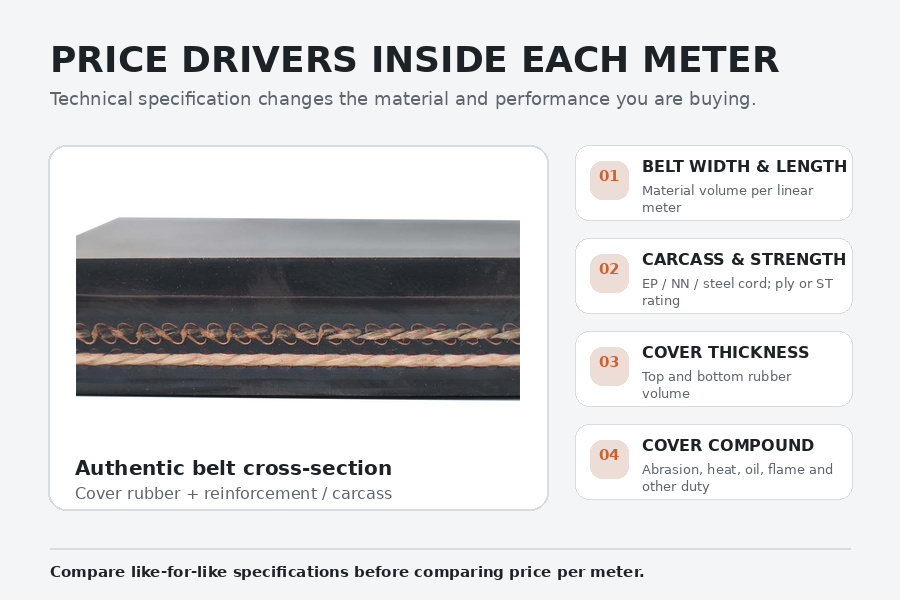
The largest pricing differences usually have an engineering reason. Buyers should make those reasons visible before negotiating the number.
2.1 Belt width and total ordered length
A wider belt uses more carcass and cover material per linear meter, so comparing meter prices across different widths is meaningless. Total order length also matters because production setup, roll planning, packing, and logistics are spread differently across a short order and a full production run. For SINOCONVE orders, the confirmed minimum order quantity for conveyor belts is 50 m; products are made to order rather than supplied from finished-stock inventory.
2.2 Carcass construction and rated strength
The carcass carries the working tension. Textile belts and steel-cord belts are therefore not interchangeable price categories. Within textile belts, the fabric type, rated strength, and ply construction affect material content and the belt's mechanical behavior. Higher strength should be specified because the conveyor requires it, not because a larger number appears safer on paper.
SINOCONVE's confirmed production scope includes textile constructions from EP100 to EP600 and steel-cord constructions from ST500 to ST7500. Those manufacturing ranges describe capability; they do not mean every conveyor should use the highest available rating.
2.3 Top and bottom cover thickness
Cover thickness directly changes rubber volume. More top cover can provide additional wear allowance where abrasion or impact justifies it, but simply adding millimeters is not a complete wear strategy. The compound, material characteristics, loading point, belt speed, cleaners, and alignment also influence service conditions. A quote that says only “10 mm belt” is less useful than one that separates carcass construction from top and bottom cover thickness.
2.4 Cover compound and operating environment
General-purpose, abrasion-resistant, heat-resistant, oil-resistant, cold-resistant, flame-resistant, and other compounds are formulated for different exposures. A special compound can raise the purchase price, but substituting a general cover where heat, oil, fire behavior, or severe abrasion is relevant can create a much larger operating risk. The correct comparison is performance requirement versus actual duty, not “special grade versus standard grade” in isolation.
2.5 Special construction, finishing, and documentation
Chevron profiles, sidewalls, breakers, special edges, endless preparation, non-standard roll lengths, branding, export packing, inspection, and third-party testing can all change the quotation scope. These items should be listed separately or clearly included so buyers know whether two suppliers are pricing the same deliverable.
3. Normalize Every Quote Before Comparing Unit Price
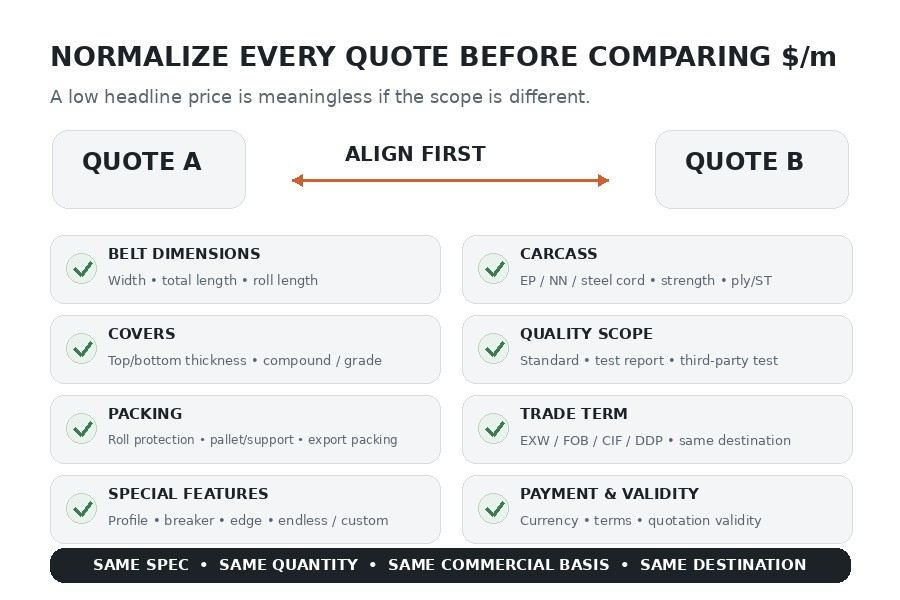
A practical comparison sheet prevents a low headline price from winning simply because important requirements were omitted.
|
Quote item |
What to align |
Why it changes the comparison |
Buyer check |
|
Belt dimensions |
Width, total length, roll length |
Defines material quantity and handling scope |
Same dimensions? |
|
Carcass |
EP/NN/steel cord, strength, ply or ST rating |
Changes reinforcement and mechanical capability |
Same construction? |
|
Covers |
Top/bottom thickness and compound/grade |
Changes rubber quantity and duty suitability |
Same cover requirement? |
|
Special features |
Profile, breaker, edge, endless or other customization |
Adds materials and processing |
Included or excluded? |
|
Quality scope |
Required standard, test report, third-party test if specified |
Changes verification and documentation scope |
Same evidence? |
|
Packing |
Roll protection, pallet/support, export packing |
Affects damage risk and freight handling |
Same packing basis? |
|
Trade term |
EXW/FOB/CIF/DDP or other agreed Incoterm |
Moves freight, insurance, duty and risk between parties |
Same term and destination? |
|
Payment & validity |
Payment terms, currency, quotation validity |
Affects cash flow and exposure to price changes |
Same commercial basis? |
4. Compare Landed Cost, Not Just Factory Price
Two identical belt specifications can still have different real acquisition costs. A factory price excludes some combination of inland transport, export handling, ocean or land freight, insurance, import duty, tax, local delivery, and sometimes installation-related services. If one quote is FOB and another is CIF or DDP, the meter prices are not on the same commercial basis.
For internal comparison, calculate a delivered or landed figure using the costs that apply to your organization. A simple structure is: belt purchase + packing + freight + insurance + import charges + local delivery + any required inspection or testing. Keep taxes that are recoverable under your local rules separate from true cost. For cross-border purchases, confirm the current Incoterm and destination rather than assuming that “shipping included” means the same thing in every quote.
5. Unit Price Is Only the First Layer of Conveyor Belt Cost
Whole-life cost adds the costs that appear after the purchase order: splicing and installation, planned maintenance, repairs, replacement labor, emergency logistics, and the operational impact of unplanned stops. The exact value is site-specific, so a supplier should not invent a universal payback percentage or service-life claim.
This is where the cheapest belt can be either a sensible choice or a false economy. For a lightly loaded, non-critical conveyor with easy access and low downtime consequence, a lower-cost specification may be entirely rational. For a high-throughput or difficult-to-access conveyor, the cost of a failure can dominate the initial price difference. The decision depends on duty and consequence.
5.1 A simple TCO comparison method
· Record the delivered belt cost on the same commercial basis.
· Add splice materials, installation labor, commissioning, and any special handling.
· Use your site's maintenance history to estimate repair frequency and labor; do not copy generic web assumptions.
· Estimate downtime cost only from your own production and maintenance data.
· Compare cost over a common operating period or cost per operating month, while keeping the assumptions visible.
The purpose is not to predict belt life with false precision. It is to stop a small difference in purchase price from hiding a much larger difference in operational exposure.
6. What a 2026 Buyer Should Verify About Standards and Test Evidence
Standards are useful only when the quoted product, test scope, and document revision are clear. For general-use textile conveyor belting, ISO 14890 was revised in 2026; ISO 14890:2026 specifies requirements for rubber- or plastics-covered textile conveyor belts for general surface use on flat or troughed idlers. It does not apply to light conveyor belts covered by ISO 21183-1. Buyers working from an older specification should therefore check which edition their contract, drawing, or tender actually requires.
A standard name on a quotation is not proof that every property important to your application has been verified. Ask which tests are applicable, what acceptance criteria are being used, and what documentation will be supplied. SINOCONVE states that products can be produced with reference to or in accordance with DIN, RMA, and ISO requirements depending on the market and customer specification, and that product test reports can be supplied; special third-party testing can also be arranged when required. The exact standard and test scope should be agreed before production.
7. Supplier Comparison: What Matters Beyond the Number
Price discipline should not become supplier-blindness. A technically complete quote is more valuable when the supplier can also show that the ordered construction can be produced, inspected, packed, and delivered consistently.
|
Supplier check |
Useful evidence |
Why it matters |
|
Specification control |
Signed datasheet or order specification |
Reduces ambiguity before production |
|
Incoming/process/final QC |
Inspection process and agreed test report |
Shows how conformity will be checked |
|
Production fit |
Capability for required width, strength and construction |
Avoids quoting outside practical capability |
|
Packing |
Defined roll protection and pallet/support method |
Reduces transport damage risk |
|
Lead time |
Confirmed production schedule for the actual order |
More useful than a generic promise |
|
After-sales handling |
Clear process for confirmed quality issues |
Important when replacement logistics are costly |
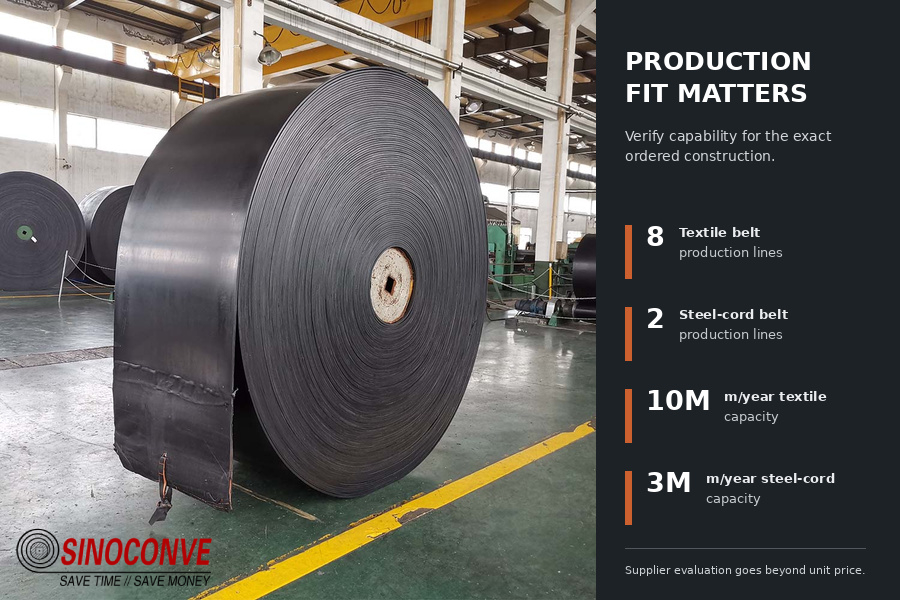
For context, SINOCONVE's confirmed conveyor-belt manufacturing information includes eight textile-belt production lines and two steel-cord-belt lines, with stated annual capacities of 10 million meters of textile conveyor belt and 3 million meters of steel-cord conveyor belt. The factory reports more than 200 employees, including 26 engineers, 15 quality-control personnel, and one laboratory. These figures are relevant to supplier evaluation, but they do not replace project-specific technical confirmation.
8. A Better RFQ Produces a More Comparable Price
If the RFQ is vague, the quotations will be vague in different ways. Send enough operating and commercial information for suppliers to price the same problem.
· Belt width, required total length, and preferred roll lengths.
· Existing belt designation, carcass type, rated strength, and ply/ST construction, if known.
· Top and bottom cover thickness and required cover grade or performance requirement.
· Material conveyed, lump size, bulk density if relevant, moisture/oil/chemical exposure, and material temperature where heat is involved.
· Conveyor length, incline, belt speed, capacity, loading/impact conditions, and pulley information when selection is not already fixed.
· Required standard, inspection documents, test reports, and any third-party testing.
· Edge/profile/special construction, splice or endless requirements, marking, and packaging.
· Quantity, destination, required Incoterm, target delivery date, and payment/document requirements.
If you are replacing a belt because it failed early, include photos of the damage and the old belt specification. Wear, cracking, delamination, edge damage, splice failure, or heat hardening can point to different causes; simply ordering a thicker version of the same belt may repeat the problem.
9. When a Lower Price Is Reasonable - and When It Is a Warning
A lower quote is not automatically suspicious. It may reflect a simpler construction, a more efficient production run, a larger order, a different freight basis, or less documentation. The warning sign is not the low number itself; it is a low number that cannot be reconciled with the stated specification and commercial scope.
Ask for clarification when a quote omits cover grade, strength, cover thickness, test scope, roll length, packing, or trade term. Also question an upgrade that has no connection to the operating conditions. Over-specification ties up budget and can introduce other design constraints; under-specification increases failure risk. The purchasing target is the lowest defensible total cost for the required duty.
10. Final Buying Checklist
· All suppliers are quoting the same width, length, carcass strength, cover thickness, and cover requirement.
· The quotation states what is included in the unit price and what is charged separately.
· Incoterm, destination, packing, freight basis, currency, payment terms, and quote validity are clear.
· Required standards, tests, inspection documents, and acceptance criteria are agreed before production.
· The selected belt matches actual material, temperature, abrasion/impact, tension, speed, incline, and environmental conditions.
· Installation, splicing, maintenance, downtime exposure, and emergency replacement risk have been considered where they are commercially significant.
· The supplier has confirmed production capability and a realistic lead time for the exact specification.
11. Frequently Asked Questions
11.1 What is a normal conveyor belt price per meter in 2026?
There is no single defensible market price without a specification. Width, construction and strength, cover thickness, compound, order length, customization, testing, packing, and trade terms can materially change the figure. Use current like-for-like quotations rather than a generic online range.
11.2 Why can two rubber conveyor belts of the same width have very different prices?
Because width describes only one dimension. The carcass, rated strength, ply or steel-cord construction, top and bottom covers, rubber compound, special features, and commercial scope may all differ.
11.3 Is price per meter or price per square meter better?
Per meter is convenient when the width is fixed. Price per square meter can help normalize width differences, but it still does not normalize strength, cover thickness, compound, or construction. Technical equivalence must come first.
11.4 Should I always choose the thicker conveyor belt?
No. Additional cover thickness can add wear allowance, but total thickness alone does not determine suitability. Carcass strength, compound, pulley compatibility, troughing behavior, loading conditions, and the actual failure mechanism also matter.
11.5 What information does SINOCONVE need for a conveyor belt quotation?
At minimum, provide width, length, construction/strength, cover thickness, application and conveyed material, required performance or standard, quantity, destination, and delivery requirements. Drawings, existing belt markings, and failure photos are useful when the specification is uncertain.
11.6 What are SINOCONVE's typical MOQ and lead time for conveyor belts?
The confirmed conveyor-belt MOQ is 50 m. The stated general production lead time is about 30 days; urgent orders may be considered for a 15-20 day production channel depending on the order. The actual schedule should be confirmed with the quotation.

Buyer Action
For a like-for-like SINOCONVE quotation, send the belt designation or existing datasheet together with width, length, cover configuration, conveyed material, operating conditions, required standard/test documents, quantity, destination, and Incoterm. If the current belt is failing, add site photos and a short description of the failure pattern so the technical discussion starts with the cause, not only the replacement price.