
Two belts can have the same width and nominal tensile rating yet be very different safety choices underground. A quotation may show "flame resistant," but that phrase alone does not confirm the test method, approval status, electrical conductivity, splice system, or suitability for the conveyor's actual tension and pulleys.
For a coal mining conveyor belt, safety begins before price comparison. Procurement teams must separate legal compliance from mechanical suitability, then verify that the delivered belt matches the tested construction. A belt that passes a flame test can still face frictional heating from a seized idler, drive slip, mistracking, or coal accumulation. Flame resistance limits fire propagation; it does not remove ignition sources.
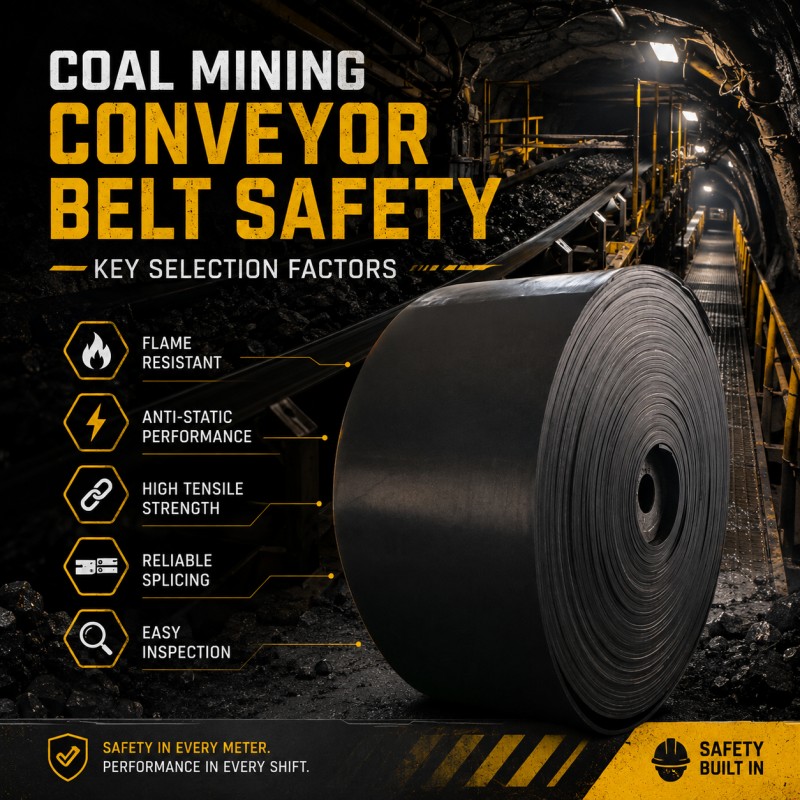
A sound specification connects five subjects that are often reviewed separately: flame resistance, anti-static behavior, belt strength, splicing, and inspection. The safest choice is not simply the thickest or strongest belt. It is the construction that matches the mine, the conveyor, and the required approval system.
Start with the Required Underground Safety Standard
"Underground grade" is not a universal specification. Requirements depend on the country, mine type, operator rules, and approval system. In the United States, conveyor belts used in underground coal mines must be approved under MSHA 30 CFR Part 14. ISO 340:2022 provides a laboratory-scale method for assessing a belt's reaction to an ignition flame. ISO 284:2025 addresses electrical conductivity intended to limit static-charge accumulation.
These documents are not interchangeable labels. An ISO 340 test report does not automatically establish MSHA approval, and a flame test does not confirm anti-static performance. State the governing requirement in the RFQ and request evidence for the exact construction offered.
|
Safety item |
What the buyer should verify |
Why it matters |
|
Flame performance |
Standard, edition, construction, and report identity |
"Flame resistant" without a named method is hard to compare |
|
Electrical conductivity |
Applicable method and result for the supplied belt |
Static control is separate from flame resistance |
|
Product approval |
Valid market approval and permanent marking where required |
A general test report may not satisfy legal rules |
|
Production conformity |
Batch traceability and controlled compound/carcass construction |
Construction changes can alter safety performance |
For U.S. purchases, Part 14 links approval to the documented belt construction and requires permanent approval marking. The same procurement principle is useful elsewhere: the order description, test report, belt marking, and delivered roll should identify the same product.
Flame Resistance and Anti-Static Performance Are Separate Controls
A flame-resistant belt is designed to resist ignition or limit continued burning under a specified test. It is not fireproof. Underground fire risk also depends on belt slip, frozen idlers, edge contact with steelwork, hot work, electrical faults, and combustible accumulations.
The cover and skim compounds matter because the belt contains a large continuous mass of polymer. However, selecting a higher flame-resistance category does not correct poor tracking or a slipping drive. Belt properties and mechanical safeguards must work together.
An anti-static belt addresses another ignition path. As the belt flexes and contacts pulleys and idlers, electrostatic charge can develop. ISO 284 specifies a maximum electrical resistance and a test method so the belt is sufficiently conductive to dissipate charge. Ask for the current test standard and actual result rather than relying on "conductive" or "anti-static" without documentation.
Conductivity is only one layer of mine safety. Conveyor structures, pulleys, electrical equipment, bonding, grounding, monitoring, housekeeping, and ventilation must also comply with the mine plan and local rules.
Select Coal Mining Conveyor Belt Strength from System Tension
A heavy-duty coal conveyor may carry high tonnage, but tonnage alone cannot determine the belt rating. The engineer needs maximum operating tension, starting and braking conditions, lift, center distance, speed, take-up arrangement, drive layout, and required safety factor. Loading impact and lump size influence cover and carcass damage; tension determines reinforcement demand.
Textile belts are often practical for shorter or moderate-tension conveyors because they are flexible and easier to handle and splice. Steel cord belts suit long, high-tension systems where low elongation is valuable. Neither construction is automatically safer. Check pulley diameters, transition distances, trough geometry, splice design, inspection capability, and rip consequences.
A higher rating can create new problems. A thicker or stiffer underground mining belt may not trough correctly on the existing idlers. It may require larger pulleys, increase bending stress, or load the splice differently. Extra cover thickness also adds belt mass and can affect drive power and take-up behavior.
|
RFQ input |
Why the supplier needs it |
|
Width, speed, center distance, and lift |
Establishes geometry and tension demand |
|
Drive power, number of drives, and start method |
Shows starting torque and transient loading |
|
Take-up type and available travel |
Affects tension control and elongation allowance |
|
Pulley diameters and trough angle |
Checks flexing and troughability |
|
Coal size, moisture, and loading height |
Guides impact resistance and cover selection |
|
Existing rating and failure marks |
Separates underspecification from system faults |
The top cover must resist abrasion, impact, cuts, and indentation at the loading zone. The bottom cover runs against pulleys and idlers, affecting traction, tracking, and heat generation. A thick top cover cannot protect a weak splice, and a high tensile rating cannot prevent edge damage from mistracking.
Treat the Splice as Part of the Belt Specification
The splice is not an installation detail to decide after delivery. It repeatedly passes over every pulley and idler under tension. The method, dimensions, materials, curing conditions, and technician competence should be agreed during purchasing.
For fabric belts, a vulcanized step splice must match the plies, fabric type, rating, and pulley geometry. Mechanical fasteners may suit certain repairs or operating conditions, but underground suitability depends on the belt, conveyor, local rules, and operator risk assessment. Do not assume that a fastener used on a surface conveyor is acceptable underground.
Steel cord splicing requires controlled cord preparation, alignment, rubber compatibility, cleanliness, pressure, temperature, and cure time. Contamination or cord misalignment can reduce integrity even when the surface looks acceptable. The splice kit should match the belt compound and remain within its specified storage life.
Confirm the splice length, working space, press dimensions, power availability, curing procedure, and inspection method before ordering. A belt may fit the conveyor but still be impractical to splice in a restricted underground location.
Use Damage Marks to Find the Ignition Source
Replacing a damaged belt without correcting the cause can return the conveyor to the same unsafe condition. Inspection should connect belt marks with idlers, pulleys, loading equipment, cleaners, structure, and tension control.
|
Observation |
Possible cause |
Immediate check |
|
Polished or burnt edge; rubber dust near structure |
Mistracking and rubbing |
Loading symmetry, seized idlers, pulley alignment |
|
Glazed drive surface or localized heat damage |
Belt slip or inadequate traction |
Take-up tension, lagging, contamination |
|
Hot, noisy, or non-rotating idler |
Bearing deterioration or seizure |
Rotation, temperature trend, coal buildup |
|
Repeated cover cuts at one transfer |
Impact or chute interference |
Chute geometry, impact support, skirt clearance |
|
Cracks or lifting edges at a splice |
Flex fatigue or adhesion loss |
Pulley size, splice condition, tension history |
|
Normal appearance but unknown static status |
Electrical property cannot be judged visually |
Test documents and site electrical controls |
Mine-fire research has identified friction, misalignment, bad bearings, slippage, and drives or rollers operating in coal accumulations as recurring belt-related fire initiators. Inspection must therefore cover the complete system, not only the belt surface.
In U.S. underground coal mines, 30 CFR 75.362 requires examination along each operating belt conveyor haulageway during each production shift. Other jurisdictions have their own schedules. Trend checks of idler temperature, belt edge condition, drive slip, splice dimensions, carryback, and repeated mistracking can reveal deterioration between major maintenance stops.
Compare Supplier Quotations on Evidence, Not Grade Names
Suppliers may use the same terms--FR, anti-static, mining grade, heavy duty--while offering different tests and constructions. Ask each supplier for:
1. Full designation, carcass, rating, ply count or steel cord grade, cover thicknesses, and total thickness.
2. Applicable flame, conductivity, and mechanical standards, including the edition where relevant.
3. Test reports, approval numbers, and marking required by the destination market.
4. Recommended splice design, materials, storage conditions, and installation procedure.
5. Minimum pulley requirements, take-up considerations, roll dimensions, and handling limits.
6. Manufacturing traceability, inspection records, and change-control procedure.
The lowest price per meter can mislead when one quotation excludes splice materials, documentation, marking, packaging, or technical review. Compare the complete installed requirement and the evidence behind it.
Final Selection Check
A safe purchase should answer three questions: Is the belt legally acceptable for this mine? Is it mechanically compatible with the conveyor? Can the operator splice, inspect, and maintain it underground?
SINOCONVE has 35 years of industrial belt manufacturing experience and applies raw-material inspection, process control, finished-product inspection, and performance testing. For a technical review, provide conveyor geometry, tension data, material conditions, required standards, and the current belt's damage pattern. Where approval is mandatory, confirm that the exact offered product carries it before ordering.
FAQ
Is a flame-resistant belt fireproof?
No. It has met defined behavior under a specified test. Prolonged friction, a seized idler, drive slip, hot work, or another heat source can still damage or ignite it. Prevention also depends on conveyor design, monitoring, housekeeping, and maintenance.
Does an anti-static belt remove the need for grounding?
No. Belt conductivity helps dissipate charge but does not replace bonding, grounding, suitable electrical equipment, or other mine controls.
Is a higher tensile rating always safer underground?
No. The rating must match calculated tension and the required safety factor. An unnecessarily stiff belt may not suit the pulleys, trough angle, transitions, or take-up.
Should an underground coal conveyor use fabric or steel cord belting?
It depends on tension, length, lift, elongation limits, pulley sizes, splice access, and inspection strategy. Fabric is often practical at moderate tension; steel cord is common for long, high-tension duties.
What information is required for an accurate coal mining conveyor belt quote?
Provide width, speed, conveyor length and lift, drive and take-up data, pulley diameters, capacity, coal characteristics, loading conditions, required safety standard, existing belt specification, splice preference, and current damage details.
Can flame resistance and anti-static performance be confirmed from a photo?
No. Appearance cannot establish compound formulation, electrical resistance, flame-test performance, or approval status. Verify traceable test documents, belt markings, and the exact product designation.