
OEM V-Belt Manufacturer for Industrial Equipment Brands: From Sample to Mass Production
For an industrial equipment OEM, approving a V-belt is not the end of the sourcing process. It is the point where repeatability begins to matter. A prototype belt may fit the pulley and run correctly during testing, but the purchasing risk appears when hundreds or thousands of belts must reproduce the approved dimensions, construction, marking and packaging across later production batches.
This is why selecting an OEM V-belt manufacturer requires more than comparing unit prices or asking whether private labeling is available. Equipment brands need a supplier that can work from a drawing, existing belt or approved sample; identify specification gaps before production; control the transition from sample to batch manufacturing; and provide inspection evidence before shipment.
For OEM buyers, the practical objective is simple: turn an approved belt into a controlled purchasing specification that can be repeated.
OEM Buyer Quick Answer: Do not qualify an industrial V-belt supplier from a catalog and quotation alone. Qualify the complete process: specification review, sample reproduction, approval criteria, production controls, final inspection, marking, packaging and change control. The approved sample should become a reference for mass production, not a substitute for a written specification.
 1. Why OEM V-Belt Sourcing Is Different from Buying a Replacement Belt
A maintenance department replacing one failed belt and an equipment manufacturer purchasing belts for a machine series face different risks.
For a replacement, the immediate question is usually compatibility: does the new belt have the correct profile, length designation and construction for the existing drive? For an OEM, compatibility remains important, but another requirement is added: repeatability.
The same approved belt may need to be installed on machines produced months apart. A distributor may also need to replenish the same SKU over multiple orders. Uncontrolled variation in dimensions, marking, construction or packaging can therefore become an assembly, warranty, inventory or aftermarket problem.
A qualified industrial V-belt manufacturer should consequently be evaluated as part of the OEM's supply chain rather than simply as a source of rubber belts.
| Sourcing Situation | Primary Question | Main Purchasing Risk |
|---|---|---|
| Single replacement | Will the belt correctly fit the existing drive? | Wrong profile, length convention or construction |
| OEM prototype | Does the sample meet the machine requirement? | Approving a sample without defining measurable acceptance criteria |
| Mass production | Can later batches reproduce the approved requirement? | Batch variation and undocumented changes |
| Private-label distribution | Can product identity remain consistent across SKUs and repeat orders? | Marking, packaging or SKU-control errors |
2. Start Supplier Qualification with the Drive Specification
Before discussing a logo or carton design, an industrial OEM should establish exactly what the belt must match.
V-belts transfer power through interaction between the belt and pulley groove. A nominally similar belt is not automatically interchangeable. The profile family, cross-section and length designation have to correspond to the intended drive system. For classical and narrow V-belts, international standards such as ISO 4184 address belt dimensions and datum-system lengths, while ISO 4183 addresses principal dimensions of corresponding grooved pulleys. The applicable standard and edition should be agreed for the specific project rather than assumed from a familiar profile name.
This distinction becomes especially important when an OEM is transferring an existing part from another source. A worn belt can be useful evidence, but wear can change its apparent dimensions. Markings may also be incomplete or use a length convention that is not obvious from the number alone.
For a deeper explanation of profiles and length identification, OEM buyers can use SINOCONVE's V-belt buying guide for OEMs and distributors.
2.1 What should be defined before requesting a sample?
A useful OEM specification normally identifies the information needed to remove ambiguity between buyer and manufacturer. Depending on the drive, this may include:
- V-belt type and construction, such as wrapped, cogged/raw-edge, banded or another specified form;
- profile or section and the applicable dimensional convention;
- length designation and the length basis used by the approved specification;
- machine or drive application;
- quantity per machine and whether multiple belts operate as a set;
- motor power, driver and driven speeds, pulley diameters and center distance where drive verification is required;
- operating conditions such as repeated starts, shock load, dust, oil, water, heat or outdoor exposure;
- required product marking and private-label information;
- packaging, carton labeling and destination-market requirements;
- drawing revision, reference sample or existing part number where applicable.
The purpose is not to create paperwork for its own sake. It is to make the quotation, sample and eventual purchase order refer to the same product definition.
3. Sample Approval Should Test the Specification, Not Just Appearance
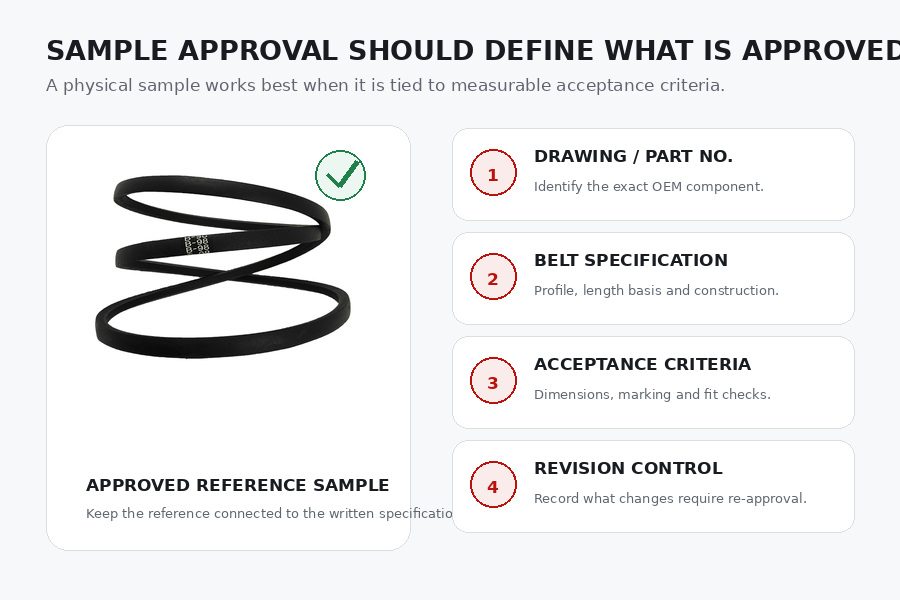
Sample testing is one of the most useful risk-control stages in custom V-belt sourcing, provided the OEM knows what the sample is supposed to prove.
SINOCONVE supports standard samples or small test samples for discussion before bulk ordering. For OEM/ODM projects, production can also be discussed from customer drawings, samples or specific requirements.
A sample should not be approved simply because it looks similar to the existing belt. Depending on the application, the OEM should verify relevant dimensions, fit, marking and actual drive behavior against its own acceptance criteria.
OEM Approval Warning: “Sample approved” is too vague for repeat manufacturing if nobody records what was approved. Link the sample to a drawing, specification revision, part number or agreed inspection criteria. Otherwise, a later disagreement can become a subjective comparison between two physical belts.
3.1 Separate product verification from machine validation
This distinction reduces confusion during approval.
Product verification asks whether the supplied belt matches the agreed product specification. Machine validation asks whether that specification actually works in the OEM's equipment under the intended duty.
A manufacturer can inspect dimensions and production characteristics, but the equipment OEM remains in the best position to validate the complete drive inside its machine. Installation geometry, pulley condition, alignment, tensioning method and duty cycle can all affect belt behavior.
For example, repeated squealing or belt dust does not automatically prove that the belt compound is defective. Incorrect tension, pulley wear, misalignment or an unsuitable belt section can produce similar symptoms. SINOCONVE's transmission belt and V-belt maintenance guide explains these drive-side checks in more detail.
4. Convert the Approved Sample into a Mass-Production Control Reference
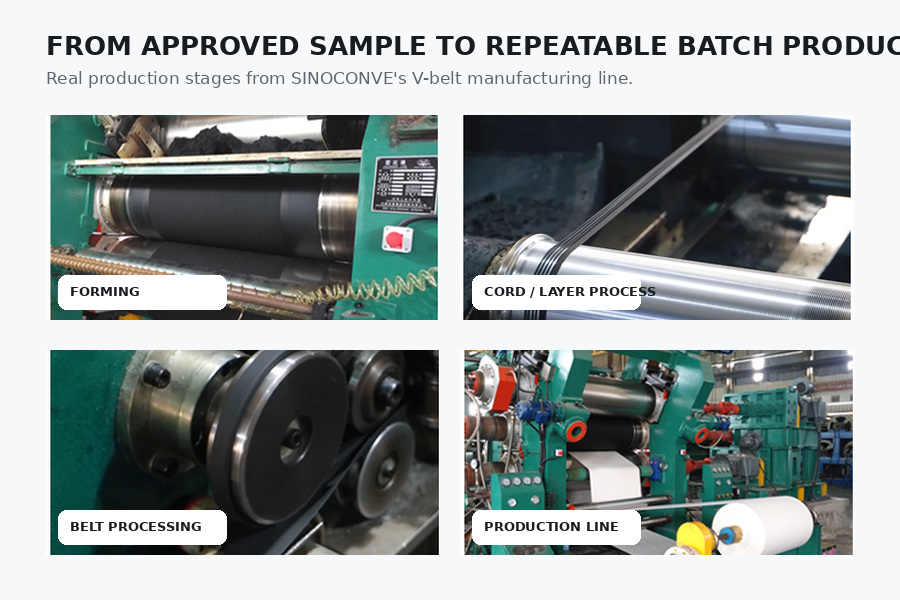
The transition from prototype to production is where many OEM sourcing programs become commercially exposed.
The first sample may receive close attention from both buyer and supplier. Mass production introduces a different challenge: the agreed characteristics must remain controlled when the order moves through normal manufacturing, inspection, packing and repeat-order processes.
A good approval package therefore connects four things:
- Buyer requirement: drawing, technical specification, existing sample or agreed product definition.
- Approved sample: the physical belt accepted by the OEM.
- Inspection criteria: the characteristics that will be checked before shipment.
- Commercial identity: OEM part number, marking, packaging and purchase-order information.
If any of these elements changes, the buyer should know whether a new approval is required.
4.1 Ask how changes are controlled
Change control is easy to overlook during a first order because both sides are focused on getting the sample approved. It becomes much more important after an equipment brand has standardized the component.
An OEM should ask what happens if a material, construction detail, marking method or another approved characteristic needs to change. The appropriate control depends on the significance of the change, but the principle is straightforward: a supplier should not treat an approved custom specification as an informal target that can move without communication.
This matters particularly for private-label products because the OEM's name remains on the finished machine or replacement part. A sourcing decision that saves a small amount on the belt but creates uncontrolled variation later can move the real cost into assembly, field service and warranty handling.
5. What Quality Evidence Should an Industrial OEM Request?
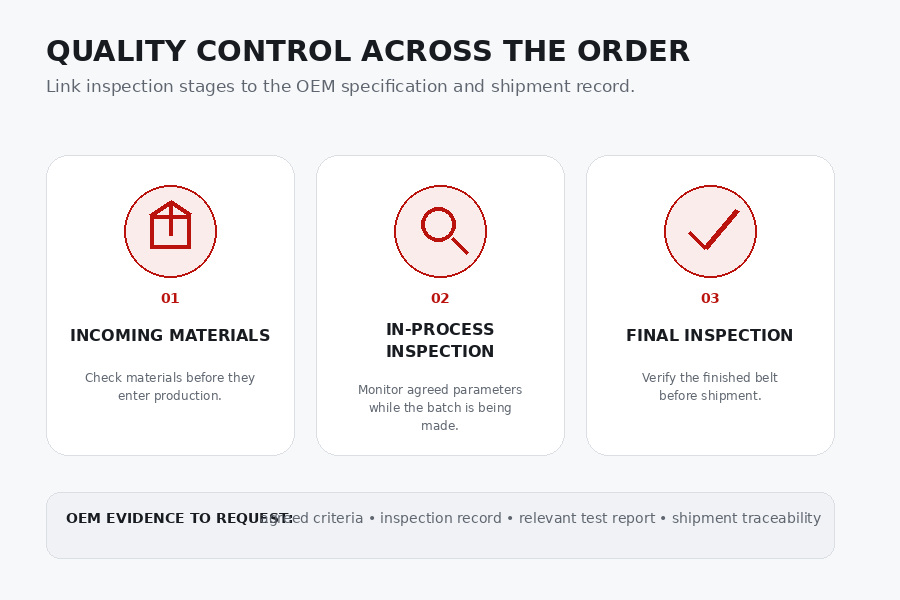
“Strict quality control” is not useful supplier-qualification evidence by itself. An OEM needs to understand what is checked, when it is checked and what documentation can accompany the order.
SINOCONVE's confirmed quality process includes incoming raw-material inspection, in-process inspection and final testing/inspection before shipment. ISO certificates and product test reports can be provided, and third-party testing can be arranged when a customer has special standard requirements.
The important purchasing question is whether the available evidence matches the characteristics that matter for the specific OEM part.
| Control Point | What the OEM Should Verify | Why It Matters |
|---|---|---|
| Incoming materials | Whether materials are inspected before entering production | Production control starts before belt forming |
| In-process inspection | Which agreed process or product parameters are monitored | Helps detect deviation before an entire batch is completed |
| Final inspection | What acceptance criteria apply before shipment | Connects the shipped product to the approved requirement |
| Test documentation | Which report is available for the specific product/order | A certificate name alone does not prove every requested characteristic |
| Third-party testing | Whether the required method, laboratory and acceptance criteria are agreed before ordering | Prevents disagreement about what an external test was intended to verify |
OEM buyers should also distinguish a management-system certificate from a product-specific test report. They answer different questions. Likewise, specifying “ISO” without the applicable product standard, characteristic or test method may still leave the purchase requirement unclear.
6. Private Label Is More Than Printing a Logo
Industrial equipment brands often want the replacement component to remain identifiable after the machine enters service. That makes marking and packaging part of product control, not merely marketing.
SINOCONVE supports OEM/ODM cooperation as well as logo, color and packaging customization for V-belts. The practical details should be agreed before mass production.
For a private-label program, confirm:
- exact brand artwork and permitted printing format;
- OEM part number and belt-size marking;
- which information appears on the belt and which appears only on packaging;
- carton quantity and packing method;
- outer-carton labels, barcodes or distributor labels if required;
- language or market-specific packaging requirements;
- whether mixed sizes are permitted in the same shipment;
- how revised artwork or part numbers are approved.
For an equipment manufacturer with a replacement-parts network, clear identity also helps reduce picking errors and makes future replenishment easier.
7. Evaluate Commercial Capability Alongside Technical Capability
A technically acceptable belt does not automatically make a supplier commercially suitable for an OEM program.
MOQ, sample availability, production planning, payment terms, communication and problem resolution all affect the practical cost of maintaining the supplier relationship.
According to SINOCONVE's confirmed commercial information, the normal MOQ for V-belts is generally 30–50 pieces depending on the model. V-belts are produced to order rather than maintained as finished-goods stock. General production lead time is approximately 30 days; urgent orders may be discussed for approximately 15–20 days, subject to order confirmation and production conditions.
For OEM buyers, these numbers should still be reconfirmed against the actual model, quantity, customization and required delivery date at RFQ stage. A general lead time is not a promise that every customized SKU can follow exactly the same schedule.
Buyer Tip: Compare total sourcing risk, not only EXW unit price.
A lower quotation can lose its advantage if the OEM has to repeat sample approval, correct marking errors, expedite replacements or spend engineering time resolving specification ambiguity. Put technical scope, documentation, packaging and delivery assumptions into the RFQ before comparing prices.
8. A Practical OEM V-Belt Supplier Qualification Checklist
| Qualification Area | What to Verify | Warning Sign |
|---|---|---|
| Specification | Profile, length convention, construction, application and applicable standard | Quotation based only on a generic belt name |
| Sample process | Reference drawing/sample, approval criteria and revision identification | No record of what the approved sample represents |
| Mass production | How approved requirements are transferred to production and repeat orders | Sample and bulk production treated as unrelated orders |
| Quality control | Incoming, in-process and final inspection plus relevant reports | Only general statements such as “high quality” |
| Private label | Logo, marking, SKU, color and packaging controls | Branding discussed only after production starts |
| Change control | How changes affecting an approved product are communicated | No defined route for buyer review |
| Commercial terms | MOQ, production lead time, payment terms and packing scope | Price comparison without matching quotation scope |
| Corrective response | How confirmed product-quality issues are investigated and resolved | No clear technical or commercial escalation route |
9. What Should Be Included in an OEM V-Belt RFQ?
An RFQ is most useful when competing manufacturers are quoting the same requirement. Sending only “A-section V-belt, 1,000 pcs” leaves too much room for assumptions.
For a custom industrial V-belt project, prepare the information that actually defines the component and commercial scope:
- OEM part number and drawing revision, if available;
- belt type, profile and exact length designation;
- reference sample, drawing or clear photographs when identification is uncertain;
- machine/application and relevant drive data;
- operating environment and duty conditions;
- quantity per size and estimated order quantity;
- required standards, inspection documents or special tests;
- logo, marking, color and packaging requirements;
- sample quantity and approval procedure;
- destination and required delivery schedule.
If the belt will be used in a new machine design rather than copied from an established part, provide enough drive information for the belt requirement to be reviewed rather than asking a manufacturer to infer it from a part number.
10. Common OEM Sourcing Mistakes That Increase Purchasing Risk
10.1 Approving by size name alone
A familiar profile designation does not resolve every detail of construction, length convention or application. Preserve the exact specification used during validation.
10.2 Treating the physical sample as the entire specification
A sample is valuable, but a written and revision-controlled definition makes repeat orders easier to inspect and dispute resolution more objective.
10.3 Discussing branding before engineering compatibility
A correctly printed logo does not make an incorrectly specified belt acceptable. Establish the technical requirement first; then lock down private-label details.
10.4 Assuming every belt problem is a manufacturing defect
Pulley wear, misalignment, contamination and incorrect tension can damage an otherwise suitable belt. Supplier evaluation should therefore distinguish product conformity from drive-system troubleshooting.
10.5 Comparing quotations with different scopes
One quotation may include customized marking, test documentation and export packaging while another covers only the belt. Normalize the scope before deciding which price is actually lower.
11. FAQ for Industrial OEM Buyers
Can an OEM V-belt manufacturer produce from an existing sample?
Yes, sample-based development can be part of an OEM process, but an existing belt should be supplemented with available drawings, markings, application information and acceptance criteria. A worn sample should not automatically be treated as an exact dimensional master.
Should we approve a V-belt sample before mass production?
For a new custom or transferred OEM part, sample approval is a useful risk-control step. Define what the sample must demonstrate and record the approved specification or revision so that the reference can be carried into mass production.
What information is most important when requesting a custom V-belt quotation?
Start with the belt type, profile, length designation, quantity and application. Add relevant drive conditions, drawing or sample information, required standards, private-label marking, packaging and documentation requirements. New-drive projects may require additional pulley, speed and power information.
Can SINOCONVE support private-label V-belts?
Yes. SINOCONVE's confirmed capabilities include OEM/ODM production and customization of logo, color and packaging. Exact artwork, marking positions, packing format and order quantities should be confirmed during the project.
What is SINOCONVE's MOQ for V-belts?
The general MOQ is 30–50 pieces depending on the model. The actual requirement should be confirmed for the requested belt type and customization.
How long does V-belt production take?
SINOCONVE's general lead time is approximately 30 days. For urgent requirements, approximately 15–20 days may be discussed subject to production availability, model, quantity and customization requirements.
What happens if a quality issue is found after delivery?
SINOCONVE states that when an issue is confirmed to be caused by the product itself, the team will work with the customer on an appropriate solution, which may include replacement, compensation or technical support depending on the confirmed situation.
12. From Approved Sample to Repeatable Supply
The strongest OEM V-belt sourcing process does not end when a sample runs successfully. It converts that successful sample into a specification, inspection basis and repeat-order reference.
For industrial equipment brands, this reduces ambiguity at the points where sourcing risk usually grows: supplier transfer, batch production, private labeling, replenishment and quality investigation. The objective is not simply to find a factory that can manufacture a rubber V-belt. It is to establish a supply process that can reproduce the component the equipment was validated to use.
Preparing an OEM V-Belt RFQ for SINOCONVE?
Send the belt profile and length designation, drawing or reference sample, machine/application, quantity, required marking and packaging, and any applicable inspection or documentation requirements. For a new drive design, include relevant power, speed and pulley information so the requirement can be reviewed before sample production.
You can review the SINOCONVE V-belt range, submit requirements through the contact and RFQ page, or email sales@sinoconve.com.
Related Products
- Industrial V-Belts and Transmission V-Belts – browse SINOCONVE V-belt product options for industrial power transmission.
- Rubber Cogged V-Belts – product category for cogged V-belt requirements.
- SPA, SPB and SPC Transmission Wrapped V-Belts – a relevant wrapped V-belt product option for industrial drive applications.