
Custom Conveyor Belt Manufacturer: Width, Cover, Carcass, Edge and Branding Options
A custom conveyor belt order becomes risky when “custom” means little more than changing the width or printing a logo. For an OEM, distributor or industrial importer, the real question is whether the manufacturer can translate an application requirement, drawing or approved sample into a controlled belt specification—and reproduce it when the order moves from sampling to mass production.
Width, cover rubber, carcass construction, edge finish and branding can all be customized, but they should not be approved as isolated options. Each one affects fit, operating behavior, inspection or repeat-order consistency. A capable custom conveyor belt manufacturer should therefore ask what the belt will carry, how the conveyor operates, which requirements are fixed, and what evidence the buyer expects before shipment.
This guide explains how OEM buyers can structure that process and reduce purchasing risk before releasing a production order.
Quick Answer: Do not qualify a custom rubber conveyor belt from a quotation alone. Freeze the application requirements, belt construction, dimensions, cover, edge, marking and packaging in an approved technical reference. Then define how the sample, inspection records and production order will be tied back to that reference.
1. What “Custom” Should Mean in an OEM Conveyor Belt Project
A catalog belt and an OEM belt can start from the same basic construction. The difference is control. In an OEM project, the manufacturer is expected to convert customer requirements into something that production, quality control and purchasing teams can identify consistently.
Depending on the application, customization may involve width, length, thickness, fabric construction, cover rubber, surface, edge treatment, color, logo and packaging. SINOCONVE supports customized conveyor belt production according to customer requirements, including production based on drawings, samples and OEM/ODM requirements.
That flexibility is useful, but more available options do not automatically mean lower sourcing risk. A buyer should distinguish between engineering requirements and commercial customization.
| Customization Area | What the Buyer Should Define | Why It Matters |
|---|---|---|
| Width & dimensions | Required width, length, thickness and applicable tolerances | Controls machine fit and repeat-order consistency |
| Cover | Material handled, operating environment, required cover properties and thickness | The cover faces abrasion, impact, heat, oil or other application-specific exposure |
| Carcass | Required construction and strength based on the approved conveyor specification | Affects tension-carrying capability, flexibility and dimensional behavior |
| Edge | Required edge construction, width tolerance and finishing requirement | Needs to match the belt construction, conveyor clearance and approved specification |
| Branding | Logo, marking text, model identification, color and packaging artwork | Important for distributors, OEM identification and repeat-order traceability |
2. Width Customization Starts With Conveyor Fit, Not Factory Capability
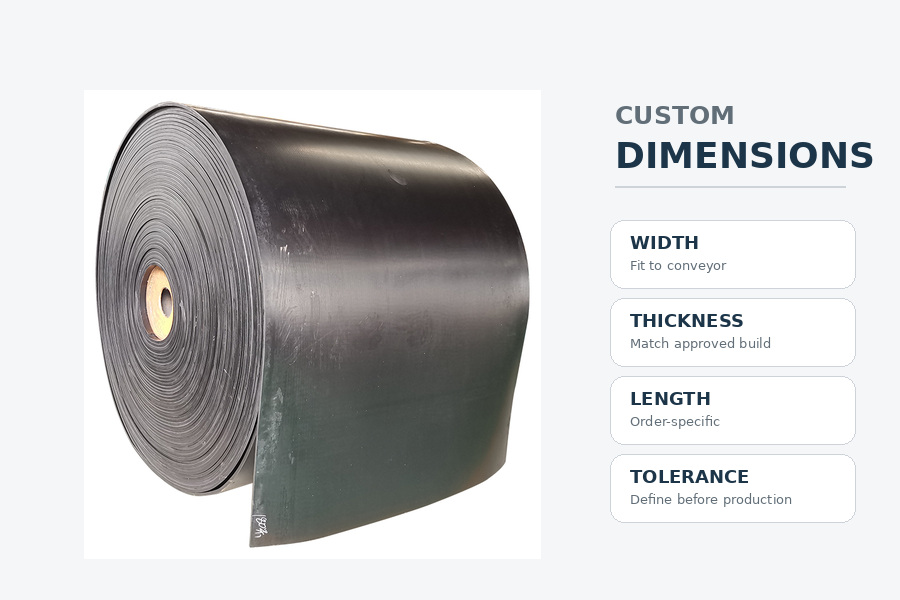
Width is one of the easiest dimensions to put on an RFQ and one of the easiest to treat too casually. A buyer may specify “1,200 mm wide,” but the manufacturer still needs to know whether that is a nominal requirement, a drawing dimension with tolerance, or a value copied from an old belt.
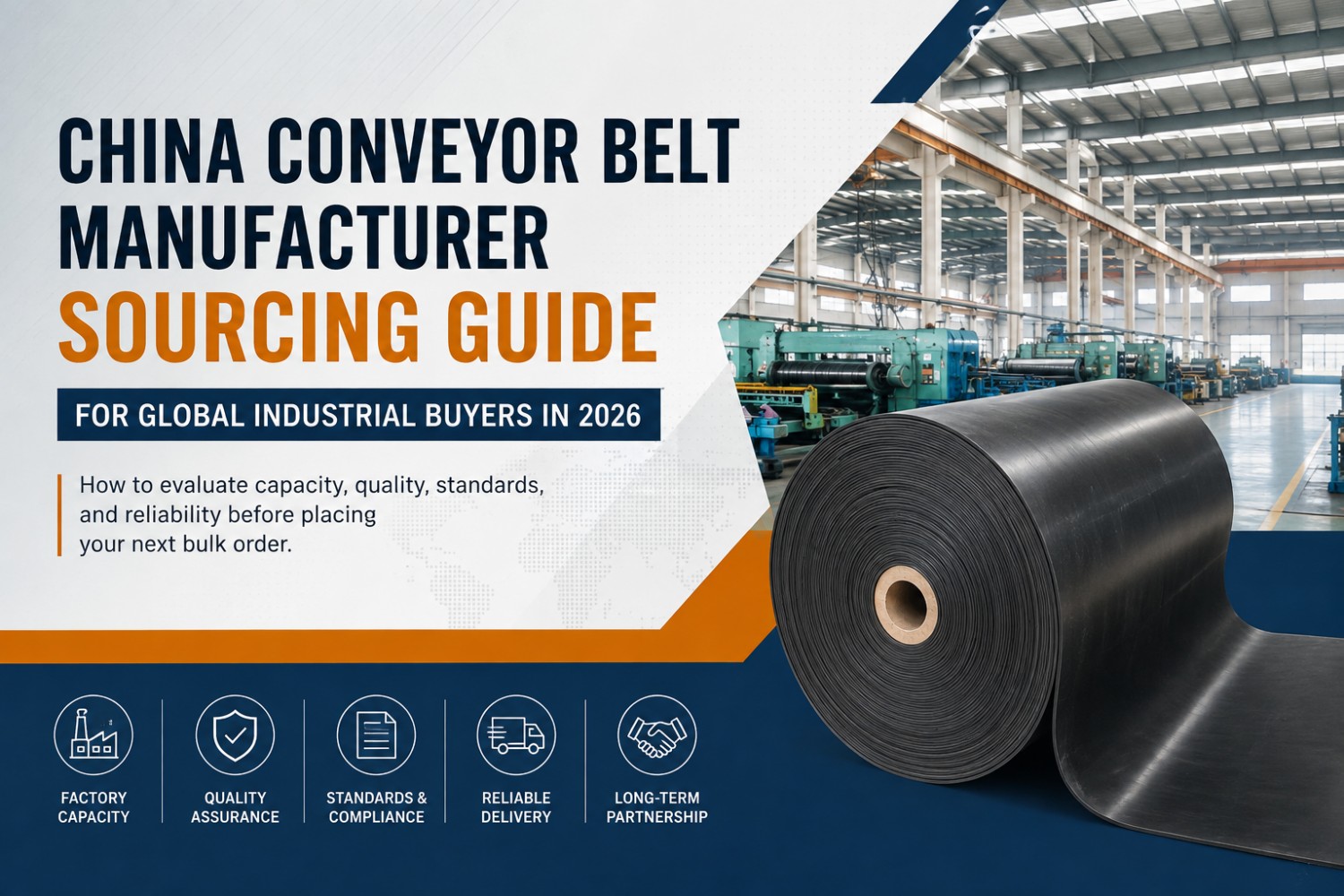
SINOCONVE's confirmed conveyor belt manufacturing range covers widths from 100 mm to 3,000 mm and thicknesses from 3 mm to 100 mm. These ranges describe manufacturing capability; they do not determine what width or thickness a particular conveyor should use.
For a replacement belt, provide the existing specification or drawing where possible. If the previous belt has abnormal edge wear, tracking marks or dimensional problems, include photographs rather than asking the factory to duplicate the old belt without review.
Buyer Tip: Separate “must match the drawing” dimensions from parameters that remain open for engineering review. This prevents an assumption made during quotation from becoming an unintended production requirement.
3. Cover Customization Should Follow the Material and Failure Risk
The cover is not simply the visible rubber layer or a choice of thickness. It protects the carcass while facing the conveyed material and operating environment. Abrasive aggregate, sharp stone, oily material and hot material do not create the same failure mechanism.
Before requesting a custom cover, describe the material being conveyed, lump characteristics, loading conditions and any relevant exposure to abrasion, cutting, oil, heat, chemicals, moisture or other environmental factors. Buyers who need a deeper comparison of cover specifications can review SINOCONVE's conveyor belt cover grade guide.
Cover thickness should also be evaluated with the complete belt construction. More rubber is not automatically a better specification. The useful question is what protection the belt needs for the actual duty and whether the proposed construction remains compatible with the conveyor.
If the application is not yet fully specified, the broader rubber conveyor belt selection guide explains how material behavior, reinforcement and operating conditions influence selection.
4. Carcass Selection Cannot Be Reduced to Ply Count
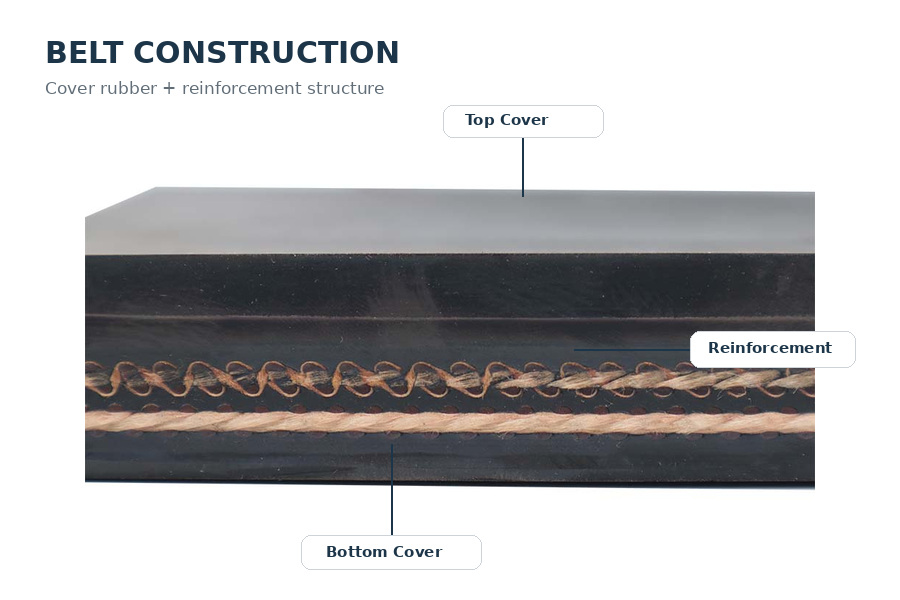
The carcass carries the working tension and gives the belt much of its structural behavior. For that reason, an OEM RFQ should not define a belt simply as “3-ply” or “4-ply” without identifying the required strength and construction.
SINOCONVE's confirmed fabric production capability covers EP100 to EP600, while its steel cord conveyor belt capability covers ST500 to ST7500. The factory operates eight fabric conveyor belt production lines and two steel cord conveyor belt production lines.
Those ranges show what the factory can manufacture; the correct rating still depends on the conveyor design. Belt length, working tension, loading, take-up, pulley diameters and splice arrangement can influence the appropriate construction. For standard fabric-belt requirements, buyers can review the available EP rubber conveyor belt range.
For high-tension or long-distance systems, do not automatically move to steel cord because it appears to be the stronger option. Fabric and steel cord constructions have different application ranges, installation requirements and splice considerations. The system specification should drive the decision.
5. Edge Options Need to Be Written Into the Approved Specification
Edge construction is sometimes left out of an RFQ because the buyer assumes the supplier will use its normal production method. That is risky for an OEM or repeat-order program. If edge construction, finish or dimensional tolerance matters to the equipment or customer's approved design, state it explicitly.
The same principle applies when reproducing an existing belt. A photograph of the old edge can be useful, but it should be supported by measurements and the known construction whenever possible. An old belt may already be worn, distorted or modified in service.
Condition → Risk → Specification: If edge geometry or finish is important to machine clearance, tracking-related inspection or customer approval, leaving it undefined creates repeat-order ambiguity. Put the agreed edge requirement into the drawing or technical specification before production.
6. Branding Is Part of OEM Control, Not Just Marketing
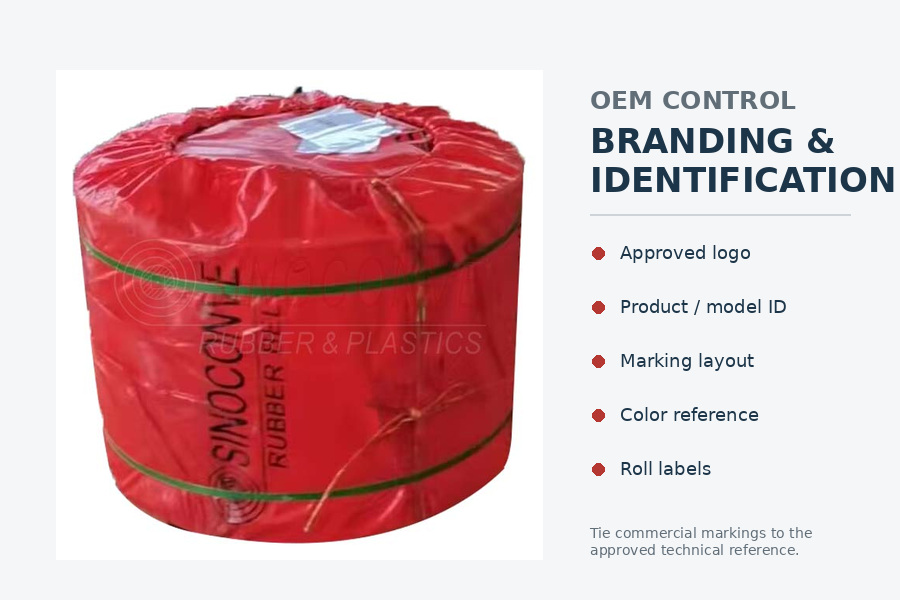
Private-label buyers often focus first on whether a custom supplier can print a logo. A more useful question is whether the supplier can control the complete identification system across repeat orders.
SINOCONVE supports logo, color and packaging customization as part of its OEM/ODM service. Buyers should supply approved artwork and define what must appear on the belt or packaging before production starts.
A branding specification can identify:
- approved company or product logo;
- model or product identification;
- required marking position and layout;
- approved color where color is commercially important;
- roll labels and shipping identification;
- branded or customer-specific packaging; and
- any destination-market labeling information required by the buyer.
Do not approve branding separately from the technical product reference. A belt carrying the correct logo but built to the wrong construction is still the wrong product.
7. Drawing Approval Is Where Customization Becomes Measurable
A drawing is valuable because it turns email discussions into an identifiable technical reference. It should show the parameters that production and inspection actually need rather than becoming a decorative attachment to the purchase order.
For a custom rubber conveyor belt, the controlled reference may include dimensions, tolerances, carcass requirement, cover specification, surface or profile where applicable, edge requirement, splice-related details, marking and packaging information.
The buyer should also assign a revision to the approved drawing or specification. If something changes after sampling, both sides need to know whether the bulk order follows the first inquiry, the sample, or the latest approved revision.
| Approval Item | What to Record | Procurement Purpose |
|---|---|---|
| Technical reference | Drawing/specification number and revision | Prevents different departments from using different versions |
| Dimensions | Width, length, thickness and relevant tolerances | Creates measurable acceptance criteria |
| Construction | Approved carcass, strength and cover requirements | Controls what is reproduced in production |
| OEM details | Logo, marking, color, labels and packing | Avoids commercial approval problems after production |
| Inspection | Items to test or inspect and required documentation | Defines how conformity will be demonstrated |
8. Sample Approval Must Answer a Specific Question
A sample can reduce risk, but only if the buyer defines what the sample is supposed to prove. SINOCONVE can provide standard samples or small test samples for customer evaluation.
A small sample may help confirm appearance, rubber or surface characteristics and certain construction details. It does not automatically prove how a complete belt will track, flex, splice or perform under full operating load.
For a higher-risk custom project, decide whether approval should be based on a drawing, physical sample, trial piece or a combination. Record what was approved and connect that reference to the production order.
RFQ Warning: “Sample approved” is too vague for repeat production. Record the sample reference, drawing revision, dimensions, construction, marking and the characteristics the sample was intended to approve.
9. How to Verify a Custom Belt Factory Before Mass Production
Customization capability is only useful if the manufacturer can reproduce the approved product. OEM buyers should therefore evaluate the production and quality-control system behind the sales quotation.
SINOCONVE's conveyor belt factory has more than 200 employees, including 26 engineers and 15 quality-control personnel, as well as a laboratory. Its confirmed production setup includes eight fabric conveyor belt lines and two steel cord conveyor belt lines, with stated annual production capacity of 10 million meters of fabric conveyor belts and 3 million meters of steel cord conveyor belts.
The factory was established in 1988 and has more than 35 years of manufacturing experience. Buyers can review additional SINOCONVE manufacturing and quality-control information during supplier qualification.
Factory scale should not replace order-specific qualification. Ask how the proposed belt will move through raw-material inspection, production monitoring, finished-product inspection and release. SINOCONVE's confirmed process includes incoming raw-material checks, production inspection, final testing and pre-shipment inspection.
10. Ask for Evidence That Matches the Order
An ISO certificate can be useful when evaluating a supplier's management system, but it should not be treated as proof that every parameter of a particular conveyor belt has been tested and accepted.
SINOCONVE can provide ISO certificates and product test reports. Where customers have special standard requirements, third-party testing can also be arranged. Conveyor belts can be manufactured with reference to DIN, RMA, ISO and other applicable requirements according to the agreed specification.
Before production, define what evidence is actually required. Depending on the order, that could include dimensional inspection, agreed performance test results, product identification, final inspection records or other project-specific documentation.
The important point is traceability: the buyer should be able to connect the evidence to the belt specification being purchased rather than receiving a general document that does not identify what was checked.
11. Packaging Is Also a Customization Decision
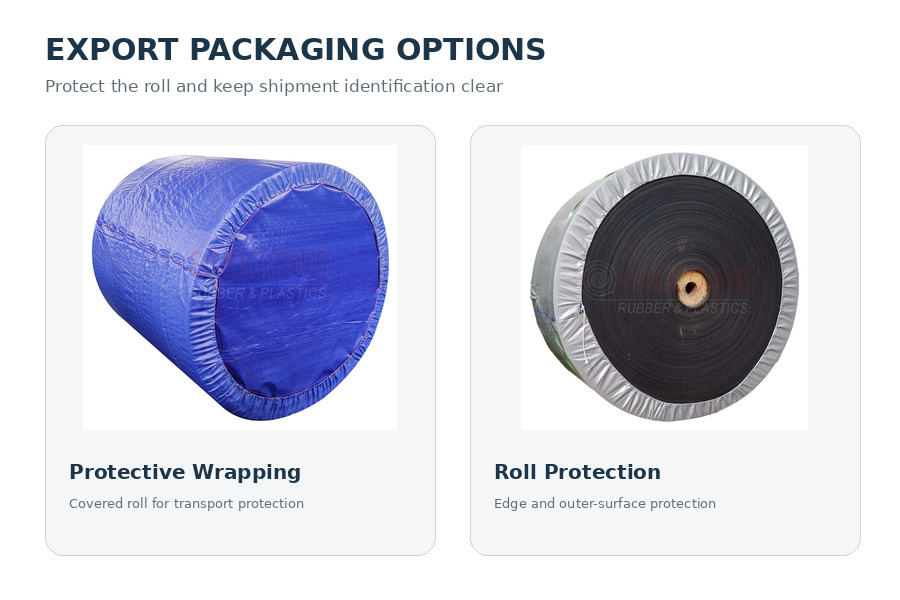
Export packaging should be discussed before the belt is finished, especially for private-label and overseas orders. A technically correct belt can still create a receiving problem if the roll identification is unclear or the packaging does not match the agreed shipping requirement.
For conveyor belts, SINOCONVE can use PVC board and iron-sheet protection and can palletize the shipment to help protect the belt during transportation. Custom logo and packaging requirements can also be discussed during OEM order confirmation.
Buyers should state any special handling, roll identification, pallet, labeling or destination requirements in the purchase specification rather than waiting until the shipment is ready.
12. Move From Sample to Mass Production With Change Control
The transition from an approved sample to mass production is where many OEM purchasing systems become weak. The sample is kept by one department, the drawing sits in another email chain, and the purchase order contains only a short product description.
A better approach is to create one controlled production reference. The purchase order should point to the approved drawing or specification revision, while the inspection requirements and branding reference remain linked to the same product.
If a material, construction, marking, packaging or other approved requirement needs to change, the buyer should review the change before it enters production. This matters even more for distributors and equipment manufacturers expecting repeat orders.
For a broader discussion of purchasing controls, inspection, lead-time risk and replacement planning, see the conveyor belt sourcing guide.
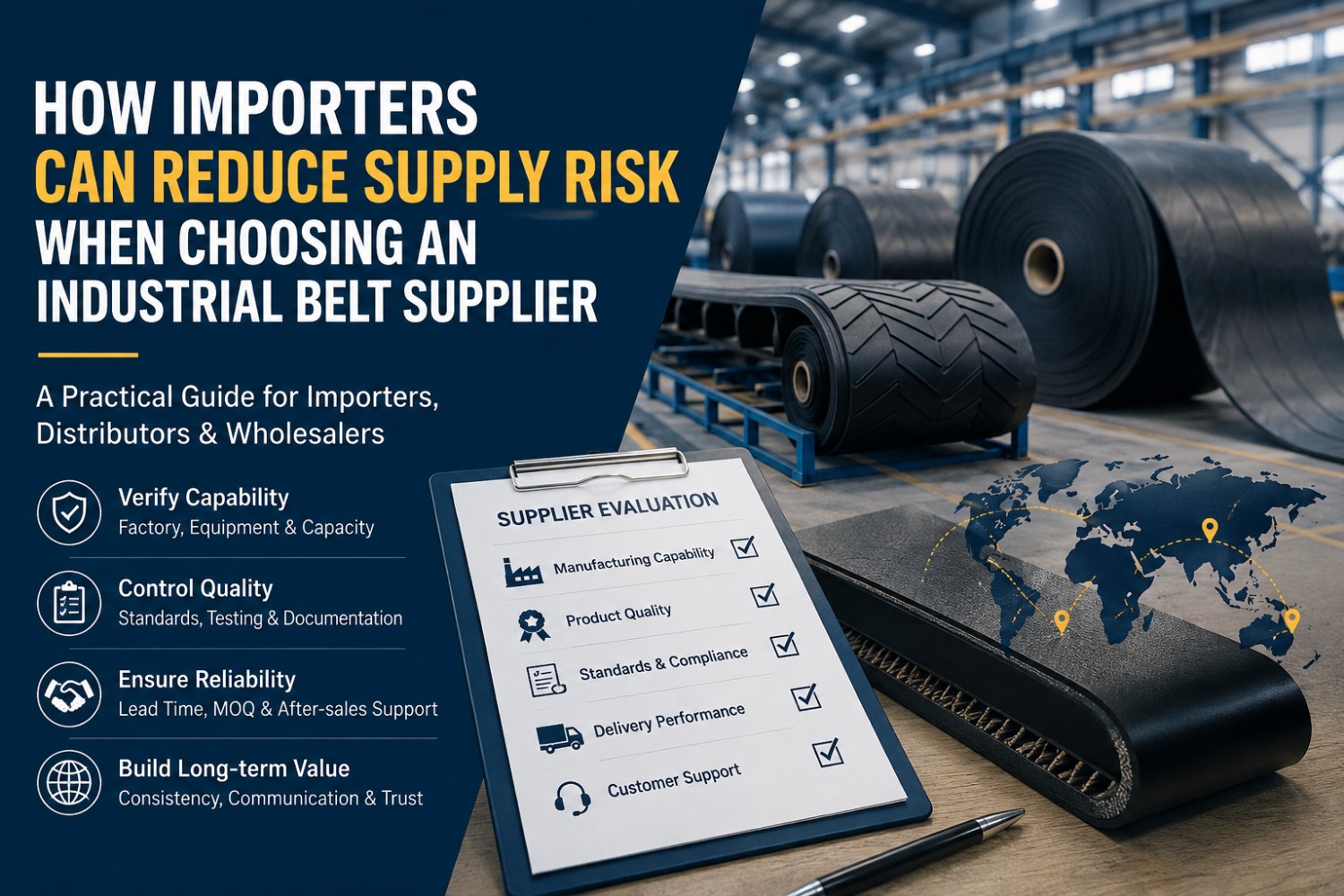
13. Custom Conveyor Belt Supplier Qualification Scorecard
| Qualification Area | Evidence to Request | Warning Sign |
|---|---|---|
| Technical intake | RFQ review, drawing or application data | Quotation issued from width and price request with no technical questions |
| Customization | Controlled dimensions, construction, cover, edge and OEM details | “Anything can be customized” without a confirmation process |
| Sample approval | Identified sample and corresponding revision | Approval based only on an unmarked sample |
| Production control | Production process and inspection checkpoints | No clear link between sample and bulk production |
| Testing | Agreed test items and order-related reports | Generic certificates offered as proof of every specification item |
| Repeat orders | Revision and change-control process | Previous order recreated from memory or informal messages |
14. What to Put in a Custom Conveyor Belt RFQ
A useful RFQ gives the manufacturer enough information to identify uncertainty before price becomes the main discussion. You do not need to invent technical parameters that have not yet been calculated. Mark them as items requiring supplier or engineering review.
- Application: conveyor function and industry.
- Conveyed material: material type, relevant lump characteristics and known wear or contamination conditions.
- Dimensions: belt width, length, thickness and required tolerances where defined.
- Construction: existing or required carcass and strength specification.
- Cover: required cover properties and thickness, or operating data for technical review.
- Conveyor data: incline, pulley information, capacity, belt speed and other relevant system data where available.
- Reference information: drawing, current belt marking, photographs or approved sample.
- OEM requirements: edge, surface, color, logo, marking, labels and packaging.
- Quality requirements: applicable standard, inspection points, reports and third-party testing if required.
- Commercial information: quantity, required schedule and destination.
SINOCONVE's confirmed minimum order quantity for custom conveyor belts is 50 meters. Normal production lead time is approximately 30 days; urgent orders may be discussed for a 15–20 day production schedule depending on the actual order and production arrangement. These timing requirements should be confirmed for the specific project before the purchase order is released.
15. FAQ for OEM and Custom Conveyor Belt Buyers
Can SINOCONVE manufacture a conveyor belt from my drawing or sample?
Yes. SINOCONVE supports OEM/ODM production and customization based on customer drawings, samples and specific requirements. For a production order, the drawing or sample should be connected to a controlled technical specification so that both sides know exactly what has been approved.
Can I customize conveyor belt width, logo, color and packaging?
Yes. SINOCONVE supports conveyor belt customization according to customer requirements, including dimensions, logo, color and packaging. Technical construction and commercial customization should both be confirmed before production.
What is the MOQ for a custom rubber conveyor belt?
The confirmed SINOCONVE MOQ for conveyor belts is 50 meters. Actual order planning should also consider belt dimensions, construction and other customization requirements.
Can I request a sample before mass production?
Standard samples or small test samples can be provided. Define what you need the sample to verify. A small sample may confirm appearance or selected material characteristics, but it should not automatically be treated as proof of full-scale operating performance.
What quality documents can SINOCONVE provide?
SINOCONVE can provide ISO certificates and product test reports. Third-party testing can also be arranged when a customer has specific standard requirements. Required test items, acceptance criteria and documentation should be agreed before production.
Should I send an old belt as the sample?
An old belt can provide useful reference information, but wear, stretching or previous modifications may make it an incomplete specification. Where possible, combine the sample with the original drawing, belt marking, conveyor data and an explanation of any failure observed in service.
How should I compare two custom conveyor belt factories?
Compare the same technical and commercial scope. Look at specification review, drawing control, sample traceability, manufacturing capability, inspection evidence, packaging, delivery planning and repeat-order control—not only unit price or whether both factories can print the requested logo.

16. Before You Approve the Production Order
The strongest custom conveyor belt purchase is not the one with the longest specification. It is the one in which the critical requirements are clear, measurable and connected from RFQ through production and final inspection.
Before releasing mass production, confirm the approved belt construction, width and other critical dimensions, cover requirements, edge details, branding, packaging, drawing revision, sample reference where applicable, inspection requirements and required documentation. For repeat orders, keep that approved reference rather than rebuilding the product from previous emails.
Prepare Your Custom Belt RFQ
For a SINOCONVE technical review or quotation, send the existing belt specification or drawing together with the required dimensions, conveyed material, relevant conveyor conditions, quantity, branding or packaging requirements and destination. If you are replacing a belt that failed early, include photographs and a description of the failure instead of requesting an exact copy without diagnosis.
You can submit the project through the SINOCONVE inquiry page or email sales@sinoconve.com.
Related Products
- SINOCONVE Conveyor Belt Products — Browse rubber conveyor belt categories and other industrial belt solutions.
- EP Rubber Conveyor Belts — Fabric-reinforced rubber conveyor belt options for industrial material handling.