
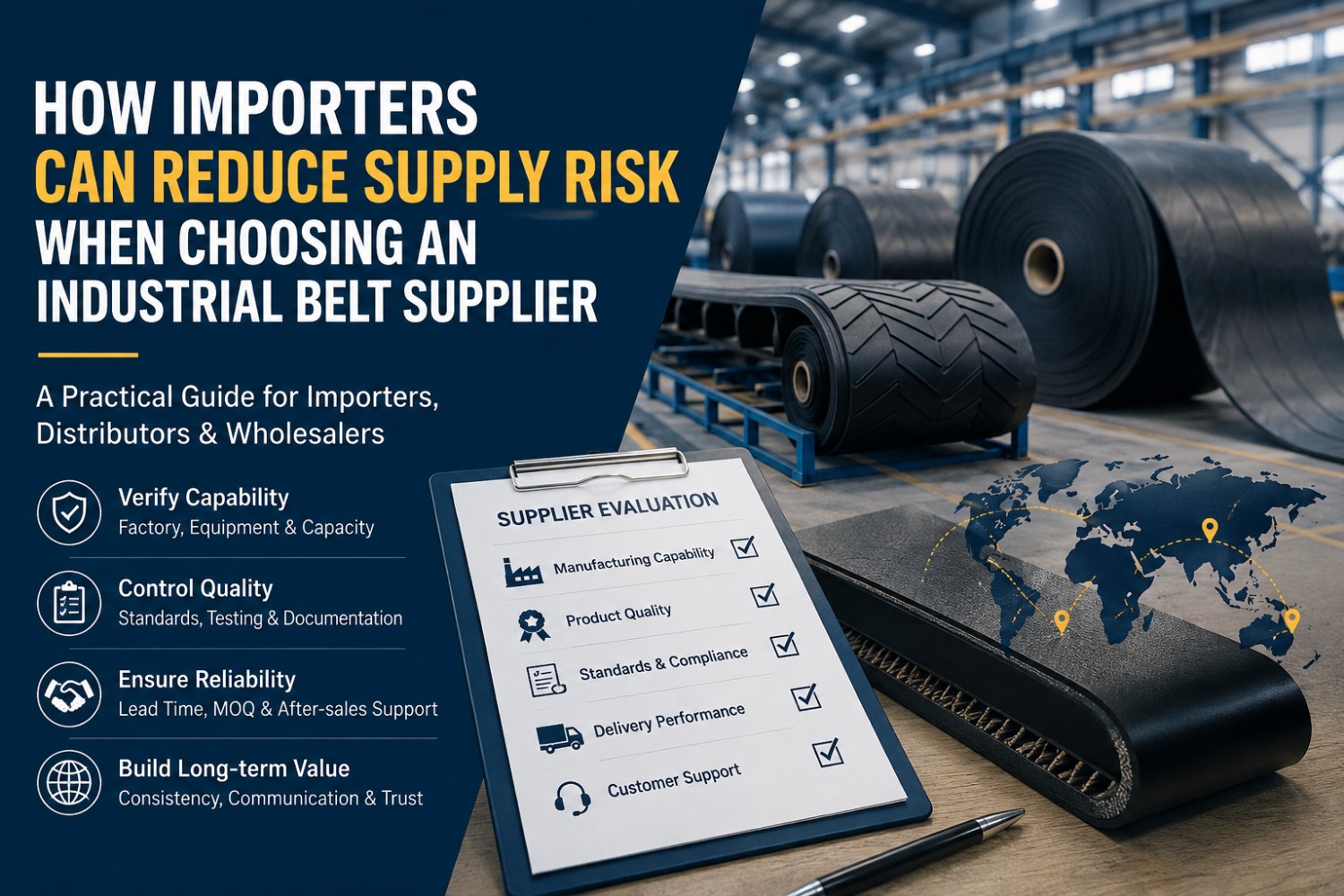
How Importers Can Reduce Supply Risk When Choosing an Industrial Belt Supplier
For an importer or industrial belt distributor, a low quotation is only useful if the supplier can reproduce the required product, document its quality, meet the agreed shipment window, and respond when specifications change. A failed supplier decision can create costs far beyond the purchase price: rejected goods, delayed customer orders, emergency replacement purchases, inconsistent repeat batches, and inventory that cannot be sold.
That is why evaluating an industrial belt supplier should start before price negotiation. Buyers need to verify what the factory can actually manufacture, whether the RFQ is technically complete, how quality is controlled, what evidence will be supplied, and whether commercial terms fit the importer’s inventory model. This guide provides a practical framework for importers, distributors, and wholesalers sourcing industrial belts, including conveyor belts and transmission belts.
Quick Answer
Do not qualify an industrial belt supplier from a catalogue, certificate, and unit price alone. Compare suppliers against the same specification and verify five areas together: manufacturing capability, specification control, quality evidence, commercial reliability, and repeat-order support. The objective is not simply to find a factory that can make a belt once. It is to build a supply source that can reproduce the approved requirement when your customers reorder.
1. Supply Risk Starts Before the Purchase Order
Industrial belt importers face a different risk profile from end users. A plant may buy a belt for one conveyor. A distributor may order several widths, constructions, belt types, or private-label packages for multiple customers. If something is wrong, the problem can spread across inventory and customer accounts rather than remain on one machine.
The first step is therefore to separate product price from total purchasing risk.
| Supply Risk | What Can Go Wrong | What the Importer Should Verify |
|---|---|---|
| Specification risk | The supplied belt matches the description but not the actual application. | Construction, dimensions, operating conditions, required standard and approved reference. |
| Quality risk | A sample passes, but production batches are inconsistent. | Incoming inspection, process controls, final inspection and batch-specific evidence. |
| Capacity risk | The supplier accepts the order but cannot support the required schedule. | Relevant production equipment, realistic scheduling and current lead-time confirmation. |
| Inventory risk | MOQ forces the distributor to carry slow-moving stock. | MOQ by product and size, mixed-order possibilities and repeat-order planning. |
| Delivery risk | Production or export delays affect customer commitments. | Production schedule, packing, documentation and shipment responsibilities. |
A supplier with the lowest initial price can therefore become the more expensive source if procurement has to absorb claims, remake orders, airfreight emergency stock, or explain inconsistent products to downstream customers.
2. Verify the Factory Behind the Quotation
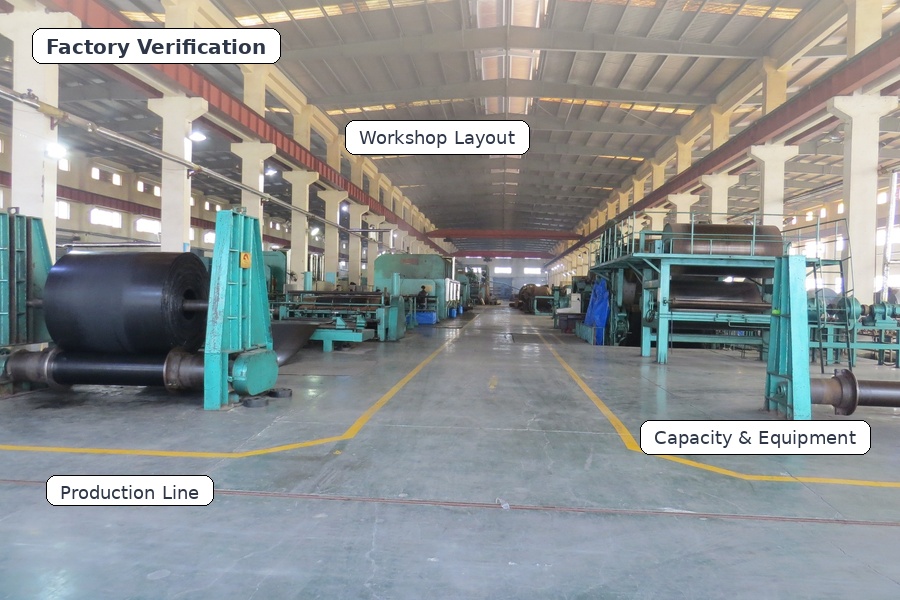
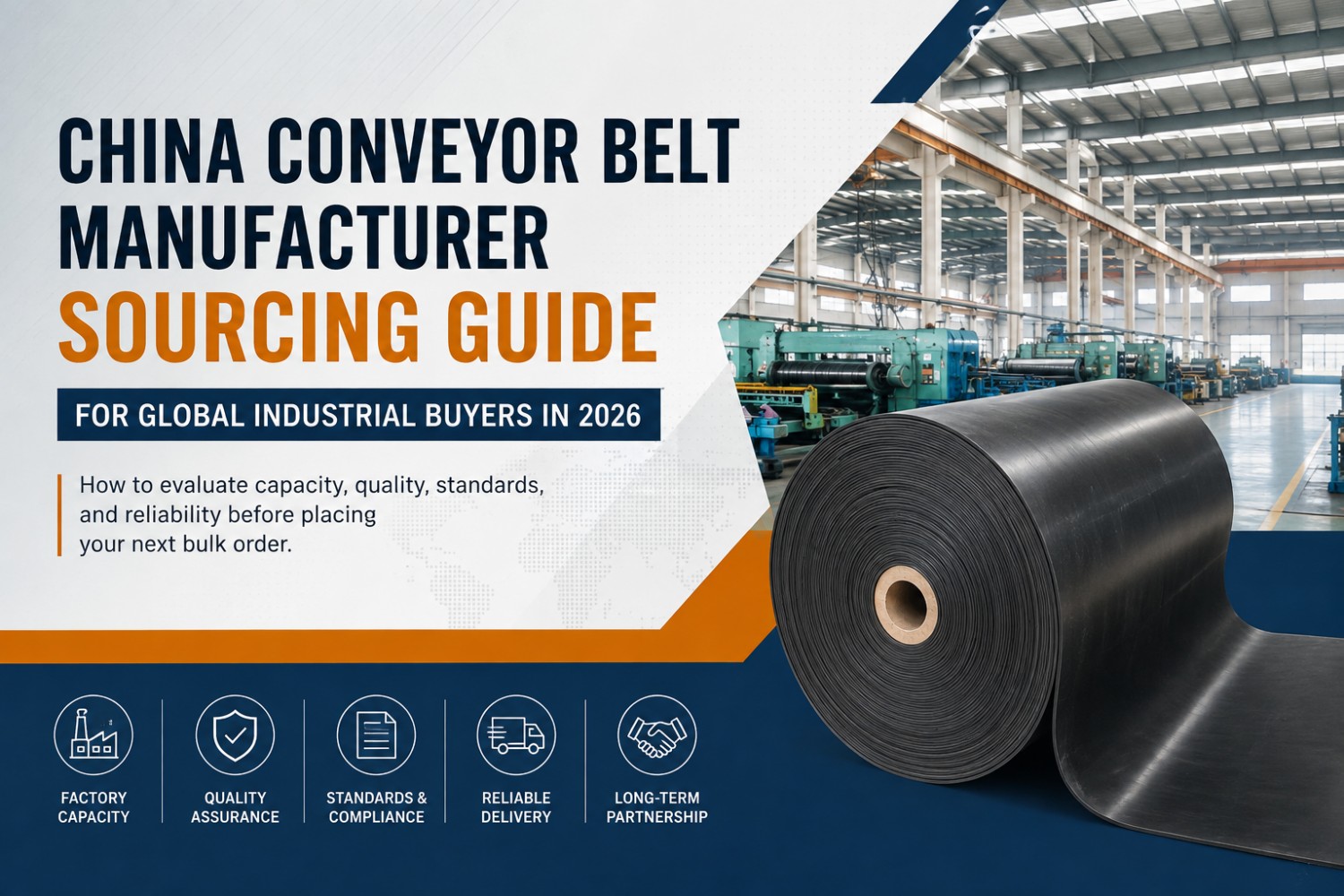
A broad product catalogue does not automatically prove broad manufacturing capability. An importer should establish which products are actually manufactured by the supplier, what relevant production resources are available, and whether the factory can handle the required construction and order volume.
For conveyor belt sourcing, that means going deeper than asking, “Are you a conveyor belt factory?” If the requirement includes textile and steel cord belts, for example, confirm capability for both constructions. If unusually wide, thick, or high-strength products are required, compare those requirements with the factory’s confirmed manufacturing range.
Buyer Tip: Ask for capability evidence that matches your order.
Factory photographs and company presentations are useful for initial screening, but a stronger qualification process connects equipment, manufacturing range and inspection capability to the actual product being purchased. For a critical or high-volume program, consider a live factory video review, audit, production records, sample evaluation, or third-party inspection as appropriate.
SINOCONVE's conveyor belt operation, established in 1988, has more than 35 years of manufacturing experience. Confirmed resources include eight fabric conveyor belt production lines and two steel cord conveyor belt production lines, supported by more than 200 employees, 26 engineers, one laboratory, and 15 quality-control personnel.
The stated annual production capacity is 10 million meters of fabric conveyor belt and 3 million meters of steel cord conveyor belt. Its confirmed manufacturing range covers widths from 100 mm to 3000 mm, thicknesses from 3 mm to 100 mm, fabric ratings from EP100 to EP600, and steel-cord ratings from ST500 to ST7500.
These figures are useful for qualification, but capacity should not be treated as a delivery promise. Importers should still confirm the actual production schedule for each purchase order. Buyers who want to review the manufacturing background can also see the SINOCONVE factory and manufacturing capability information.
3. Make the RFQ Comparable Before Comparing Prices
One of the easiest ways to make a bad supplier comparison is to send a vague RFQ.
If Supplier A assumes one construction, Supplier B assumes another, and Supplier C quotes the cheapest interpretation possible, the three prices are not really comparable. This is especially risky with industrial belts because the same general product name can cover substantially different constructions and application requirements.
A conveyor belt RFQ, for example, should normally identify the information required to establish the correct construction rather than stopping at “rubber belt, 1000 mm wide.” Depending on the project, useful information can include:
- belt type and application;
- width, length and required quantity;
- required strength or carcass construction;
- top and bottom cover requirements;
- material being conveyed;
- abrasion, impact, heat, oil, flame, chemical or other special exposure;
- conveyor incline and relevant pulley information;
- splice or endless-belt requirement;
- required standard and inspection documentation;
- marking, logo and packaging requirements;
- destination and required shipment timing.
For replacement orders, photographs of the existing belt, current markings, drawings, previous specifications, and evidence of the failure can be particularly valuable. A technically responsible supplier may identify missing information before quoting rather than immediately returning a price.
Procurement Principle
If several suppliers are quoting different technical scopes, comparing unit prices creates false savings. Freeze the RFQ basis first, record approved changes, and then compare commercial offers.
4. Replace “Good Quality” With Verifiable Quality Evidence
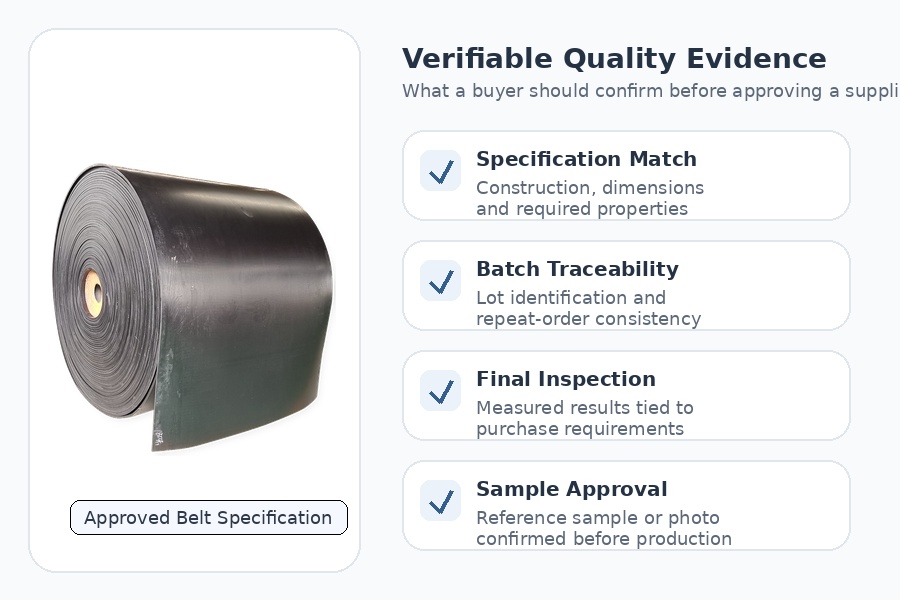
“High quality,” “premium rubber,” and “strict QC” are not measurable purchasing criteria. An importer needs to know what the supplier controls and what evidence can accompany the order.
A practical qualification process follows the product through manufacturing:
| Control Stage | What to Verify | Useful Buyer Evidence |
|---|---|---|
| Incoming materials | Whether relevant raw materials are checked before production. | Supplier QC procedure or relevant inspection records. |
| Production | Whether key construction and process parameters are monitored. | In-process records, production identification or inspection checkpoints. |
| Finished product | Dimensions, appearance and properties required by the PO. | Final inspection record and product test report where applicable. |
| Shipment release | Product identity, quantity, labels and packaging. | Packing list, roll identification, photographs or agreed release documents. |
SINOCONVE's confirmed QC process includes incoming raw-material inspection, in-process inspection, and final testing and inspection before shipment. ISO certificates and product test reports can be provided, while third-party testing can be arranged where a customer has specific standard requirements.
That distinction matters. A management-system certificate, a product test report, and compliance with a specific belt standard answer different questions. An importer should define exactly what evidence is required for the order rather than accepting a folder of unrelated certificates.
5. Treat Standards as Purchase Requirements, Not Supplier Badges
Industrial belt buyers often ask, “Do you meet DIN, ISO, or RMA?” The question is too broad to control an order.
The RFQ should identify the applicable product requirement and the properties that need to be verified. The supplier can then confirm whether the requested construction can be produced to that requirement and what inspection or test documentation will be available.
This becomes especially important for distributors serving several markets. One customer may work from a DIN-based specification, another from an ISO requirement, and another from a proprietary plant standard. The importer should not assume that a generic claim of “international standard” makes those orders interchangeable.
RFQ Warning
Never add multiple standard names to an RFQ simply to make the specification look stronger. Identify the governing requirement, required edition where relevant, acceptance values, test scope, and documentation needed by your customer.
6. Check MOQ Against Your Inventory Model
MOQ is not merely a supplier term. For an importer, it affects working capital, SKU coverage, test-market flexibility, and the amount of slow-moving stock sitting in a warehouse.
A distributor introducing a new belt size may prefer a smaller initial order even if the unit cost is higher. A mature SKU with predictable turnover may justify a larger production run. Supplier evaluation should therefore consider MOQ alongside landed cost and inventory velocity rather than negotiating MOQ in isolation.
Based on SINOCONVE's confirmed commercial information, the typical MOQ for V-belts is 30–50 pieces depending on the model, while conveyor belt MOQ is 50 meters. Products are primarily manufactured to order rather than held as general finished stock.
Importers sourcing power-transmission products can review the current V-belt range, while buyers focused on bulk-material handling can start from SINOCONVE's rubber conveyor belt range.
7. Test the Supplier Before Scaling the Order
A large first order increases the consequence of every unresolved assumption. Where the product and project allow it, qualification can be staged.
For example, a buyer can first confirm drawings or technical data, review a standard or small test sample, freeze the agreed specification, place an appropriate initial order, and then evaluate documentation and repeatability before expanding the program.
SINOCONVE states that standard samples or small test samples can be provided. For a distributor, the purpose of a sample should be defined before testing. A sample can help confirm visible construction, dimensions, surface, branding or application behavior, but it does not by itself prove that every future production batch will be identical. Repeat-order control still matters.
For customized programs, SINOCONVE supports production based on customer requirements and can work from drawings or samples. Logo, color, packaging, and OEM/ODM requirements can also be discussed according to the product and order.
8. Evaluate Lead Time as a Supply-Chain Variable
A quoted lead time is useful only when the buyer understands what it covers.
Ask when the production clock begins: deposit receipt, drawing approval, sample approval, or final specification confirmation? Does the quoted period mean production completion, factory release, or shipment departure? What happens if the customer changes a specification after production planning has started?
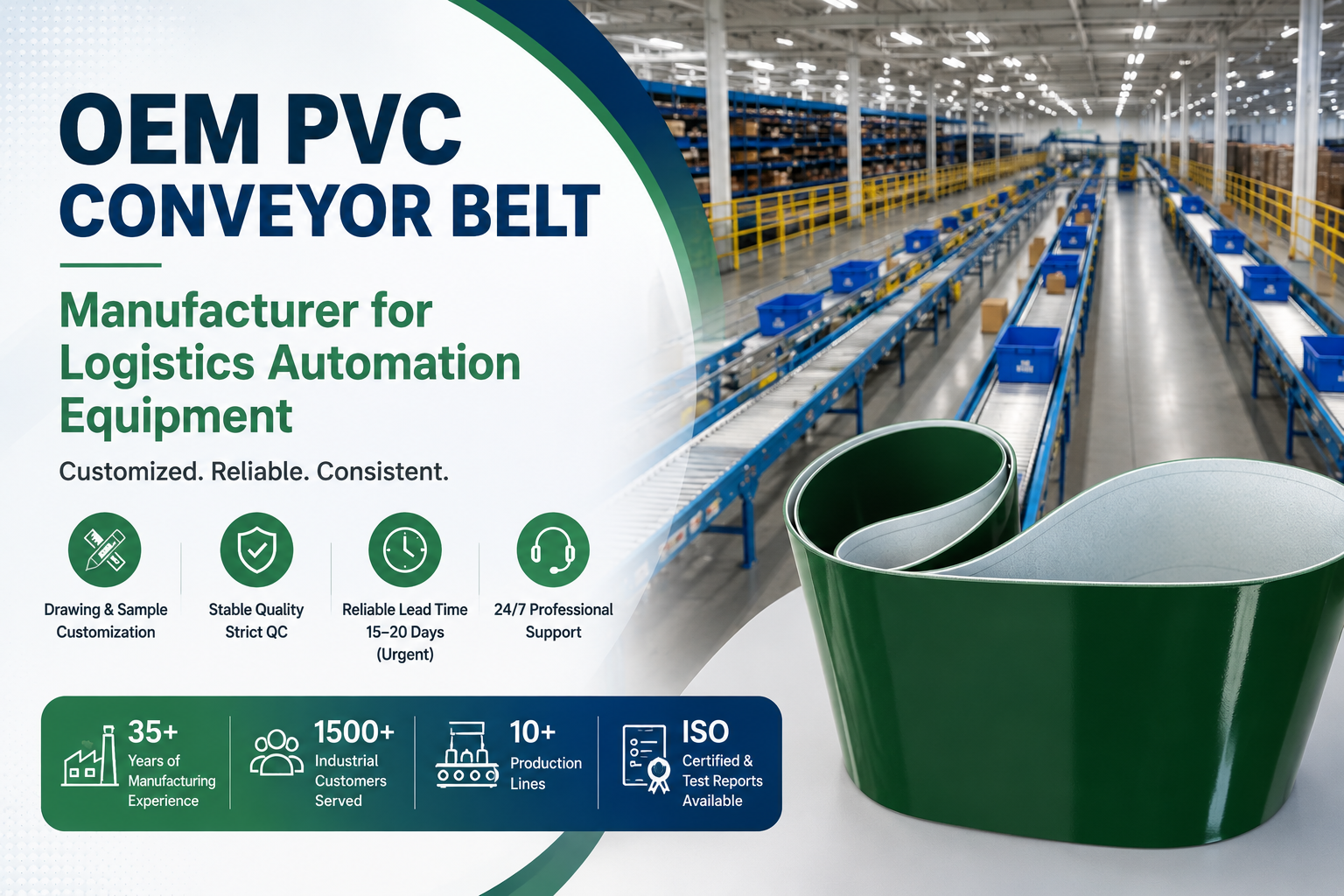
SINOCONVE's confirmed general production lead time is approximately 30 days. For urgent requirements, a production green channel may reduce this to around 15–20 days, subject to the actual specification, quantity, factory schedule, and order confirmation.
Importers should still confirm timing for every PO. A supplier's annual capacity and its available production slot for a particular order are not the same thing.
9. Packaging Is Part of Supplier Qualification
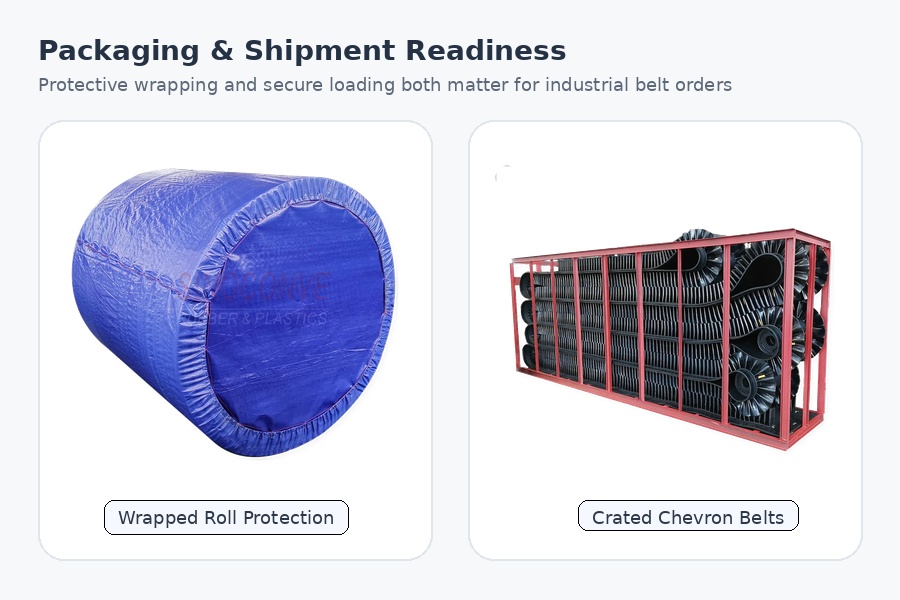
A technically correct industrial belt can still arrive in poor condition if packaging does not match the product and transport route.
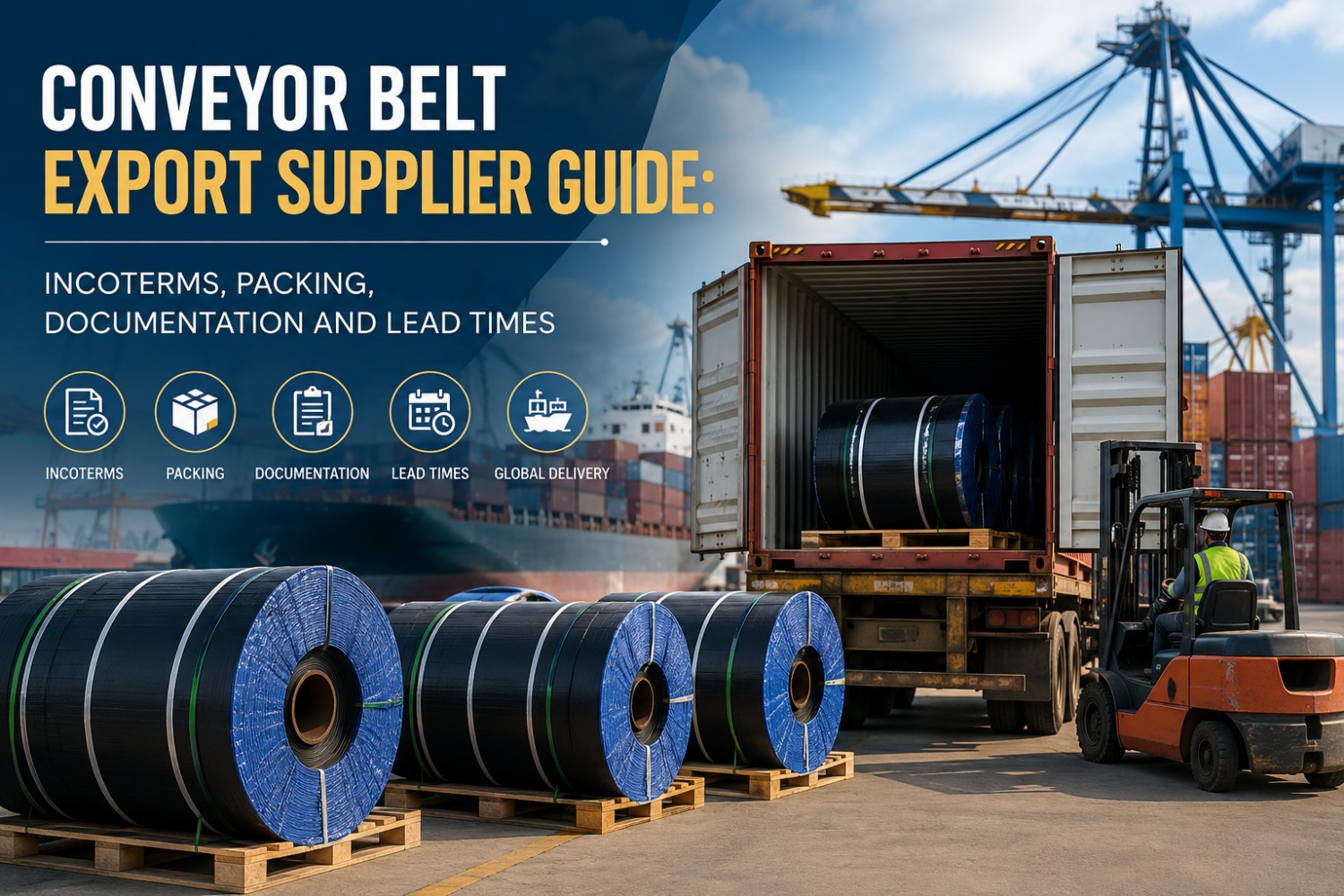
For conveyor belts, SINOCONVE can use PVC board and iron-sheet protection and palletized packing to help protect the roll during transportation. V-belts can be packed in cartons, with woven-bag options depending on the requirement. Customized logos and packaging can also be discussed.
For distributors, packaging deserves additional attention because the goods may be stored or resold after arrival. Confirm roll identification, labels, customer branding, carton quantities, pallet requirements, and export marks before production rather than after the goods are ready to ship.
10. Assess How the Supplier Handles a Quality Claim
Supplier qualification is incomplete if it evaluates only how the supplier wins an order. Importers also need to understand what happens when something goes wrong.
Before approving a supplier, ask what evidence is required for a claim, who investigates it, how technical and commercial teams communicate, and what remedies can be discussed when a product-quality problem is confirmed.
SINOCONVE's stated process is to investigate confirmed product-quality issues and work with the customer on an appropriate solution, which may include replacement, compensation, or technical support depending on the case. For standard conveyor belt products, the confirmed general warranty is one year. V-belts do not have a single uniform warranty period because operating conditions and applications vary.
A distributor should also maintain its own claim records. Product markings, PO number, installation date, operating conditions, photographs, failure location, remaining belt samples where available, and customer feedback can make technical investigation far more useful than a message stating only that “the belt failed.”
11. Build a Supplier Scorecard Instead of Buying on Price Alone
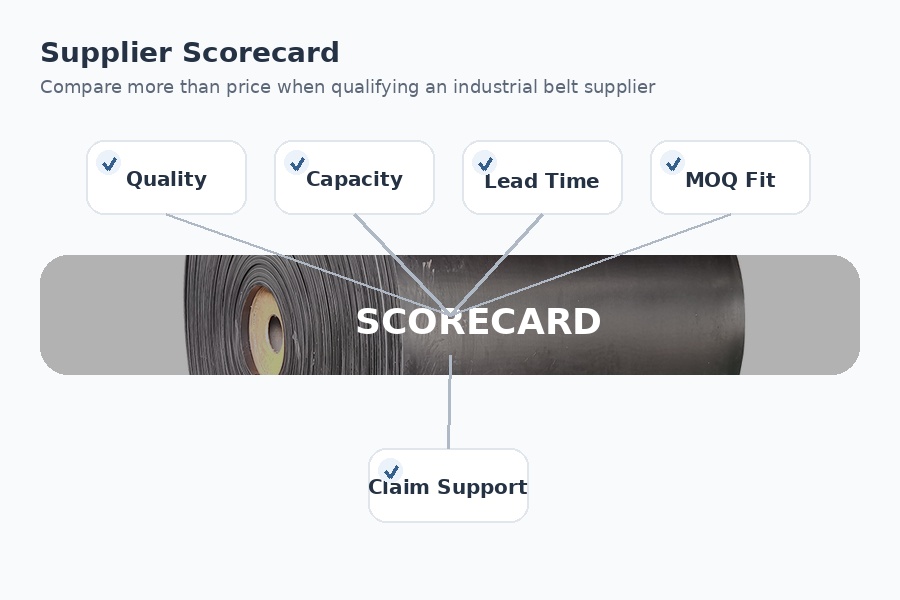
Once the RFQ scope is aligned, importers can compare suppliers more consistently with a weighted scorecard. The weighting should reflect the business. A project importer may place greater emphasis on technical compliance and delivery. A wholesaler may give more weight to MOQ, product coverage, packaging, and repeat-order consistency.
| Evaluation Area | What to Compare | Warning Sign |
|---|---|---|
| Technical capability | Product range, manufacturing limits, application understanding. | Immediate quotation without addressing missing critical data. |
| Quality control | Inspection stages, test capability, traceability and documents. | Only generic quality claims or unrelated certificates. |
| Commercial fit | MOQ, payment terms, customization and packaging. | Terms that create excessive inventory or cash-flow exposure. |
| Delivery control | Production planning and realistic shipment commitments. | Very short promises without checking specification or quantity. |
| Repeat-order control | Approved specification, product identification and change control. | Each reorder has to be reconstructed from informal messages. |
| After-sales response | Claim investigation and technical communication. | No defined path once payment and shipment are complete. |
12. What Should an Importer Send in the First RFQ?
A good RFQ makes the supplier easier to evaluate because it reduces the opportunity for different assumptions.
Industrial Belt RFQ Checklist
- Product identification: belt type, existing specification, drawing or sample reference.
- Dimensions and construction: size, length, strength/construction and other product-specific requirements.
- Application: machine or conveyor type, conveyed material or drive duty, and relevant operating conditions.
- Special exposure: abrasion, impact, oil, heat, cold, chemicals, flame requirements or other applicable conditions.
- Quality requirement: governing standard, required test items, inspection documents and any third-party inspection requirement.
- Commercial scope: quantity by SKU, expected repeat volume where known, packaging, branding and destination.
- Schedule: required shipment date and any project milestone that makes the order time-critical.
If the current product has failed prematurely, include failure photographs and operating information. That changes the discussion from “quote the same belt” to “identify whether the existing specification should actually be repeated.”
13. Frequently Asked Questions
13.1 What is the most important factor when choosing an industrial belt supplier?
There is no single factor. For importers, the strongest qualification combines product capability, specification control, QC evidence, commercial fit, delivery reliability, and repeat-order support. Price should be compared only after suppliers are quoting an equivalent scope.
13.2 Should an importer always choose a factory-direct supplier?
Not automatically. Factory-direct sourcing can improve communication around manufacturing, customization, and production planning, but the buyer still needs to verify whether that factory is suitable for the specific belt and order. “Factory direct” is a sourcing model, not proof of product quality.
13.3 How can I verify an industrial belt factory remotely?
Start with business and certification documents, relevant manufacturing capability, factory photographs or video, technical discussion, sample evaluation, QC procedures, and product-specific test evidence. For higher-risk orders, a live video audit, independent factory audit, pre-shipment inspection, or third-party testing may provide additional control.
13.4 Is a low MOQ always better for a distributor?
No. A lower MOQ can reduce inventory exposure when testing new SKUs or markets, but unit economics, freight efficiency, production consistency, and reorder timing also matter. MOQ should fit the distributor's sales velocity and stocking strategy.
13.5 What documents should I request before shipment?
The document set should follow the purchase specification. Depending on the order, it may include the commercial invoice, packing list, agreed inspection records, product test report, certificate documents, identification records, and any customer-required third-party documentation. Define the list before production.
13.6 How should I compare two suppliers offering different prices?
First verify that both offers cover the same construction, dimensions, performance requirements, standard, testing, packaging, quantity, delivery basis, and documentation. If those items differ, the prices are not yet comparable.
14. Reduce Risk by Making the Purchase Requirement Reproducible
The strongest industrial belt supply relationship is not the one that produces the cheapest first shipment. It is the one that can turn the buyer's requirements into an approved specification, manufacture it consistently, provide agreed evidence, and reproduce it when the distributor needs the next order.
For importers, this changes supplier qualification from a price exercise into a control process: define the requirement, verify capability, approve the technical basis, establish QC evidence, confirm commercial terms, and retain the approved information for repeat orders.
SINOCONVE manufactures conveyor belts and power-transmission products for industrial applications and supports customized production based on customer requirements. Importers can review the broader industrial belt product range or send an RFQ through the SINOCONVE contact page.
Preparing an Industrial Belt RFQ?
Send the product type, required dimensions and construction, quantity, application or operating conditions, required standard/test documents, packaging requirements, destination, and target shipment date. For replacement problems, add the current specification, drawings or photographs and failure details.
Email: sales@sinoconve.com | Request a Quote
Related SINOCONVE Products
| Product Category | Suitable Sourcing Context |
|---|---|
| Rubber Conveyor Belts | Bulk-material handling, mining, quarrying, cement, ports and industrial conveying. |
| Industrial V-Belts | Industrial power transmission, machinery, replacement and distributor programs. |
| Timing Belts | Synchronous-drive and industrial equipment applications. |
| Conveyor Rollers | Conveyor-system procurement and component consolidation. |
Related Articles
- Conveyor Belt Sourcing Guide: How to Reduce Replacement Risk and Downtime — A procurement-focused guide to specification control, supplier qualification, testing and delivery risk.
- How to Evaluate a Rubber Conveyor Belt Manufacturer in China for Long-Term Supply — What importers should verify when assessing factory capability and repeat-order consistency.
- OEM Conveyor Belt Manufacturer Guide for Buyers — How to evaluate customization, technical communication and controlled OEM production.
- Rubber Conveyor Belt Selection Guide for Industrial Lines — A technical guide to application conditions, belt construction and selection risks.