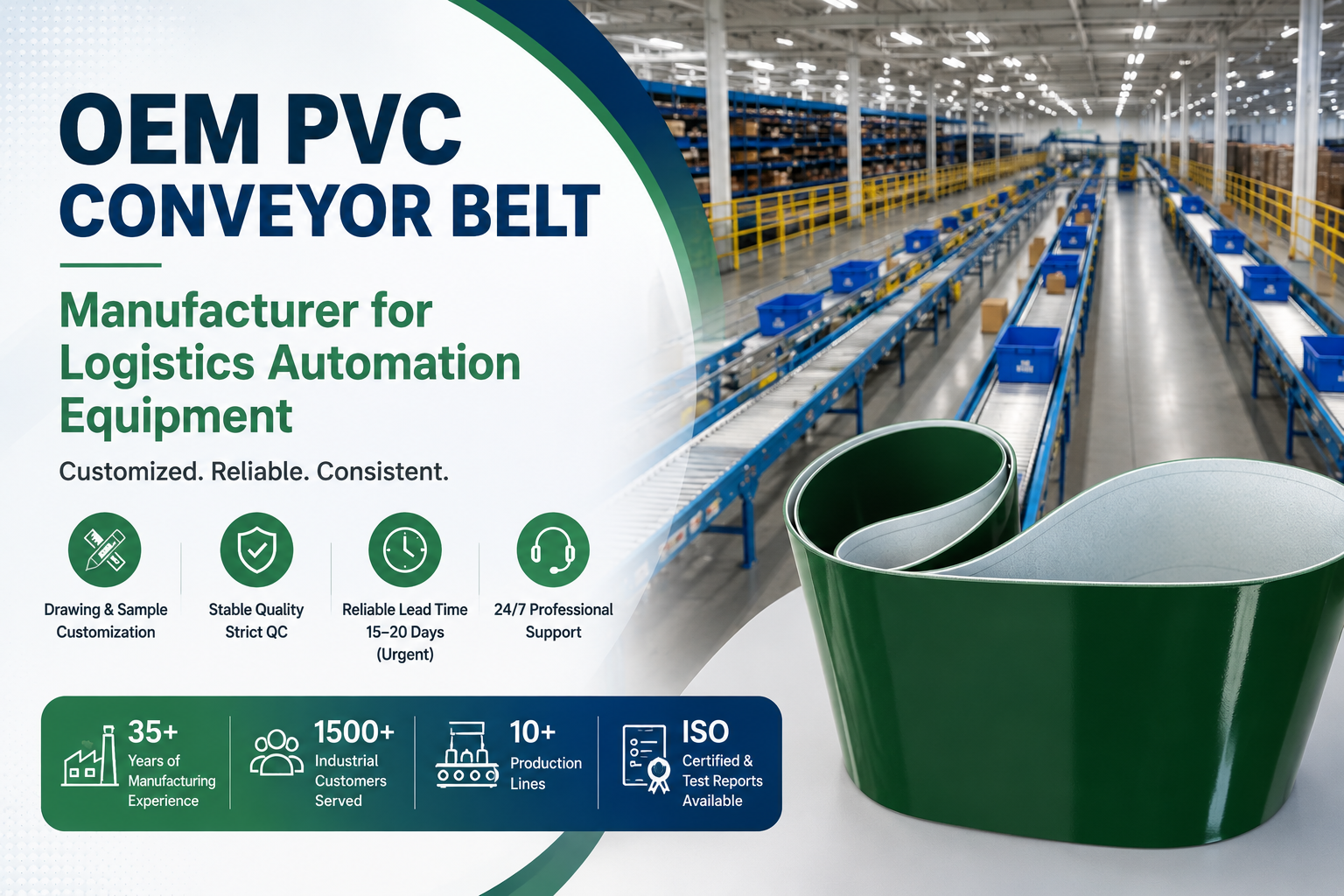
OEM PVC Conveyor Belt Manufacturer for Logistics Automation Equipment
For a logistics automation OEM, a PVC conveyor belt is not simply a replacement component. It becomes part of the machine's conveying accuracy, transfer behavior, maintenance access, and final acceptance. A belt that looks correct on a quotation can still create problems if its surface grip, flexibility, tracking arrangement, splice, or fabrication details do not match the conveyor design.
This makes supplier evaluation different from ordinary belt purchasing. An OEM PVC conveyor belt manufacturer should be able to work from application data, drawings, or samples; identify unclear specifications before production; support prototype verification; and reproduce an approved belt consistently when the equipment enters batch production.
For automation equipment builders, system integrators, and logistics conveyor manufacturers, the practical question is therefore not only “Can this supplier make a PVC conveyor belt?” It is “Can this supplier convert our machine requirements into a repeatable production specification?”
Quick Answer for Automation OEM Buyers
Before approving a PVC conveyor belt supplier, verify four capabilities: application-based specification review, drawing/sample customization, pre-production verification, and repeat-order quality control. Price matters, but an inexpensive belt becomes costly if the OEM has to redesign the conveyor, modify the belt after delivery, or troubleshoot inconsistent batches.
1. Why Logistics Automation OEMs Need More Than a Standard PVC Belt
Warehouse and logistics equipment can place very different demands on belting even when two conveyors have similar dimensions. One line may move rigid cartons horizontally. Another handles polybags through scanning and sorting points. A compact transfer conveyor may use relatively small pulleys, while an inclined section needs more grip to prevent products from sliding.
This is why specifying only width, length, thickness, and color leaves too many variables unresolved.
For many clean, light-duty conveying applications, a PVC conveyor belt can be configured with different surfaces and fabricated features. The useful configuration depends on what the belt must do inside the equipment.
| OEM Condition | Possible Risk | What the Belt Specification Should Address |
|---|---|---|
| Carton transfer | Slipping, unstable transfer or excessive grip | Surface texture, product contact behavior and conveyor angle |
| Polybag or parcel sorting | Product shifting or poor positioning | Surface friction, belt stability, tracking and transfer layout |
| Compact conveyor | Poor flexing around the pulley | Belt construction, thickness, splice and actual pulley diameter |
| Inclined transfer | Carton or product rollback | Surface profile and, where required, cleat geometry |
| Precision automation | Tracking variation and edge contact | Belt tracking arrangement, guide geometry and conveyor alignment |
The implication for an automation OEM is straightforward: belt selection should start from machine conditions rather than a supplier's standard catalogue description.

2. What Should Be Customized for a Logistics Conveyor?
OEM customization has value only when each modification answers a functional requirement. Changing the belt color or adding a customer's logo is customization, but those changes do not solve tracking, grip, pulley compatibility, or product-transfer problems.
A more useful discussion starts with the belt construction and fabrication details.
2.1 Surface and product contact
A smooth surface may be appropriate where clean release is important. A textured surface can provide additional grip for cartons or packaged goods, while rougher surfaces may be considered for certain inclined transfers. More grip, however, is not automatically better. Excessive friction can affect product release or transfer behavior.
OEMs should therefore describe the actual product: carton, tray, bag, component, parcel, or another item. Product weight, base material, conveyor angle, contamination, and required transfer behavior all help narrow the surface choice.
2.2 Cleats, guides, sidewalls and perforations
Fabricated features change the way the belt interacts with the machine. Cleats can control spacing or rollback on an incline. Guides can support tracking in conveyor designs prepared for them. Sidewalls can help contain small or loose products. Perforations may be required for vacuum, drainage, airflow, or positioning functions.
Each addition also introduces another interface that must be checked. A cleat requires sufficient return clearance. A guide must match the groove arrangement. A sidewall changes edge clearance and cleaning access. A perforation pattern should be reviewed against the required belt construction.
Buyers comparing these configurations can review SINOCONVE's PVC conveyor belt structure selection guide before finalizing the OEM drawing.
2.3 Splice and pulley compatibility
The joint is part of the moving belt, not a separate purchasing detail. Its construction can influence flexibility, smooth running, maintenance, and how the belt passes around the conveyor pulleys.
For that reason, the OEM should provide actual pulley dimensions and installation requirements instead of selecting a splice only because it was used on another machine. A belt configuration suitable for a large, simple horizontal conveyor may not be appropriate for a compact conveyor with tighter bending requirements.
OEM Design Warning: Do not approve the belt from width and thickness alone. Pulley diameter, surface requirement, conveyor direction, incline, splice, guides or profiles, and the product being transported can all change the final construction.
3. Drawing Approval Should Prevent Problems Before Production
A useful drawing is not paperwork added after the technical decision. For a custom supplier, it is one of the main tools for translating an equipment requirement into something production and inspection teams can reproduce.
Depending on the belt design, an OEM drawing or technical confirmation should identify the relevant dimensions and fabrication details clearly.
| Item to Confirm | What the OEM Should Provide | Why It Matters |
|---|---|---|
| Belt dimensions | Required width, length and thickness | Basic fit with the conveyor design |
| Surface | Required texture and product-contact conditions | Affects grip, release and product stability |
| Pulleys | Actual pulley diameters and layout | Helps evaluate belt flexibility and joint compatibility |
| Profiles | Cleat, guide, sidewall or other geometry where applicable | Controls spacing, containment, tracking or incline behavior |
| Joint | Endless or installation requirement | Influences installation and running behavior |
| Marking and packing | Logo, identification and packaging requirements | Important for OEM branding, receiving and repeat orders |
SINOCONVE supports OEM/ODM production and customization based on customer drawings, samples, and specific requirements. This is particularly useful when an automation OEM already has an approved belt from a previous machine and needs a supplier to reproduce the required configuration rather than redesign it from a product name alone.
4. Sample Testing Is More Valuable Than a Low Prototype Price
For a new machine platform, sample verification can reduce the risk of moving an untested belt specification directly into a production order. SINOCONVE can provide standard samples or small test samples according to the requirement.
The OEM should use that stage to answer application-specific questions rather than simply confirming color and appearance.
- Fit: Does the belt match the intended conveyor dimensions and installation method?
- Flexing: Does it run correctly around the machine's pulley arrangement?
- Product handling: Does the surface provide suitable grip and release for the actual carton, bag, tray, or component?
- Tracking: Does the belt remain stable under realistic loading and transfer conditions?
- Fabricated features: Do guides, cleats, sidewalls, or other profiles clear the frame and return path?
- Transfer: Does the product enter and leave the conveyor without unacceptable instability?
A short unloaded run is not the same as an application test. Where practical, the prototype should be evaluated under conditions that resemble the final machine: representative products, intended speed, repeated starts and stops, transfers, and the expected loading pattern.
5. Production Capability Means Repeatability, Not Just Making One Sample
A successful prototype proves that a configuration can work. It does not automatically prove that every production batch will reproduce the approved result.
This distinction matters to automation manufacturers. Once a conveyor becomes part of a standard machine series, purchasing may need the same belt for multiple builds, replacement parts, overseas installations, or future repeat orders. Uncontrolled changes in dimensions, surface, joint preparation, profiles, or marking can create assembly and after-sales problems.
Supplier qualification should therefore examine the route from approved requirement → production → inspection → identification → repeat order.
SINOCONVE's confirmed company information states that the factory was established in 1988 and has more than 35 years of manufacturing experience. The company also maintains a technical product-development team and supports customized development according to customer operating conditions and technical requirements.
For OEM buyers, experience is useful when it appears as a controlled process rather than a marketing number. Ask how the supplier records an approved configuration, how changes are communicated, what is inspected before shipment, and what information should be referenced when placing the next order.
For a broader supplier-evaluation framework, see the SINOCONVE OEM conveyor belt manufacturer guide.
6. Quality Control: Ask What Is Actually Checked
“Strict quality control” has little purchasing value unless the buyer knows what the process contains.
According to SINOCONVE's confirmed company information, incoming raw materials are inspected before production. Production is subject to process inspection, and finished products undergo testing and final inspection before shipment. ISO certificates and product test reports can be provided, while third-party testing can also be arranged when a customer has special standard requirements.
For an automation OEM, the acceptance requirements should be connected to the approved belt specification. The relevant checks depend on the product and application; a generic certificate should not replace dimensional, construction, or functional verification for a custom part.
Buyer Tip: Define the acceptance criteria before mass production, especially for a custom belt. If a parameter is important enough to stop machine assembly when it is wrong, it should be clear in the drawing, order specification, approved sample, or inspection agreement.
7. Logistics Applications Need Different PVC Belt Decisions
“Logistics conveyor” covers more than one operating condition. The belt used on a horizontal carton conveyor does not automatically transfer to every section of an automated warehouse.
Parcel and carton transport: stable conveying and predictable transfer are usually more important than aggressive surface grip. The supplier needs information about package material, weight range, speed, and conveyor angle.
Sorting and scanning equipment: tracking and consistent product positioning can become more important because downstream devices depend on predictable movement. Conveyor alignment and the belt specification should be reviewed together rather than expecting a guide profile to correct every tracking problem.
Inclined logistics conveyors: the OEM should evaluate product rollback before specifying the surface. Texture may be sufficient in one application, while another may need cleats. Cleat height and spacing should be based on the product and machine geometry rather than selected as a generic upgrade.
Compact transfer modules: pulley dimensions deserve particular attention. A belt that is unnecessarily thick or a fabrication detail that cannot negotiate the required pulley arrangement may cause a problem even when the belt's width and length are correct.
More application considerations are covered in SINOCONVE's guide to logistics conveyor belts.
8. How OEM Purchasing Can Reduce Commercial Risk
Purchase-price reduction and total purchase-risk reduction are not always the same thing.
A lower belt quotation may lose its advantage if engineering has to clarify specifications repeatedly, samples differ from production, packaging is unsuitable, or the next batch no longer matches the approved design. For an automation OEM, supplier cost therefore includes engineering communication and repeatability as well as unit price.
A practical sourcing process is:
- Send the application conditions and conveyor drawing.
- Identify unclear belt parameters before requesting final production approval.
- Confirm customization and fabrication details.
- Use a sample or small test sample where verification is necessary.
- Record the approved specification.
- Agree on the relevant pre-shipment inspection and documentation.
- Use the approved reference for repeat production.
SINOCONVE's confirmed commercial information states that conveyor belt orders normally have a 50 m MOQ. General manufacturing lead time is approximately 30 days; for urgent requirements, an accelerated production arrangement may reduce this to approximately 15–20 days, subject to the specific order.
Because SINOCONVE conveyor belts are customized rather than held as standard finished-goods stock, OEMs should include production time in their project schedule instead of assuming immediate inventory availability.
9. RFQ Data That Helps a Manufacturer Quote Correctly
A good RFQ reduces assumptions. It also makes quotations from different suppliers easier to compare because each supplier is working from the same technical basis.
| RFQ Information | What the Buyer Should Provide |
|---|---|
| Conveyor application | Machine function and where the belt sits in the logistics process |
| Conveyed product | Carton, polybag, tray, parcel, component or other product; include representative size and weight information |
| Belt dimensions | Required width, length, thickness and existing belt specification where available |
| Machine geometry | Pulley diameters, incline, transfer arrangement and relevant frame clearances |
| Surface requirement | Required grip, release behavior, surface pattern or approved reference sample |
| Fabrication | Joint, guides, cleats, sidewalls, perforations or other required features |
| OEM requirements | Drawing, sample, logo, color, identification and packaging requirements |
| Commercial information | Required quantity, project schedule and destination |
If the existing machine is already operating, photos of the conveyor and old belt can also help. For a replacement part, however, an old belt should not automatically become the complete specification: wear, stretching, previous modifications, or incomplete markings can make it an unreliable reference on its own.
10. Questions to Ask Before Approving an OEM PVC Conveyor Belt Manufacturer
- Can the manufacturer review a conveyor drawing or reproduce a requirement from an approved sample?
- What application information is required before the belt construction is confirmed?
- Can a sample or small test sample be supplied before production approval?
- How are surface, dimensions, profiles, guides, cleats and joint requirements recorded?
- What incoming, in-process and final inspections are performed?
- Which inspection or test documents can be supplied for the order?
- How is an approved specification controlled for future repeat orders?
- Can OEM logo, color and packaging requirements be incorporated where required?
- What are the MOQ and realistic production lead time for the actual configuration?
The answers provide a better basis for supplier qualification than a catalogue containing dozens of PVC belt types. For an automation OEM, the goal is not maximum product variety. It is a supplier process capable of converting engineering requirements into a belt that can be approved, produced, inspected, and ordered again.
11. FAQ
Can SINOCONVE manufacture a PVC conveyor belt from a drawing or sample?
SINOCONVE supports OEM/ODM and customized production according to customer drawings, samples, and specific requirements. For an automation project, supplying both the drawing and application conditions is preferable because dimensions alone may not describe the belt's operating requirements.
Can I request a sample before placing a production order?
Yes. Standard samples or small test samples can be provided. The sample requirement should be discussed according to the belt configuration and what the OEM needs to verify.
What information is needed for a PVC conveyor belt RFQ?
Start with belt dimensions, conveyed product, machine layout, pulley diameters, conveyor angle, surface requirement, joint, required fabricated features, quantity, and destination. Drawings, photos, or an existing approved sample can reduce specification ambiguity.
Is a thicker PVC conveyor belt always better for an automation conveyor?
No. Thickness should be considered together with construction, load, flexibility, pulley arrangement, surface requirement, and machine geometry. Adding thickness without an engineering reason can create compatibility problems rather than solving them.
Should a tracking guide be added whenever a belt runs to one side?
Not automatically. Belt mistracking can also be related to conveyor alignment, pulley or roller condition, loading, tension, or other machine factors. A guide should be specified only when the conveyor design and belt construction are compatible with it.
What is SINOCONVE's MOQ for conveyor belts?
The confirmed MOQ for conveyor belt orders is generally 50 meters. The actual requirement should still be confirmed for the specific customized configuration.
How long does production normally take?
General production lead time is approximately 30 days. For urgent requirements, SINOCONVE may arrange an accelerated production channel of approximately 15–20 days, depending on the specific order and production situation.

12. Prepare the Machine Data Before Requesting a Quote
For a logistics automation project, a useful quotation begins with the machine rather than a generic request for “green PVC belt” or “3 mm PVC conveyor belt.” Prepare the belt dimensions, conveyed product, pulley diameters, conveyor angle, required surface behavior, joint or fabrication requirements, drawing or sample, quantity, and project schedule.
SINOCONVE can review OEM/ODM requirements based on drawings, samples, and application information. Send the technical package to sales@sinoconve.com, or submit it through the SINOCONVE inquiry page. The objective is to clarify the belt specification before production, not after the belt reaches the assembly line.
Related Products
PVC Conveyor Belt — Explore SINOCONVE PVC conveyor belt solutions for light-duty conveying, packaging, logistics, and customized automation applications.
Sand Pattern PVC Conveyor Belt — Review a patterned PVC belt option and related PVC belt construction information.
Related Articles
- PVC Conveyor Belt: Efficient Solutions for Material Handling Challenges
- PVC Conveyor Belt Types: How to Choose the Right Structure
- Cleat PVC Conveyor Belt Selection Guide
- Logistics Conveyor Belts: Efficiency & Design Insights
- OEM Conveyor Belt Manufacturer: What Industrial Buyers Should Check Before Ordering