
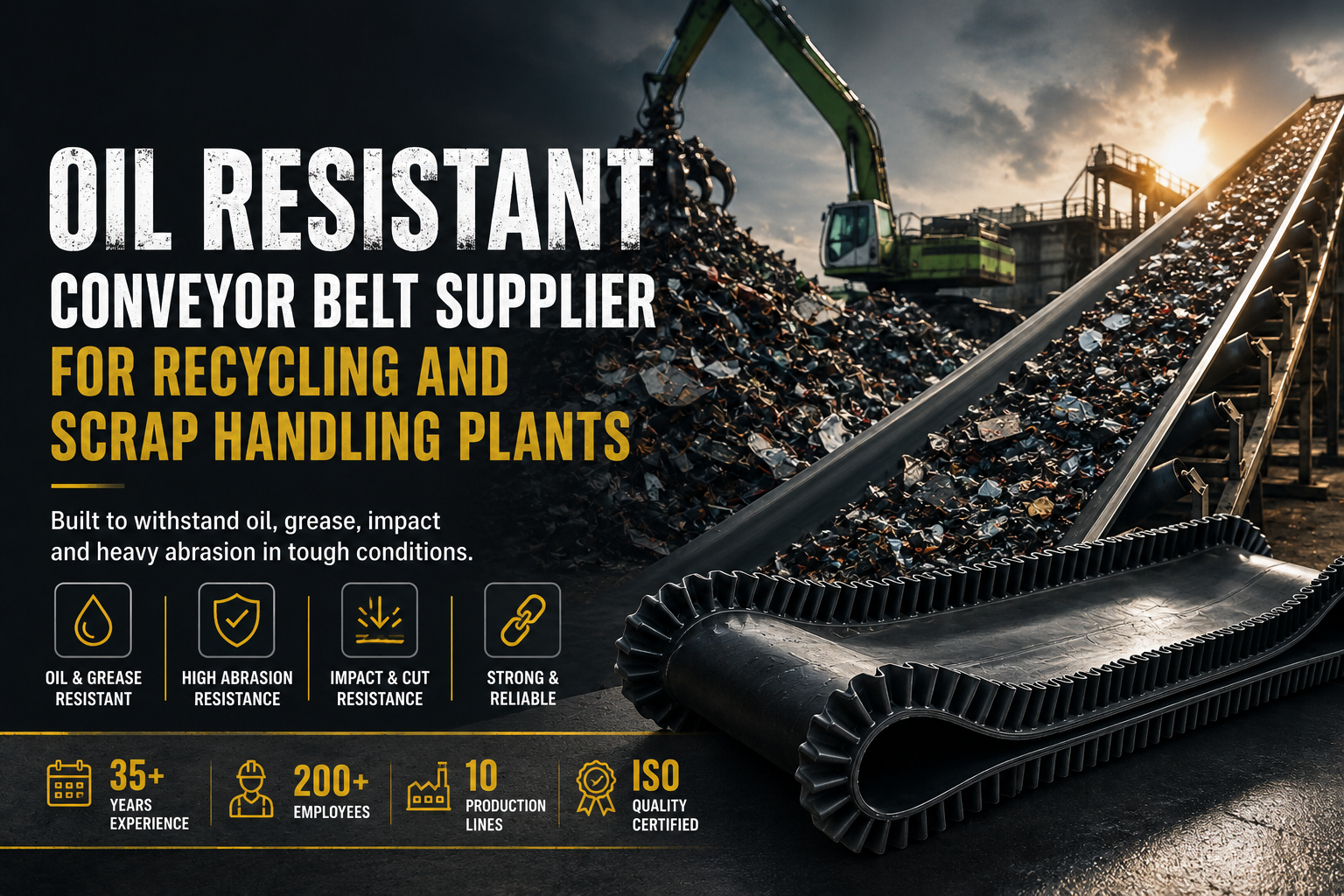
Oil Resistant Conveyor Belt Supplier for Recycling and Scrap Handling Plants
A recycling plant rarely handles a clean, consistent material stream. Shredded automotive parts may arrive with lubricants still attached. Metal scrap can carry cutting fluid or hydraulic oil. Recovered plastics may be contaminated with grease, while sharp fragments and irregular loads add abrasion and impact at the same time. For a buyer, this makes an oil resistant conveyor belt supplier decision more complicated than simply requesting an “oil-resistant rubber belt.”
The supplier has to understand both sides of the application: chemical exposure from oil and the mechanical demands of scrap handling. Before issuing a bulk order, procurement teams should therefore verify the oil type, exposure level, belt construction, operating conditions, test requirements, production capability and inspection documents. A technically detailed RFQ makes quotations easier to compare and reduces the risk of approving a belt that meets the purchase description but not the actual conveyor duty.
Quick Buyer Answer: Do not qualify an oil resistant conveyor belt supplier by price and an “oil-resistant” label alone. For recycling and scrap handling, verify the actual contaminant, exposure frequency, abrasion and impact conditions, carcass requirement, cover construction, splice arrangement, test method, QC documentation and the supplier's ability to reproduce the approved specification for future replacement orders.
1. Why Recycling and Scrap Handling Need a Different Supplier Evaluation
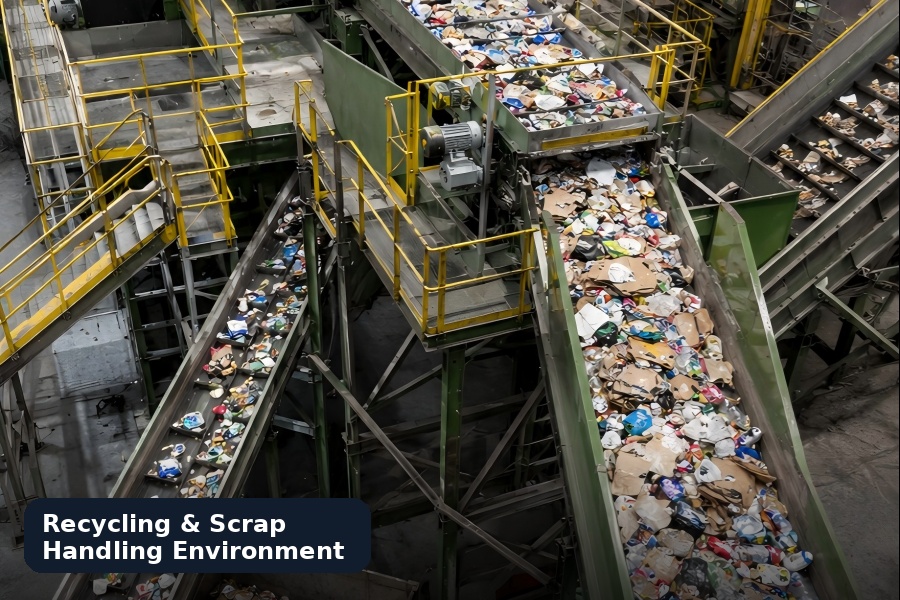
Oil resistance is only one part of the duty in a recycling conveyor. The material stream can change from shift to shift, and the belt may encounter several stresses at the same transfer point.
Consider a line processing automotive or industrial scrap. Residual engine oil, hydraulic fluid, grease or machining fluid may contact the belt cover.At the same time, irregular metal pieces can cut or abrade the surface. A heavy fragment dropping from a chute introduces impact. If the conveyor is inclined, contaminated surfaces can also affect material behavior and housekeeping around the system.
This means the purchasing question should not be “Can you supply an oil resistant conveyor belt?” A more useful question is: Can the proposed belt construction be matched to our actual contaminant and mechanical duty, and can the supplier provide enough documentation for us to verify it?
The distinction matters because liquid exposure can change rubber properties. Depending on the rubber and liquid involved, absorption, extraction of soluble constituents or chemical interaction may occur. Changes can include swelling and changes in physical properties. This is why oil compatibility should be evaluated against defined exposure conditions rather than assumed from the product name.
| Recycling Condition | Potential Belt Risk | Specification Implication |
|---|---|---|
| Oil-contaminated automotive scrap | Cover swelling, softening or other property changes | Identify the oil and exposure level before selecting the cover compound. |
| Sharp metal fragments | Cuts, gouging and localized cover damage | Oil resistance must be considered together with cut, impact and abrasion requirements. |
| Heavy pieces at a transfer point | Impact damage to cover or carcass | Provide lump size, approximate piece weight, drop height and loading arrangement for engineering review. |
| Mixed or changing waste stream | Specification based on an incomplete contamination profile | Describe worst credible operating conditions rather than only the average material. |

2. Start Supplier Qualification With the Oil, Not the Belt Catalog
A buyer can send width, length and ply information and receive a conveyor belt quotation quickly. That does not mean the proposed cover is appropriate for the application.
The first technical question should identify what actually contacts the belt. Vegetable oils, animal fats, mineral oils, hydraulic oils, lubricating oils and mixed industrial fluids should not automatically be treated as equivalent exposures. The supplier also needs to know whether contamination is occasional, repeated every shift or effectively continuous because the conveyed material remains saturated.
Temperature matters as well.A buyer should report the actual material and operating temperature rather than assuming that “oil resistant” automatically means suitable for simultaneous oil and elevated-temperature exposure.
For recycling streams where the contaminant is uncertain, send the supplier as much practical evidence as possible: a description of the upstream process, photos of the material, known fluid types and, where appropriate, a representative sample. This gives the supplier a better basis for discussing the cover compound and testing requirements.
RFQ Warning: “Oil resistant rubber conveyor belt, 800 mm wide” is not a complete technical specification. It tells the supplier the desired property and one dimension, but says nothing about the oil, exposure, load, impact, carcass, covers, conveyor geometry or acceptance criteria.
3. Oil Resistance Does Not Replace Mechanical Specification
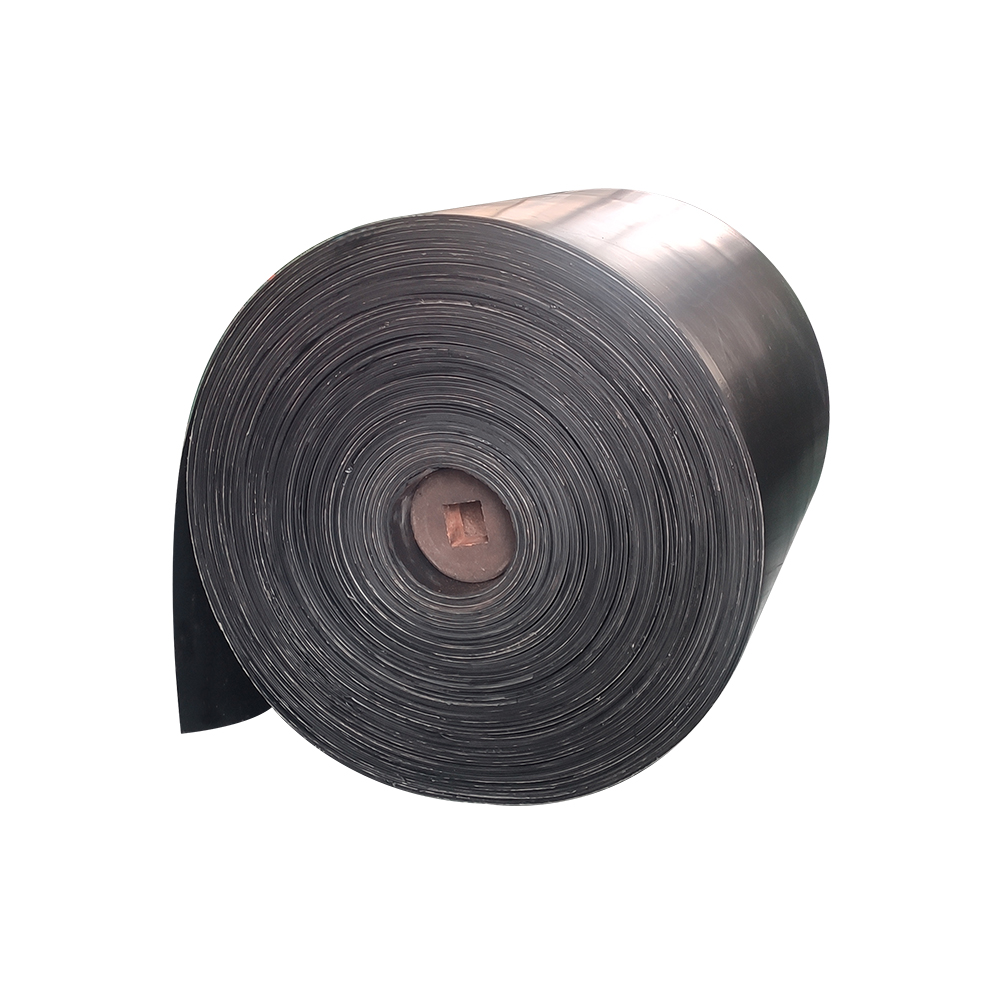
A belt with an appropriate oil-resistant cover can still be the wrong belt for a scrap conveyor.
The carcass has to carry the working tension. Cover thickness has to reflect the wear environment. The belt must flex correctly around the conveyor pulleys, and the splice has to suit the construction and operating duty. Transfer-point impact, belt speed, conveyor length and loading conditions still influence selection.
This is particularly important in scrap handling because buyers can become focused on the visible contamination problem and under-specify the mechanical one. If sharp scrap is damaging the cover, increasing oil resistance alone does not address the failure mechanism.
SINOCONVE's broader guide to rubber conveyor belt material selection explains why cover properties and carcass construction need to be treated as separate but related decisions.
3.1 Ask What Failed on the Existing Belt
If the purchase is replacing a belt that failed early, include the failure evidence in the RFQ. Photos and operating history can be more useful than simply sending the old purchase specification.
| Observed Condition | What It May Indicate | What the Buyer Should Check |
|---|---|---|
| Cover visibly swollen or softened | Possible incompatibility with the contacting liquid | Oil/fluid identity, exposure duration and current cover compound |
| Deep cuts or gouges | Sharp material or severe loading-point damage | Scrap geometry, drop height, chute arrangement and impact support |
| Damage concentrated near belt edges | Tracking, loading or structural contact may be involved | Loading alignment, idlers, frame contact and belt tracking |
| Repeated splice trouble | Joint, tension,pulley or installation issue may contribute | Splice method, pulley diameters, belt construction and operating tension |
A supplier should be willing to discuss these conditions rather than treating every failure as a request for a thicker belt. SINOCONVE's guide on rubber conveyor belt field performance provides additional points for diagnosing the application before replacement.
4. What Proof of Oil Resistance Should a Buyer Request?
Terms such as “high oil resistance” are difficult to compare unless the quotation states what is being offered and how it can be verified.
For rubber-liquid compatibility, ISO 1817 provides methods for evaluating the effect of liquids on vulcanized or thermoplastic rubber by measuring properties before and after immersion in specified test liquids. For procurement purposes, the important lesson is not to place a standard number on the RFQ without context.The buyer should define the relevant fluid or required test condition and agree with the supplier on what result or documentation will constitute acceptance.
A laboratory result for a rubber specimen also should not be interpreted as proof that the entire conveyor belt is correctly designed for a recycling line. Oil compatibility does not verify carcass strength, splice suitability, impact resistance, tracking or the conveyor's mechanical design. Those remain separate checks.
4.1 Put the Verification Requirement Into the Purchase Specification
Before the order is released, clarify:
- the oil or fluid that represents the actual exposure;
- the test method or customer specification to be applied;
- which property changes or acceptance limits are required by the project specification;
- whether a supplier test report or third-party testing is required;
- how the approved construction will be identified on production documents; and
- which documents must accompany the shipment.
SINOCONVE states that raw materials are inspected before production, production is subject to in-process inspection, and finished products are tested and finally inspected before shipment. Product test reports can be provided, while third-party testing can be arranged where a customer has special standard requirements. Buyers should state these documentation requirements in the RFQ rather than requesting them after production.
5. Qualify the Factory, Not Just the Sales Quotation
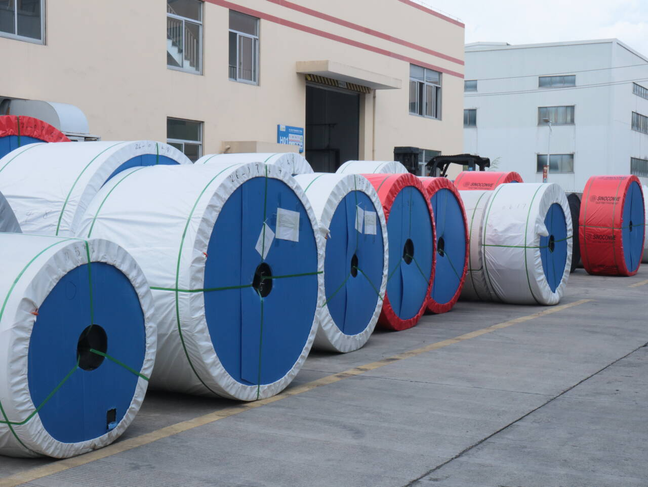
A sample and a competitive price may be enough for an initial screening. A bulk order needs another level of supplier qualification: can the factory repeatedly manufacture the approved construction and support future replacement requirements?
SINOCONVE's conveyor belt factory was established in 1988 and has more than 35 years of manufacturing experience. Current company information lists more than 200 employees, 26 engineers, 15 quality-control personnel and a laboratory. Conveyor belt production includes eight fabric conveyor belt production lines and two steel cord conveyor belt production lines.
For a recycling buyer, factory scale is relevant mainly when it translates into process control, production planning and repeatability.It does not replace product qualification. The approved belt still needs to match the application.
Buyers evaluating SINOCONVE can review its conveyor belt manufacturing capability and should use the same qualification logic when comparing any industrial supplier.
| Supplier Check | Evidence to Request | Why It Matters |
|---|---|---|
| Manufacturing capability | Production scope relevant to the ordered construction | Confirms the supplier can manufacture rather than merely quote the requirement. |
| Incoming material control | Raw-material inspection procedure | Compound and reinforcement consistency starts before vulcanization. |
| In-process QC | Inspection stages relevant to the belt specification | Reduces reliance on finished-product inspection alone. |
| Final inspection | Required test report and dimensional checks | Gives procurement an acceptance record before shipment. |
| Specification control | Confirmed construction on quotation/order documents | Important when the same replacement belt must be reordered later. |
6. Build an RFQ That Produces Comparable Quotations
A weak RFQ creates a price comparison between products that may not be technically equivalent. A strong RFQ forces the technical assumptions into the open.
For an oil resistant conveyor belt supplier, the following information is especially useful:
- Conveyed material: metal scrap, automotive scrap, shredded plastics, mixed recycling material or another defined stream.
- Contaminant: known oil, grease, hydraulic fluid, cutting fluid or mixed contamination.
- Exposure: occasional splash, repeated contact, heavily contaminated material or another realistic description.
- Material characteristics: approximate maximum lump size, sharp edges, impact conditions and whether tramp material is expected.
- Conveyor data: belt width and length, conveyor length, incline, belt speed and relevant pulley diameters.
- Existing belt: carcass/strength rating, number of plies where applicable, top and bottom cover thickness and splice method.
- Failure information: photos and description if replacing a prematurely damaged belt.
- Verification: required test method, inspection documents and any customer-specific acceptance criteria.
- Commercial information: quantity, required delivery date, packaging requirement and destination.
If some mechanical data are unavailable, send the existing belt specification, conveyor drawing or equipment documentation rather than guessing. SINOCONVE's conveyor belt sourcing guide also explains why specification control, documentation and lead-time planning should be completed before a replacement becomes urgent.
7. Sample Approval Should Be a Gate, Not a Formality
For a new supplier or a materially different specification, a staged approval process can reduce purchase risk. SINOCONVE can provide standard samples or small test samples for customer evaluation.
The sample should be linked to an agreed specification. Otherwise, a buyer may approve a piece of rubber without establishing what the production batch must reproduce.
Where the project requires testing, define the method and acceptance criteria before sample approval. Then make sure the purchase order identifies the same belt construction and documentation requirement. For critical projects, buyers may also specify third-party verification where appropriate.
Buyer Tip: Keep the approved specification, supplier quotation, sample/test records and final inspection documents under the same purchasing reference. This creates a clearer baseline when the plant reorders the belt or investigates a later failure.
8. Check MOQ, Lead Time and Packaging Before Bulk Approval
Technical qualification is only part of an industrial purchase. A belt that meets the specification but cannot fit the shutdown schedule can still create procurement risk.
According to SINOCONVE's current supplied company information, the minimum order quantity for conveyor belts is generally 50 meters.Normal lead time is approximately 30 days; urgent orders may be discussed for a shorter production schedule, typically around 15–20 days depending on the order and production arrangement.
These figures should be reconfirmed for the actual specification and quantity at quotation stage. Custom industrial belts are production items rather than inventory assumptions, so a buyer should not treat a general lead-time statement as a guaranteed delivery date for every construction.
Packaging also belongs in the RFQ, particularly for export orders. SINOCONVE can use PVC board and iron-sheet protection for conveyor belts and palletized arrangements where required to reduce transport damage. Buyers should confirm the packaging method, roll dimensions and unloading limitations before shipment if site handling is restricted.
9. Compare Total Purchase Risk, Not Only Price per Meter
Price per meter is easy to place in a spreadsheet. Specification ambiguity is harder to see.
Two quotations can show the same width and nominal belt strength while differing in cover construction, oil-resistance requirement, cover thickness, testing, packaging or included documentation. A lower price is meaningful only after the technical scope has been normalized.
A useful commercial comparison therefore asks:
- Are both suppliers quoting against the same oil exposure?
- Is the same carcass or required strength being offered?
- Are top and bottom covers clearly specified?
- Are test and inspection documents included?
- Are packaging and export requirements included?
- Is lead time confirmed for this exact construction and quantity?
- How will a verified manufacturing defect be handled?
SINOCONVE states that ordinary conveyor belt products generally carry a one-year warranty. Where an issue is confirmed to result from the product itself, the company works with the customer on an appropriate solution, which may include replacement, compensation or technical support.The applicable warranty terms should still be written into the quotation or purchase agreement for the specific order.
10. A Practical Supplier Qualification Checklist
| Qualification Area | What to Verify | Before PO? |
|---|---|---|
| Application | Material, oil type, exposure, abrasion, impact and temperature | Yes |
| Belt construction | Width, length, carcass/strength, covers and splice requirement | Yes |
| Oil-resistance verification | Test method, test liquid and project acceptance requirement | Yes |
| Supplier capability | Relevant manufacturing,QC and testing capability | Yes |
| Documentation | Inspection/test reports and any required certificates or third-party reports | Define before PO |
| Commercial terms | MOQ, confirmed lead time, payment, warranty and packaging | Yes |
| Repeat order control | Method for identifying and reproducing the approved specification | Recommended |

11. Questions Recycling Buyers Often Ask
Is an oil resistant conveyor belt automatically suitable for metal scrap?
No.Oil resistance addresses compatibility with oily contamination, but metal scrap can also create cutting, abrasion and impact loads. The belt construction has to address the combined operating conditions.
What information does a supplier need to select the oil-resistant cover?
Start with the oil or fluid type, exposure frequency, material temperature and whether the material is lightly contaminated or saturated. Then provide the mechanical operating data so the complete belt can be reviewed rather than the cover compound alone.
Should I request an ISO 1817 test?
ISO 1817 is a method for evaluating the effect of liquids on rubber. Whether it should be specified depends on your project and acceptance requirements. Define the relevant test liquid and required acceptance criteria with the supplier instead of using the standard number as a generic quality label.
Can SINOCONVE provide samples before a bulk order?
Yes. Standard samples or small test samples can be provided for evaluation.Buyers should specify what they intend to verify so that sample approval is connected to the production requirement.
What is SINOCONVE's MOQ for conveyor belts?
The current general MOQ for conveyor belts is 50 meters. The exact requirement should be reconfirmed for the requested construction and order.
What is the typical production lead time?
General production lead time is approximately 30 days. For urgent requirements, a shorter schedule of around 15–20 days may be discussed depending on the specification and production arrangement. Confirm the actual date before issuing the purchase order.
What should I send if the existing recycling belt is failing?
Send clear photos of the damaged areas, the current belt specification, material description, contaminant information and conveyor operating data. Note where the damage occurs and how long the belt had been operating. This helps distinguish oil-related degradation from abrasion, impact, tracking, splice or system problems.
12. Prepare the RFQ Before You Compare Suppliers
For recycling and scrap handling plants, supplier qualification should end with a technically clear RFQ, not a generic request for the lowest price. Identify the scrap or recycling stream, oil or fluid exposure, belt dimensions, existing strength/carcass specification, covers, loading conditions, conveyor speed and geometry, splice requirement, required test documentation, quantity and destination.
If an existing belt has failed, include photos and its specification so the failure mechanism can be reviewed before the replacement is quoted.
SINOCONVE has manufactured industrial conveyor belts since 1988 and supports customized conveyor belt production, sample evaluation and pre-shipment testing.For a project-specific review, send your RFQ to sales@sinoconve.com or use the SINOCONVE quotation and contact page.
Related Products
Oil Resistant Conveyor Belt
For recycling, scrap handling and other industrial material streams where oil or grease contamination must be considered as part of the belt specification.
EP Rubber Conveyor Belt
Fabric-reinforced rubber conveyor belt construction for industrial material handling. Carcass strength, cover properties and dimensions should be selected according to the conveyor duty.
Related Articles
- Oil Resistant Conveyor Belt: What Buyers Should Check First — a technical starting point for identifying oil exposure and belt-selection requirements.
- Oil Resistant Conveyor Belts for Greasy and Oily Environments — an overview of oil-contaminated applications and selection considerations.
- Conveyor Belt Sourcing Guide: How to Reduce Replacement Risk and Downtime — procurement guidance covering specifications, supplier qualification and replacement planning.
- Rubber Conveyor Belts: Material Choices, Failure Risks, and Best Use Cases — explains how cover properties and carcass construction relate to operating conditions.