

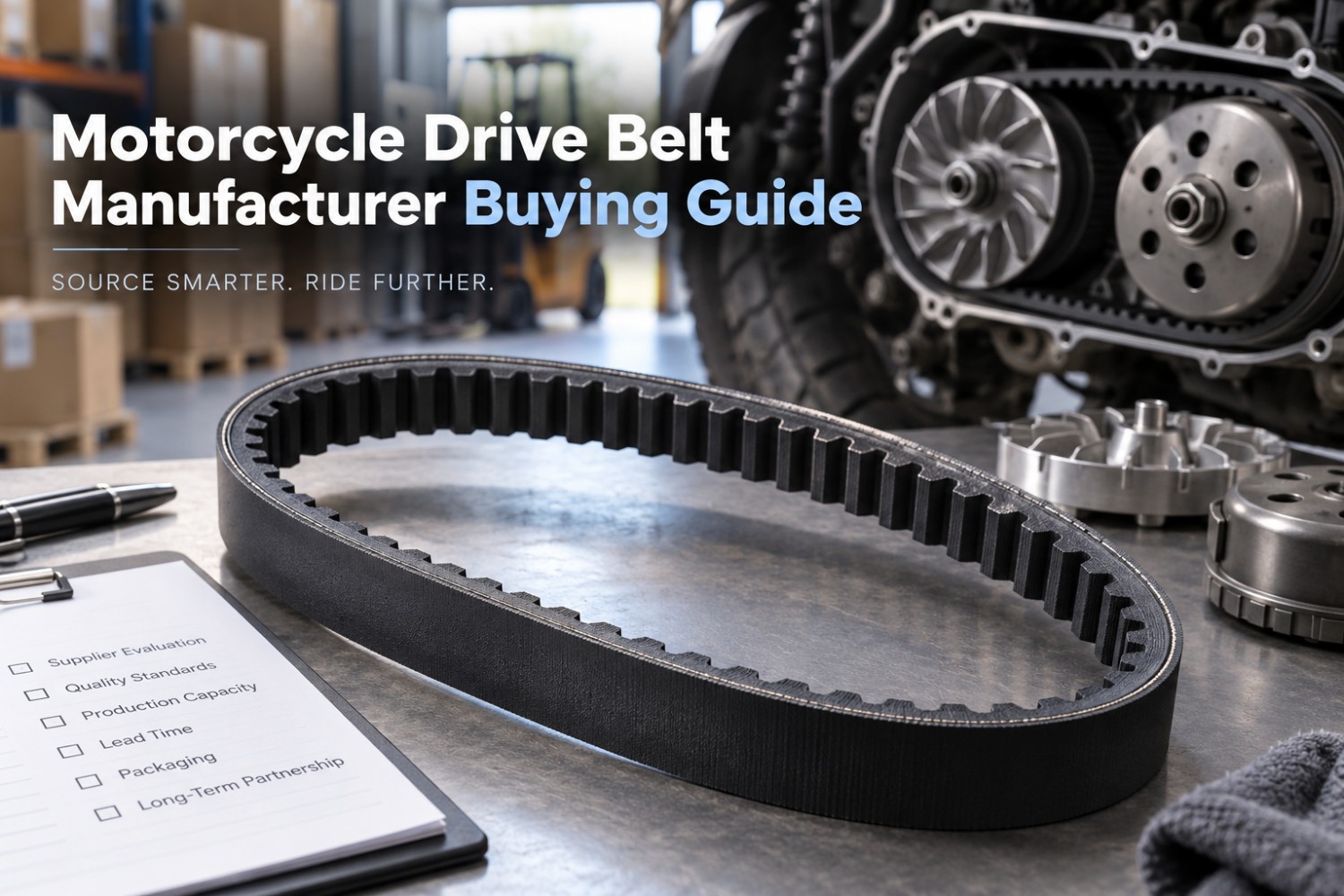
An engine timing belt that fails early does not fail quietly. It usually fails far from the counter where you sold it: on a workshop lift, halfway through a scheduled service, with the cylinder head already off and a customer watching the clock. By the time the story gets back to you, it has become a warranty claim, a refunded labor bill, and a workshop that quietly moves its belt business to the supplier down the street. Aftermarket distributors carry that exposure every time they commit to an automotive timing belt program on price alone, which is why this buying decision deserves a repeatable sourcing checklist rather than a gut feeling.
We are Ningbo Sinoconve Belt Co., Ltd. — SINOCONVE — and rubber has been compounded and cured on our factory floor since 1988. Timing belts are part of the drive-belt range we make in-house, and after 35-plus years in the business we have seen both sides of this transaction: what a well-prepared distributor sends us, and what a less careful one learns to regret. This guide is the vetting process we wish every buyer ran. It covers the RFQ data you must send before a quote means anything, the evidence a genuine automotive timing belt manufacturer can show, the construction details that separate long-life rubber timing belts from look-alikes, and the commercial terms that make private label and bulk orders workable.

Sections 01 and 02 set the scene from the distributor's side: what a failed belt really costs and what you are buying when you order a replacement. Sections 03 through 06 give you working checklists and the technical details to verify them. Sections 07 through 10 cover factory-level proof, private label, commercial terms and the warning signs that separate a manufacturer from a middleman. If you only have an hour, spend it on the two tables in sections 03 and 04 — copy them straight into your supplier questionnaire.
01Why a Failed Timing Belt Costs More Than the Belt
Let's start with the math most distributors skip. A timing belt's own value on an invoice is small — a few dollars at wholesale even for a quality engine belt. But the belt is not what fails alone.When an interference engine snaps a belt, pistons meet valves, and the repair bill runs to a head job, sometimes a full engine.Even on a non-interference engine, a broken belt strands the vehicle, and the customer pays a tow truck, a rental, and a workshop's labor before you hear about it. The workshop does not blame the engine. It blames the part it fitted, which means it blames you.
That chain of blame is why warranty returns are the wrong way to measure a timing belt supplier. A return rate that looks tiny on paper — one or two percent — can still wipe out your margin on the whole program once you add freight back, restocking, the replacement part you ship free, and the account you lose when a workshop switches to a competitor's brand. We have watched distributors absorb exactly this sequence with imported belts that looked identical to the original at arm's length. The belt that fails early is rarely the belt with the visible defect. It is the belt with the slightly cheaper cord, the softer compound, or the tooth profile that is close but not to print.
So a sourcing decision for an automotive timing belt is really a decision about who controls those invisible variables. The checklist below is built around one idea: before you commit a container or a stock order, force the supplier to prove the variables you cannot see.
What "cheap" usually cuts first
Cutting cost in a synchronous belt means cutting one of four things: the tensile cord, the rubber compound, the tooth fabric, or the cure and inspection time.Cheap belts tend to show it in flex fatigue — the cord or the tooth root cracks after thousands of cycles — and in dimensional drift, where pitch or width wanders outside tolerance as the belt ages on the shelf. Neither failure shows up in a quick visual check, and both show up in your warranty ledger eighteen months later. That is the risk profile you are underwriting with every purchase order.
| Failure mode | What it does in service | Where the root cause usually sits |
|---|---|---|
| Cord breakage / belt snaps | Valve or cam timing lost; engine damage on interference designs | Tensile member strength or fatigue resistance |
| Tooth shearing / stripped teeth | Belt skips timing; rough running; MIL light | Tooth fabric, rubber shear strength,or pitch mismatch |
| Cracking at tooth root | Progressive failure after 20–60k km of service | Compound heat/ozone resistance and flex fatigue |
| Noise / whine in timing cover | Customer complaints; premature replacement | Backing cover friction, tooth profile, or tensioner interaction |
Typical service ranges and failure patterns above are based on common field experience; always confirm the expected interval against the vehicle maker's published schedule and the belt specification sheet for the exact application.
02Know What You Are Actually Buying
Before you can vet a supplier, you need to know what a timing belt is made of and which of its parts do the work. A modern automotive timing belt is a composite: a tensile member of glass or aramid cords that carries the load, a rubber compound that holds everything together and resists oil and heat, tooth fabric bonded to the tooth faces so engagement wears slowly, and a backing layer on the outside.The belt transmits crankshaft rotation to the camshafts with no slip, which is what makes it a rubber timing belt rather than a friction drive — teeth lock into the sprocket grooves and the belt is pulled, not gripped.

Two families of tooth profile dominate the aftermarket. Trapezoidal profiles — the classic square-ish teeth — are still common on older engines. Curvilinear profiles such as HTD-style rounded teeth spread the load over a larger tooth flank, which improves load capacity and reduces stress concentration at the tooth root; most modern replacement programs lean this way. The tooth pitch — the distance from one tooth to the next — must match the sprocket exactly. Pitch mismatch is one of the fastest ways to destroy a belt and the engine behind it, which is why a distributor's first job is to make sure the supplier is building to a defined, verifiable geometry, not "close enough."
The three numbers on every timing belt you stock
Every timing belt you will stock can be reduced to three parameters, and your staff should be able to read them from a spec sheet or a calliper in under a minute. First, the tooth profile family and pitch, which ties the belt to its sprocket family. Second, the belt width, which sets the load capacity and the engagement with the sprocket flanges. Third, the number of teeth around the loop, which fixes the belt length and therefore the timing relationship between crankshaft and camshaft. Add the engine application and the OE part number, and you have the complete identity of the part. A manufacturer that cannot tell you these three numbers for its own catalog is not manufacturing — it is reselling somebody else's confusion.
This is also where you separate an engineering conversation from a price conversation. When we receive an RFQ for a timing belt program, the first thing our engineers ask for is the application data behind each part number: engine family and year range, OE cross-reference, and the physical parameters above. If a buyer sends only a list of OE numbers, we still quote — but we flag the ones where the cross-reference needs verification, because a wrong cross-reference on a cam drive is a claim waiting to happen. A supplier who does not ask those questions is not protecting you from the risk; it is just deferring the problem to your warranty desk.
03Build the RFQ Data Pack Before You Send a Single Inquiry
Most bad timing belt orders do not start with a bad supplier. They start with an incomplete RFQ. When you send a manufacturer a vague inquiry — "quote 10,000 timing belts for popular cars" — you hand the supplier permission to fill in the blanks, and the blanks are exactly where the risk hides. A disciplined RFQ does the opposite: it forces every candidate to quote against the same, complete specification, so you are comparing apples to apples instead of apples to wishful thinking.
Here is the data pack we recommend every aftermarket distributor assemble before contacting manufacturers. Fill in as much as you can per line; where you genuinely do not know a value, say so explicitly and ask the supplier to propose with justification, rather than leaving it blank.
| Data item | Why it matters | Example |
|---|---|---|
| Vehicle / engine application | Ties the belt to real sprocket geometry and OE part number | Honda 1.5L VTEC 2016–2021 |
| OE part number(s) | The cross-reference the whole program hangs on | 13510-R1A-A01 (format example) |
| Tooth profile & pitch | Must match sprocket; trapezoidal vs curvilinear | Curvilinear, 8 mm pitch family |
| Belt width & tooth count | Physical identity; width sets load capacity | 22 mm × 143 teeth |
| Construction requirements | Compound class, cord type, any OE-specific construction | HNBR compound, glass cord, tooth fabric |
| Branding & packaging | Private label, printed specs, box design, language | Our brand, 1 belt/carton,retail box |
| Volume & forecast | MOQ, lead time, price breaks, stock program | 8,000 pcs/yr across 40 SKUs |
| Target standard / market | Regional certification or labeling expectations | EU market, CE-marked packaging preferred |
Notice what this pack does: it turns the conversation from "how much for belts" into "here is exactly what we need, prove you can make it." That single change filters out most trading companies before you ever see their price list, because a reseller cannot answer the construction and verification questions with its own process data — it has to ask its own upstream factory, and the answers come back slow, vague, or not at all.
04Qualify the Factory: Proof of Capability to Demand
A manufacturer proves capability in four layers: what it can show on paper, what it can show in the building, what it can show in the laboratory, and what it can show on a shipping record. Work through the layers in order and do not let a shiny brochure skip you straight to the price list.The most convincing factory visit we know of is the one where the customer arrives with a checklist and a calliper — so here is the checklist to bring.

| Evidence to request | What it proves | How to check it |
|---|---|---|
| Quality management certificate | Basic system discipline exists | Confirm issuer and scope; ISO 9001 is a floor, not a differentiator |
| Production line & equipment list | Real manufacturing capacity vs assembly/trading | Calendering, cord processing, curing,cutting lines on-site |
| In-house test records | Dimensional, adhesion, aging, fatigue data exists | Ask for raw records from the last three production batches, not a summary |
| Batch traceability system | A recall or a complaint can be isolated | Pick a batch number on a finished belt and walk it back to raw material |
| Export history / markets served | The factory has shipped to demanding markets before | Ask for sample BLs or customs documentation style, references per region |
| Physical tour or live video audit | The building matches the story | Walk the line; watch housekeeping, label discipline, stock rotation |
If a full visit is not possible before the first order, a structured live video audit is a workable second best: ask to see the curing area, the cutting and tooth-forming section, the lab,and the finished-goods store in one continuous call, and ask the person on camera to show you the batch records for a belt you name. A factory that does this smoothly on short notice is usually telling the truth about being a factory. A middleman cannot show you its own floor at all — which is, in itself, an answer.
We run an ISO 9001 system across a plant that has produced rubber belting since 1988, and we build timing belts alongside our V-belts and conveyor lines — ten production lines in total, staffed by more than 200 people. When a distributor asks for batch records or a video audit, we treat it as a sign of a professional buyer, not an inconvenience. You should expect the same reception from anyone you take seriously.
05Construction Signals That Separate Long-Life Belts From Look-Alikes
Once a factory passes the paperwork test, the next question is whether it can build a belt that survives real engines. You will rarely be in a position to run a full durability test before your first container, so learn to read the construction signals that correlate with service life — and learn where to look for them.
Tensile cord. The cord does the heavy lifting, and its quality decides fatigue life more than any other component. Glass cord is the workhorse of aftermarket timing belts; aramid cord appears where higher strength and better fatigue resistance justify the cost.What you can verify without a lab is that the supplier can name its cord source and construction, and that the cord is straight and evenly spaced when you cut a belt open. Cord wandering under the tooth line is a red flag you can see with a knife and your own eyes.
Rubber compound. Automotive timing belts live next to oil and heat, so compound choice matters. Chloroprene (CR) was the traditional base; HNBR and other heat-and-oil-resistant bases dominate modern replacement programs because they survive higher under-bonnet temperatures. Ask which compound family each SKU uses and why. A supplier that answers "rubber" has not designed the part — it has copied a price.
Tooth fabric and tooth form. The fabric bonded to the tooth faces protects the tooth from wear against the sprocket. Look at a cut tooth: the fabric should wrap the tooth cleanly with no bare rubber at the root corners, and the cured tooth should be crisp, not rounded or feathered. Sloppy tooth form is the classic signature of a belt cured in a worn mold or on a line running too fast for its own tolerances.
Backing and finish. The outside backing protects the cord on the return side and carries the printing. Felt-like or fabric-reinforced backings are common on OE designs. Check that printing is legible, the belt lies flat rather than taking a permanent set, and the edges are clean — rough edges usually mean a dull cutter and a batch that may measure inconsistently.
One factory, two drive families: a useful cross-check
Here is a practical shortcut distributors rarely use: look at what else the factory makes. The disciplines behind a good timing belt — compound formulation, cord processing, calendering, curing, and dimensional inspection — are the same disciplines behind every other rubber power-transmission and conveying product. When you visit SINOCONVE you will find timing belts and V-belts sharing a compounding and curing infrastructure — we operate as a conveyor belt manufacturer whose flagship is the rubber conveyor belt — and we work as a conveyor belt supplier to mines, quarries and ports, supplying everything from EP and steel cord constructions to an industrial conveyor belt range built for abrasive stone duty. It is the same story on the transmission side, where we operate as a transmission belt manufacturer and V-belt manufacturer, and we also supply conveyor belt distributor partners with chevron and sidewall profiles for steep-angle lines. Buyers who deal with us directly are dealing with a conveyor belt factory, not a trader — and you can browse the whole range, including wholesale conveyor belts, in our product catalog. A factory that masters both families has compounding depth that a belt-only trader cannot fake.
This cross-check matters for one more reason: breadth usually correlates with process control. Running diverse products forces a plant to maintain a serious incoming-material testing program, because a compound or cord failure in one line would poison several product families at once. When a factory tells you it tests every incoming rubber batch and every cord spool, believe it more if the same statement is visible in its conveyor business — that is where its reputation already rides on it.
06Samples, Test Reports and Batch Traceability
Paper capability earns a supplier an invitation; samples and records decide whether it gets the order.Run a small sample approval process on every new program, even for belts that look identical to what you already stock. The process does not need to be elaborate, but it has to be consistent, because consistency is what you are actually testing.

Start with measurement. Take three belts from different batches of the same SKU, if the supplier can deliver them that way, and check tooth count, width, and overall length against the spec sheet with a calliper and a tape. Measurement repeatability across batches is the single cheapest quality test you can run, and it catches sloppy lines instantly. A belt that varies in length by more than a couple of millimeters batch to batch will create tension problems in the field even if every belt passes its own visual check.
Then ask for the test record behind each batch. A real manufacturer tests incoming rubber and cord, then runs process and finished-product checks — dimensional, adhesion, hardness and appearance at a minimum, with heat, oil and flex-fatigue testing for the critical SKUs. The deliverable is a certificate or batch record tied to the batch number printed on the belt.Do not accept a single generic certificate for "all our belts." Tie the paper to the part.
Cut one belt open. It sounds crude, but a cross-section tells you more than most certificates: cord spacing, tooth fabric wrap, compound fill, and the thickness of the backing are all visible at the cut. Keep a reference sample of the belt you approve, photographed and stored, so next year's batch has something to be compared against. Distributors who keep reference samples resolve disputes with suppliers in days instead of months.
Test batch traceability by asking a stupid question. Take the batch code off a finished belt and ask the factory to show you where that belt's compound batch and cord spool were recorded. A factory that can walk a random belt back to raw material within a day has the system you need when a real complaint arrives. One that cannot will improvise exactly when you need precision most.
07Private Label, Packaging and Shelf Life
For most aftermarket distributors the goal is not to resell the factory's brand — it is to build your own. That makes branding and packaging a specification, not an afterthought, and it is worth agreeing in writing before the first production run.
Private label basics. Confirm the supplier can print your brand, part number and spec marking on the belt itself, in the position and font style you specify.Belt printing is done with a marking system at a defined point in the process; cheap suppliers print only a generic code that helps them, not you. Specify exactly what appears on the belt: your brand, your part number, the rib or tooth code, and the length or application marking your market expects. Then check the first articles against a printed spec sheet, because once the marking is wrong, the whole batch is wrong in a way customers notice immediately.
Packaging is a selling tool and a protection device. Timing belts should not arrive at your warehouse kinked, crushed or with printing rubbed off. Agree the retail pack format (box or polybag, card style, language, barcode), the master carton quantity, and the packing standard for sea freight — belts in crushable cartons at the bottom of a container are a classic source of "mystery" cosmetic damage claims. If your market expects barcode scanning at the counter, make the barcode data part of the approval sample, not a surprise on the first shipment.
Shelf life and rotation. Rubber ages whether it is in service or on a shelf, so agree on package date marking and talk openly about stock rotation. A responsible manufacturer dates its batches and will advise sensible maximum storage periods for its compound family; an honest distributor plans order quantities so the oldest stock sells before the newest. When a supplier offers pricing that only works if you take eighteen months of inventory, the discount is often just prepaid aging.
Put the agreement in the spec. Every branding, packaging and marking detail belongs in a written specification attached to the PO — not in a friendly chat message. The discipline of writing it down is what makes the next batch, and the next supplier comparison, measurable. This is also where you protect your program against the "yes we can" supplier who confirms everything verbally and delivers a plain belt in a plain box.
08Commercial Terms That Work for Bulk and Private Label Orders
Quality gets the supplier approved; commercial terms decide whether the program survives its first year. Timing belts are a catalog business — many SKUs, low volume per SKU — which is different from a conveyor belt order where one part number might fill a container. Structure your buying accordingly.
| Term | What to agree | Question to ask |
|---|---|---|
| MOQ | Per-SKU and per-order minimums, mixed-SKU allowance | Can a first order mix 40 SKUs at 200 pcs each? |
| Lead time | Standard and express timing, sample timing | What is the gap between confirmed order and loading? |
| Payment terms | T/T split, L/C availability,deposit share | Is a documentary L/C acceptable on large orders? |
| Stock / blanket program | Forecast commitment vs call-off flexibility | Can we book annual volume and call off monthly? |
| Inspection & claims | Pre-shipment inspection right, claim window, remedy | Who inspects before loading, and what is the claim path? |
| Logistics & Incoterms | Incoterms, packing standard, documentation | Which Incoterm fits your freight and duty model? |
Two commercial points deserve special attention from distributors building a private label line. First, samples: a serious supplier ships samples within days and charges nothing beyond freight, because it knows samples are how trust is built. Ask for the sample timeline in the first reply; a supplier that hesitates on samples will hesitate on everything else.Second, batch consistency across reorders: write into the terms that each shipment's batches must match the approved reference sample in construction and marking, and keep the reference sample file current as your catalog grows. We quote timing belt programs with these same structures — mixed-SKU minimums, T/T with a standard deposit split or L/C for larger orders, 30-day-class lead times with an express lane when a distributor is filling a stock gap. Every number is confirmed against the actual program, because a volume promise without a production plan behind it is just marketing.
09Red Flags: Factory or Middleman?
The aftermarket timing belt trade has a long tail of trading companies that buy from the same handful of factories and resell under dozens of brands. Some traders are honest and add value through logistics and credit; many are not, and they compete purely on price because they have nothing else to offer. Here is how to tell the difference before your money is in the chain.
The price that is always the lowest. A genuine manufacturer has a cost structure — compound, cord, curing, testing, people. When a quote sits far below every comparable factory quote, the seller is either dumping seconds, substituting construction, or planning to make it up on the reorder. Ask for the construction behind the price on the ten SKUs you care about most; watch how the answer changes the price.
Instant "yes" to everything. Real engineers push back. When we receive an RFQ with an OE number we cannot confirm, we say so and propose verification steps. A middleman confirms every part number instantly because confirmation costs it nothing — it will sort out the mismatch only after you have paid. Prefer the supplier who occasionally tells you "that cross-reference looks wrong."
Test data that is a wall of marketing. If the factory cannot produce batch-level records and dodges questions about its laboratory with brochures, treat the marketing as a sign that there is no laboratory. Same for quality certificates: a scanned generic certificate with no batch linkage is worth the paper it is not printed on.
Reluctance to show the floor. Any factory can arrange a video walk of its production area. A supplier that changes the subject, offers "another factory's video," or needs two weeks' notice for a call that would take ten minutes is telling you where its production actually happens.
Vague logistics and lead times. Ask how your first order will be packed, which port it will load from, and what documentation will accompany it. A trader answers in generalities; a factory answers with its own warehouse and shipping team's standard practice. If the answers sound like they were written for any product in any industry, they probably were.
10The Twelve-Point Gate: Your Repeatable Sourcing Checklist
Everything above condenses into a single gate your team can run on every candidate — new supplier or existing one, once a year, with the same questions. Score each item pass/fail and agree a minimum pass count before anyone talks about price.
- Factory identity confirmed: own production floor, not a trading desk.
- Quality system certificate current and scoped to belt production.
- Manufacturer can name compound family and cord type per SKU family.
- Tooth profile, pitch, width and tooth count defined per SKU, on paper.
- RFQ data pack complete: applications, OE references, volumes, branding.
- Batch-level test records available for finished belts.
- Finished belts carry batch marking that ties to the records.
- Sample measurement repeatable across batches within agreed tolerances.
- Live video audit or visit completed; floor matches the story.
- Reference samples kept and photographed for future comparison.
- Commercial terms in writing: MOQ, lead time, payment, claims path.
- Branding, packaging and barcode spec approved on first articles.
Run the gate before you run the price comparison.A supplier that passes eleven of twelve items and quotes ten percent high is worth negotiating with; a supplier that passes six and quotes twenty percent low is not a bargain, it is next year's problem. If you want to put the gate to work immediately, send us the RFQ pack from section 03 — we will answer it line by line, confirm what we can verify, and flag honestly what needs checking. That is the standard of conversation a distributor deserves from a partner.

FAQFrequently Asked Questions
How many timing belt SKUs do distributors usually need to start?
Most distributors start with the 30 to 80 OE numbers that cover their market's best-selling engine families, then expand from sales data. A serious manufacturer will help you group SKUs by shared geometry so you are not duplicating inventory under different part numbers. Volume per SKU is low in the first year; mixed-SKU minimums matter more than per-part minimums.
Should we buy timing belts with or without tensioner kits?
That depends on your market and workshop behavior.Many professionals replace the tensioner with the belt as a set, and selling matched sets protects both the part and the installation. If you sell belts alone, confirm the belt construction is compatible with the original tensioner specification — that is an engineering question, not a packaging one, and a supplier that cannot answer it should not quote the belt.
What is the difference between a trapezoidal and a curvilinear tooth timing belt?
Trapezoidal profiles use straight-sided teeth and suit many established engine designs; curvilinear (HTD-style) profiles use rounded teeth that spread load over a larger flank, which improves load capacity and reduces tooth-root stress. The profile must match the sprocket — never substitute one for the other on an application that specifies the opposite geometry. Confirm the profile family from the engine application and OE part number before quoting.
How do we verify a supplier's test reports are real?
Ask for batch-level records tied to a specific belt code rather than a summary certificate, request records from three different recent batches, and ask to see the laboratory equipment on a live video call. Real records show dates, batch numbers, test methods and values; they are internally consistent, and the factory can talk you through the method. If the supplier cannot produce one coherent example, the reports are probably decoration.
What payment and lead time should we expect on a first timing belt order?
Industry norms for Chinese factory-direct programs are T/T with a deposit split before shipment, or L/C on larger orders, with standard lead times around one month and faster lanes for stocked or repeat items; samples typically ship in days. Confirm every number in writing for your specific mix, because SKU count and tooling status change both price and schedule. Never accept a verbal lead time as a contract.
Can one supplier handle our private label across belts, packaging and barcode?
Yes — this is exactly how factory-direct distributor programs work. The belt carries your brand and part marking, packaging is produced to your retail spec, and barcode data is agreed at the approval sample stage. The key is writing the full branding spec before production and locking first articles against it, as described in section 07. Ask the supplier for examples of private label programs it already runs so you can verify the capability exists.
Related Products You May Need
| Timing Belt Synchronous rubber and PU timing belts for automotive and industrial drives. |
V-Belt Wrapped, cogged and banded V-belts from the same in-house compound team. |
| Rubber Conveyor Belt Multi-ply fabric conveyor belting produced on the same factory floor. |
EP Rubber Conveyor Belt EP carcass belts for abrasive and high-tension bulk handling duties. |
| Full Product Catalog Browse the complete SINOCONVE belt and roller range. |
Contact Us Send your RFQ and get a factory-direct reply from our export team. |
Related Blog Posts
- Automotive Timing Belt Guide: Construction, Uses, and Buying Tips
- Auto EPDM Rubber Timing Belt: Durability & Precision
- Private Label Timing Belt Supplier for Distributors
- V-Belt Manufacturer for Industrial Distributors: Product Range and Sourcing Checklist
- How Importers Can Reduce Supply Risk When Choosing an Industrial Belt Supplier
- Conveyor Belt Manufacturer Quality Control: 10 Tests Industrial Buyers Should Ask


