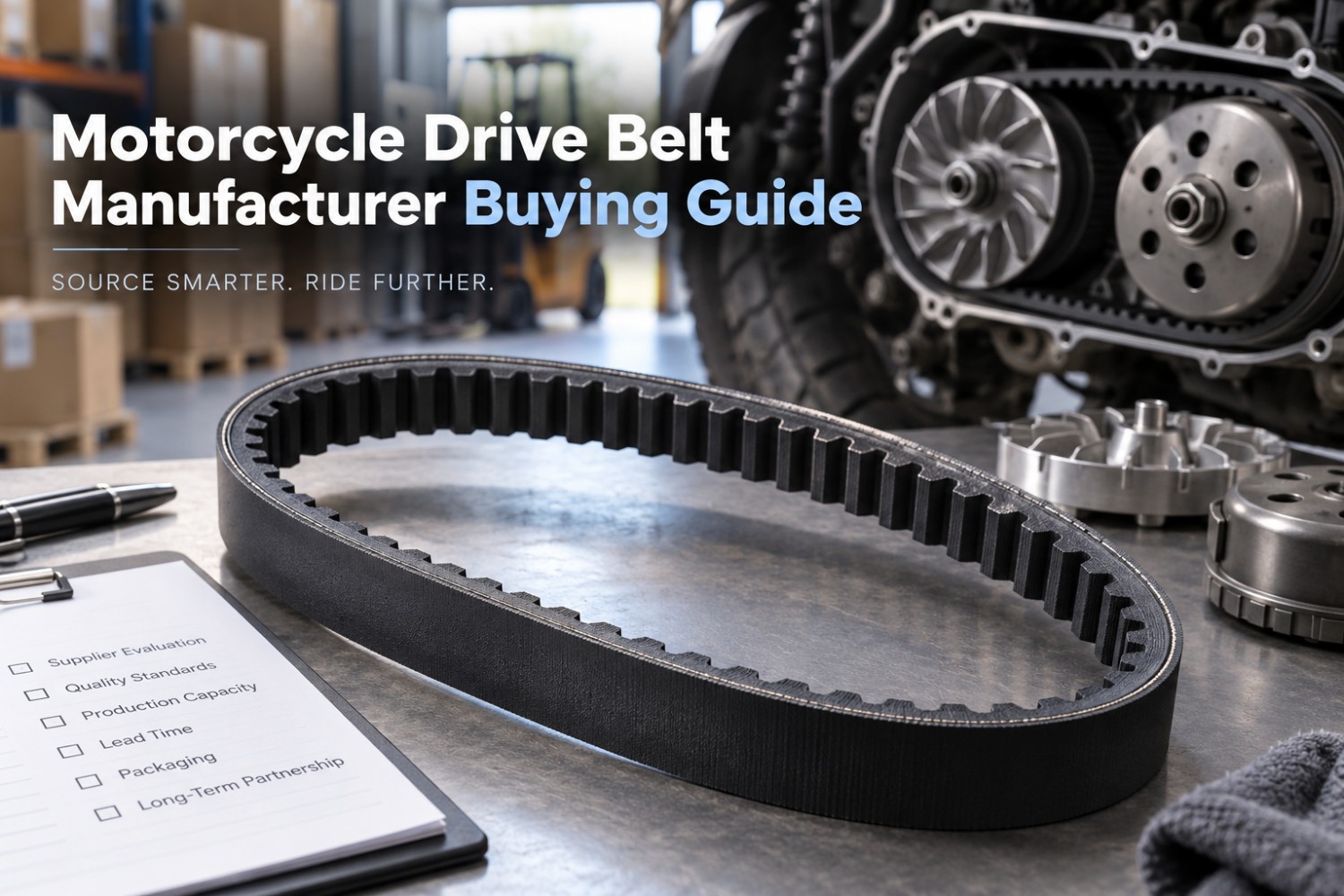

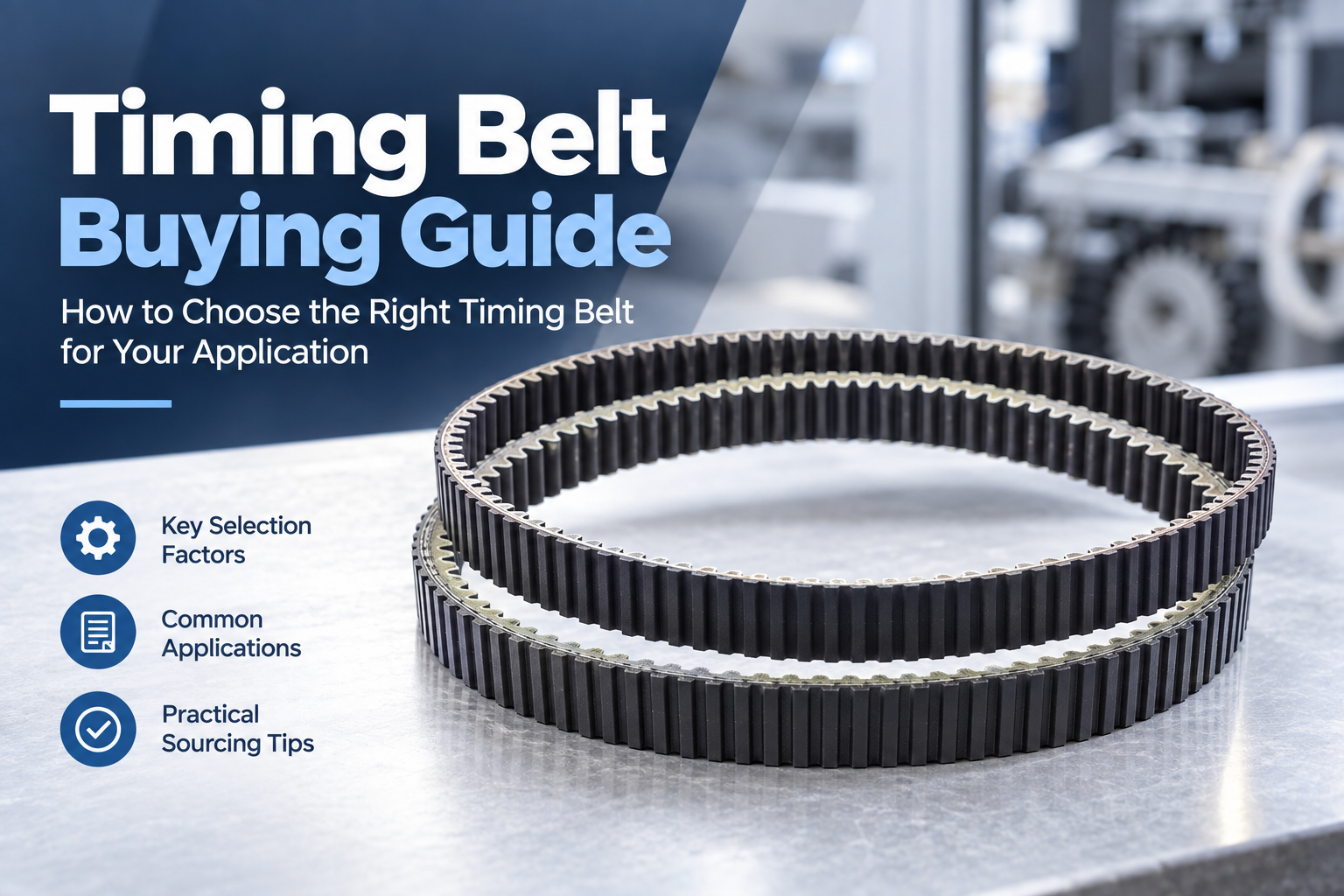
Ask any importer who has been burned once, and they will tell you the same story: a scooter CVT belt looked identical to the one they already sold, cost half of what they were paying, and inside one riding season the warranty claims ate the entire margin. We hear that story regularly at our plant, because Ningbo Sinoconve Belt Co., Ltd. (SINOCONVE) has built rubber belts since 1988, and much of our job is explaining why motorcycle drive belt sourcing fails, and how to make it stop failing. This guide is written for importers and dealers who want one dependable motorcycle drive belt manufacturer behind their catalog instead of a different trader every season.
Scooter and ATV CVT belts are high-turnover aftermarket items, and they punish guesswork harder than most parts. A belt that is a few millimeters off in width, a few degrees off in face angle, or a notch short on the cord package fails early, and the failure comes back to you as a refund, a lost account, and a damaged shelf reputation. Below we walk through the sourcing sequence that protects you: the risk map, the RFQ data pack, the supplier evidence checklist, the construction signals that separate long-life CVT belts from cheap ones, the size and part-number verification that stops wrong-fitment returns, sample and test procedures, private label and packaging, and the commercial terms that make a bulk import order workable for both sides.

We keep the tone practical on purpose. You are buying thousands of belts a year, not one; every check below is something our own engineers run before a rubber drive belt order ships from our floor. Use the tables as templates, adjust them for your market, and send them to any factory you are evaluating. A supplier that answers cleanly is worth a serious conversation. A supplier that dodges the list is telling you something before you spend a dollar.
01Where Aftermarket Drive Belt Sourcing Goes Wrong
The motorcycle aftermarket rewards good sourcing and punishes bad sourcing in the same currency: repeat orders or dead stock. CVT belts are consumables, which is exactly why they attract so many suppliers that should not be supplying them. Before you compare unit prices, compare the failure modes, because each one below has a different cost attached to it.
The first and most common failure is wrong fitment. A belt looks right in a photograph, but the top width is off by a millimeter or two, the face angle does not match the sheave, or the effective length sits outside the variator travel range. The belt slips, the scooter loses top speed, the dealer gets a return, and the return gets blamed on you.Fitment errors are the number one reason containers of CVT belts end up sitting unsold in a warehouse.
The second failure is premature wear on belts that did fit.The dimensions are correct, but the construction is not: the cord package is light, the compound lacks heat resistance, or the teeth are molded from a rubber that cannot survive constant flexing. The belt works for a few hundred kilometers, then sheds teeth or snaps. Customers do not diagnose the construction; they simply never buy that brand again.
The third failure is batch inconsistency. Your first order performed acceptably, so you reorder, and the second batch behaves differently because it came from a different subcontractor or a different compound lot. Dealers notice when a belt that used to last a season now lasts a month. Inconsistent quality is harder to detect than an outright defect, and it does more damage to your reputation over time.
Behind all three failures sits a structural problem: many sellers of motorcycle drive belts are traders, not factories. They buy from whichever plant offers the lowest price this month, so they cannot control compound consistency, they cannot show you production records, and they disappear when a defect claim arrives. A genuine motorcycle drive belt manufacturer, by contrast, controls the rubber from mixing through calendering to curing, keeps batch records, and can defend its product with data instead of promises.
There is also a quieter risk that importers rarely price in: specification drift inside your own catalog. As your SKU list grows, a part number that was cross-referenced once gets copied into new listings without verification.Before long you are selling a belt under a platform it was never built for.That is why this guide treats part-number mapping and physical measurement as a discipline, not a one-time task, and why we recommend you structure your supply so one factory owns the specification of each SKU.
02Prepare the Data Pack Before You Send a Single RFQ
Most RFQs that arrive at our plant are too thin. A buyer writes "need CVT belt for scooter 125cc" and expects the factory to guess the rest. A serious supplier will ask fifteen questions back, and that back-and-forth costs you days. Prepare the full data pack first, send it to every candidate factory at once, and you will compare their answers on the same footing. Speed and completeness of the reply also tells you something about the factory: a plant that answers a complete RFQ with more questions, within 24 hours, is engaged. A plant that quotes blind from a vague inquiry is pricing a lottery ticket.
The table below is the data list we ask importers to assemble. It applies whether you are sourcing scooter CVT belts, rubber drive belts for ATVs, or aftermarket replacements for the major scooter and ATV platforms in your market.
| Data item | Why the factory needs it | Example format |
|---|---|---|
| Vehicle platform and year | Narrows the CVT generation and sheave geometry | Scooter, 125 cc, 2018-2023 |
| OEM or stock part number | Starts the cross-reference; never the final word | Format example: 3211202 |
| Top width, measured | Confirms sheave seating; tolerances are tight | 19.8 mm across top land |
| Effective length or outside circumference | Sets variator travel and ratio range | Measured, not read from a label |
| Belt angle (included angle) | Must match sheave groove angle | Confirm against the service drawing |
| Tooth style and pitch | Cogged vs smooth; blocky tooth form vs trapezoid | Cogged, blocky profile as photo |
| Photos of old belt | Tooth wear, cord exposure, glaze tell a story | Top, side, cut-end, and tooth face |
| Target market and climate | Heat, humidity, and mileage patterns affect compound | Southeast Asia, tropical,daily commuter use |
| Annual volume and order rhythm | MOQ, mold availability, and price tier | 3 SKUs, 2,000 pcs/year each |
Two notes on that table. First, the part number is only a starting point. Numbers in the style of 3211202 are printed on OE belts for a specific platform, but aftermarket suppliers in different regions mark the same physical belt with different numbers, and some numbers are copied so widely that they no longer point at one true specification. Always confirm a part number against physical measurements of the belt you actually need. Second, the effective length must be measured the same way every time, because CVT belts are measured on the outside circumference under a defined tension in some systems and by a pitch or datum method in others. If your supplier measures one way and you measure another, every SKU in your catalog will be wrong by the same hidden amount.
03Qualify the Factory: Evidence to Demand Before the First PO
Once the RFQ data is complete, flip the process around. Now the supplier must prove capability.We recommend a written qualification pass before any money moves, because a factory audit on paper catches most of the traders and most of the weak plants before you waste a sample cycle. Ask for documents, ask for production photos with dates, ask for a live video call on the factory floor, and treat every answer as evidence to be verified rather than a promise to be trusted.
Below is the evidence checklist we hand to importers who visit or audit us, and that we ourselves use when we qualify raw material and cord suppliers. You can use it unchanged.
| Evidence to request | What a real factory can show | Red flag if missing |
|---|---|---|
| Business license and factory ownership | License matching the manufacturing address | Trading company fronting as plant |
| Production line photos and video | Mixing, calendering, slitting,molding lines in operation | Only stock catalog photos offered |
| Quality system certification | ISO 9001 certificate in the plant's legal name | Expired or name mismatch |
| Incoming material test records | Rubber batch and cord/fabric test data | Cannot name suppliers of cord or compound |
| Finished belt test reports | Dimension, tensile, adhesion,and aging data | "We test everything" with no report |
| Batch traceability system | Batch code maps to compound and cord lots | No batch marking on belts or boxes |
| Export history for your market | Customs records, past shipments, references | No verifiable export documents |
| Engineering response quality | Answers technical RFQ questions with specifics | Sales-only staff avoid technical detail |
Add one practical step that no document can replace: ask for a live look inside the plant on a video call. Walk the line with them. You want to see where rubber is mixed, whether cord and fabric reels carry lot tags, how belts are cured and trimmed, and whether the finished-goods area is organized. Housekeeping is a surprisingly honest signal. A plant that keeps its floor clean and its stock labeled usually runs its process with the same discipline.
We are, of course, describing our own operation when we write this.SINOCONVE has been a rubber belt factory since 1988, we hold ISO 9001 certification, and we can supply to DIN, ISO, RMA, and AS standards depending on the market. Around 200 employees run ten production lines, and the same compounding and calendering discipline that builds our conveyor belting feeds the transmission belt side of the plant. Invite a factory to show you its floor before you invite it into your supply chain.
04How a CVT Works, and What the Belt Has to Survive
You cannot judge a CVT belt supplier without understanding the drive the belt lives in. In a continuously variable transmission, two variable-diameter pulleys are joined by a single belt. Each pulley has a fixed flange and a movable flange; as the movable flange slides, the effective diameter the belt runs on changes. When the drive pulley closes, the belt rides higher and the driven pulley opens in response, so the ratio shifts continuously instead of stepping through gears. The engine stays near its power band while the belt constantly flexes, wedges into the sheaves, and transmits torque through the sides of the belt, not through teeth.
That last point matters more than buyers expect. The teeth you see on a CVT belt are not gear teeth; the belt transmits power by friction between its side faces and the pulley sheaves. The teeth exist to reduce bending stiffness and let the belt wrap the small pulley radii without generating excessive internal heat.So a cogged CVT belt and a smooth-faced belt are built for different flex and heat requirements, and swapping one for the other changes how the drive behaves.

A CVT belt survives a harder life than most parts on the vehicle. Every ride it is wedged into sheaves under high side loads, bent around the smallest pulley radius at engine speed, and heated by friction and proximity to the engine. That combination of flex, heat and side load is exactly what separates a belt engineered for the duty from a belt that merely looks similar. Four construction elements decide whether a belt earns its keep:
The cord package. The load-carrying cords run around the belt and take the tension as the belt transmits torque. Aramid-reinforced belts are common in this class because aramid delivers high strength with low stretch and good fatigue behavior in a hot, flexing environment; polyester and other cord systems appear in lighter duty designs. What you want from a supplier is a straight answer about cord type and cord count for each SKU, because cord package is the largest single driver of both price and service life.
The rubber compound. The compound must resist heat, hold the teeth, and grip the sheaves without glazing or squealing. Compound formulation is proprietary to each factory, but the discipline behind it is not: a real manufacturer specifies hardness and heat-related properties per SKU family and tests incoming rubber batches. If a supplier cannot name its polymer base or show a compound spec, treat the belt as an unknown chemical with a price tag.
The tooth design and reinforcement. Blocky, heavily reinforced teeth reduce bending stiffness and manage heat, as described above. Look at a cut tooth: the fiber reinforcement should be consistent, the rubber fill clean, and the tooth should show no voids where the tooth meets the body. The close-up view of a belt section tells an importer more about a factory's molds and cure control than a shelf of certificates.

The finish and the edges. CVT belts run with their sides against the sheaves, so the side finish is a working surface, not a cosmetic detail. Molding flash, rough transitions, or uneven tooth spacing create localized heating and slip.A factory that inspects finished belts for flash, dimension and appearance — and records the results per batch — is a factory you can build a catalog on.
05Size Verification, Part-Number Mapping and the Sample Round
Here is the reality of the aftermarket: your catalog maps part numbers to vehicles, and the physical belt behind each number has to be right in three dimensions that no number alone guarantees — top width, face angle, and effective length, plus the tooth style. That is why physical verification belongs in your process before the first bulk order and again whenever you add an SKU.

| Check | Tool | Pass criterion |
|---|---|---|
| Top width | Calliper across the top land, multiple points | Matches spec within the declared tolerance |
| Face angle | Angle gauge against the side face | Matches the sheave groove angle spec |
| Effective length | Measured under defined tension,same method each time | Repeatable within a few millimeters per SKU |
| Tooth style and count | Visual + count around the loop | Matches the approved reference sample |
Run this table on three samples from different batches if you can get them, then keep one measured sample and its photograph as your SKU reference. When the production shipment arrives, spot-check against that reference before the goods enter stock. The whole routine takes an hour per SKU and saves weeks of fitment returns over the life of the program.
Part-number mapping deserves its own rule: never copy a cross-reference from a competitor's listing without measuring the physical belt. The number on your old belt, the number in your catalog, and the number the factory prints may be three different things pointing at the same part — or at slightly different parts. Establish the physical specification first, then assign your own part numbers and keep the factory's batch code on the box so any future question can be traced to a specific production lot.
06Private Label, Packaging and Catalog Discipline
Most importers do not sell the factory's brand; they sell their own, and the belt is the smallest part of the brand you ship. A CVT belt program that arrives without branding discipline creates problems in three places: at the counter, where two identical-looking belts with different numbers start arguments; at the customs desk, where unclear marking can slow clearance; and at the warranty desk, where a belt with no traceable identity is a claim you pay twice. Treat branding and packaging as part of the engineering spec.
Marking. Decide exactly what appears on each belt and box: your brand, your part number, the vehicle application or platform code, the batch code, and any origin or safety markings your market requires. Approve the marking on a first article before mass production — a wrong mark on a cured belt cannot be fixed without scrapping the belt. Ask the factory to print batch codes that tie back to its records; that single line on the belt is what lets you investigate a field failure without guessing.
Packaging. Agree the retail pack, the master carton, and the sea-freight packing standard. CVT belts are flexible but not indestructible: they should ship laid flat or in formed packs that prevent kinking, with cartons strong enough to sit at the bottom of a mixed container.If your market sells through retail racks, specify the hanging or display format and verify it survives transit. Barcode data is agreed at the sample stage, not discovered on the first shipment.
Catalog discipline. Assign each physical specification exactly one part number in your catalog, and keep the factory's own identification in the background for traceability. When you add a platform, measure first and publish second. The importers who fail at CVT belts almost always fail here — not because they bought a bad belt once, but because they let their catalog drift until nobody knew which number meant which physical part.
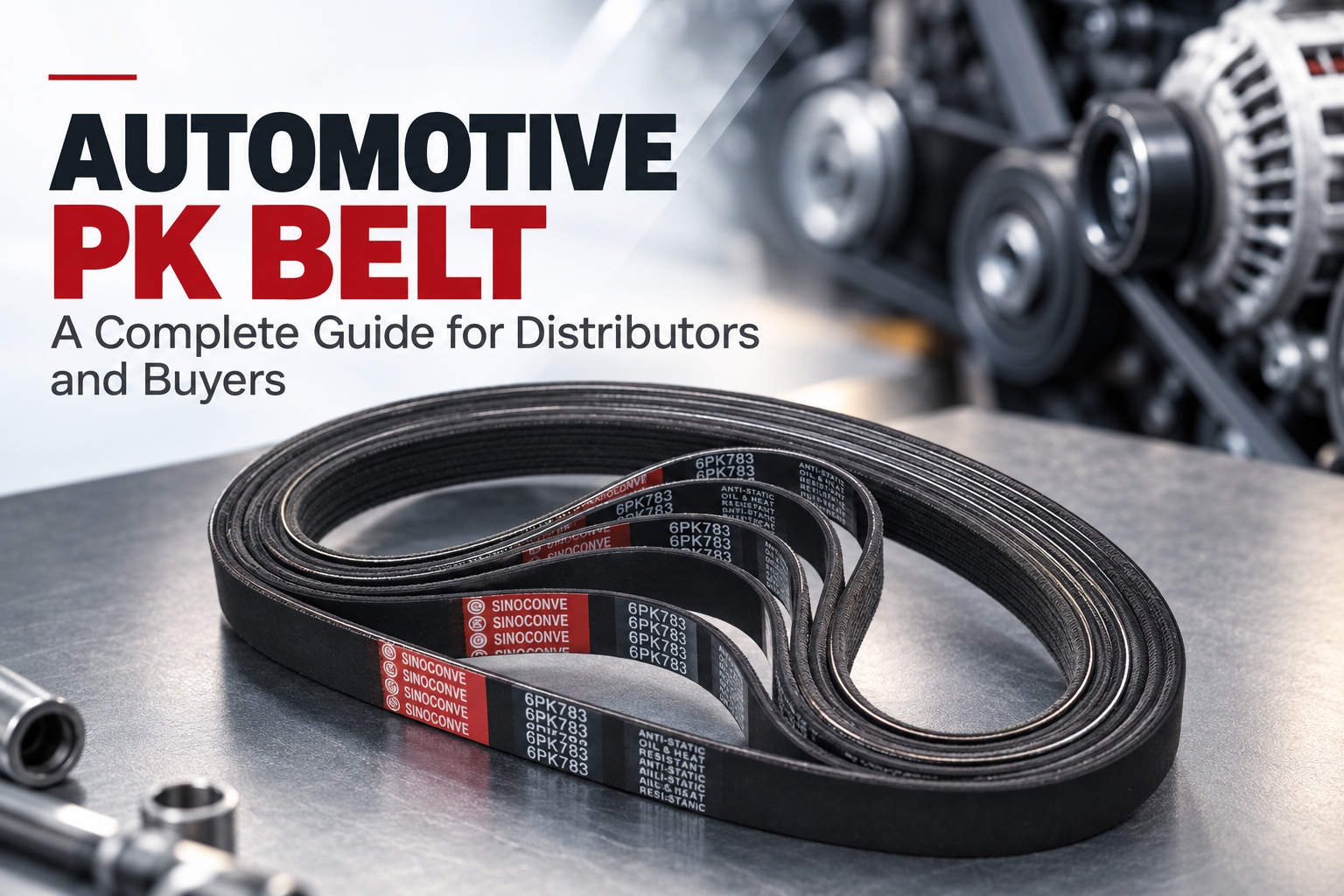
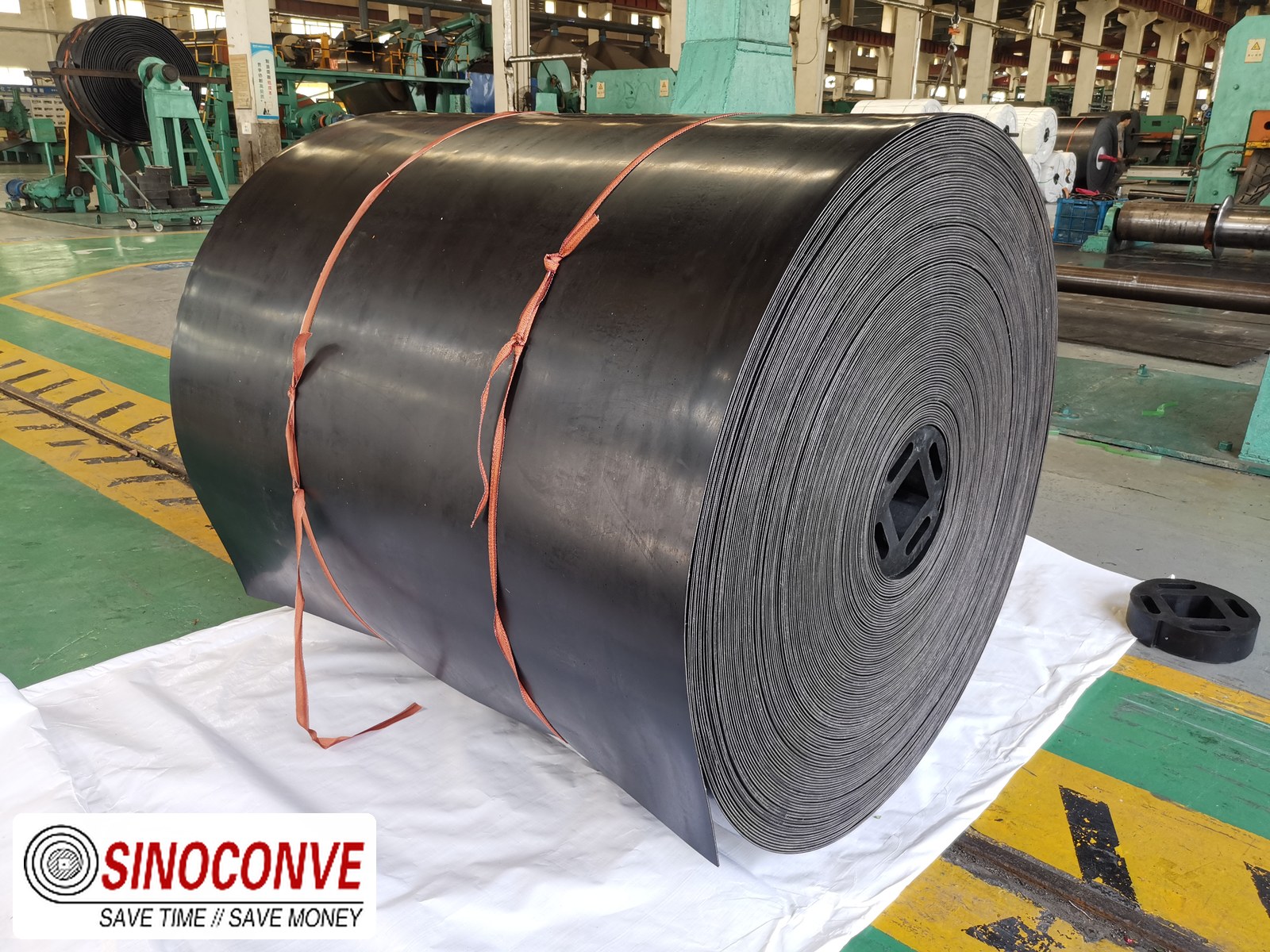
Behind every good brand sits a factory that can actually stand behind the product, and this is where the breadth of a manufacturer becomes a useful signal. The disciplines of compounding, calendering and curing that produce a dependable rubber drive belt are the same disciplines behind every belt we ship from this plant. SINOCONVE works as a conveyor belt manufacturer and conveyor belt supplier for mining, cement and port customers worldwide, builds industrial conveyor belt ranges for crushing plants, and runs a complete rubber conveyor belt program beside its V-belt and timing belt lines. As a transmission belt manufacturer and V-belt manufacturer and conveyor belt distributor for chevron profiles, we ship wholesale conveyor belts and transmission belts from one conveyor belt factory, which means the same laboratory and the same batch records back every product family. When you private label with us, the brand on the belt is supported by a factory with real cure capacity and real test data behind it.
07Bulk Import Terms: MOQ, Lead Time, Payment and Logistics
Motorcycle drive belts are an import business built on repeat cycles: a handful of SKUs, steady reorders, and margin made on reliability rather than on any single order. Structure the commercial terms so the relationship survives the first year, when volumes are still low and trust is still new.
| Term | Workable structure | Why it matters |
|---|---|---|
| MOQ | Per-SKU minimums with mixed-SKU order flexibility | Keeps a thin catalog profitable in year one |
| Lead time | Standard production lane plus express for stocked sizes | Avoids stock-outs on your top movers |
| Payment | T/T deposit before production,balance before shipment; L/C on large orders | Aligns cash flow with production milestones |
| Inspection | Pre-shipment inspection right against the approved samples | Catches batch drift before it is on the water |
| Incoterms & packing | Agreed Incoterm and sea-freight packing standard | Puts freight, duty and damage risk in the right hands |
| Claims | Defined claim path tied to batch records and photos | Turns disagreements into data reviews, not arguments |
Ask two extra questions before signing anything. First, samples: a genuine motorcycle drive belt manufacturer ships samples within days and stands behind the sample round with engineering support — the sample is where the technical relationship starts, so a supplier that hesitates on samples is signaling how the whole relationship will feel.Second, batch consistency: write into the terms that every shipment must match the approved reference sample in construction, dimension and marking, and keep your reference samples current as your range grows. Our own programs run on these structures — mixed-SKU orders, T/T with a standard deposit split or L/C for larger containers, roughly 30-day-class production lead times with express options for repeat sizes — and every number is confirmed against your actual SKU mix before it goes into a quotation. A volume promise without a production plan behind it is just a decoration on the email.
08Red Flags When Sourcing Motorcycle Drive Belts
Every importer eventually develops a sense for the difference between a factory and a middleman, but you should not have to learn it from a bad container. The signals below have been consistent across years of watching buyers get burned in this category, and they are worth memorizing.
"We can make any size" without a mold list. CVT belts are molded or ground to specific sizes; every SKU in a factory's range is tied to tooling or a cutting program. A seller that claims unlimited sizes with no mold list, no tooling discussion, and no minimums per size is almost certainly not making anything. Ask which sizes it actually produces in volume and watch whether the answer narrows as the conversation deepens.
Construction questions answered with "standard." A real manufacturer can name the cord type (aramid or other), the compound family, and the tooth construction for its main SKUs. When every technical question comes back as "standard belt" or a shrug emoji, the person on the other side does not know what is inside the product, and neither will you.
Part numbers confirmed too easily. The part-number chaos described in section 05 means honest suppliers verify cross-references against physical measurements. A seller that confirms every OE number in your list within an hour is confirming nothing — it is collecting orders. The supplier who says "that number needs verification against the belt" is the supplier doing the work.
Test reports that never arrive or never tie to a batch. Generic certificates without batch numbers are decoration. Ask for the report behind the specific batch you are buying and give the seller three days. If the report cannot materialize, neither can the quality.
Live factory video that keeps not happening. Any genuine plant can show you its line on a short video call. Excuses, rescheduling and "partner factory" offers are the polite forms of the truth. You do not need a two-week audit for a first order; you need ten minutes of honest video showing mixing, curing and finished goods.
Pricing that lives in another galaxy. Aramid-reinforced CVT belts have a real cost floor. When a quote sits far below comparable factories, the difference is being recovered somewhere — in cord package, compound quality, mold reuse, or the reorder.The cheapest belt in the market is usually the most expensive one to sell.
09Your Repeatable Importer Qualification Gate
Here is the whole guide condensed into ten pass/fail checks. Run them on every candidate before the first purchase order, and rerun them annually on your existing suppliers. Set a minimum pass count before price conversations begin, and keep the records so next year's review is a comparison, not a memory exercise.
- Factory floor verified by live video or visit — real production lines, not a trading desk.
- Business license and quality certificate in the plant's own name, current.
- Construction declared per SKU: cord type, compound family, tooth design.
- Physical specification measured and recorded per SKU: width, angle, length, tooth style.
- Part-number mapping verified against measurements, not copied from listings.
- Batch-level test reports tied to batch codes on belts and boxes.
- Reference samples kept and photographed for every approved SKU.
- Private label, marking, packaging and barcode locked at the sample stage.
- Commercial terms in writing: MOQ, lead time, payment, inspection, claims.
- Engineering response quality confirmed — technical questions get technical answers.
Run the gate before you run the price comparison, and you will find that the supplier worth keeping is rarely the cheapest and never the vaguest.Every check in this guide is one we run ourselves before a motorcycle drive belt order ships from our floor, and every table is a template you can adopt unchanged. When you are ready to test the process, send us the data pack from section 02 — we will answer it line by line, show you the batch records behind our belts, and give you a factory-direct reference point to measure every other quote against.
10From Gate to Pilot: How to Phase Your First Order
Passing the qualification gate earns a supplier a pilot, not a program. The most durable importer-supplier relationships we see start small on purpose, then scale on evidence. A pilot does three jobs at once: it proves the factory can actually deliver what the paperwork promised, it gives your market a chance to vote with repeat orders, and it builds the reference data you will use for every future decision.
Start with three to five SKUs. Choose the belt sizes behind your best-selling scooter and ATV platforms — the ones your dealers reorder weekly, not the slow movers you hope to create demand for. Keep the pilot small enough that a wrong decision costs a few hundred belts, not a container. Agree the pilot quantity, the sample schedule, and the measurement checkpoints in writing before production starts.
Lock the samples as the contract. Approve the pilot batch against your reference samples using the section 05 table, photograph everything, and keep the measurement record with the batch code. This is the moment when the spec becomes the relationship: from here on, every argument about a shipment is settled against the approved reference, not against memory or mood. Ask the factory to ship the pilot with the batch test report attached, and check that the report's batch code matches the boxes before you accept the goods.
Sell the pilot deliberately. Put the pilot SKUs into your best dealer accounts, not into the slowest channels, so you collect real feedback in weeks instead of seasons. Track three numbers from the start: sell-through rate, fitment complaints per hundred belts, and early failure claims. If fitment complaints appear, measure the returned belt against the reference — the answer will tell you whether the problem is your catalog mapping or the factory's batch. If claims stay near zero and reorders follow, you have earned the right to expand the range.
Scale on evidence, not on schedule. Expand SKU by SKU, platform by platform, keeping the reference-sample file and the scorecard current as the range grows. Most importers who fail at CVT belts fail not because their first order was bad but because they scaled a program that was never proven. A pilot that takes an extra month costs little; a container of wrong belts costs a season.When you are ready to run that pilot, send us your section 02 data pack and the SKU list — we will quote it cleanly, build the samples against your measurements, and let the evidence decide whether we earn the program.

FAQFrequently Asked Questions
Are scooter CVT belts the same as motorcycle drive belts?
In everyday trade language they are the same product family: the rubber belt that transfers power through a continuously variable transmission on scooters and many small-displacement motorcycles, as well as ATVs and snowmobiles in related sizes. What matters commercially is the physical specification — width, face angle, effective length and tooth style — plus the vehicle platform it is matched to. Always qualify by measurement, not by category name.
How do I know a CVT belt part number really fits my target vehicle?
Verify the physical belt against the platform: top width, included angle, effective length under a defined measurement method, and tooth style. Then confirm the cross-reference with the factory rather than trusting a copied listing.Part numbers in the style of 3211202 are platform-specific codes, but aftermarket sellers mark the same physical belt with different numbers, so measurement is the ground truth.
What is the difference between cogged and smooth CVT belts?
Cogged belts have molded teeth on the inside that reduce bending stiffness, letting the belt wrap small pulley radii with less internal heat — which is why most scooter CVT belts are cogged. Smooth-faced belts suit designs with different flex requirements. The belt transmits power through its side faces against the sheaves in both cases; choose the style the platform specifies and never substitute casually.
Why do some imported CVT belts fail after a few hundred kilometers?
Premature failure usually traces to construction, not to luck: a light cord package, a compound without enough heat resistance, or teeth that cannot survive constant flexing. The dimensions may be correct while the engineering is not. Batch-level test data and a reference-sample comparison are how you keep that failure mode out of your catalog before it reaches your customers.
What MOQ and lead time should an importer expect?
Expect per-SKU minimums with mixed-SKU flexibility on opening orders, standard production lead times around one month, and samples within days. Payment is commonly T/T with a deposit before production and the balance before shipment, or L/C on larger containers.Confirm every number in writing for your actual SKU mix, because mold status and order size change both price and schedule.
Can we build our own brand on a factory-direct CVT belt program?
Yes — private label is the normal model for importers and dealers. The factory prints your brand and part number on the belt, produces your retail packaging, and keeps batch codes for traceability. Lock the marking and packaging spec on a first article before mass production, and keep one reference sample per SKU so every reorder is measured against the approved standard.
Related Products You May Need
| V-Belt Wrapped and cogged V-belts for scooters, utility vehicles and machinery. |
Timing Belt Synchronous belts for engines and industrial precision drives. |
| Rubber Conveyor Belt Fabric conveyor belting from the same compounding and curing lines. |
EP Rubber Conveyor Belt EP carcass belts for heavy bulk handling applications. |
| Full Product Catalog Browse the complete SINOCONVE belt and roller range. |
Contact Us Send your bulk import inquiry for factory-direct terms. |
Related Blog Posts
- Car Transmission Belt Evolution: SINOCONVE 6PK1735
- Transmission Belt Guide: Choosing and Maintaining a V Belt
- V-Belt Buying Guide for OEMs and Distributors: Profiles, Lengths and Application
- Agricultural V-Belt Manufacturer for Harvesters and Farm Machinery Distributors
- OEM V-Belt Manufacturer for Industrial Equipment Brands
- How Importers Can Reduce Supply Risk When Choosing an Industrial Belt Supplier