
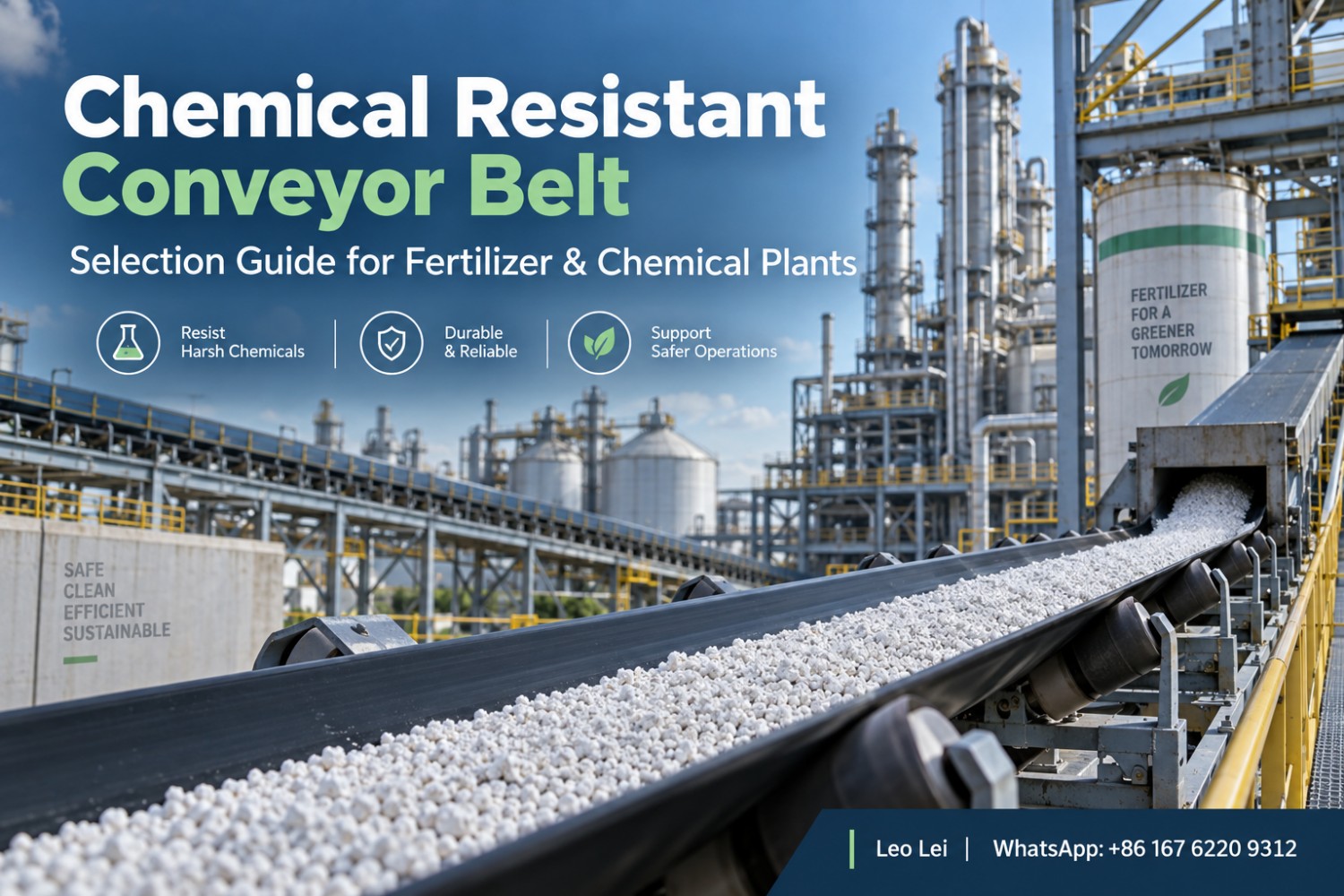
A 1,200 mm urea line, nitrogen plant on the coast. Two top covers gone in eleven weeks. Same belt supplier, same EP carcass, same nominal 4 mm cover as the line running beside it, which had been in service for two years. Nothing was wrong with either belt. The difference was 12 °C of residual product temperature and a wash-down hose that stayed open for twenty minutes at every shift change.
We have quoted a lot of fertiliser and chemical duty since the plant opened, and that pair of belts is the reason we ask so many questions before we send a price. The media name on its own does not pick a belt. Media, concentration, working temperature and cleaning practice pick the belt. The fourth item is the one buyers most often leave out of the RFQ.
This guide is the working document we use internally when a chemical plant or fertiliser plant sends us a new line. It gives you the compound selection matrix we start from, the failure mechanisms behind it, four fertiliser duty types we quote every month, and the carcass and splice decisions that follow. If you only read one part, read the matrix in section 02 and the information checklist in section 07. Those two pages cover about eighty percent of the mistakes we see.
One note on scope. We are a chemical resistant conveyor belt maker, not a rubber chemist working for a polymer house. When a duty falls outside what we can support with immersion data, we say so rather than guess. Where a recommendation in this article is a typical starting point rather than a tested result for your exact medium, we mark it that way. Always confirm against the actual duty, the drawing and a sample test on your product.

01Compound Selection Starts With the Media, Not the Belt
Most buyers open the conversation with a sentence like "we need a chemical resistant belt, 800 mm, 315 three ply." Fair enough. But the interesting decision, the one that decides whether you get eleven weeks or two years, is the cover polymer and the cure system behind it. A carcass can be described in a catalogue. A compound has to be matched.
Why the same acid behaves differently on two different lines
Take 30 percent sulfuric acid at ambient temperature. On a closed transfer with a clean, dry belt and no wash-down, a chloroprene or CSM cover will often run for years. Put the same acid on a belt at 65 °C with intermittent hose-down and a fine dust layer that keeps the surface wet, and the cover will swell, soften and start to delaminate inside twelve months. The chemistry did not change. The exposure did.
Three variables drive that difference. Concentration decides how aggressive the medium is at the rubber surface. Temperature decides how fast the medium diffuses into the polymer network, and diffusion is roughly exponential with temperature, not linear. Exposure pattern decides whether the medium is in contact for eight seconds or eight hours per cycle, and whether it is replenished. A belt that sees acid twenty-four hours a day needs a different compound from a belt that sees it for one hour at the end of a shift.
There is a fourth variable that surprises people: mechanical action. A cover that flexes over a 500 mm pulley with 1.5 m of material drop on it will crack far sooner than the same cover on a gentle run, because flexing opens the surface to fresh medium and pumps it into micro-cracks. In plants where acid and impact occur at the same transfer point, we treat the cover as a wear part with a chemical duty, not the other way round.
Temperature is the second axis, and often the deciding one
Ask a maintenance team for the product temperature and you will usually get the ambient figure. That is not the number we need. We need the temperature of the material as it lands on the belt, and the temperature of the belt surface during the hottest fifteen minutes of the day, which is often well above both. Urea leaving a prilling tower, ammonium nitrate after a dryer, and phosphate rock slurry after a mill all arrive warm, and warm plus wet is the combination that destroys covers.
As a rule of thumb we plan for continuous cover temperature, not peak. If the peak sits more than 15 °C above the continuous figure and lasts longer than a few minutes per hour, we step up a compound class. You can read more about how we handle the heat side of the same problem in our notes on heat resistant conveyor belt grades and in the cement clinker case study, where a heat resistant conveyor belt failed for a reason nobody had written down.
What we say to buyers who ask for "a chemical belt"
There is no such product. A conveyor belt manufacturer who offers you one compound for everything is either selling you a compromise or has not asked enough questions. What exists is a family of covers, each with a window: EPDM for oxidising agents and hot water, CSM for acids and hypochlorite, chloroprene for a broad middle ground with reasonable oil tolerance, NBR for fats and hydrocarbons, and PVC or PVC-NBR blends for lighter duties where cost matters more than temperature. Any conveyor belt supplier worth talking to will want the media list before quoting, because the compound choice is what we are actually being paid for.
On an industrial conveyor belt carrying fertiliser, the carcass matters too, but in a different way. The cover protects the carcass. Once acid reaches the fabric plies, the belt is finished, and no field repair brings it back. That is why we care as much about splice quality and edge condition as about the cover formulation.
02Chemical Class, Temperature and Concentration: The Selection Matrix
Below is the matrix we open when a duty sheet lands on the desk. Treat the cover column as the starting point for a quotation and the carcass column as a default; both are adjusted after we see concentration and temperature. Where we write "sample test," it means we would not commit to a life figure without running a piece of the actual cover in the actual medium first. That is not caution for its own sake. Rubber is not a pure polymer in service. Fillers, plasticisers, accelerators and cure residues all take part in the reaction, and two compounds with the same polymer name can behave differently.
| Medium | Typical duty (temperature / concentration) | Cover compound we start from | Carcass note | Main watch-out |
|---|---|---|---|---|
| Sulfuric acid, dilute | Ambient to 50 °C / up to 30% | CSM (chlorosulfonated polyethylene) or chloroprene | EP fabric, open-weave edge protection | Wet dust film keeps acid in contact far longer than the flow time |
| Sulfuric acid, concentrated | Ambient to 40 °C / above 70% | Sample test required; CSM often acceptable at low temperature | EP fabric, sealed edges | Concentrated acid dehydrates many rubbers and hardens the surface |
| Hydrochloric acid | Ambient to 55 °C / up to 33% | CSM or EPDM | EP fabric; avoid exposed steel cord ends | Vapour attacks the carcass at cut edges and at the splice line |
| Nitric acid, dilute | Ambient to 45 °C / up to 20% | CSM; sample test for anything warmer | EP fabric, heavy cover | Strong oxidiser; even short contact discolors and embrittles chloroprene |
| Urea (granular or prilled) | 40 to 80 °C, hygroscopic, mildly alkaline | EPDM for heat and moisture; SBR for cool, dry runs | EP fabric, heat-tolerant splice gum | Damp urea plus residual heat is the classic two-week cover eater |
| Ammonium nitrate (prills, granules) | Ambient to 60 °C, dry, dust-generating | SBR or chloroprene, antistatic formulation | EP fabric, conductive options available | Flame spread and static discharge, not chemical attack, dominate the specification |
| Phosphate rock slurry | Ambient to 60 °C, acidic, abrasive | SBR or chloroprene, thick cover | Heavy-duty EP, or steel cord on long high-tension runs | Abrasion removes cover faster than acid attacks it; do not over-specify the polymer and under-specify thickness |
| Potash, potassium chloride and sulfate | Ambient to 50 °C, saturated brine, hygroscopic | Nitrile or chloroprene | EP fabric, sealed edges | Brine migrates along plies; belt edges show the damage first |
| Caustic soda, sodium hydroxide | Ambient to 70 °C / up to 50% | EPDM or CSM | EP fabric; avoid polyester where hot alkali sits on the belt | Hot alkali hydrolyses polyester; ask the carcass question, not just the cover question |
| Sodium hypochlorite, bleach | Ambient to 45 °C / up to 15% active | CSM only; no natural rubber | EP fabric, PVdC-treated plies where available | Oxidiser plus humidity hardens the surface and cracks it at pulley radii |
| Solvents, aromatic and ketone | Ambient; splash and vapour rather than immersion | Nitrile (NBR) or PVC-NBR blend | EP fabric; mechanical fasteners rarely survive | Strong solvents extract plasticiser and the cover turns hard and shrink-wrapped |
| Animal and vegetable oils, fats | Ambient to 80 °C | Nitrile (NBR), medium to high acrylonitrile | EP fabric, oil-resistant splice gum | Check the splice gum as well as the cover; a cold bond that swells undoes a good cover |
| Kraft black liquor, pulp service | 60 to 95 °C, strongly alkaline | EPDM with a heat-stable cure system | EP fabric, heat-resistant plies; steel cord only if tension demands it | Hot alkali plus steam is the harshest combination in this table; specify to the continuous temperature |
| Ammonium sulfate, crystallising | Ambient to 55 °C, acidic salt | EPDM or CSM | EP fabric, smooth cover preferred | Crystals build up on the return strand and cut the cover from the inside |
| Phosphogypsum, wet cake | Ambient to 60 °C, acidic and abrasive | SBR or chloroprene, 6 to 8 mm cover | Heavy EP, wide belt with reinforced edges | Wet cake sticks to the cover and carries back; ploughs and cleaners must be specified together with the belt |
| Molten urea, urea solution | 70 to 100 °C in splash zones | EPDM on a heat-rated compound; sample test above 90 °C | EP fabric with heat-resistant treatment | Splashes cool and leave a sticky film that glues the belt to the pulley face |
Read the table as a filter, not an answer key. Two duties that look identical on paper will land in different rows once you know the concentration and the wash-down routine. If your medium is not listed, that is normal. There are hundreds of process streams in a fertiliser complex, and the matrix is built from the ones we see most.
03Failure Mechanisms and the Symptoms You Can See From the Walkway
Belts rarely fail without warning. They fail after a sequence of small changes that somebody noticed and nobody recorded. Learning to read the damage pattern tells you which mechanism is running, and the mechanism tells you which compound change will actually fix it.
We have pulled failed covers off fertiliser lines in four countries and the same handful of mechanisms comes up again and again. Here is how we label them, and what each one looks like from the walkway.
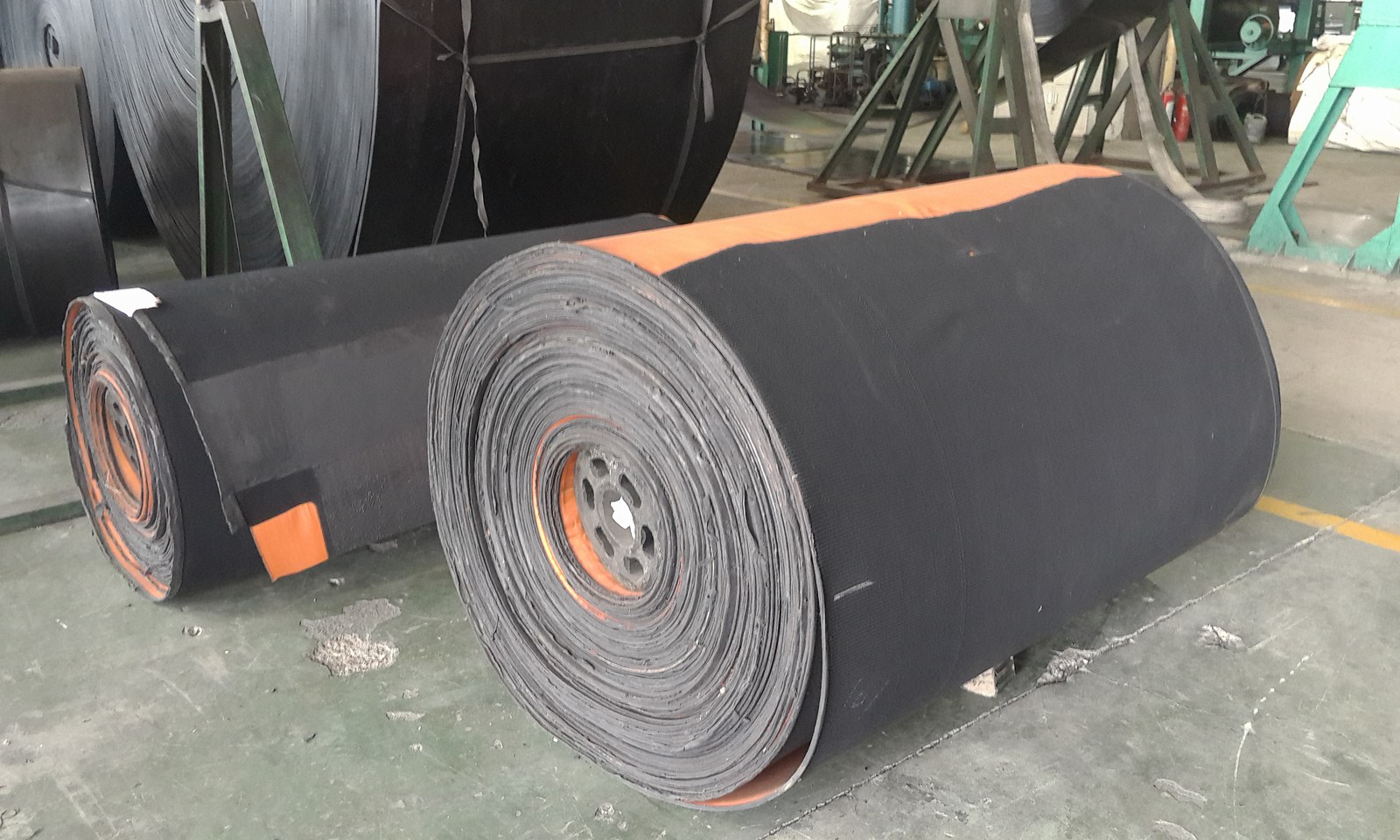
A finished roll waiting for dispatch. The cover is the part that has to survive the media; the carcass only has to stay dry.
Swelling and plasticiser extraction
Swelling is the easiest mechanism to see. The cover gains volume, the edges bulge, and the belt no longer fits its skirt clearances. In mild cases the belt still runs. In severe cases it rubs the structure, tracks badly, and the extra mass loads the drive. The mechanism is solvent or oil entering the polymer network and pushing the chains apart.
Plasticiser extraction is the mirror image, and it is the one that fools people. The medium pulls the plasticiser out of the compound instead of pushing into it. The cover loses volume, turns hard, and cracks. A maintenance team that sees a hard cover often reports "the rubber went brittle, so the belt was old." Usually the belt was not old. It was being extracted. Aromatic solvents, some ketones and aggressive hydrocarbon streams do this, and it is one reason an oil resistant conveyor belt specification has to name the solvent family rather than just the word "oil."
Hydrolysis, hardening and cracking
Hot alkali and hot water attack certain polymers and certain carcass yarns directly. Polyester is the classic victim: strong at ambient, but hot caustic soda or hot black liquor hydrolyses it, and the belt loses tensile strength while looking perfectly healthy from above. By the time the plies show, the belt is scrap.
Hardening shows up as a shiny, almost polished cover face with fine cracks at the point where the belt bends over the smallest pulley. It is a compound problem, not a thickness problem. Adding cover thickness does not help, because the crack initiates at the surface. We see it most on lines with intermittent high-temperature exposure and no cooling between them.
Delamination and ply separation
Delamination tells you the medium reached the ply-to-ply bond. It can start at a cut edge, at a splice, or through a crack that penetrates the cover. Once acid or hot condensate sits between plies, the bond layer degrades and the belt starts to open like a book.
Two practical notes here. First, edge damage is not cosmetic on a chemical belt; a nicked edge in a wet fertiliser plant is an entry point. Second, a splice that overheats or under-cures during vulcanising will delaminate even if the cover is perfect. We have opened belts where the cover was intact for 1,800 mm and the failure started eighteen months earlier at one splice.
| Mechanism | Typical media that drive it | What you see on site | Countermeasure |
|---|---|---|---|
| Swelling | Solvents, oils, some amines | Bulging edges, belt rubbing skirts, drive amps creeping up | Move to NBR or PVC-NBR; increase skirt clearance; control spillage |
| Plasticiser extraction | Aromatic solvents, chlorinated streams | Hard, glossy cover, shrinkage, fine surface crazing | Low-plasticiser compound; sample test before order; review vapour exposure |
| Acid hydrolysis of carcass | Hot alkali, hot black liquor, wet acid at the edges | Belt stretches, take-up runs out, cover still looks fine | Switch to hydrolysis-resistant carcass treatment; seal edges; stop the wet path |
| Oxidation and embrittlement | Nitric acid, hypochlorite, ozone near drives | Cracked cover at pulley radii, chalking, colour change | CSM cover; keep belts out of ozone zones; reduce peak temperature |
| Bond-line attack | Wet acid, brine, condensate | Ply separation starting at a splice or a cut edge | Hot-vulcanised splice with chemically matched gum; edge repair at first sign |
| Thermal-chemical synergy | Warm urea, warm ammonium sulfate, warm slurry | Cover softens, picks up material, wears in patches | Heat-rated compound plus cooling at the transfer; check the actual landing temperature |
| Abrasion masking chemistry | Phosphate rock, phosphogypsum, potash | Rapid cover loss in one local band, usually under the load point | Thicker cover and a better impact bed; do not chase it with a different polymer alone |
One habit that saves money: photograph the damage and write the belt's service hours next to the picture. Six months of those records will tell you more about your compound choice than any generic table, ours included.
04Four Fertiliser Plant Duties We Quote Every Month
A fertiliser complex is not one plant. It is a nitrogen train, a phosphate train and a blending line sitting inside the same fence, and each one loads a belt differently. These four duty types cover the bulk of our fertiliser enquiries, and they are the ones where we see the widest gap between what buyers ask for and what the line actually needs.
Urea: hygroscopic product plus residual heat
Urea leaves the process warm and it pulls moisture out of the air. Those two facts together create the worst case in this article: a damp, alkaline, warm film that sits on the cover and keeps reacting. On a dry, cool, well-enclosed urea transfer, an SBR cover with a good abrasion grade will give solid service at low cost. On an open line downstream of a prilling tower, with material arriving at 60 to 70 °C and humidity in the building, we move to an EPDM-based heat and moisture compound and we look harder at the splice gum than at the cover.
What we ask for on urea duties: landing temperature, not ambient; whether the belt is enclosed; how often the area is hosed down; and whether the same belt also carries product that has already absorbed water. That last question sounds odd until you have seen a return strand carrying a sticky urea paste.
Ammonium nitrate: the specification is about fire and static, not acid
Ammonium nitrate dust is a fire and explosion consideration, and it behaves very differently from urea. The belt spec here is driven by flame spread and static dissipation. We work to the standard set the site uses, whether that is a national fire-code requirement or an internal engineering standard, and we supply antistatic or flame-retardant covers where the risk assessment calls for them. Chemical resistance is a secondary requirement on most AN lines.
In practice that means the cover compound and the electrical properties have to be agreed together. Adding conductive black to a compound changes its cure behaviour and its physical properties, and adding a flame-retardant package usually costs some abrasion resistance. There is a trade-off, and it should be a decision on paper, not an accident.
Phosphate: wear and acid arriving together
Phosphate rock and phosphogypsum are abrasive, wet and acidic. Here the belt loses cover thickness at the load point long before any chemical swelling appears, so cover gauge and impact control matter more than polymer chemistry. We often start at 6 to 8 mm top cover on these lines and specify a heavier carcass for the tension. Adding an impact bed under the chute and improving the skirt rubber usually buys more life than upgrading the polymer.
Phosphogypsum brings a specific problem: wet cake sticks to the cover and travels back on the return strand, where it builds up on the return rollers. The result is a belt running over a lumpy, hard surface with uneven support. That is a mechanical failure waiting to happen, and no compound choice prevents it. Cleaners, ploughs and roller spacing have to be part of the same conversation.
Compound fertiliser (NPK): everything at once
NPK blending lines are where chemical duty and mechanical duty overlap most awkwardly. The product is a mix, so the media list is a mix, and the plant often runs several recipes on the same belt. Temperatures are usually moderate, but the material is hygroscopic, sometimes oily from a coating step, and abrasive from the granules.
Our default for NPK is a chloroprene or NBR-based cover with a decent abrasion grade, sized to the worst recipe rather than the average one. If the line also applies a coating oil or a release agent, the oil tolerance becomes the binding constraint, and that is when we say plainly that the belt should be specified as an rubber conveyor belt with a nitrile cover rather than a general-purpose chemical grade. Nitrile costs more. It also stops the cover from turning to a hard shell in fourteen months.
| Duty type | Cover direction | Carcass | Splice | Specification priority |
|---|---|---|---|---|
| Urea, warm and open | EPDM, heat and moisture rated | EP fabric with heat-resistant treatment | Hot vulcanised, matched gum | Continuous temperature and moisture control |
| Urea, cool and enclosed | SBR, abrasion grade | EP fabric, standard | Hot vulcanised or cold bond | Cover wear life against cost |
| Ammonium nitrate | SBR or chloroprene, flame-retardant, antistatic | EP fabric, conductive option | Hot vulcanised; conductive continuity checked | Fire and static per site standard |
| Phosphate rock and gypsum | SBR or chloroprene, 6 to 8 mm top cover | Heavy EP; steel cord on long high-tension runs | Hot vulcanised for tension; cold bond for repairs | Abrasion and impact first, acid second |
| NPK blending | Chloroprene or NBR, oil-tolerant if coated | EP fabric, abrasion-rated covers both sides | Hot vulcanised where oil is present | Worst recipe, not average recipe |
If your plant runs two of these duties on one belt, tell us. Belt specifications that try to cover a urea train and a phosphate chute at once usually end up mediocre at both jobs, and a split of the transfer into two belts is often cheaper over five years than one over-specified compromise.
05Carcass and Joint Decisions Under Chemical Exposure
The cover gets all the attention in a chemical specification. The carcass and the splice decide whether the belt survives a second year. We have seen a first-class CSM cover written off because the splice opened and acid walked into the plies in a single wet weekend.
Fabric core or steel cord
Fabric carcasses (EP, or polyester warp with polyamide weft) dominate chemical and fertiliser duties. They flex easily, they tolerate small pulley diameters, they track predictably, and they can be spliced on site with portable equipment. For belts up to roughly ST 3150 class tension on a long overland run, we still look at fabric first unless the tension calculation says otherwise.
Steel cord enters the picture when the required tensile strength climbs past what a practical fabric belt can offer, typically on long single-flight conveyors from a mine or a port to the plant. It is not a chemical advantage. In fact a steel cord belt has one extra vulnerability: any moisture that reaches the cords through a damaged cover or an open splice corrodes them, and corroded cords lose strength where you cannot see it. If a steel cord belt has to work in a wet acidic environment, edge protection and splice integrity stop being maintenance items and become the whole specification.
One carcass detail that is often overlooked: the treatment of the fabric itself. Where hot alkali or hot wet acid is in contact with the belt edges, a hydrolysis-resistant carcass treatment is worth discussing. This is the point where the choice stops being about polymer brand names and starts being about how the whole belt is built, which is why we would rather be asked as a steel cord conveyor belt and fabric belt maker than as a compound shop.
Cold bond or hot vulcanised splice
This is the decision where chemical plants and quarry plants diverge most. In a quarry, a well-executed cold-bond splice with a two-component adhesive is fast, needs no power and can be done at night. In a fertiliser plant, the adhesive itself may be the weak link. Many cold-bond systems are built on a solvent or waterborne chemistry that swells or softens when it meets the same media that attacks the cover.
A hot-vulcanised splice cures rubber to rubber. The splice gum can be chosen to match the cover compound, so the joint has roughly the same chemical resistance as the belt body. It takes longer, needs a press, and needs clean dry conditions in the splice area. On acid, alkali, oil and warm wet duties, we recommend it by default, and we would say the same to anyone sourcing a conveyor roller or belt from another supplier.
Two field points. Step the splice correctly for the ply count; a three-ply belt with a two-step splice will fail at the joint long before the cover wears out. And keep the splice dry during cure. We have rejected splices where rain got into the joint overnight, because that joint will delaminate in service even if it passes a pull test on the day.
| Joint type | Chemical resistance of the joint | Temperature capability | Where it fits |
|---|---|---|---|
| Hot vulcanised, matched gum | Matches the cover compound | Up to the belt's rated temperature | Acid, alkali, oil and warm wet duties; our default for chemical plants |
| Cold bond, solvent-based adhesive | Depends on the adhesive, often the weak point | Typically limited to moderate temperature | Dry, cool, unbranded duties; emergency repairs where the belt will be replaced soon |
| Cold bond, two-component system | Better than solvent adhesive, still below a vulcanised joint | Moderate | Repairs and short belts where a press cannot be moved in |
| Mechanical fastener | Metal corrodes; no chemical protection at all | Limited by the belt cover in the fastener zone | Temporary runs and mobile equipment only; avoid on acid lines |
| Finger splice, vulcanised | Good, and it spreads load over a shorter length | Same as step splice | Thin belts, straight-run high-tension duties, enclosed transfer points |
06Cover Grade, Thickness and the Standards Worth Writing Into the RFQ
Once the polymer family is settled, the RFQ still needs numbers. The three that matter most are top cover thickness, the abrasion grade of the compound, and the standard the belt is being supplied to. Get those wrong and the perfect polymer will not save you.
Thickness is a wear allowance, not a chemical shield
A thicker cover does not slow chemical attack in any meaningful way. What it does is buy time before the carcass is exposed, both for abrasion and for the slow surface loss a chemical duty causes. On hard rock, gypsum and phosphate work we commonly start at 6 to 8 mm top cover. On clean granular urea in an enclosed gallery, 3 to 4 mm is often enough and a heavier cover just costs money and adds weight.
One exception is worth remembering. Where a belt sees both impact and chemical exposure, the cover under the load point can be worn through in a narrow band while the rest of the belt looks new. That is a case for a thicker cover plus a better impact bed, or for a belt with a reinforced centre, rather than for a more expensive polymer.
Standards: what to quote and what they do not cover
We supply belts to DIN 22102, ISO, RMA, AS 1332, BS and SANS type requirements, and the RFQ should name the one the site works to. Be aware of what a general standard actually guarantees. It sets dimensions, tensile class, adhesion values and cover grades. It does not certify that a compound will survive your medium. Chemical resistance is established by immersion or exposure testing on the specific product, at the specific concentration and temperature you run, and by service experience.
That difference matters commercially. If a specification sheet says "chemical resistant" with no medium named, it is not a technical claim, it is a description. This is exactly the point we make in our buyers' notes on heat resistant conveyor belt verification, where a similar gap between a grade name and a real duty causes most of the disputes.
The fields we want filled in, in order of importance
Top of the list: medium, concentration, continuous temperature and contact pattern. Then belt width, troughing angle, capacity in tonnes per hour, centre distance, pulley diameters and take-up travel. Then the environment: indoor or outdoor, UV exposure, ambient temperature range, wash-down frequency and whether steam cleaning is used. Last, the commercial frame: required length, whether the order is a one-off or a repeat, and the delivery date.
When a buyer sends all of that, we can quote a compound with reasons attached. When the enquiry says "chemical belt, as per attached drawing," we have to ask, and each question adds a day. Comparing quotations without those fields also gets difficult, because a cheaper belt often just means a thinner cover or a lower-grade compound, and neither shows up on the drawing.
07What We Ask Before We Quote: The Media Information Checklist
This is the checklist our own sales engineers complete before a chemical or fertiliser belt goes into quotation. It is short on purpose. Every item on it has cost us or a customer money at some point, usually because it was missing.
| # | Item | Why it changes the belt | What a weak answer costs |
|---|---|---|---|
| 1 | Medium or media list, including any cleaning chemicals | Selects the polymer family | Wrong compound; cover life cut by half or more |
| 2 | Concentration, including worst case during upset | Decides whether the duty is mild, moderate or aggressive | Under-specified cover; failure inside the first year |
| 3 | Continuous product temperature at the belt surface | Drives the cure system and the heat rating | Premature hardening and cracking at the pulleys |
| 4 | Contact pattern: continuous, intermittent, splash, vapour only | Sets the exposure dose per shift | A belt sized for splash that actually sees immersion |
| 5 | Wash-down and steam cleaning frequency and duration | Adds hot water, steam and cleaning chemistry to the duty | The single most common cause of early urea belt failure |
| 6 | Ambient temperature range and UV exposure | Affects cover ageing and splice gum choice | Surface chalking and cracking on outdoor galleries |
| 7 | Oil, grease or coating presence | Moves the cover to NBR and the splice to hot vulcanised | Swelling, hardening, splice failure |
| 8 | Fire and static requirements | Flame-retardant and antistatic formulations trade off against abrasion | Non-compliance with a site standard on an ammonium nitrate line |
| 9 | Abrasion and impact duty at the load point | Sets cover thickness and carcass class | Localised cover loss under the chute in a few months |
| 10 | Any previous belt failure record with photos | Tells us what actually killed the last belt | Repeating the same mistake with a more expensive compound |
Ninety percent of the enquiries that stall are missing items 3, 4 or 5. Documentation for a medium is also worth more than a verbal description: a safety data sheet, a process flow line reference, or a sample of the wet material all help. Where a wholesale conveyor belts catalogue gives a temperature band of minus 30 to plus 80 °C for a whole product range, that band is a compound family limit, not an operating instruction for your line.
08Heat, Oil and Acid Belts: Where Each One Fits on a Chemical Line
Buyers sometimes treat heat resistance, oil resistance and chemical resistance as three boxes on a form. On a fertiliser line they interact, and the interaction decides which one leads. Getting the order of priority right at the enquiry stage is worth more than any single upgrade later.
When heat leads
If the product lands above 80 °C, the heat duty leads and the chemical duty has to fit inside it. Most of the polymers that shrug off acids at ambient temperature are less comfortable at 100 °C, and cure systems that hold up in hot service are not always the ones with the best acid resistance. On clinker, sinter and hot urea duties we choose the heat side first, then confirm the chemical exposure is inside the window of that compound. Our heat resistant conveyor belt range is built along those lines, with cover grades matched to the continuous temperature rather than to the peak.
When oil leads
Any duty with a coating oil, a release agent, a gearbox leak above the belt or a lubricant mist will push you toward nitrile. An oil resistant conveyor belt in a chemical plant is usually specified for a mixed duty: fertiliser granules plus a coating, or a product line that also carries oily scrap. Where oil is the main threat, NBR leads. Where acid is the main threat and oil is a nuisance, chloroprene is often the better compromise, because it handles moderate oil and gives useful acid resistance at the same time.
When acid leads, and what it does to the other two
On wet phosphoric, sulfuric and hydrochloric duties, acid leads and everything else follows. Here we set the compound from the acid duty, then check the temperature rating and the oil exposure are acceptable. A belt specified as a conveyor belt for chemical products and fertilizer should carry three clear numbers on its data sheet: the polymer family, the continuous temperature, and the media it was chosen for. If a data sheet has the first two and not the third, ask why.
One more naming point, because it causes real mix-ups in stores. On a fertiliser conveyor belt line item we expect to see the intended media written next to the grade, not just a compound code. The acid and alkali resistant conveyor belt on a phosphoric transfer and the belt running in a dry urea gallery may look identical on a pallet, but their covers behave nothing alike, and a swap during a shutdown will not be noticed until the covers start to swell three months later. Write the duty on the line, not just the part number.
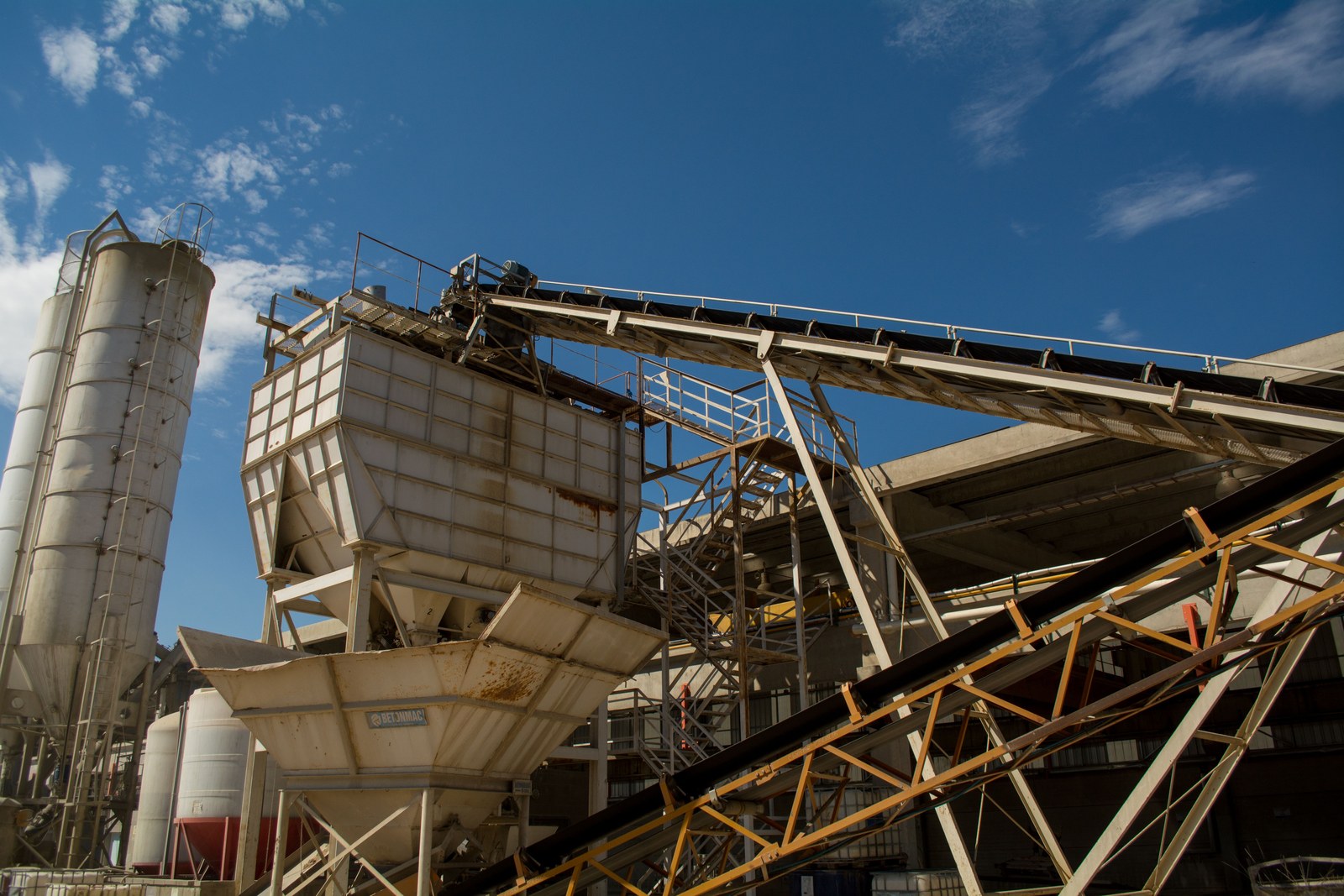
In a fertiliser complex the belt rarely sees one clean medium. Dust, condensate and wash water all reach the cover.
There is a practical test for the priority question. Write down which failure you would accept on the maintenance schedule: a cover worn thin in eighteen months, a cover swollen and rubbing its skirts, or a splice that opens. Whichever one you refuse to accept tells you which requirement has to lead. In our experience most fertiliser plants will accept wear. They will not accept a splice that opens on a line feeding a prilling tower, because the clean-up cost dwarfs the price difference between a standard belt and the right one.
09Cleaning, Steam and Wash-Down: Where Chemical Belts Die Early
Cleaning practice is the most under-specified part of every chemical belt enquiry we receive, and it is responsible for a large share of the early failures we are asked to investigate. A hose is not a neutral object. Neither is a steam lance.
Think about the mechanics. Wash water carries dissolved product into the same micro-cracks that flexing opens. Steam raises the surface temperature sharply and repeatedly, which accelerates diffusion of whatever is dissolved in that water. Cleaning chemistry, usually a caustic or a mild acid, adds a third medium to the list. And if the belt is cleaned while still hot, all three effects happen faster.
What we recommend on wet-process lines
Let the belt cool before wash-down where the process allows it. Ten minutes of cooling makes more difference than a compound upgrade on many lines. Avoid directing a high-pressure jet at the splice; that is the most common way to open a joint that was fine. Use the cleaning chemistry the compound can tolerate and include it in the media list. Where a caustic wash is routine, the carcass question comes back into play, because hot caustic plus polyester is a poor combination.
For enclosed urea and NPK galleries, mechanical cleaning often works better than wet cleaning. A well-set primary cleaner, a secondary cleaner and correct plough positioning on the return strand will remove most of the carryback, and the belt stays dry. Dry dust is a nuisance. Wet, warm, alkaline paste on a moving belt is a slow chemical attack, and it runs for three shifts a day.
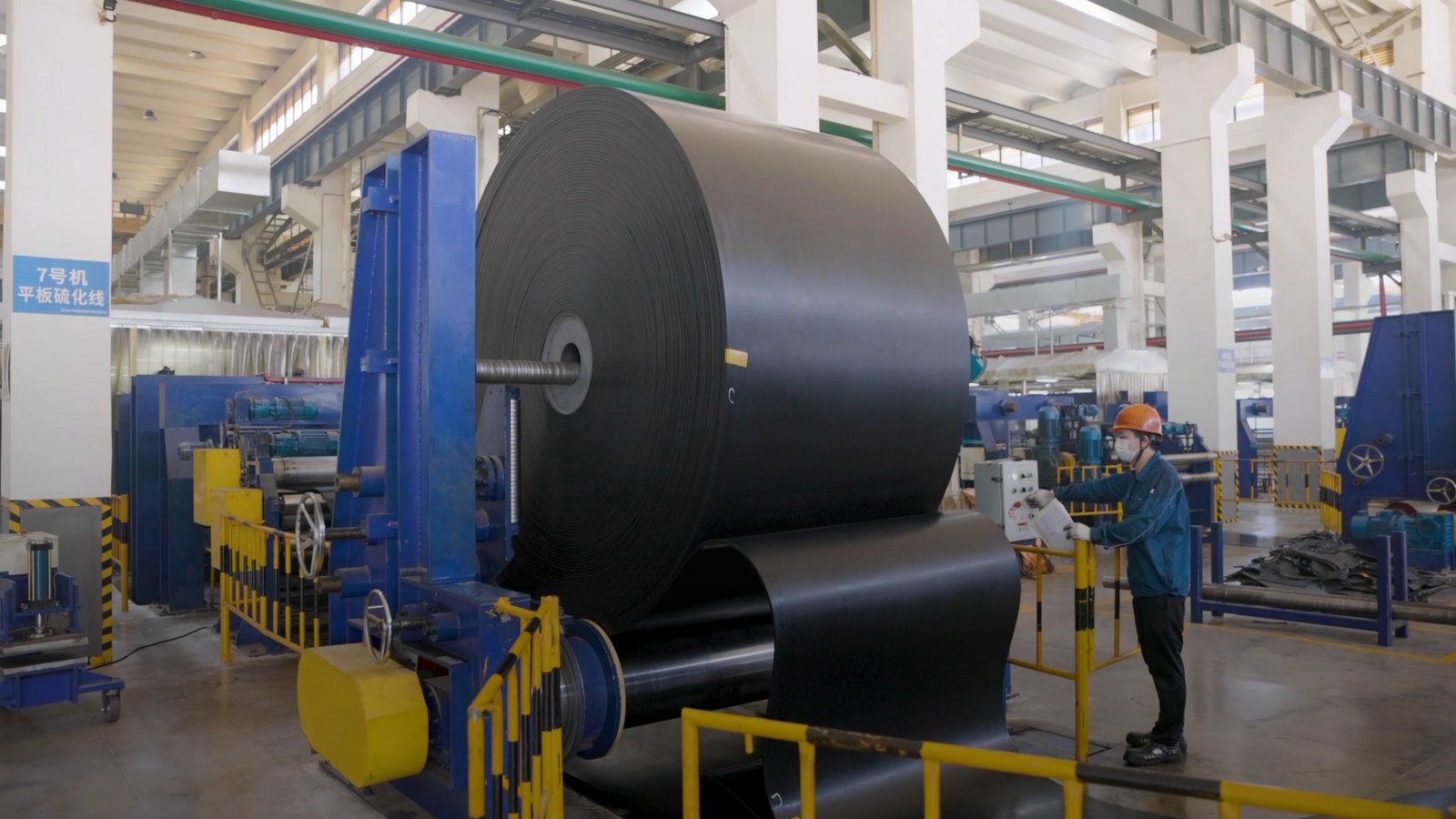
Curing on the press. The compound's acid and alkali resistance is set here, long before anyone measures cover wear on site.
Skirt rubber, chute liners and the belt next to the belt
One thing we notice on site visits: the belt is often blamed for damage done by its surroundings. Oversized skirt gaps, a chute liner that rubbed through, a worn plough blade digging into the cover, or a seized return roller grinding a flat spot. Each of these creates a local defect that then becomes the entry point for the medium. A chemical cover cannot protect a belt from a piece of steel leaning on it. Fixing the structure is cheaper than upgrading the compound, and it usually lasts longer.
10Installation, Tracking and Take-Up in a Corrosive Plant
Fitting a belt into a fertiliser or chemical plant is different from fitting one into a quarry, for three reasons. The structure is often congested, the environment is wet, and a stoppage costs more because the plant is usually running a continuous process.
Before the belt goes in
Check the pulleys for flat spots and the lagging for hardening; a hard, glazed lagging will slip and generate heat at the drive pulley, which is bad news on a heat-rated compound. Check the skirt clearance along the full length, not just at the midpoint. Measure the take-up travel available and record it before the new belt is fitted, because you will want that number in six months.
Cleanliness at the splice area is not optional on a chemical line. We ask for a dry, covered space, and we ask for the surrounding steelwork to be clean so that rust flakes do not end up in the joint. A conveyor belt distributor carrying out an installation on our belt should be following the same rules; if a site does its own splicing, we send the step pattern and the cure schedule rather than leaving it to be guessed.
Tracking, and why the first week matters
Run the belt empty for a few hours before loading it. Then run it loaded at reduced rate and watch the edges for the first two days. Chemical belts often track differently from the belt they replaced because the cover compound has different friction characteristics, and a belt that swells slightly over its first weeks will change its tracking behaviour again. Setting the training idlers once and walking away is how belt edges get chewed in the first month.
Take-up is the other number to watch. If the take-up has travelled more than a third of its available stroke within the first three months, something is wrong. The usual causes are a splice that has begun to creep, or a carcass damage path that is letting the belt stretch. Both are worth investigating at once on a chemical duty, because a creeping splice in an acid environment rarely stays a splice problem for long.
Drive and transmission side of the line
The conveyor is not the only rubber product in a fertiliser plant that suffers. Drives on crushers, blowers, pumps and compressors work in the same humid, dusty, chemically loaded air. When a plant asks us to look at a conveyor problem, we often end up looking at the drive too, since it is the same buyer, the same site and usually the same maintenance team. As a transmission belt manufacturer as well as a conveyor supplier, we can review both, and if the site needs a broader supply base, most plants keep a stock of drive belts alongside their conveyor spares.
11Cost, MOQ, Lead Time and Sampling Reality
Technical selection and commercial reality have to be settled together, because the best compound in the world is useless if the delivery date does not fit the shutdown. Here is how we actually work, with the caveats stated rather than buried.
Order quantities and lead times
For conveyor belting we work from around 50 m per type, size and specification. For V-belts the entry point is higher in piece count, typically 30 to 50 pieces, because that is where a run becomes economical. Standard lead time is about 30 days, with a fast-track route at 15 to 20 days for urgent shutdown work. Samples take 2 to 5 days depending on whether the compound is one we run regularly or a formulation we need to prepare.
Payment terms are T/T with 30 percent deposit and the balance before shipment, or L/C. We support OEM and ODM work, logo printing, and custom width, thickness and colour where the volume justifies it. None of that is unusual in this sector; what matters is that a conveyor belt factory states its lead time at the enquiry stage rather than after the order, and that it does not promise a compound it has never run.
Sample testing: what it is and what it is not
When the medium is aggressive or unusual, we would rather test than argue. A sample test means we take the candidate cover compound, expose it to your medium at your concentration and temperature for a defined period, and report what we measured: mass change, volume change, hardness change and a visual assessment. It is not a lifetime prediction and we do not present it as one. It does tell you whether a compound is clearly unsuitable, which is often the most valuable answer at the enquiry stage.
Two limits on this. First, sample testing takes time, so it has to start early in the project, not on the week the shutdown is planned. Second, immersion results at a single temperature do not extrapolate neatly to a belt that sees splash and heat cycles; that is why we combine test output with service experience from comparable duties. Where a plant already has a belt that lasted well, that track record is worth more than any laboratory result, and we will ask for it. It is also why we keep our own installation records, and why we are careful with drive-side claims in the same plant. We build conveyor belts, and we also build drive belts as a V-belt manufacturer, so a site can bring both conversations to one place.
12Mistakes We See in Compound Selection
Twelve years of quotations on chemical and fertiliser duties has produced a short list of repeated errors. None of them is exotic. All of them are expensive.
Asking for the same belt as the neighbour's line
Copying a nearby plant's specification works when the process is the same. It fails when the medium, the temperature or the cleaning routine differs, and those differences are rarely written in a tender document. We have quoted two urea lines on the same site that needed different covers because one was upstream of a cooler and one was not.
Buying the polymer and ignoring the carcass
A CSM cover over a polyester carcass on a hot caustic duty is an expensive mistake. The cover will do its job while the yarn quietly hydrolyses. Ask the carcass question in the same message as the cover question.
Specifying temperature from the process diagram
Process diagrams show setpoints. Belts see reality: a material temperature that drifts upward when throughput rises, a hot summer gallery, a stuck cooler. Add a margin, and ask the operations team for the highest temperature they have seen rather than the design figure.
Treating wash-down as a maintenance detail
It is a process variable. Put the frequency, the water temperature and the cleaning chemistry into the belt specification. If the plant is planning to increase cleaning for hygiene or environmental reasons, that plan belongs in the same conversation as the compound choice.
Choosing the cheapest splice to save a shift
The price difference between a cold bond and a hot vulcanised splice is small against the cost of one unplanned stoppage on a continuous line. On acid, alkali and oil duties, hot vulcanising is the option that matches the belt's own resistance. Saving eight hours at installation to lose a week in service is not a saving.
Never recording what failed
If nobody writes down which belt failed, where and after how many hours, the next order repeats the same choice. A simple register with belt reference, installation date, run hours, failure mode and photographs turns compound selection from guesswork into engineering. We ask every chemical plant we work with to keep one, and we will help set it up.

13FAQ: Compound Selection for Fertiliser and Chemical Belts
Can one belt handle both acid and oil duty?
Sometimes, but with a caveat worth understanding. Chloroprene handles moderate oil and gives useful resistance to dilute acids at moderate temperature, so it is the usual compromise when both are present at low intensity. If either one is severe, the compromise stops working. A strong aromatic solvent plus hot acid will defeat any single cover we can offer, and the honest answer is to split the duty, change the process, or accept a short cover life and plan for replacement. We would rather tell you that at the enquiry stage than ship a belt that fails.
What temperature should I quote for a urea belt?
Give us the product temperature at the point where it lands on the belt, and the belt surface temperature during the hottest part of the day. Do not give the design setpoint from the process diagram, and do not give the ambient figure from the building. If you cannot measure it, give the highest figure operations has seen in the last twelve months and tell us it is an estimate. We will add our own margin on top, because a covered gallery in summer with a hot product inside can run well above what anyone expects from the room temperature.
Is a thicker cover enough protection on a phosphate line?
Thickness helps with abrasion, not with chemistry. On phosphogypsum and rock slurry duties the cover usually disappears because of mechanical wear under the load point, so 6 to 8 mm of top cover plus an impact bed is a sensible answer. It will not stop acid from reacting with the surface. If the acid duty matters on your line, specify the compound for the medium and use thickness to buy service life against wear. Two separate decisions, made for two separate reasons.
Do I need a hot-vulcanised splice in a fertiliser plant?
On acid, alkali, oil and warm wet duties, yes, we recommend it. The splice gum is chosen to match the cover compound, so the joint has chemical resistance comparable with the belt itself. Cold-bond adhesives can work well on dry, cool, benign duties and they are the right tool for a temporary repair. The problem is that many adhesives are more sensitive to the medium than the cover they are joining, and the splice then becomes the failure point even though the belt was correctly specified.
Which cover compound suits sodium hypochlorite?
Chlorosulfonated polyethylene, usually written CSM, is the family we look at first for hypochlorite and other oxidising duties, and we would not put natural rubber in that service. Even so, active chlorine concentration and temperature have to be named before anyone commits to a service life. Hypochlorite is a case where a short immersion or exposure test on the actual cover is worth the few days it takes, because the difference between a 5 percent and a 15 percent active solution at 40 °C is significant.
How long should a chemical resistant conveyor belt last?
Anyone who gives you a single number without asking about concentration, temperature and wash-down is guessing. In our experience the range across fertiliser plants is very wide: two years or more on a cool, dry, enclosed urea line, and eleven weeks on the same nominal belt in a hot, wet, hosed-down transfer we were called in to look at. That is why we ask for the media checklist in section 07 before quoting, and why we prefer to agree a realistic life target with the maintenance team rather than promise a figure we cannot support.
Can you test my product against a candidate cover?
Yes, and on aggressive or unusual media we would rather do it. Send the medium with a safety data sheet, the concentration, the temperature and the expected contact pattern, and tell us whether it is immersion, splash or vapour only. We expose the candidate compound for a defined period and report mass, volume and hardness change with a visual assessment. Treat the result as a filter that rules compounds in or out, not as a service life prediction. Send the enquiry to sales@sinoconve.com and we will tell you what is feasible before you commit to a trial.
Related Products You May Need
| Rubber Conveyor Belt General-purpose EP and NN belting for fertiliser handling, blending and bulk transfer lines. |
EP Rubber Conveyor Belt Polyester-nylon carcass belting in the tension classes most chemical plant conveyors use. |
Heat Resistant Conveyor Belt Cover grades for warm urea, dried ammonium nitrate and hot process material. |
| Steel Cord Conveyor Belt For long, high-tension flights where fabric classes run out of strength. |
Chevron Conveyor Belt Cleated covers for inclined transfers where wet fertiliser would otherwise slide back. |
V-Belt Drive belts for the crushers, blowers and pumps that share the same building. |
Related Blog Posts
- Chemical Resistant Conveyor Belts: What the Cover Has to Survive
- Oil Resistant Conveyor Belts and How to Specify Them
- Heat Resistant Conveyor Belts in Cement Plant Clinker Handling
- Heat Resistant Conveyor Belt Supplier: Reading the Temperature Data
- High Temperature Conveyor Belt: What Buyers Should Check
- Flame Resistant Conveyor Belt Manufacturer: Standards and Test Evidence