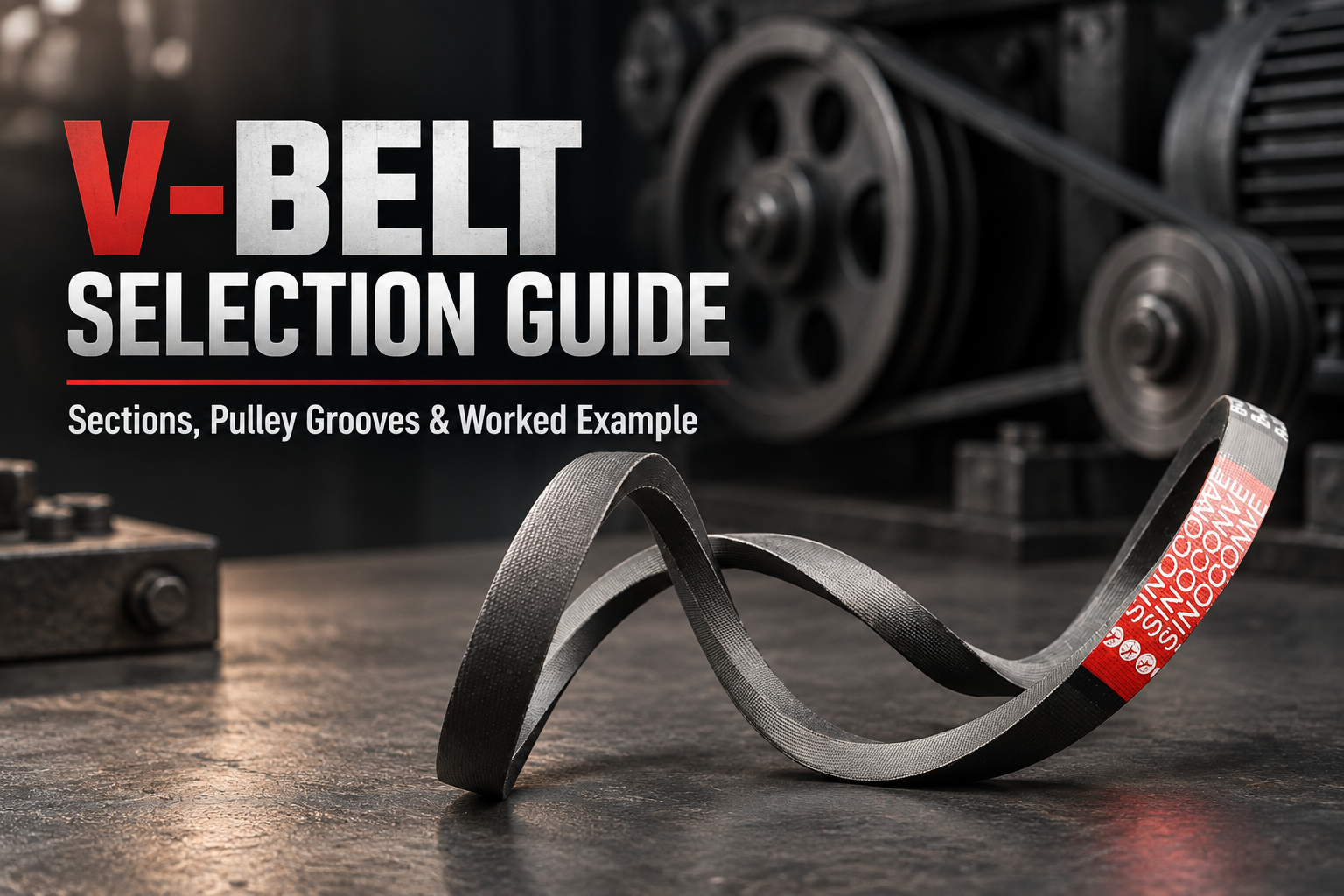
We have been building power transmission belts since 1988, and the calls that reach our technical desk follow a pattern. A quarry loses belts off a crusher drive every few weeks. A plant replaces one broken belt on a screw compressor and the next one in line goes inside a week. Somebody emails a photo of a sheave where three belts are shiny and one has polished the groove down to bare metal. The question is always the same: which belt should we buy instead?
Almost never is the compound the problem. The set is the problem.
A multiple V-belt drive is a load-sharing system. Three, four or more belts run side by side in matched grooves, and the entire design assumption is that each belt carries the same share of the torque. That only holds when the belts are effectively identical in the one dimension that governs how a V-belt behaves under load: the datum length at working tension. Miss by a couple of millimeters and the drive stops sharing. It starts punishing. The belt that happens to be shortest does the most work, wears fastest, and takes the whole drive down with it when it lets go. The rest of the belts are still serviceable, which is exactly why so many maintenance teams keep repeating the same failure.
This article is about the set side of belt drives. How a banded V-belt set is built, how to read its part number, when a 2-band set is the correct answer and when you genuinely need 3 or 4 bands, how to tension a set so it survives its first month, and how to read the failures. We also run one complete selection calculation from motor nameplate to purchase order. If you need the wider picture of profiles, sizes and shelf stock, our buying guide to V-belt profiles and sizes covers that ground; this page stays on the matching question.

01Why a Multi-Groove Drive Fails When the Belts Are Not a Set
Start with the physics, because everything else in this article follows from it. A V-belt does not transmit torque by gripping like a chain on a sprocket. It wedges into a V-shaped groove and transmits force through friction on the two flanks. The tighter the belt, the deeper it wedges, the higher the normal force on the flanks, and the more torque that belt can carry before it slips.
Every Belt in the Drive Sits on the Same Center Distance
Here is the constraint that makes sets necessary. All the belts in a multi-groove drive run between the same two shafts. They share the same center distance and the same take-up position. There is no mechanism that gives one belt more room than another. So when you tension the drive, you are setting one common geometric condition, and each belt responds to it according to its own length.
If the belts are the same length, the arithmetic is clean. Same length, same installed tension, same elastic stretch under load, same load share. Each belt in a 3-band set takes one third of the tangential force. In a 4-band set, one quarter. That is what the drive was designed around, and that is what the sheave grooves, the shaft, the bearings and the belts themselves are sized for.
Now introduce a length difference. It does not take much. Datum lengths on industrial drives run anywhere from a few hundred millimeters on a small fan to over 10,000 mm on a big crusher, and manufacturing tolerances on a single belt of that length are measured in millimeters. Mix two production batches, or combine an old belt with three new ones, and a spread of 1 to 4 mm across the set is entirely normal.
What a Few Millimeters of Mismatch Does to Load Share
A V-belt is a spring. Its tension is proportional to how far it is stretched, and stretch is proportional to length. That means a small absolute difference in length becomes a small difference in strain, but a strain difference that the drive cannot avoid converting into a tension difference.
Put three belts of 2,500 mm, 2,502 mm and 2,498 mm on the same drive and tension the drive to the correct deflection. The middle belt is 2 mm longer than the shortest one, which is 0.08 percent. That sounds negligible. It is not, because the working tension range of a belt is narrow relative to its stiffness. The shortest belt, being stretched slightly more for the same center distance, starts at a higher static tension. Higher static tension means it wedges deeper, generates more friction, and takes on a disproportionate share of the tangential load. On drives we have stripped down, the imbalance is not a rounding error; one belt in a badly mismatched four-groove drive can look like a belt that has run several times longer than its neighbors.
Load sharing in a multi-V drive is not a compromise that settles in the middle. It is a winner-takes-most equilibrium, and the winner is always the shortest belt.
The Shortest Belt Dies First, and Then the Cascade Starts
The overloaded belt fails before its neighbors. That is the first event. The second event is the one that costs money, because it usually arrives days later and nobody connects the two.
When one belt in a set breaks, three things change at once. The total load that the remaining belts must carry goes up, so each of them is now running above its design share. The take-up and tensioner move, because the drive has lost a belt's worth of length in the belt loop, and the remaining belts lose installation tension. And if the failed belt has wrapped or frayed, its loose end can slap the guard, catch on the sheave or foul a neighboring belt.
The surviving belts are now under-tensioned and over-loaded. They slip. Slip generates heat and wear at the flank, and glazes the friction surface. A glazed belt needs more tension to transmit the same torque, which the take-up cannot provide without over-stressing what is left. The cascade is now running on its own. Each successive failure comes closer to the last. This is the exact failure signature behind the classic maintenance complaint that "these belts only last a few weeks now."
Groove Wear and Alignment Multiply the Problem
There is a second-order effect worth naming. Uneven load share accelerates groove wear on the sheave. The overloaded belt presses harder into its groove, so that groove widens faster than the others. Once the grooves are no longer identical, a new belt set that is perfectly matched will still see uneven contact, because the geometry it runs in is no longer uniform. Worn grooves also let belts sit lower, which reduces the effective pitch diameter and, with it, the belt speed and the transmitted power.
Misalignment does the same job from a different direction. A drive out of parallel by even half a degree loads one side of the set more than the other and adds a lateral force that tries to roll belts out of their grooves. We have walked into plants where a set was changed four times in a year and the real fault was a sheave that had never been aligned since commissioning.
The practical conclusion is short. On any drive with more than one groove, the belt is not the unit of purchase. The set is.
02Banded Belts, Matched Sets and Loose Belts: Three Different Things
Buyers use these three terms as if they were interchangeable. They are not, and the difference decides whether your drive shares load by design or by luck.
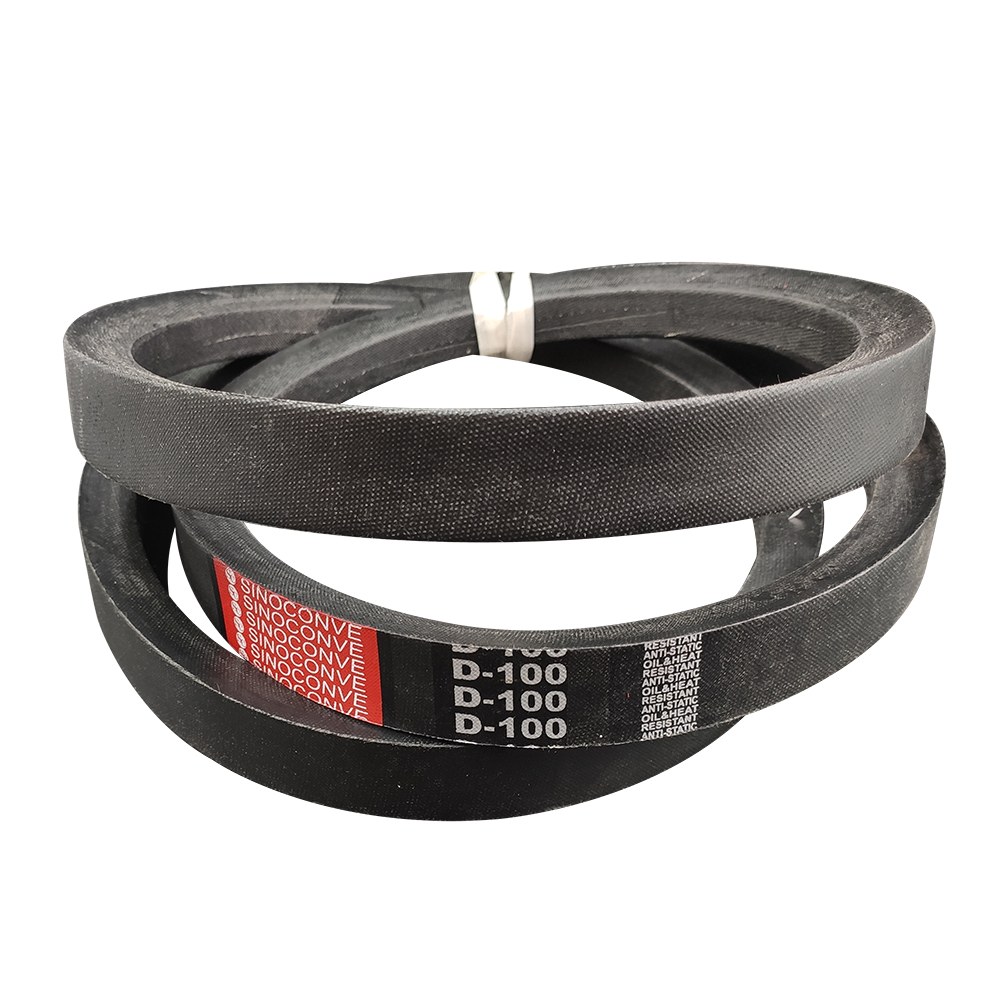
A banded V-belt set in a heavy classical profile, tied across the top so the individual belts cannot separate or migrate.
Loose Individual Belts
A loose belt is one belt. It is molded, cured and measured on its own, then packed on its own. Its datum length is controlled to a manufacturing tolerance, and that tolerance is what you are buying. Two belts that carry the same printed part number can therefore sit at opposite ends of the allowed length window. When a distributor pulls four belts off a shelf to fill a four-groove drive, those four may come from four different cure batches on four different days. Individually, all four are in specification. As a set, they may not be within a useful match of each other.
Loose belts still have a place. Single-groove drives, emergency repairs, agricultural equipment kept running through harvest, and drives where the take-up can be adjusted belt by belt. On a proper multi-groove industrial drive, though, buying loose belts and hoping for the best is a decision that gets paid for later.
Matched Sets: The Older, Still Useful Discipline
Matched set V-belts are individual belts drawn from production and grouped so that their measured lengths fall inside a tight window. In the older standard practice each group carried a match number stamped on the belt, and a legitimate set shared that number. The intent is straightforward: the belts remain separate objects, but they behave as though they were made together.
Matched sets solve the length problem as long as the discipline is respected. It breaks the moment somebody tops up a set. Add one unmatched belt to three matched belts and the drive is back to the mismatch scenario from section 01. It also cannot stop a matched belt from rolling over in a worn groove or from whipping on a long center distance, because the belts are still free to move independently.
Banded V-Belts: Load Sharing by Construction
A banded V-belt, sometimes called a joined V-belt or a power band, is several V-belt ribs molded and cured as one continuous body with a reinforcing tie band across the top. The ribs are permanently connected. They cannot be separated, spaced unevenly, or mixed with ribs from another production run. The set is the belt.
That single design feature buys four things on a real drive. First, load sharing is guaranteed by geometry rather than by inspection, because every rib is the same length to within the manufacturing tolerance of one molded body. Second, the tie band resists the lateral movement that lets individual belts flip out of a worn or misaligned groove. Third, the band stiffens the belt against vibration and whip on long spans and on drives with pulsating loads, which is precisely the condition found on crushers and reciprocating compressors. Fourth, installation and re-tensioning become one operation instead of four, which matters when the drive sits behind a guard inside a crusher station.
The trade-off is honest and worth stating. A banded set costs more than the same number of loose belts, because there is more material, more handling and a stricter mold setup. You cannot build a set out of shelf stock the way you can with single belts, so a banded set may be a made-to-order item on unusual profiles and lengths. And a banded set must be ordered, changed and retired as a unit; there is no partial replacement option by definition.
Banded V-Belts Are Not Ribbed Belts
One more distinction saves a lot of confusion in the purchasing department. A banded V-belt has discrete V-shaped ribs tied across the top; each rib wedges into its own deep groove exactly like a conventional V-belt. A ribbed or multi-V belt (a PK belt) has a completely different construction: a flat-backed, thin belt with many small longitudinal ribs that wraps small diameters and drives accessory loads. They are different products with different grooves, different tensioning rules and different applications, and the guide to PK belts and ribbed belt profiles covers that family separately.
One more thing about where these belts live. Most of the plants we serve run both families at once and the same maintenance crew looks after both: a rubber conveyor belt feeding raw stone into a crusher, and a banded set driving the crusher itself. Failures in the two areas are related more often than people expect, because a belt that slips and a belt that runs off center usually trace back to the same alignment and housekeeping habits.
03Reading a Banded V-Belt Part Number
Half of the ordering errors we see come from a designation that was copied down without being understood. As a V-belt manufacturer we read those order lines every day, and the same three mistakes keep coming back. A banded V-belt set designation carries three pieces of information and they must appear in the same order on the order confirmation and on the belt itself.
Piece One: The Profile
The profile is the cross section, and it decides how much power one rib can carry, which groove it fits, and how small a sheave it can run on without overheating. Narrow-wedge profiles are written SPZ, SPA, SPB and SPC. Classical profiles are written A, B, C and D in the inch-based world, and there is an inch-based narrow-wedge family as well, written 3V, 5V and 8V. The letters are not decorative. An SPB belt in an A groove is loose and slips; an A belt forced into an SPB groove sits high, contacts the wrong part of the flank and destroys both the belt and the sheave.
Piece Two: The Number of Bands
This is the number that says how many ribs are joined together, and it must match the number of sheave grooves. A 3-band belt on a 4-groove sheave leaves a groove empty, which cuts the drive capacity by a quarter and unbalances the loading across the shaft. A 4-band belt on a 3-groove sheave is simply impossible to install. We write the band count immediately after the profile, separated by a dash or a slash: 3-SPB, SPB 3, or 3/SPB, depending on which convention the receiving system expects.
Piece Three: The Datum Length
The third piece is the length, and this is where money gets lost. A V-belt has at least three lengths worth knowing: the inside length, the datum or pitch length, and the outside length. They differ, and the difference grows with the profile. Narrow-wedge profiles are almost always designated by datum length in millimeters, so an SPB belt is written as SPB 4-1700, meaning four ribs on a 1,700 mm datum length. Classical A, B, C and D belts are usually designated by a number in inches, and the relationship between that number, the datum length and the outside length depends on the section, so a number copied from an old belt can easily be misread.
Our advice is unglamorous but effective. Always put the datum length in millimeters on the purchase order, even when the customer's existing designation is in inches, and ask the supplier to confirm the datum length before cutting material. On a made-to-order banded set, a length error means the whole set is scrap.
How a Complete Banded Set Designation Looks
Put the three pieces together and you get something like SPB 4-1700, or in the inch-based narrow-wedge world 5V 3-1250, or in the classical world 3/B112. On a quotation from us you will also see the construction (wrapped or cogged), the cord type, the antistatic property if the belt needs it, and the band count spelled out in words as well as numbers, because we have learned that "3" and "8" survive telephone calls badly.
A real order line, written the way we prefer to receive it, reads like this: "SPB 4-1700, wrapped, oil and heat resistant, 6 complete sets, datum length 1,700 mm, band count 4, for jaw crusher drive, tag each set with the same match code." That single sentence removes every ambiguity that a part number alone leaves open.
04Profiles and Set Sizes We Build, in One Table
Before the question of 2, 3 or 4 bands can be answered, the profile has to be fixed, because the profile sets the ceiling on how much power one rib can carry. The table below is the working summary we use when a customer sends us a drive and asks what is possible. Treat the power column as an order of magnitude for a mid-size sheave at 1,450 rpm, not as a published rating: the number you rely on must come from the current rating table for the exact construction being quoted, adjusted for sheave diameter, belt speed, arc of contact and belt length.
| Profile | Nominal cross section, top width × height (mm) | Datum length range we commonly tool (mm) | Typical band counts | Order of magnitude per rib at 1,450 rpm | Where we see it |
|---|---|---|---|---|---|
| SPZ | 9.7 × 8 | 630 – 3,550 | 2 – 5 | 1.5 – 3 kW | Small fans, compactors, light pumps |
| SPA | 12.7 × 10 | 800 – 4,500 | 2 – 6 | 2.5 – 5 kW | Pumps, small compressors, workshop drives |
| SPB | 16.3 × 13 | 1,250 – 8,000 | 2 – 20 | 5 – 11 kW | Screw compressors, crushers, mixers, fans |
| SPC | 22 × 18 | 2,000 – 12,500 | 3 – 20 | 9 – 20 kW | Large crushers, mills, big pumps, belt-driven blowers |
| A (1/2 in) | 12.7 × 8 | 660 – 4,000 | 2 – 6 | 1.5 – 3 kW | Legacy machinery, replacement drives, light plant |
| B (21/32 in) | 16.7 × 11 | 800 – 5,000 | 2 – 8 | 2.5 – 5.5 kW | Agricultural machinery, older pumps, sawmill drives |
| C (7/8 in) | 22.2 × 14 | 1,200 – 7,000 | 2 – 12 | 4 – 9 kW | Crushers, compressors, mill drives on legacy designs |
| D (1-1/4 in) | 31.8 × 19 | 2,000 – 10,000 | 2 – 12 | 7 – 16 kW | Heavy crusher and mill drives, quarry plant |
| 3V / 5V / 8V | 9.5 / 15.9 / 25.4, heights 8 / 13 / 23 | 500 – 12,500 depending on section | 2 – 20 | 1.5 – 25 kW | North American machinery, OEM replacements |
Why We Usually Ask for the Groove Before the Profile
Customers often send a belt photo and a part number. We would rather see the sheave. A quick photo of the drive with a tape measure across the sheave face and a count of the grooves tells us more than a worn belt does, because worn belts lose their original shape and a stretched belt no longer matches any datum length in a catalog. Where the profile is in doubt, a sectioned sample of the old belt settles it in seconds.
As a transmission belt manufacturer we mold banded sets in narrow-wedge and classical profiles, wrapped or cogged, with oil, heat and antistatic options, and we build them to the datum length on your drawing rather than to the nearest catalog step when the drive demands it. If the drive is a legacy design with a classical profile and a long center distance, we keep both wrapped and cogged constructions available so the set can be built to suit the sheave diameter you actually have.
05Two, Three or Four Bands: Matching the Set Size to the Load
There is a temptation to treat set size as a preference. It is not. The number of bands on the belt has to equal the number of grooves on the sheave, and the number of grooves on the sheave is a result of the power that has to be transmitted and the space available. The belt follows the sheave; it does not lead it.
Start From the Groove Count, Not the Belt Count
If you are replacing an existing set, count the grooves and measure them. If the sheave has four grooves and the old set has four ribs, order a four-band set. If the old installation has four grooves and only three belts inside, somebody before you decided to reduce capacity and you should find out why before repeating the decision. If you are specifying a new drive, the groove count comes out of the calculation in section 10.
One caution from experience: when a drive is running with fewer belts than grooves, the remaining belts are overloaded and the empty groove collects dust, rust and debris. Reinstating the full set later without cleaning the sheave is a common cause of rapid early failure.
What Each Set Size Is Usually Asked to Do
The table below is our default guidance for narrow-wedge and classical industrial drives, based on typical duty hours and typical shock levels. It is a starting point for discussion, not a substitute for the calculation, because a 22 kW drive with a 1.7 service factor behaves quite differently from a 22 kW drive on steady load.
| Set size | Typical design power window | Grooves on the sheave | Equipment we see it on | When to step up instead |
|---|---|---|---|---|
| 1 belt (no set) | Up to about 15 kW | 1, occasionally 2 with one belt removed from service | Small centrifugal pumps, fans, workshop machines, single-groove legacy drives | Anything above 15 kW, or any drive with real shock loading, belongs on a set |
| 2-band set | 15 – 30 kW on SPB or B | 2 | Small screw compressors, process pumps, cooling tower fans, crop and feed machinery, small hammer mills | Go to three or four bands when the required power exceeds the two-rib rating, when duty exceeds about 4,000 h a year, or when the driven machine starts under load |
| 3-band set | 22 – 45 kW on SPB or B | 3 | Screw compressors, medium centrifugal pumps, screw conveyors, agitators, hammer mills, small vibratory screens | Step to four bands or a heavier profile when the driven mass is high, when ambient runs hot, or when the take-up travel is already near its limit |
| 4-band set | 45 – 75 kW on SPB or B | 4 | Jaw and cone crushers, large compressors, mixer drives, fan banks, heavy pump sets | Beyond about 75 kW, the sensible step is a wider set (6, 8, 10, 12 bands) or a change of profile to SPC, not four ribs of an undersized section |
| Larger sets (5 – 20 bands) | 75 kW upward | 5 up to 20 and more | Primary crushers, ball and rod mills, large blowers, ship loader drives, mining plant | When a set gets very wide, check that both sheaves can carry that many grooves, that the shaft deflection stays acceptable, and that belt speed is still within limits |
When a Single Belt Is the Right Answer
Not every drive needs a set, and overselling one wastes our customers' money. A single belt is correct when the sheave has one groove, when the load is steady and light, when the drive is a low-hour application such as a standby fan or a workshop machine, and when the take-up allows individual belt changes. Small agricultural drives and light process pumps often belong in this group. The moment you add a second driven load, a heavy starting torque, or a driven machine with fluctuating demand, the set argument starts to win.
There is also a middle route worth mentioning. On a two-groove drive with modest load, a 2-band set is usually cheaper over five years than two loose belts, because the second belt is no longer being replaced early after the first one fails. Buyers who purchase wholesale conveyor belts and drive belts through one channel tend to notice this quickly, because they see the repeat order pattern in their own data: loose belts generate callbacks, and matched sets do not.
06Equipment Notes: Crushers, Compressors, Pumps, Fans and Mixers
The set size follows the load character of the driven machine, and that character is different in every one of these applications. What follows is what we ask about when a drive specification lands on our desk.
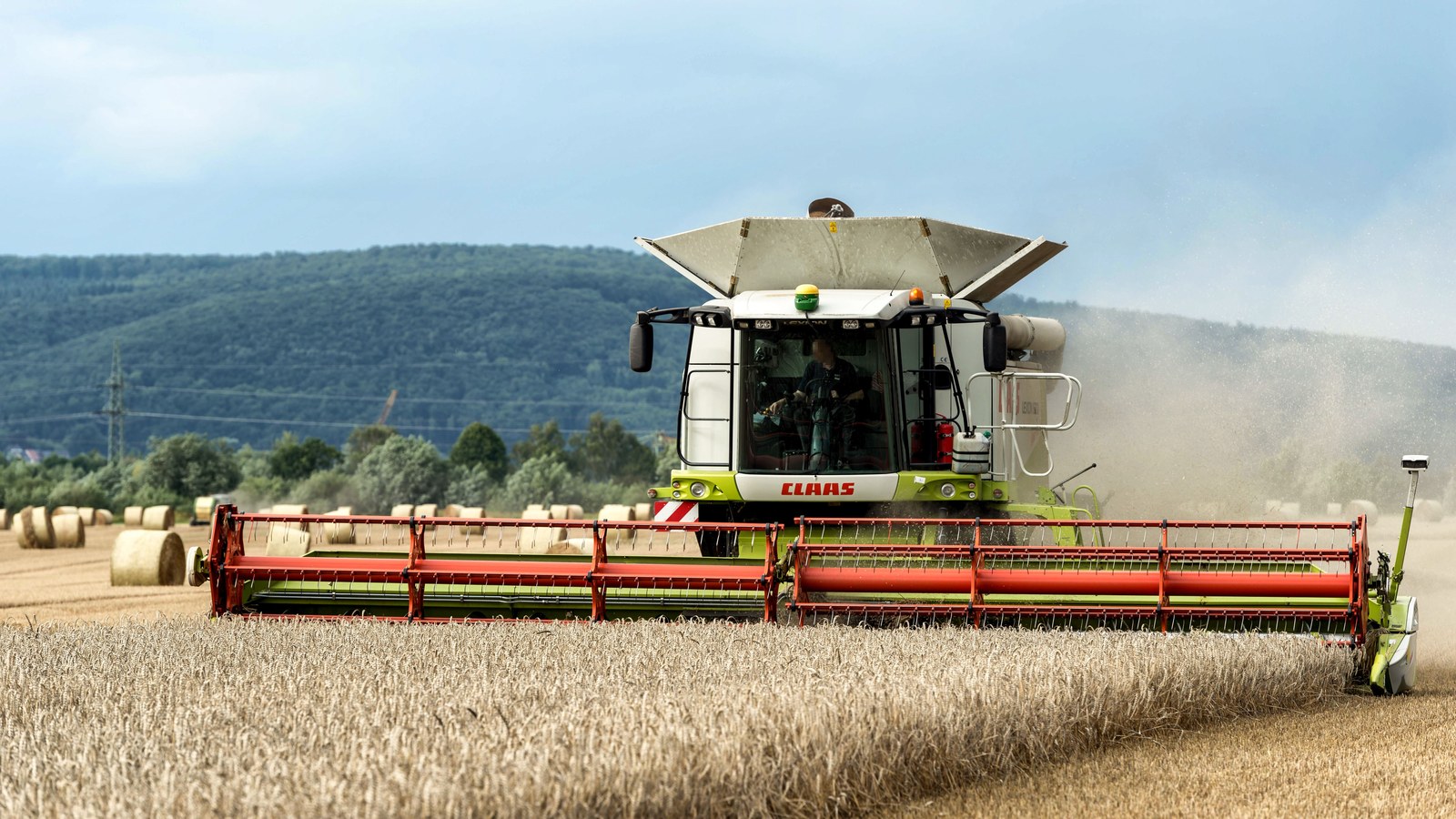
Seasonal machinery is hard on drive belts: high torque, dust, vibration and no tolerance for downtime in the middle of a harvest.
Jaw and Cone Crushers
Crushers are the classic case for banded sets. The load is pulsating, the starting torque is high, and the drive usually sits under a guard with limited take-up travel. A 4-band set in SPB, SPC, C or D is common, with service factors pushing the design power well above the motor rating. Two things matter more than the belt count on a crusher. The first is belt speed and sheave diameter, because a crusher flywheel sheave is often large and the motor sheave small, which pushes up the required arc of contact. The second is inspection access: if the guard cannot be removed in ten minutes, the set will never be re-tensioned after the first run-in and the belts will slip for the rest of their lives.
Screw and Reciprocating Compressors
Screw compressors run continuously and their drive belts see a lot of hours. A 2-, 3- or 4-band set is typical depending on motor size, and the failure that shows up most often is not a broken belt but glazing on one rib after months of slight slip. Reciprocating compressors are a harder duty: the torque fluctuation is significant, which is exactly where the tie band in a banded V-belt set earns its cost by damping lateral belt movement. On either machine, belt tension must be rechecked after the first 24 to 48 hours of running, because the initial seating of a new set changes the effective length of the loop.
Centrifugal Pumps and Fans
Pumps and fans are usually the easiest drives to belt, because the load is smooth and the starting torque is often low. This is where a 2-band set is often entirely sufficient, and where a well-built single belt still has a role on small units. The exception is high-inertia fan rotors, which take a long time to accelerate and can punish an under-sized set during every start. On a crusher plant, the drive belts and the industrial conveyor belt moving screened stone away from the discharge are usually specified by different people on different budgets, which is how a plant ends up with a perfectly sized discharge belt and a drive set that was bought on price.
Mixers, Agitators and Hammer Mills
These drives combine a heavy driven mass with shock. A mixer that starts with a tank full of slurry is one of the hardest starting conditions in a process plant. We size these with a service factor on the high side, and we usually recommend a banded set with a heavier profile rather than more ribs of a light one, because a heavy rib carries shock better than thin material in a wide set. Hammer mills behave like small crushers and should be treated the same way.
Agricultural and Construction Machinery
Seasonal machinery compresses a year of work into a few weeks, so a failure is measured in lost harvest rather than lost hours. We build banded sets for threshing and harvesting drives, and matched set V-belts remain the practical answer on machines where the sheaves are already grooved for multiple belts. Dust is the main enemy here, and it does two things: it polishes the flanks and it fills the grooves so belts sit high and lose grip.
One pattern worth pointing out to procurement: the equipment around the crusher is not the only thing on the same drive circuit. If you already buy EP feed belts through a conveyor belt supplier, putting the drive belts into the same order and the same shipping container usually lowers the landed cost per item and removes one inbound inspection from your warehouse. We consolidate those shipments regularly, and we tag each banded set so it stays with its matching sheave when the crate is opened on site.
07Cogged, Wrapped and Banded: Which Construction for Which Drive
Three words get mixed up constantly in purchase orders, and clearing them up prevents a lot of returns.
Wrapped Construction
A wrapped belt has a fabric jacket covering the whole cross section, top, bottom and both flanks. It is the traditional industrial answer, it tolerates dusty and slightly oily environments, and it holds up on drives that are not perfectly aligned. Its limit comes when the sheave is small: the jacket resists bending and the belt runs hot.
Cogged Construction
A cogged belt has molded teeth on the underside. The teeth do not engage anything; they exist to make the belt easier to bend around a small sheave. The gains are real: less bending stress, less heat build-up, better grip through greater flexibility, and often a longer service life on compact drives. That is why cogged V-belts are common on machines where space forces a small motor sheave. On a large crusher sheave, the benefit shrinks, because the belt is barely bending. Our comparison of classic V-belts versus cogged constructions goes into that trade-off in more detail, and cogged belts remain available in banded form on the profiles that need them most.
The practical rule we give maintenance teams: if the small sheave pitch diameter is close to the minimum recommended for the profile, choose cogged. If the drive runs in abrasive dust or outdoors, weigh the wrapped jacket's protection carefully. And on any multi-groove drive, banded construction sits above both, because the tie band fixes load sharing regardless of which underside the belt has.
What the Industrial V-Belt Market Is Telling Buyers
Watch what replacement buyers actually order and the pattern is easy to read. Demand has shifted toward cogged and narrow-wedge profiles on new machinery, because OEMs keep shrinking drive envelopes and pushing more power through less space. At the same time, classical wrapped profiles refuse to disappear, because there are decades of installed equipment in quarries, mills and farms that will be rebuilt with the same sheaves for another generation. Any serious industrial v belt market conversation ends up in the same place: the profile and construction are decided by the sheave, and the sheave is decided long before the belt. Add the third layer, which is the set, and you have the whole decision. That is why we keep four construction families in production rather than declaring one of them obsolete.
For heavier, dirtier drives where the jacket takes real punishment, our buyers' notes on wrapped V-belts for industrial drives cover jacket selection, storage and the tell-tale signs of a jacket that was asked to do more than it could. A conveyor belt distributor stocking quarries and asphalt plants will usually see both problems in the same week: a chevron belt on a steep incline wearing its cleats, and a drive set on the same plant closing up because nobody checked the deflection.
If you want to know what to look for when you audit a supplier, come and look at a conveyor belt factory that also molds its own V-belt sets. The questions are the same ones you would ask about your own maintenance department: is the length documented, is the set kept together, and is somebody accountable for the deflection check?
08Installing and Tensioning a Banded Set
A banded set that is installed badly will fail exactly like a loose-belt drive, and the customer will blame the product. Most of the failures we investigate on banded drives trace back to three things: the set was not replaced completely, the sheaves were never checked, or the tension was set by thumb pressure and never rechecked.
Change the Whole Set, Every Time
This is the rule that pays for itself fastest. A banded set is one belt, so this is automatic. On a matched set of individual belts, it means resistance to a very common and very expensive habit: replacing the one belt that broke and leaving the rest in service.
Here is why the habit is so costly. A used V-belt has already stretched and its cord has already taken a permanent set. A new belt next to a used belt is a different length under the same tension, so the pair does not share load from the first minute. The new belt does more work, the old belt slips more, and the drive reaches a worse state than it was in before the repair. Replacing one belt of four usually guarantees another failure within weeks. If you cannot change the whole set today, the honest choice is to remove the broken rib from service, drop the drive to a lower output if the process allows, and schedule the set change properly.
Inspect the Sheaves Before the New Set Goes On
Run a finger along each groove wall. A healthy groove is smooth and flat; a worn one has a ridge, a step, or a mirror-polished hollow where a slipping belt has been spinning. Use a groove gauge if you have one, or lay a new belt into the groove and confirm it sits proud of the sheave edge by roughly the amount the manufacturer specifies for that profile. A belt that sinks until it bottoms out on the groove floor is transmitting almost nothing, because the wedging action is gone.
Check both sheaves for chips on the groove edges and for burrs where belts have been pried off. A single sharp burr will shave the flank of a brand new banded set within a shift.
The Deflection Method, Step by Step
Deflection testing is the only tensioning method we trust in the field, because it measures something repeatable instead of a feeling. You need a straight edge, and a spring scale or a known mass. That's it.
Start by backing off the take-up and fitting the new set into the grooves by hand. Never roll a belt on with a lever or a screwdriver; the cord damage that causes is invisible and permanent. Where the drive has a detachable sheave or a movable motor, shorten the center distance enough that the set drops in without being forced.
Snug the take-up, run the drive unloaded for two to five minutes so the ribs seat in the grooves, then stop it and lock it out. In practice that short run-in is the step most customers skip, and it's usually why their first reading afterwards looks wrong.
Lay a straight edge across the tops of the belts at mid-span, touching both sheaves, and measure the span between the two sheave tangent points.
Take 1.6 percent of that span as your target deflection. A 1,000 mm span gives 16 mm, which is the 16 mm per meter figure the field handbooks quote. Then apply a perpendicular force at mid-span and read the scale at the moment the belt reaches that deflection.
What you do with the reading is where the mistakes live. Compare it against the banded set's specification for that profile and set width; on a four-band SPB set the figure we normally see sits somewhere in the region of 150 to 250 N for the whole set rather than for one rib. So check whether the table in front of you is per rib or per set. No other single error mis-tensions as many drives. And don't copy those two numbers onto a different drive — the band moves with the drive geometry, the sheave diameters and the number of ribs you are running, so the set's own specification sheet outranks anything you read here.
Adjust the take-up and repeat until the force falls inside the band. Drives with more than one take-up point get both adjusted evenly, so the set stays square to the sheaves.
One field exception you'll meet sooner or later: on freshly re-grooved or brand new sheaves the first reading can sit low even when the force is right, because the ribs have not yet mated with the groove profile. Leave the tension where it is and re-test after the run-in instead of cranking the take-up tighter.
The feel of a correctly tensioned banded set is a firm, springy push with no slapping when the drive starts. Push it down with one finger and if it gives easily, the set is too loose — whatever the table says.
Run-In and the Re-Tension Nobody Does
A new set stretches as the cord beds in. That is normal and expected, and it's why the tension you set this morning is not the tension the drive holds next week.
Every set we ship carries the same instruction: recheck the deflection after the first 24 to 48 hours of running, then again after the first week. Two checks, ten minutes each. The usual result is that the second check finds a set that has already lost enough tension to matter, which is exactly why we keep repeating the instruction.
Honest answer on the interval after that: a clean drive gets by with a deflection check every 500 running hours, a dusty plant with every 250. Those two figures come from what we see on drives that come back to us, not from a formula, so treat them as a starting point and shorten the interval if you've had a failure on that line. And put it on the maintenance schedule with a name against it, because an unowned check does not happen.
Alignment, and Why Half a Degree Matters
Align the sheaves with a straight edge held against both groove faces — or a laser tool, if the plant has one.
Half a degree of angular error sounds fussy until you have watched a set roll its ribs out of the grooves. The driven shaft should be parallel to the motor shaft, and the grooves coplanar within the tolerance the drive was built to.
Misalignment does two things: it shifts load onto one side of the set, and it adds a lateral force that tries to roll ribs out of the groove. On a banded set the tie band resists that roll, which slows the failure down but does not remove the cause. Twenty minutes with a straight edge still beats a year of buying belts.
This is also where a plant with mixed responsibilities loses money. As a conveyor belt manufacturer we see the same pattern on conveying equipment that we see on drive belts: nobody owns the geometry. A discharge chute gets adjusted for a spillage problem, the belt runs off center for a month, and the belt takes the blame. On a drive, the equivalent is a shim pack lost during a motor change, with nobody writing it down.
09Failure Modes on Banded Drives: Symptom, Cause, Action
When a drive fails, the belt is the evidence, not the verdict. The table below maps what you see to what it usually means. It is the checklist we run through on the phone before we accept an order for replacement belts, because selling a new set into an unfixed drive just schedules the next failure.
| Symptom | What it usually means | Action |
|---|---|---|
| One rib broken, neighbors look serviceable | Mismatched lengths from a history of single-belt replacement, or one groove worn deeper and running that rib at a different effective diameter | Replace the complete set, gauge the grooves, correct alignment, and change the purchasing rule to sets only |
| Rib rolled over or flipped out of the groove | Misalignment, an over-wide or worn groove, or tension far below specification; debris in the groove does the same thing | Align the drive, gauge the grooves, clean and re-tension; check the guard for interference |
| Cracks across the bottom face, belt feels stiff and hot | Bending stress beyond what the belt can take: sheave or idler diameter below the minimum for the profile, or a back-side idler that is too small | Measure sheave pitch diameters against the profile minimum, enlarge the small sheave, or change to a cogged construction that bends more easily |
| Frayed or torn tie band on a banded set | Foreign object in the drive, a damaged sheave edge, or guard contact that shaves the top band as it runs | Inspect sheaves and guard clearance, remove the source of contact, replace the set |
| Squealing on start-up, flanks glossy and polished | Slipping from low tension or from glazing caused by earlier slipping; sometimes the driven load has grown since the drive was sized | Re-tension to the deflection specification; if the flanks are glazed, replace the set; recalculate whether the drive still matches the load |
| Belt sits deep in the groove and bottoms out | Worn sheave grooves; the belt has lost the wedging contact that makes a V-belt work | Regauge the sheave, replace or re-machine it; do not fit new belts into worn grooves |
| Outer ribs worn much faster than inner ribs on the same set | Angular misalignment between the shafts, so one side of the set runs tighter | Realign both planes, then re-tension; check the motor feet and base for cracks |
| Set has stretched beyond the take-up travel | Normal creep at end of life, or sustained overheating from an undersized drive running hot | Replace the set; if it happens repeatedly, check belt speed, sheave diameter and whether the drive is under-rated |
| Belt swollen, soft and covered in oil or solvent | Compound attacked by lubricant leaking from a bearing or gearbox, or by process chemicals | Fix the leak first, then specify an oil resistant construction rather than a standard one |
| Cords exposed, sudden failure with no warning | Genuine overload: a jam at start, a seized driven machine, or a set that was never big enough for the duty | Investigate the driven machine, then recalculate the drive and consider a banded set with more ribs or a heavier profile |
Two of these rows deserve a comment. Cogged belts change the diagnosis in only one place, and that is bottom-face cracking: a cogged v belt tolerates a small sheave far better than a wrapped one, so if cracking keeps coming back on a compact drive, the construction is the fix rather than the tension. The other row is the bottomed-out belt, which is the single most misdiagnosed condition we see. Maintenance teams read it as a belt that has stretched, then buy a shorter set, which bottoms out as well and runs hotter than before.
10A Worked Selection Example: 22 kW Fan Drive
Numbers settle arguments. Here is a complete selection, from nameplate to order line, for a drive that lands on a four-band set. If your drive is bigger, the steps are identical; only the table values change.
Motor, sheave and driven machine: every banded set decision starts with the duty data on this side of the drive.
Step 1: Collect the Duty Data
Motor 22 kW, four-pole, 1,460 rpm. Driven machine: centrifugal fan required to run at roughly 950 rpm. Duty 16 hours a day, dusty indoor environment, driven by a slide-rail motor base with about 40 mm of take-up travel available. That last number matters and is often missing from a specification.
Step 2: Apply the Service Factor
The service factor converts motor rating into design power by accounting for shock, starting torque and hours of duty. For a centrifugal fan on 16-hour duty a factor of 1.3 is normal practice. Design power is therefore 22 × 1.3 = 28.6 kW. A crusher on the same motor would carry a factor closer to 1.6 to 1.8, which is the entire reason crusher drives need so many more ribs for the same motor.
Step 3: Choose the Profile and the Sheaves
SPB is the practical choice for this power level; it is stocked widely, tolerates the 950 rpm output speed comfortably, and keeps the sheave size sensible. Motor sheave pitch diameter 180 mm gives a belt speed of π × 0.18 × 1,460 / 60 = 13.8 m/s, which is well inside the working range for narrow-wedge profiles. For a ratio of 1,460 divided by 950, the driven sheave needs about 276 mm, so we take the standard 280 mm and get an actual fan speed of 1,460 × 180 / 280 = 938 rpm. That is about one percent below target, which is usually acceptable but must be checked against the process, because fan output moves with speed.
Step 4: Fix the Datum Length
With a center distance of 500 mm between shaft centers, the belt length calculation gives 2 × 500 + π × (280 + 180) / 2 + (280 − 180)² / (4 × 500), which comes to about 1,728 mm. The nearest standard datum length is 1,750 mm, so the set is ordered at 1,750 mm and the take-up absorbs the small difference. On a drive with a long center distance, this step is where a made-to-order length earns its place, because forcing a standard length can leave you with no adjustment left after the first month.
Step 5: Correct the Rating and Count the Ribs
Take the base power per rib for SPB at 180 mm and 1,460 rpm from the current rating table, which for this construction sits near 9 kW. Then correct it for the drive geometry. The arc of contact on the small sheave is 180 − 60 × (280 − 180) / 500, which is 168 degrees, giving a correction factor of about 0.97. The belt length correction for a 1,750 mm SPB belt is about 0.95. The corrected rating is therefore roughly 9 × 0.97 × 0.95, or 8.3 kW per rib.
Divide design power by corrected rating: 28.6 / 8.3 = 3.45. Round up, never down. The drive needs four ribs, which gives 33.2 kW of capacity and leaves a sensible margin for a fan that may be uprated later. The order line reads SPB 4-1750.
Step 6: Check the Things That Break Drives
Belt speed 13.8 m/s is fine. The 180 mm motor sheave is comfortably above the minimum recommended diameter for SPB at this speed, so bending stress is not a concern and a wrapped construction is acceptable; if the sheave had been 125 mm, we would be specifying cogged. Take-up travel of 40 mm is more than the roughly 35 mm needed to cover the stretch and installation window, so there is adjustment left for re-tensioning after run-in. Finally, confirm that the fan's starting inertia does not demand a higher service factor, and confirm that the motor slide rails actually move freely, because a take-up that will not move is the same as no take-up at all.
| Step | What we calculate | Result for this drive |
|---|---|---|
| 1 | Duty data | 22 kW, 1,460 rpm in, approximately 950 rpm out, 16 h/day, dusty |
| 2 | Service factor and design power | 1.3 → 28.6 kW |
| 3 | Profile and sheave diameters | SPB; 180 mm driving, 280 mm driven |
| 4 | Belt speed check | 13.8 m/s, inside narrow-wedge limits |
| 5 | Datum length | Calculated 1,728 mm → order 1,750 mm |
| 6 | Corrected power per rib | About 8.3 kW after arc and length factors |
| 7 | Rib count | 3.45 → 4 ribs, capacity 33.2 kW |
| 8 | Final order line | SPB 4-1750, four-band set, wrapped, match coded |
The values in the rating steps come from the section tables we work with. Yours may differ slightly, and the number that governs your purchase is the one in the current catalog for the belt you are actually buying, so ask for it rather than trusting a figure copied from an article, including this one.
11What to Send Us Before We Quote a Banded Set
We can price a banded V-belt set from a part number, but we can only guarantee it fits if we know a few things about the drive. This is the list we work through. If you can supply most of it, the quotation will come back complete and the set will install without improvisation.
- Motor rating in kW, number of poles or full-load speed, and whether the motor is inverter driven. Variable-frequency operation changes the load profile, and it changes the tensioning advice too.
- Driven machine type and required speed, plus the output shaft size if a sheave is part of the scope.
- Sheave data for both ends: profile, pitch diameter, number of grooves, and the condition of the grooves.
- Center distance between shaft centers, the take-up or slide-rail travel available, and whether an idler or tensioner pulley is fitted. If there is a back-side idler, we need its diameter.
- Hours of duty per day, ambient temperature, dust, oil mist, water, and whether the drive is indoors or outdoors.
- Starting condition: direct on line, soft starter or inverter, and whether the driven machine can start loaded.
- Any space constraint around the drive, especially the distance to the guard.
- The existing part number and, if possible, a photograph of the drive with the guard removed.
As a V-belt manufacturer supplying both drive belts and conveying belts into quarries, cement plants, ports and process plants, we see the whole drive and its surroundings, not just the belt inside the guard. If your plant also needs a rubber conveyor belt replacement in the same shutdown window, it makes sense to plan the two together, because a belt change is a shutdown and shutdowns are expensive to multiply.
On commercial terms, our V-belt order quantities typically start at 30 to 50 pieces per size, with banded sets treated as made-to-order items. Standard lead time runs about 30 days, with a fast lane of 15 to 20 days for urgent breakdown stock, and samples in 2 to 5 days. Payment is normally T/T with 30 percent deposit against order and the balance before shipment, or a letter of credit. We do OEM and private label work, including printed band marking, and we can supply the sheave as well where that removes an alignment risk on site.
When you shortlist a banded V-belt manufacturer, three questions separate a belt maker from a belt assembler. Do you mold the joined set as one body, or tie stock belts together? Can you hold the datum length tolerance across every rib in the set, and prove it on the inspection record that ships with the crate? And can you supply the set as a matched, tagged unit for a multiple V-belt drive instead of loose pieces in a carton? If the answers are vague, the drive will tell you the truth within a month. Our notes on what industrial distributors check before placing a bulk order with a V-belt manufacturer supplying industrial distributors cover the rest of that sourcing checklist.
12Storage and Handling of Matched Sets
A banded or matched set is only as good as how it was kept before installation. Belts are rubber and cord; both degrade quietly in the wrong conditions, and a set that sat in a hot workshop window for two years will never deliver the life that was paid for.
Keep sets in their original packaging, flat or on a wide-radius support, never kinked and never hanging on a nail. Store away from direct sunlight, away from motors that run hot, away from ozone sources such as welding equipment and electric motors with brushes, and away from solvents and lubricants. Rotate stock first in, first out, so that old sets go out before new ones. Keep the set together: a four-band set separated across two shelves will eventually be installed as three plus one, and the mismatch problem returns.
The discipline carries over to installation. Never pry a belt over a sheave with a screwdriver or a bar. Never roll a banded set on with a rotating motor, which is a serious hand injury risk as well as a way to damage the cord. Fit the set by hand with the center distance reduced, and let the take-up do the work of tensioning.
On our own conveyor belt factory floor we handle every banded set as a matched unit from molding through to crating, and each set leaves with its designation written on the crate and on a tag inside. Customers who buy through a distributor can ask for the same tagging, and it costs nothing but a conversation. It saves far more than it costs the first time a storeman has two sets open on the same bench.

13Frequently Asked Questions About Banded V-Belt Sets
What exactly is a banded V-belt set?
It is two or more V-belt ribs molded and cured as a single belt, joined across the top by a tie band. The ribs cannot separate, so every rib is the same length and load sharing is built into the product rather than depending on how carefully the belts were matched at the factory. People also call it a joined V-belt or a power band.
Can I replace only the broken belt in a banded set?
No. A banded set is one item, so there is nothing to replace individually. On a matched set of separate belts the answer is the same in practice: replace the whole set. A new belt next to used belts is a different length under the same tension, so it carries a larger share of the load and fails early, which is how drives end up in a failure loop.
Are banded V-belts the same as matched sets?
They solve the same problem in different ways. A matched set is separate belts selected or measured to fall inside a tight length window. A banded set is a single belt body with joined ribs, so matching is a property of the mold rather than a sorting operation. Banded construction also controls lateral movement and belt whip, which matched loose belts cannot do.
How many bands do I need for my drive?
It follows the groove count, and the groove count follows the calculation: motor power times service factor gives design power, the profile and sheave sizes give a corrected power per rib, and design power divided by that figure, rounded up, gives the number of ribs. As a rough field guide, 2-band sets suit drives up to about 30 kW, 3-band sets around 22 to 45 kW, and 4-band sets around 45 to 75 kW on SPB, but the calculation always wins over the shortcut.
Can a banded set be cogged?
Yes, and it is often the best combination on compact drives. Cogged construction reduces bending stress and heat build-up on small sheaves, while the tie band keeps the ribs sharing load. If a drive keeps cracking belts across the bottom face, we would look at a cogged banded set before we changed anything else.
How do I know when the tension is right?
Measure it. Deflect the set at mid-span by 1.6 percent of the span length, which is 16 mm per meter, and read the force needed to hold that deflection. Compare the force with the figure for the profile and set width, and be sure whether the figure is per rib or for the whole set. Then recheck after the first 24 to 48 hours of running, because a new set seats and loses tension in that window.
Do you build banded sets in classical profiles as well as narrow wedge?
We do. Banded sets are available in classical A, B, C and D profiles for legacy machinery and in narrow-wedge SPZ, SPA, SPB and SPC profiles for modern drives, in wrapped or cogged construction, with oil, heat and antistatic options where the environment calls for them. Send the sheave data and we will confirm the profile.
How long should a banded set last?
There is no honest single number, because life is set by the drive geometry, the duty cycle, the environment and the tensioning discipline much more than by the belt. A well-aligned, correctly tensioned set on a clean drive with a smooth load will run for years. The same set under-tensioned in a dusty plant with a worn sheave may not last a season.If a set is failing early, the failure table in section 09 is where we start.
14Related Products You May Need
| Rubber Conveyor Belt Heavy duty rubber belting for quarry, cement and port duty, in EP and NN fabric constructions with abrasion, heat, oil and flame resistant covers. |
EP Rubber Conveyor Belt Polyester and nylon carcass belts from EP100 to EP400 for general bulk handling, with cut edge or molded edge options. |
Steel Cord Conveyor Belt High tension steel cord belting for long overland and high capacity lines where fabric plies cannot carry the load. |
| Chevron Conveyor Belt Cleated profile belting for inclined conveying, plus sidewall and corrugated sidewall belts for steep transfer points. |
V-Belt and Banded Sets Classic and narrow-wedge V-belts, banded and matched sets, cogged drives, timing belts and ribbed PK belts for industrial drives. |
Full Product Catalog Browse the complete range of conveying and transmission products, then send us the drive data for a banded set quotation. |