
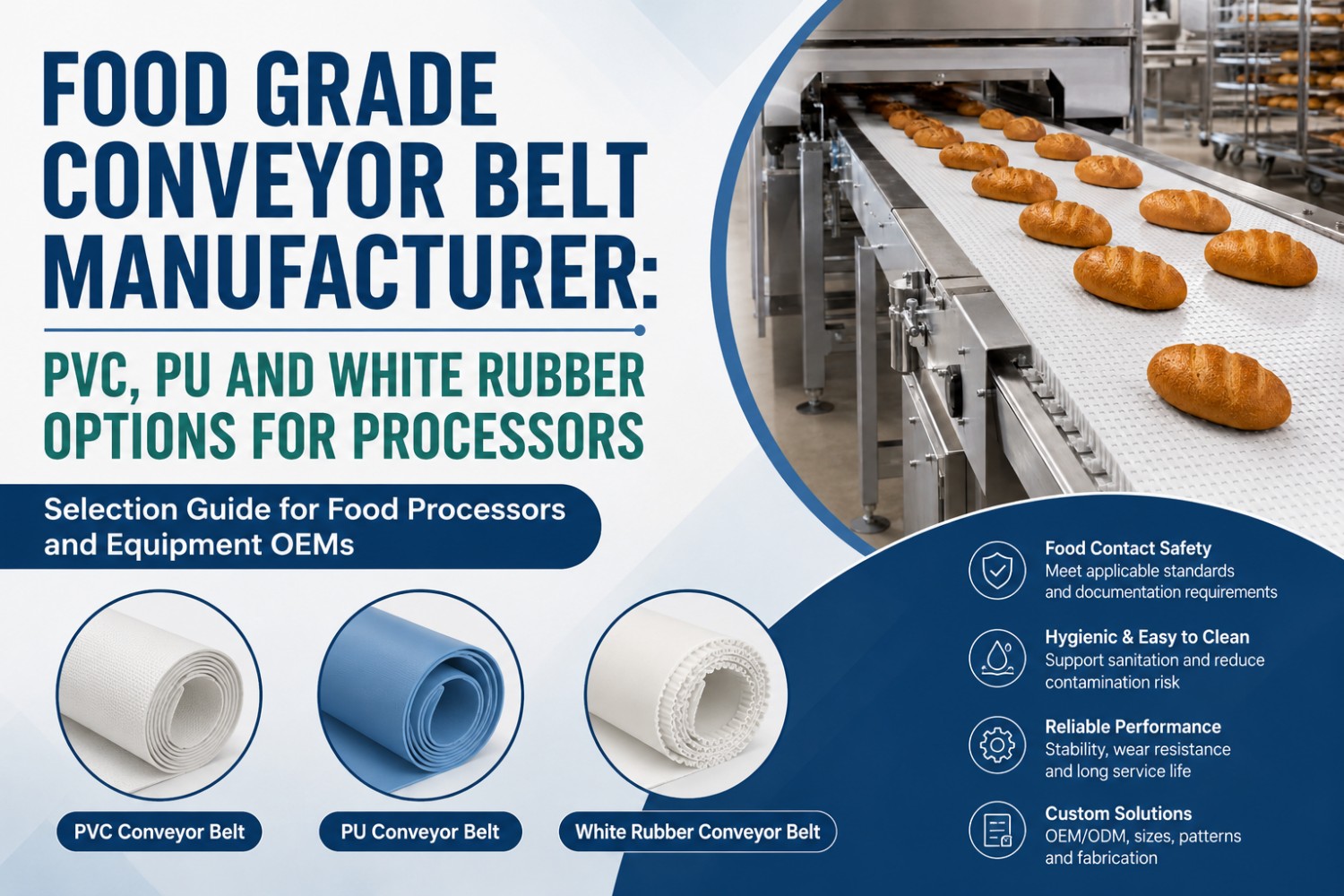
 Food Grade Conveyor Belt Manufacturer: PVC, PU and White Rubber Options for Processors
A food processor or equipment OEM rarely needs a belt simply because it is white. The real requirement is a belt that matches the product, contact conditions, cleaning routine, conveyor geometry and documentation expected in the destination market. Those details become especially important when sourcing from a food grade conveyor belt manufacturer for a new machine, a replacement program or an OEM production run.
PVC, PU and white rubber conveyor belts can all appear in food-related conveying, but they solve different problems. A belt suitable for packaged bakery products may be a poor choice for a wet processing line, while a belt selected for grip or heavier mechanical duty may require different construction from a thin hygienic processing belt. For procurement teams, the supplier decision therefore needs to go beyond material name and unit price. The manufacturer should be able to translate actual operating conditions into a reproducible specification and provide the documentation needed to evaluate the belt before purchase.
Quick Answer: Do not qualify a food grade conveyor belt supplier by asking only for “FDA belt,” “white PVC” or “food-grade PU.” Define the food-contact situation, conveyed product, moisture or oil exposure, cleaning method, temperature, conveyor geometry and required market documentation first. Then compare PVC, PU and white rubber against those conditions and ask each supplier to quote against the same RFQ.
1. What Should a Food Grade Conveyor Belt Manufacturer Actually Prove?
“Food grade” is not a complete purchasing specification. Neither is belt color. For a processor or OEM, supplier qualification should answer two separate questions: is the proposed belt appropriate for the actual conveying duty, and can the supplier provide suitable evidence for the required food-contact or customer specification?
This distinction matters because the same conveyor belt material can be produced with different formulations, reinforcement, surfaces, edges and joining methods. A white surface alone does not demonstrate suitability for direct food contact. Likewise, a general statement that a material is “FDA compliant” should not replace review of the actual product documentation and intended conditions of use.
A useful supplier review normally covers:
- Intended contact: Is the belt carrying packaged goods, or will its surface directly contact dough, meat, vegetables, confectionery or another food product?
- Operating exposure: Is the product dry, wet, oily, sticky, abrasive, chilled or warm?
- Cleaning conditions: How often is the belt cleaned, by what method, and with which cleaning agents?
- Mechanical design: What belt width, length, pulley diameter, speed, incline and transfer arrangement must the belt accommodate?
- Required evidence: What declaration, test report or other documentation does the processor, OEM or destination market require?
- Production control: Can the manufacturer reproduce the approved construction when repeat orders are placed?
For U.S. or European projects, the exact regulatory question also needs to be defined rather than reduced to a logo or generic certificate. Food-contact requirements depend on the material, application and conditions of use. Procurement teams should therefore request the documentation applicable to the belt being quoted instead of assuming that every product from a manufacturer has identical compliance status.

2. PVC, PU or White Rubber: Start With the Process, Not the Material Name
The three options overlap in some applications, but they should not be treated as interchangeable. The most useful comparison begins with the product and conveyor duty.
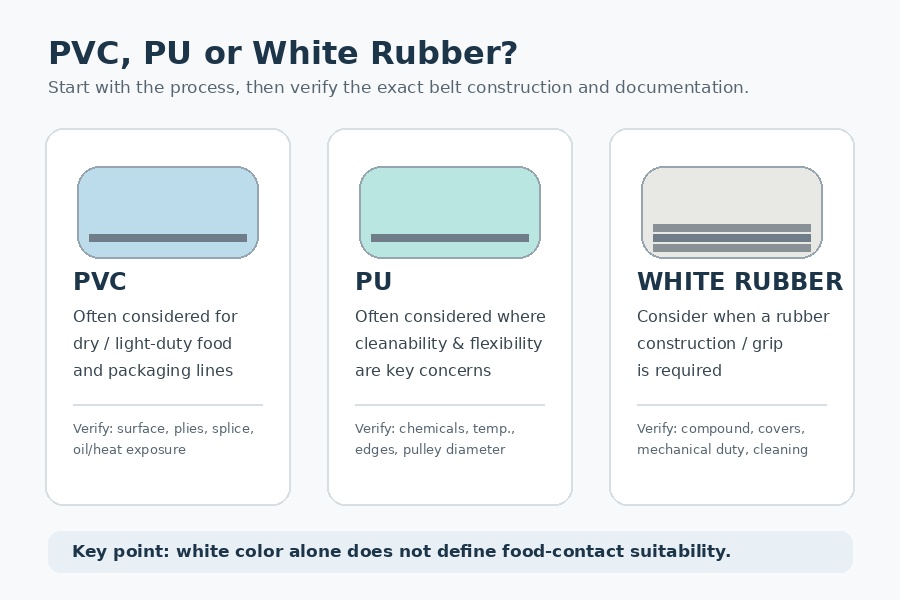
| Belt Option | Where Buyers May Consider It | What Must Be Verified | Common Procurement Risk |
|---|---|---|---|
| PVC conveyor belt | Dry or relatively light-duty food handling, bakery, packaging, inspection and general transfer applications where the selected grade is suitable. | Food-contact status, surface, thickness, fabric construction, pulley compatibility, splice and exposure to oil, heat or cleaning chemicals. | Selecting by white color and thickness while ignoring actual use conditions. |
| PU conveyor belt | Food-processing applications where cleanability, flexibility and product release are important considerations. | Actual PU construction, contact documentation, surface behavior, chemical exposure, edge and splice design, pulley diameter and cleaning regime. | Assuming PU is automatically the best choice for every hygienic line. |
| White rubber conveyor belt | Applications where a rubber construction, grip or different mechanical duty is required while a light-colored conveying surface is preferred. | Rubber compound, food-contact suitability where required, oil/chemical exposure, cover construction, mechanical duty and cleaning compatibility. | Treating “white rubber” as synonymous with “food grade.” |
2.1 When PVC Makes Sense
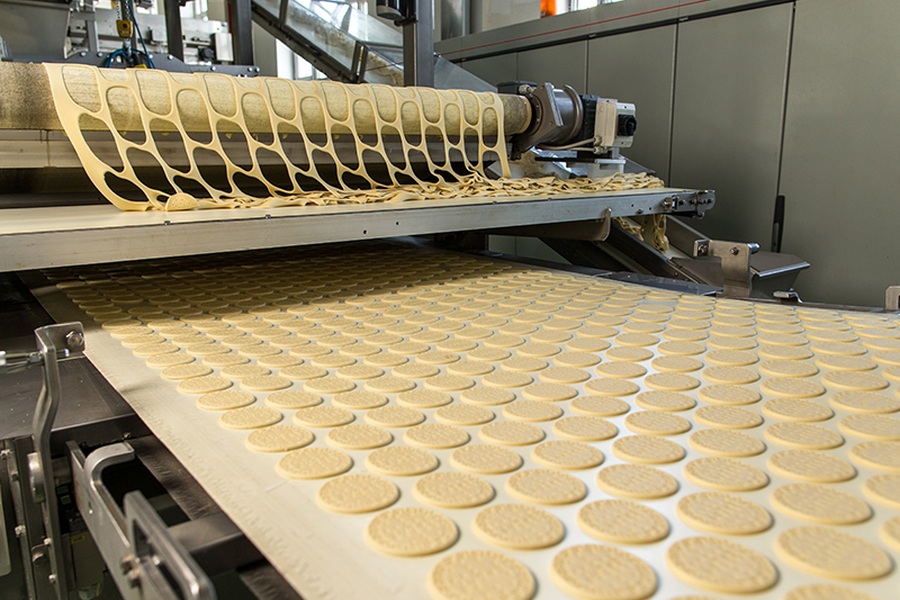
A food grade PVC conveyor belt can be a practical solution for many dry, light-duty processing and packaging applications. Bakery transfer, packaged food handling, inspection lines and similar conveyors may not need the same belt construction as wet protein processing or heavier-duty conveying.
For an OEM, PVC can also offer useful fabrication flexibility. But the buyer still needs to specify the surface, construction, pulley arrangement and joint rather than ordering by color alone. Tight transfers, inclines or special product release requirements can change the correct configuration.
2.2 When PU Deserves Closer Consideration
A PU conveyor belt is often considered when food directly contacts the conveying surface and cleaning performance is a major part of the application. Moisture, residues and frequent sanitation can make belt construction and surface behavior more important than initial purchase price.
That does not make PU a universal upgrade over PVC. A processor still needs to check product grip or release, cleaning chemicals, temperatures, conveyor geometry and the specific compliance evidence available for the proposed belt. The right question is not “Is PU better?” but “Does this PU construction fit this process better?”
2.3 Where White Rubber Fits
White rubber conveyor belts belong in a different decision space. They may be considered when the application calls for characteristics associated with a rubber belt construction while cleanliness, visual inspection or non-marking considerations favor a white surface.
Again, color is not compliance. If the belt will directly contact food, the buyer should verify the specific compound and relevant food-contact documentation. If it will only carry packaged food, the purchasing specification may be different. Making that distinction before requesting quotations prevents suppliers from pricing fundamentally different products against the same vague description.
3. The Application Data a Supplier Needs Before Recommending a Belt
A manufacturer cannot make a reliable selection from “white food belt, 2 mm” alone. That description leaves out many of the conditions that determine whether a belt tracks, releases product, survives cleaning and bends around the conveyor's pulleys.
RFQ Checklist for Food Processors and OEMs
- Food or packaged product being conveyed
- Whether contact with food is direct or indirect
- Belt width, endless length and required thickness if already defined
- Existing belt material and construction for replacement projects
- Conveyor layout, including pulley or roller diameters
- Belt speed and incline/decline conditions where relevant
- Product and ambient temperature
- Presence of water, oil, fat, sugar, acids or other process residues
- Cleaning method and cleaning agents
- Required surface pattern, cleats, guides or sidewalls
- Preferred splice or endless construction
- Required food-contact standard, declaration or test documentation
- Order quantity and destination
For an existing machine, photos, drawings and the current belt specification can remove significant ambiguity. For a new OEM project, drawings of the belt path and pulley arrangement are especially useful. A supplier that asks these questions before quoting is in a better position to identify specification conflicts early.
4. Supplier Qualification Is More Than Asking for a Certificate
Compliance evidence is important, but procurement risk also comes from manufacturing inconsistency, incomplete specifications and poor communication between sample approval and mass production.
When qualifying a food grade conveyor belt manufacturer, processors and OEMs should examine the complete supply process: how the supplier reviews the RFQ, how specifications are confirmed, what inspection is performed, what documentation can accompany the shipment and how a quality issue would be handled.
SINOCONVE's factory was established in 1988 and has more than 35 years of manufacturing experience. The company supports customized conveyor belt production and OEM/ODM cooperation based on customer requirements, drawings or samples. Its documented quality process includes incoming raw-material inspection, in-process inspection and final testing before shipment. ISO certificates and product test reports can be provided, and third-party testing can be arranged when a customer has special standard requirements.
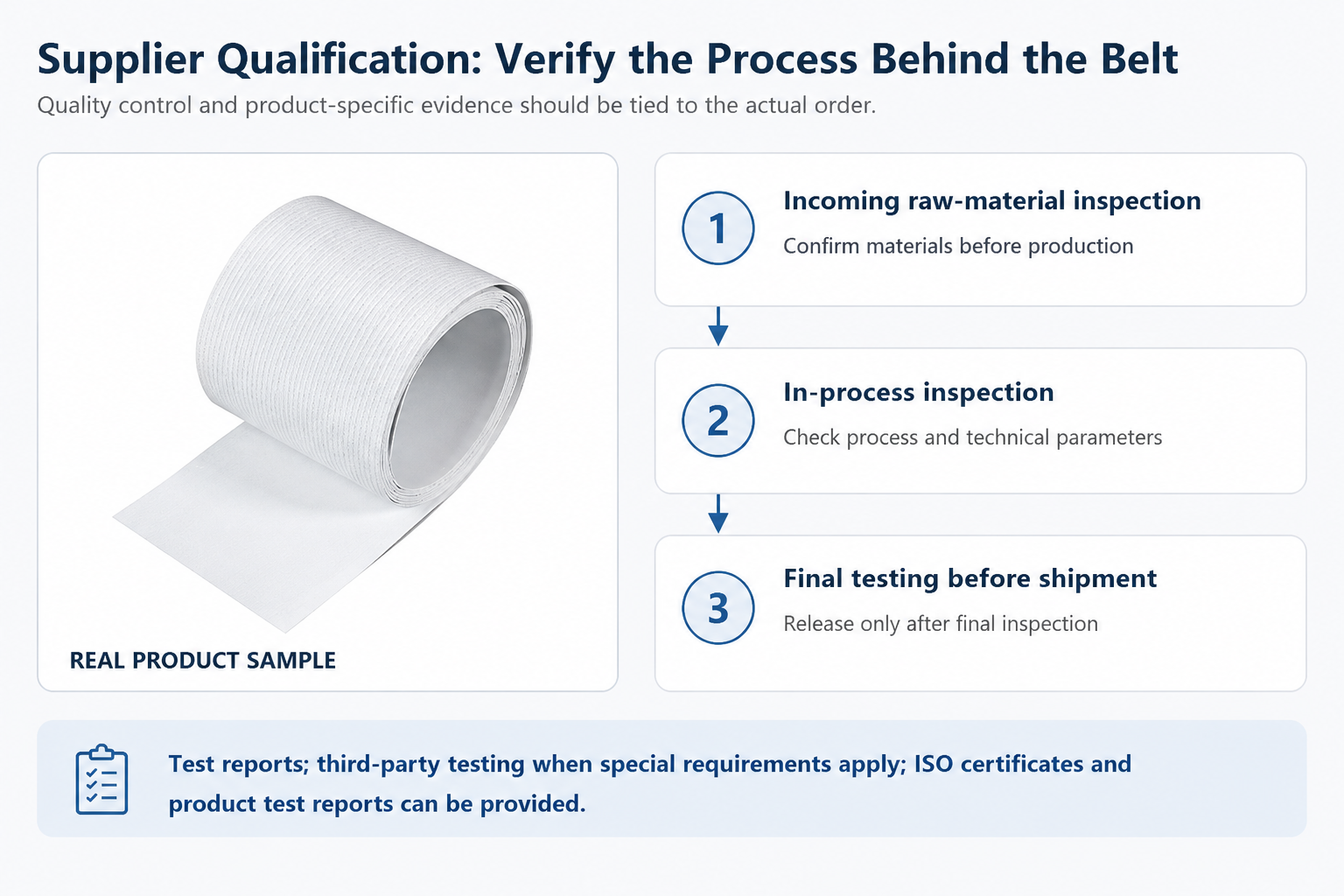
Those capabilities are useful during supplier screening, but buyers should still connect them to the actual order. Instead of asking only “Do you have ISO?”, ask which documents will apply to the specific food conveyor belt being quoted and which characteristics will be checked before shipment.
Procurement Warning: A company-level quality certificate and a product-specific food-contact document answer different questions. Do not treat one as automatic proof of the other. Ask the supplier to identify the exact evidence associated with the belt material and intended application.
5. How Equipment OEMs Should Evaluate Customization Capability
For an equipment manufacturer, the purchasing problem extends beyond finding one belt that works. The approved belt may need to be reproduced across multiple machines, supplied with specific fabrication, packaged under an OEM arrangement and supported when machine designs change.
This makes technical communication part of supplier qualification. Useful questions include whether the factory can work from drawings or samples, customize belt dimensions and construction, support logo or packaging requirements, and review special operating conditions before production.
SINOCONVE supports customized conveyor belts according to customer requirements as well as drawing- and sample-based customization, logo customization, color and packaging customization, and OEM/ODM cooperation. Standard or small test samples can also be provided for evaluation.
For custom projects, sample approval should not become a substitute for a written specification. Record the approved material, construction, dimensions, surface, splice or fabrication details and required documentation. That specification gives both buyer and manufacturer a clearer reference for repeat orders.
6. Compare Quotations on the Same Technical Basis
Two quotations labeled “food grade conveyor belt” may not represent equivalent products. One supplier may quote PVC while another quotes PU. Fabric construction, belt thickness, surface finish, fabrication and compliance documentation can also differ.
A useful commercial comparison therefore starts only after the technical scope has been normalized.
| Quotation Item | What to Verify | Why It Matters |
|---|---|---|
| Material and construction | PVC, PU or rubber; reinforcement and surface construction | Prevents comparison of technically different belts as if they were identical. |
| Dimensions | Width, length, thickness and dimensional tolerances required by the machine | Critical for fit, tracking and repeat OEM production. |
| Fabrication | Joint, guides, cleats, sidewalls or other required features | Fabrication can materially change both performance and quotation scope. |
| Food-contact evidence | Documents applicable to the quoted material and intended market | Avoids relying on generic “food grade” claims. |
| Inspection documentation | Available product test or inspection reports | Helps procurement establish what can be verified before shipment. |
| Commercial terms | MOQ, production schedule, packaging, payment and destination | Allows landed procurement risk to be compared after technical equivalence is established. |
SINOCONVE's stated MOQ for conveyor belts is 50 meters. General production lead time is approximately 30 days, while urgent orders may be handled through an accelerated production arrangement of around 15–20 days, subject to the actual order and production schedule. Because SINOCONVE conveyor belts are customized rather than held as standard finished-goods stock, buyers should confirm the final specification and required delivery date before placing an order.
7. Sample Testing and Pre-Shipment Verification Reduce Purchase Risk
For an OEM introducing a new belt construction or a processor changing from an existing material, a sample can help identify obvious compatibility issues before a larger purchase. SINOCONVE can provide standard samples or small test samples, depending on the requirement.
Sample evaluation should reproduce the real application as closely as practical. A short sample viewed on a desk cannot prove tracking, cleaning behavior or long-term performance on a production conveyor. Where possible, check the belt against the actual product, conveyor geometry and cleaning process.
Before shipment, buyers should also agree on which specification details and documents need to be verified. SINOCONVE's quality-control process includes raw-material checks, production inspection and final inspection/testing before shipment. Product test reports can be provided. If the project requires special third-party verification, this should be discussed before the order rather than after production is complete.
8. Common Food Conveyor Belt Sourcing Mistakes
Buying by color. White PVC, white PU and white rubber can represent very different constructions. Color may support visibility, but it does not define performance or food-contact status.
Sending an incomplete RFQ. Without pulley diameter, cleaning conditions, conveyed product and other operating information, suppliers may quote products based on different assumptions.
Using “FDA” as the entire specification. The buyer needs to determine which food-contact requirements and documents apply to the material and intended use. A generic statement should not replace product-specific verification.
Ignoring the splice and edges. Hygienic performance depends on more than the top surface. Belt fabrication, joints, edges and the conveyor itself can influence how easily residues can be removed.
Comparing price before technical equivalence. A lower quotation is not necessarily lower cost if it excludes required fabrication, documentation or a construction needed by the machine.
Failing to control the approved specification. OEMs should record what was approved so repeat orders can be checked against the same requirements.
9. Questions to Ask a Food Grade Conveyor Belt Manufacturer Before an RFQ
A short supplier questionnaire can reveal more than a long list of marketing claims. Ask questions that require specific answers:
- Which belt material and construction do you recommend for this product and cleaning environment, and why?
- What food-contact documentation can you provide for the exact belt being quoted?
- What operating information do you need before confirming the specification?
- Can you manufacture from our drawing, current belt sample or machine specification?
- Which belt dimensions and fabrication details will be recorded on the quotation?
- Can you provide a sample for evaluation?
- What inspections or test reports can be supplied before shipment?
- What is the MOQ and production lead time for this customized construction?
- How will repeat orders be matched to the approved specification?
- How are product-quality claims handled after delivery?
SINOCONVE states that confirmed product-quality issues are handled through discussion with the customer, with solutions potentially including replacement, compensation or technical support depending on the situation. For standard conveyor belt products, the company's stated warranty is generally one year; the actual terms should still be confirmed for the specific quotation and application.
10. FAQ
Is every white conveyor belt food grade?
No. White is a color, not proof of food-contact compliance. Buyers should verify the belt material, compound or coating, intended contact conditions and the documentation applicable to the specific product.
Is PU always better than PVC for food processing?
No. PU and PVC have different application profiles. The decision depends on the food product, moisture and oil exposure, cleaning method, temperature, surface requirements, conveyor geometry and required documentation. A dry bakery or packaging conveyor may have very different requirements from a wet processing line.
When should a processor consider a white rubber conveyor belt?
White rubber may be considered when the application needs a rubber belt construction or different mechanical behavior while maintaining a light-colored conveying surface. For direct food contact, the actual compound and relevant compliance evidence still need to be verified.
What information should I send for a custom food conveyor belt quotation?
Provide the conveyed product, direct or indirect food-contact condition, belt width and length, existing construction if available, pulley diameters, conveyor layout, speed or incline where relevant, temperature, moisture/oil exposure, cleaning method, required fabrication, compliance requirements, quantity and destination. Photos or drawings are useful for replacement and OEM projects.
Can SINOCONVE manufacture customized food conveyor belts?
SINOCONVE supports customized conveyor belt production according to customer requirements, drawings or samples, as well as logo, color, packaging and OEM/ODM customization. The final construction should be confirmed against the actual application before production.
Can buyers request samples and test reports?
Yes. SINOCONVE states that standard samples or small test samples can be provided. ISO certificates and product test reports can also be supplied, and third-party testing can be arranged where special requirements apply.
What is SINOCONVE's MOQ for conveyor belts?
The stated minimum order quantity for conveyor belts is 50 meters. Because specifications can vary significantly, buyers should confirm the MOQ for the actual customized belt during quotation.

11. Prepare a Better Food Conveyor Belt RFQ
Selecting a food grade conveyor belt manufacturer is easier when the RFQ describes the process rather than only naming a belt material. Start with what touches the belt, how the conveyor operates, how the line is cleaned and which documents must be supplied. Then determine whether PVC, PU or white rubber provides the appropriate construction for that specific duty.
For a SINOCONVE quotation or technical review:
Send the current belt specification or machine drawing together with belt dimensions, conveyed product, contact conditions, cleaning method, operating temperature, pulley information, required fabrication, compliance/documentation requirements, quantity and destination. Contact SINOCONVE at sales@sinoconve.com.
Related Food Conveyor Belt Resources
If you are still comparing belt materials or preparing an OEM specification, these SINOCONVE resources can help you continue the selection process:
- Food Grade PVC Conveyor Belt: What Buyers Should Check — selection points for bakery, food-processing and light-duty food lines.
- PU Conveyor Belt for Food Handling and Hygienic Lines — factors to check when cleanability, moisture and food handling influence belt selection.
- White Rubber Conveyor Belt: What Buyers Should Know — explains why white color alone does not determine application suitability.
- PVC Conveyor Belt Types: How to Choose the Right Structure — compares structural choices that can affect tracking, joining and conveyor compatibility.
- SINOCONVE Conveyor Belt Product Catalog — product-category access for rubber conveyor belts, PVC conveyor belts and other belting solutions.
```