
Why corrugated sidewall conveyor belts matter in steep conveying
A corrugated sidewall conveyor belt is one of those components that only gets attention when a plant runs out of room. Once a material stream has to climb sharply, or even move close to vertical, ordinary flat belts start giving away useful capacity through slip, rollback, and spillage. For engineers and sourcing teams, the real question is not whether the belt looks more complicated than a standard conveyor belt. It is whether the conveyor layout can be simplified without sacrificing material control.
That is where the sidewall belt earns its place. Its molded sidewalls and cross-cleat geometry help contain loose product on the carrying surface, making steep angle conveyor arrangements more practical for bulk material handling. In other words, the belt is not just transporting material; it is helping define the path the material can safely take.
What the belt is designed to do
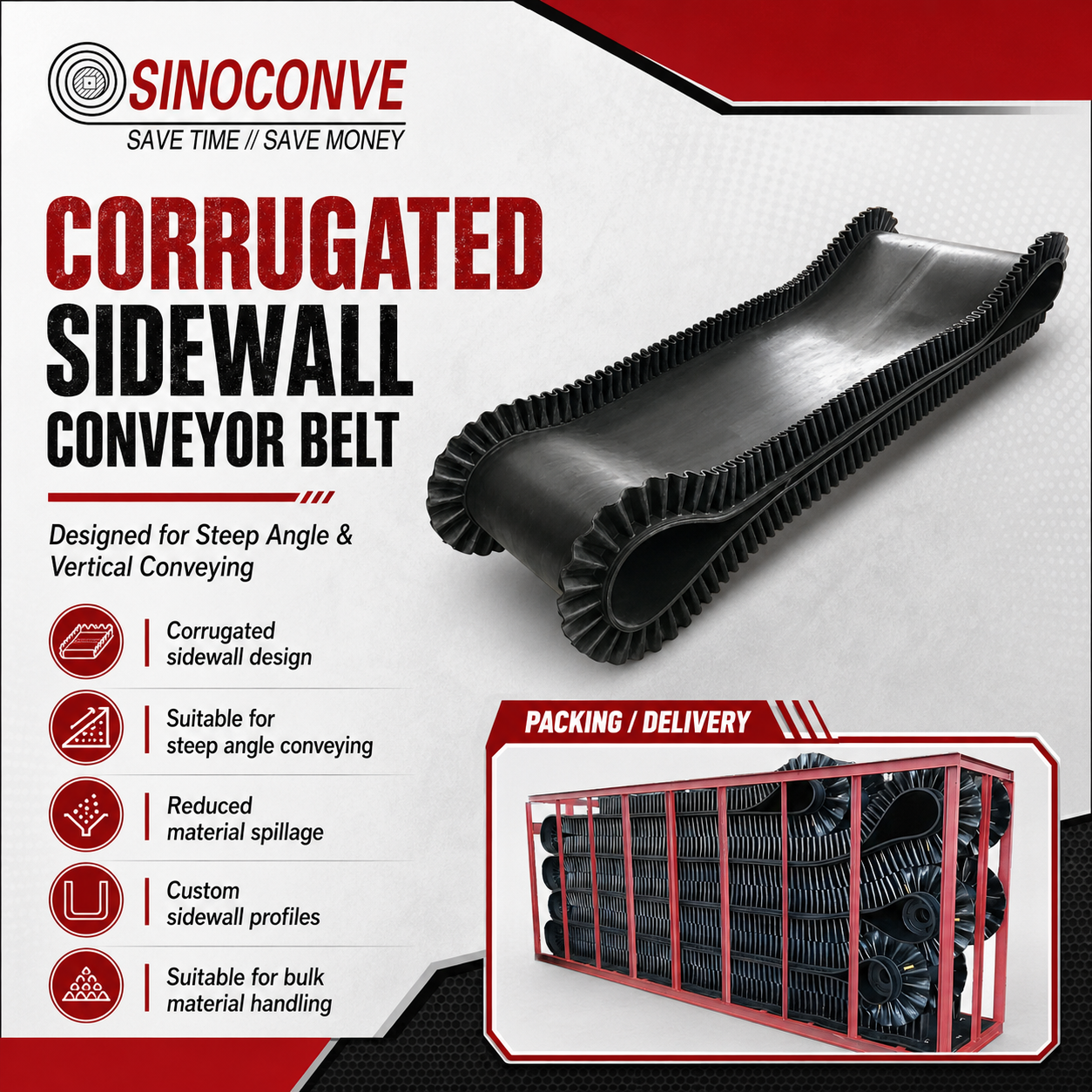
The visible structure is straightforward: a flat central carrying section with flexible corrugated sidewall belt profiles along both edges. Those raised edges are intended to retain material during vertical conveying and other steep-lift applications. In service, the geometry reduces lateral loss and helps the load stay centered as the belt changes angle.
That makes the belt useful in mining, aggregate transfer, agriculture, recycling, packaging, and similar systems where bulk material handling has to happen in limited space. The idea is to move material up or down without building long transfer runs, extra chutes, or a maze of intermediate conveyors. Sometimes that saves floor space. Sometimes it saves a project from becoming a civil works job.
How this belt differs from a standard conveyor belt
A standard belt is built for relatively gentle conveying. It works well when material can travel on a shallow incline and remain stable across the belt width. A sidewall belt, by contrast, is shaped for containment. The sidewalls act as flexible barriers, while the cleats or molded features help organize the load during the lift.
This does not mean every material should go vertical. Fine powders, mixed-size aggregates, fibrous waste, and irregular bulk solids all behave differently. A buyer should still ask whether the material flows freely, bridges, or packs under load. Those details matter more than the marketing description on a brochure.
Selection points that matter in practice
1. Material behavior
Before specifying a sidewall belt, define the product being conveyed. Free-flowing pellets are one thing; sticky, dusty, or abrasive bulk solids are another. The belt geometry may be suitable, but the material may still demand careful hopper design, loading control, and discharge planning.
2. Conveyor angle and routing
The main reason to choose a corrugated sidewall conveyor belt is the route itself. If the system has to handle steep angle conveyor sections or vertical conveying, the belt can support a much tighter footprint than conventional designs. That said, the complete system still has to be engineered around the belt, not the other way around.
3. Belt construction and fabrication method
The belt shown appears to be a black rubber or rubber-like elastomer product supplied in rolled form for shipping. The exact compound, reinforcement, and fabrication process are not specified here, so it would be unwise to assume a particular vulcanization method or performance class. For buyers, the better approach is to confirm the belt’s build, sidewall profile, and compatibility with the drive and idler arrangement before placing the order.
Common mistakes buyers make
One frequent mistake is assuming the sidewall alone solves every handling problem. It does not. If the feed point overloads the belt, or if transfer geometry dumps material too aggressively, spillage can still happen. Another common issue is underestimating how product bulk density and particle shape affect the usable cross-section of the belt. A belt that looks oversized on paper can become marginal once the material is in motion.
There is also the practical matter of installation. A corrugated sidewall belt is usually supplied in a compact rolled configuration, which helps with transport and site handling. But installation still needs care, especially where alignment and tracking are critical. Rushed commissioning is a good way to turn a capable belt into an expensive troubleshooting exercise.
Buyer-facing checklist before you specify a sidewall belt
Ask for the intended use case, the conveyor angle range, the material characteristics, and the available footprint. Confirm whether the belt is meant for steep-angle or vertical conveying, and whether the sidewall profile is standardized or custom. If the system is part of a bulk material handling line with frequent loading changes, get clarity on maintenance access and replacement strategy as well.
It is also worth checking how the belt will arrive on site. Rolled belts packaged in shipping frames are convenient, but only if your receiving and handling plan matches the delivery format.
What this product helps you decide
If your conveyor route is getting steeper and the traditional layout is running out of room, a corrugated sidewall conveyor belt is worth serious consideration. It can support vertical conveying, reduce material spillage, and make a compact conveying route possible. The decision, though, should be based on material behavior and system geometry, not just on the promise of a tighter footprint.
For sourcing managers and project engineers, the next step is usually simple: define the material, measure the route, and ask the belt supplier for a sidewall profile and construction that fits the application rather than forcing a generic belt into a difficult job.
FAQ
Is a sidewall belt only for vertical conveying?
No. It is commonly used for steep angle conveyor layouts as well, especially where material retention is important.
Can it replace a standard belt in any system?
Not automatically. The conveyor structure, loading method, and product characteristics all need to be reviewed first.
Why are these belts often shipped rolled?
Rolling makes transport and site handling easier, especially for long industrial belts supplied for bulk material handling systems.