Tags
Recent Posts
Steel Cord Conveyor Belts for Heavy Loads

Steel Cord Conveyor Belts for Heavy Loads

A steel cord conveyor belt is used when long distance, high tension, heavy loads, and low elongation matter. This article explains how ST rating, cover grade, cord layout, pulley diameter, splice design, and failure marks affect belt selection for mining and heavy-duty conveying systems.

PH and PK Ribbed Belts: Technical Guide for Compact and High-Speed Drive Systems

PH and PK Ribbed Belts: Technical Guide for Compact and High-Speed Drive Systems

1.PH and PK ribbed belts look similar externally — using one in place of the other is a reliable way to cause early failure or drive noise. 2.PH belt: 1.6 mm pitch, light-duty, ultra-quiet — suited for medical equipment, office automation, robotics, and 3D printers. 3.PK belt: 3.56 mm pitch, medium to heavy-duty — the standard for automotive serpentine drives, HVAC, and industrial machinery. 4.Rib pitch and rib count are both fixed specifications, not ranges — both must match the pulley exactly. 5.Compound grade cannot be assumed from visual appearance — EPDM and standard rubber look the same and perform very differently under heat or oil. 6.Serpentine routing and small pulley diameters favor PH; sustained torque under dynamic load favors PK. 7.Continuous-duty systems need certified fatigue resistance; frequent-replacement applications benefit from standard pitch for easy field sourcing.

Not All PVC Conveyor Belts Are the Same: How to Match the Right Type to Your Workflow

Not All PVC Conveyor Belts Are the Same: How to Match the Right Type to Your Workflow

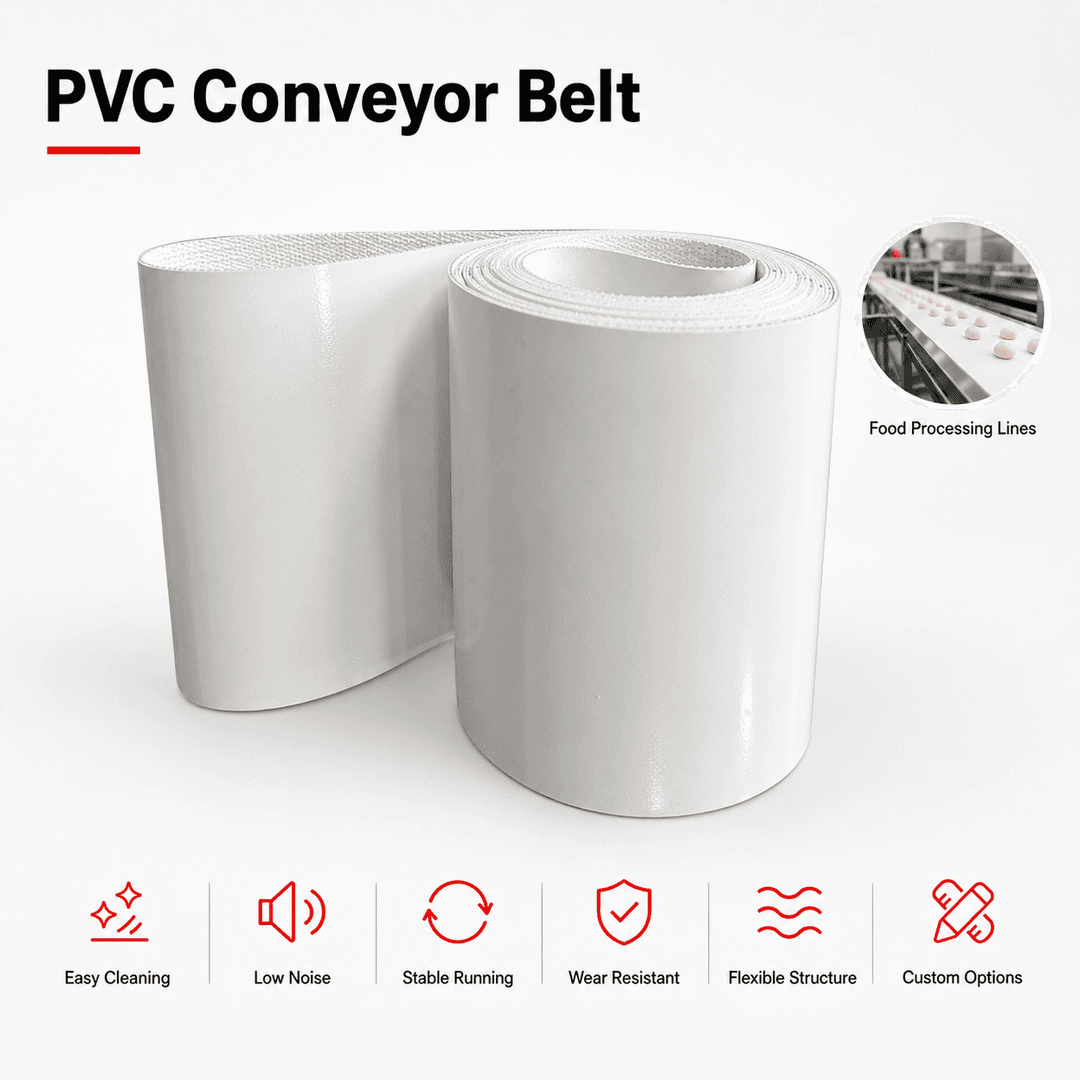
Explore the four most common types of PVC conveyor belts—clipper joint, flat, guide-strip, and sidewall—and learn how to choose the right one for your specific conveying system.

Vulcanizing Machine Guide: Modern Features and Tips

Vulcanizing Machine Guide: Modern Features and Tips

1.Unvulcanized rubber deforms, degrades, and lacks elasticity — the vulcanizing machine is what makes rubber industrially useful. 2.Uneven platen temperature and pressure loss during cure are the two machine-side causes of weak splices. 3.Digital control units enable stored cure profiles and consistent parameters across shifts — manual systems depend on operator attention. 4.Cure time must account for heat transfer through rubber thickness, not just surface temperature. 5.Pressure must be applied before temperature peaks, and maintained until the assembly cools below 60–70 degrees. 6.Platen surface condition, thermocouple calibration, and pressure system integrity are the three maintenance checks that directly affect splice quality. 7.Belt width sets the platen size requirement — a narrow platen forces multiple cure steps, which introduces a known weakness through the splice.

Sidewall Conveyor Belt: Efficiency & Safety Redefined

Sidewall Conveyor Belt: Efficiency & Safety Redefined

1.Standard flat belts cap out at around 20 degrees — sidewall conveyor belts handle up to 90 degrees without rollback. 2.Corrugated sidewalls and transverse cleats create enclosed pockets that carry material rather than just supporting it. 3.Steep-angle capability compresses horizontal footprint, eliminating transfer points and freeing up floor space. 4.The sidewall rubber conveyor belt contains fine powders and loose bulk materials structurally — no operator intervention needed. 5.Fewer moving parts than bucket elevators means lower maintenance frequency and simpler troubleshooting. 6.Sidewall, cleat, and base belt compounds each need separate specification — flexibility and abrasion resistance are different requirements.

Steel Cord Rubber Conveyor Belt: Durability and Efficiency in Material Handling

Steel Cord Rubber Conveyor Belt: Durability and Efficiency in Material Handling

1.Fabric-ply belts hit their limits fast on long, heavy runs — steel cord construction is what closes that gap. 2.Parallel steel cables replace textile plies in the carcass, delivering higher tensile strength and far less elongation under load. 3.Fewer transfer points, longer single-flight spans, and lower infrastructure cost are the direct operational payoff. 4.Troughability and load stability require a design balance — longitudinal stiffness without sacrificing transverse flexibility. 5.Steel cord construction limits rip propagation when tramp material strikes, containing damage that would destroy a fabric belt. 6.Splice quality is the most critical maintenance variable — a poorly executed vulcanized splice undermines everything else. 7.Mining, ports, power generation, and cement production are the core applications, each for slightly different reasons.

Steel Cord Conveyor Belts for Heavy Loads

Steel Cord Conveyor Belts for Heavy Loads

A steel cord conveyor belt is used when long distance, high tension, heavy loads, and low elongation matter. This article explains how ST rating, cover grade, cord layout, pulley diameter, splice design, and failure marks affect belt selection for mining and heavy-duty conveying systems.

Read More
PH and PK Ribbed Belts: Technical Guide for Compact and High-Speed Drive Systems

PH and PK Ribbed Belts: Technical Guide for Compact and High-Speed Drive Systems

1.PH and PK ribbed belts look similar externally — using one in place of the other is a reliable way to cause early failure or drive noise. 2.PH belt: 1.6 mm pitch, light-duty, ultra-quiet — suited for medical equipment, office automation, robotics, and 3D printers. 3.PK belt: 3.56 mm pitch, medium to heavy-duty — the standard for automotive serpentine drives, HVAC, and industrial machinery. 4.Rib pitch and rib count are both fixed specifications, not ranges — both must match the pulley exactly. 5.Compound grade cannot be assumed from visual appearance — EPDM and standard rubber look the same and perform very differently under heat or oil. 6.Serpentine routing and small pulley diameters favor PH; sustained torque under dynamic load favors PK. 7.Continuous-duty systems need certified fatigue resistance; frequent-replacement applications benefit from standard pitch for easy field sourcing.

Read More
Not All PVC Conveyor Belts Are the Same: How to Match the Right Type to Your Workflow

Not All PVC Conveyor Belts Are the Same: How to Match the Right Type to Your Workflow

Explore the four most common types of PVC conveyor belts—clipper joint, flat, guide-strip, and sidewall—and learn how to choose the right one for your specific conveying system.

Read More
Vulcanizing Machine Guide: Modern Features and Tips

Vulcanizing Machine Guide: Modern Features and Tips

1.Unvulcanized rubber deforms, degrades, and lacks elasticity — the vulcanizing machine is what makes rubber industrially useful. 2.Uneven platen temperature and pressure loss during cure are the two machine-side causes of weak splices. 3.Digital control units enable stored cure profiles and consistent parameters across shifts — manual systems depend on operator attention. 4.Cure time must account for heat transfer through rubber thickness, not just surface temperature. 5.Pressure must be applied before temperature peaks, and maintained until the assembly cools below 60–70 degrees. 6.Platen surface condition, thermocouple calibration, and pressure system integrity are the three maintenance checks that directly affect splice quality. 7.Belt width sets the platen size requirement — a narrow platen forces multiple cure steps, which introduces a known weakness through the splice.

Read More
Sidewall Conveyor Belt: Efficiency & Safety Redefined

Sidewall Conveyor Belt: Efficiency & Safety Redefined

1.Standard flat belts cap out at around 20 degrees — sidewall conveyor belts handle up to 90 degrees without rollback. 2.Corrugated sidewalls and transverse cleats create enclosed pockets that carry material rather than just supporting it. 3.Steep-angle capability compresses horizontal footprint, eliminating transfer points and freeing up floor space. 4.The sidewall rubber conveyor belt contains fine powders and loose bulk materials structurally — no operator intervention needed. 5.Fewer moving parts than bucket elevators means lower maintenance frequency and simpler troubleshooting. 6.Sidewall, cleat, and base belt compounds each need separate specification — flexibility and abrasion resistance are different requirements.

Read More
Steel Cord Rubber Conveyor Belt: Durability and Efficiency in Material Handling

Steel Cord Rubber Conveyor Belt: Durability and Efficiency in Material Handling

1.Fabric-ply belts hit their limits fast on long, heavy runs — steel cord construction is what closes that gap. 2.Parallel steel cables replace textile plies in the carcass, delivering higher tensile strength and far less elongation under load. 3.Fewer transfer points, longer single-flight spans, and lower infrastructure cost are the direct operational payoff. 4.Troughability and load stability require a design balance — longitudinal stiffness without sacrificing transverse flexibility. 5.Steel cord construction limits rip propagation when tramp material strikes, containing damage that would destroy a fabric belt. 6.Splice quality is the most critical maintenance variable — a poorly executed vulcanized splice undermines everything else. 7.Mining, ports, power generation, and cement production are the core applications, each for slightly different reasons.

Read More

Explore more

We are committed to providing you with better products and services. Welcome to browse more content for details