
Endless Conveyor Belts: Seamless Performance for High Precision and Clean Conveying
What Is an Endless Conveyor Belt?
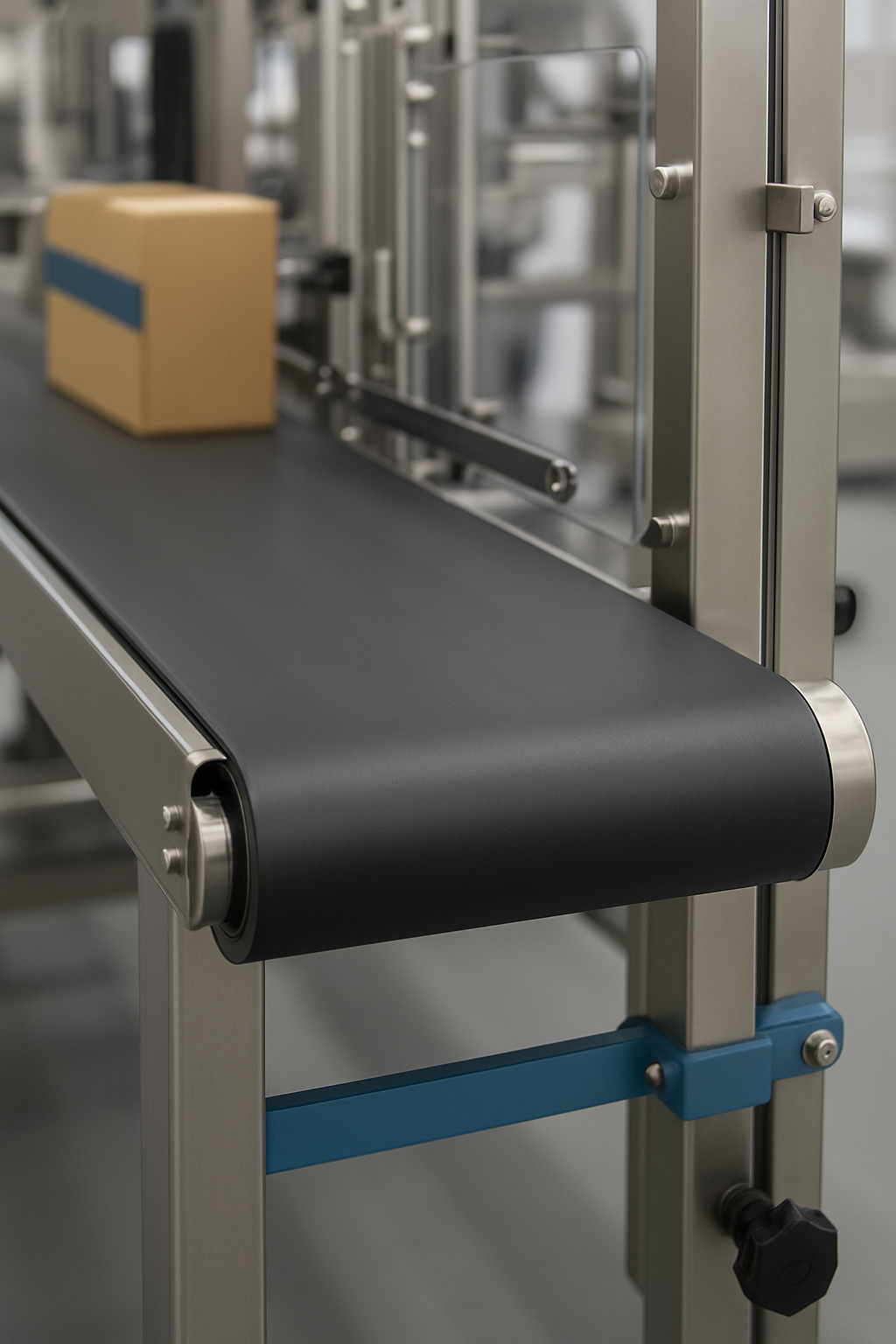
An endless conveyor belt is a belt manufactured without any mechanical or vulcanized splice, meaning the belt is produced or joined into a continuous loop. This jointless structure offers superior tracking, reduced vibration, and a smoother surface compared to traditional belts with cold joints or mechanical fasteners.
These belts are typically fabricated through endless weaving, mold-cured loops, or hot vulcanization, depending on the material and application.
Key Features and Benefits
Zero Splice, Zero Weak Point
No risk of joint failure, delamination, or breakage—ideal for 24/7 operations where downtime is costly.
Smooth Surface for Precision Handling
No bump or thickness inconsistency at the splice—essential for sensors, labeling, inspection, or printing.
No Noise, No Vibration
Seamless belts run quietly and without tension imbalance, improving bearing life and machine stability.
Improved Tracking and Alignment
Splice-free construction ensures better belt tracking, reduces off-tracking risk, and simplifies tension calibration.
More Hygienic in Clean Environments
No splice edges means fewer places for debris, bacteria, or liquid to accumulate—especially important in food, pharma, and electronics.
Typical Applications of Endless Conveyor Belts
Endless belts are chosen in industries requiring precision, cleanliness, or continuous operation without interruption:
Packaging and Labeling
-
For automated carton sealing, bottle labeling, pouch packing
-
Seamless movement improves print alignment and packaging accuracy
Printing and Inspection
-
Used in high-speed printing lines, camera vision systems, and optical sorters
-
Splice-free belt avoids signal interference and print skewing
Pharmaceutical & Cleanroom Systems
-
In tablet counting, filling, or blister packaging systems
-
Endless belts reduce particulate generation and avoid dead zones
Electronics Assembly
-
Conveyorized SMT (surface mount technology) lines and circuit board handling
-
Requires antistatic, clean-running, zero-bounce belt movement
Precision Parts Transfer
-
Bearings, gears, machine parts, small components
-
Endless belts support low-impact, synchronized conveying
Endless Belt vs. Spliced Belt: Quick Comparison
| Feature | Endless Belt | Spliced Belt |
|---|---|---|
| Splice Strength | Uniform—no splice | Weakened at splice |
| Tracking | More stable | May drift if splice misaligned |
| Surface Smoothness | Seamless | Slight bump or unevenness |
| Hygiene Level | Very high | Lower (prone to buildup) |
| Vibration | Low | Higher at splice area |
| Durability (under tension) | High | Depends on splice quality |
Materials Available for Endless Belts
Endless belts are available in different base materials depending on usage:
| Material | Application |
|---|---|
| PU / TPU | Food, pharma, electronics, cleanroom |
| PVC | Packaging, logistics, textile |
| Rubber (natural, neoprene, EPDM) | Heavy-duty or outdoor systems |
| Fabric (cotton, polyester) | Friction drive systems, dry use |
| Nylon Core / Timing Core | High-speed synchronized motion systems |
Most endless belts can be custom ordered in looped fabric or molded cured rubber, with antistatic, oil-resistant, or FDA-grade options available.
How to Select the Right Endless Conveyor Belt
Selecting the right endless belt depends on application precision, environmental cleanliness, and motion control needs. Focus on these five key factors:
-
Length & Loop Accuracy: For synchronous systems, ensure belt length tolerance within ±0.5–1 mm. Even slight deviations can cause drift or timing errors.
-
Material & Surface: Choose PU or TPU for cleanroom and pharma lines, PVC for dry packaging, and rubber for friction-heavy or outdoor use. Match surface finish (smooth, matte, fabric-back) to friction and release needs.
-
Width & Edge Control: The belt width should be 1–3 mm narrower than the pulley face to allow clean tracking without edge wear.
-
Antistatic Requirements: Electronics and printing systems need conductive or static-dissipative belts to avoid damage or misprints.
-
Cleanability: For food or pharma, select closed-surface, non-porous belts that resist water and cleaning agents.
Tip: Endless belts cannot be trimmed or repaired—confirm specs carefully before ordering.
Why Choose Sinoconve’s Endless Belts?
At Sinoconve, we manufacture precision endless conveyor belts with:
-
Seamless PU, PVC, and rubber compounds
-
Looping accuracy up to ±1 mm for synchronous applications
-
Antistatic and FDA-certified options
-
Embossed, smooth, or custom textures
-
OEM/ODM support for industrial equipment manufacturers
-
Fast global delivery and design assistance
Our belts run in labeling machines, medical systems, electronics lines, and packaging equipment across 100+ countries.
Choose Seamless Precision—Choose Endless Belts
If your application demands clean, quiet, and uninterrupted conveying, an endless conveyor belt is the smart choice. No splices, no weak points—just performance that runs smooth and lasts longer.
If you are looking for this type of conveyor belt or want to learn more, please visit our home page or contact us directly. We will get back to you within 24 hours.