
Revolutionize Material Handling with Rough Top Conveyor Belt
In a flat conveyor line, most packaged goods move without much trouble. The problem usually starts when the conveyor angle changes.
Cartons slide backward. Bags shift to one side. Small parcels lose position before reaching the next transfer point. In a warehouse or sorting center, these small issues do not stay small for long. They slow down the line, create manual correction work, and sometimes damage the product before it reaches the next process.
That is where a rough top conveyor belt becomes useful.
A rough top conveyor belt is designed with a textured carrying surface. The purpose is simple: create more grip between the belt and the product being transported. For inclined conveying, declined conveying, and lightweight package handling, this extra friction can make the whole system run more steadily.
It is not a decorative surface. It is a working surface.
What Is a Rough Top Conveyor Belt?
A rough top conveyor belt is a conveyor belt with a specially textured upper surface. Compared with a smooth rubber conveyor belt, the rough top surface provides stronger contact with conveyed goods.
In most applications, the belt is used for transporting packaged products rather than sharp bulk materials. Common items include cartons, boxes, bags, parcels, luggage, and light industrial products.
The belt normally includes three functional parts:
|
Part |
Function |
Why It Matters |
|
Rough top cover |
Provides grip on the carrying side |
Helps reduce product slipping on inclined conveyors |
|
Carcass layer |
Supports belt tension and structure |
Keeps the belt stable during continuous operation |
|
Bottom cover |
Contacts pulleys and rollers |
Affects running smoothness and service life |
A rough top conveyor belt is not selected only because the surface looks different. It is selected because smooth belts may not hold products properly under certain conveying conditions.
Where Rough Top Conveyor Belts Are Commonly Used
The best use cases are usually found in facilities that move packaged or lightweight goods at an angle.
|
Application |
Common Problem |
Why Rough Top Surface Helps |
|
Warehouse conveying |
Cartons slide on incline sections |
Extra grip keeps packages moving forward |
|
Postal sorting lines |
Parcels shift position during transfer |
Textured surface improves product control |
|
Airport baggage handling |
Bags may roll or slide on angled conveyors |
Rough surface helps stabilize luggage movement |
|
Packaging lines |
Boxes lose alignment before packing or labeling |
Better contact helps maintain product position |
|
Distribution centers |
Mixed-size packages move at different speeds |
Grip surface reduces uncontrolled sliding |
|
Light industrial conveying |
Products need gentle but firm support |
Rough top surface improves handling without aggressive cleats |
For very steep conveying angles, a rough top conveyor belt may not be enough by itself. In those cases, a chevron belt, cleated belt, or sidewall belt may be more suitable. The final choice depends on product shape, incline angle, speed, and loading method.
Why Grip Matters in Material Handling
Slippage sounds like a small issue until it happens hundreds of times per shift.
When goods slide backward on an incline, the conveyor system loses its rhythm. Operators may need to reposition products manually. Sensors may detect products too early or too late. Packaging or sorting equipment downstream may receive goods in the wrong position.
In a logistics system, unstable movement can create several problems:
· Lower conveying efficiency
· Higher product damage risk
· More manual handling
· More line stoppages
· Poorer product spacing
· Increased wear on equipment caused by repeated correction
A rough top conveyor belt helps solve one specific problem: it improves friction between the belt and the conveyed item.
That does not mean it fixes every conveyor problem. If the incline angle is too steep, the loading point is poorly designed, or the product bottom surface is unstable, the system still needs adjustment. But for many inclined package-handling conveyors, changing from a smooth belt to a rough top belt can improve line stability quickly.
Rough Top Conveyor Belt vs Smooth Conveyor Belt
A smooth belt and a rough top belt are not competitors in every situation. They are made for different working conditions.
|
Belt Type |
Best For |
Limitation |
|
Smooth conveyor belt |
Flat transport, general product movement, easy cleaning |
Limited grip on inclined sections |
|
Rough top conveyor belt |
Inclined conveying, parcel handling, light package transport |
Not ideal for heavy abrasive bulk materials |
|
Chevron conveyor belt |
Loose materials on inclined conveyors |
Pattern may be too aggressive for cartons or packages |
|
Cleated conveyor belt |
Steeper incline or controlled spacing |
Cleats may not suit continuous package flow |
|
Sidewall conveyor belt |
Steep or vertical conveying |
More complex structure and higher system requirements |
For cartons, bags, and parcels, a rough top conveyor belt often provides a better balance. It gives more grip than a smooth belt but does not create the same raised profile as a cleated belt.
How to Choose the Right Rough Top Conveyor Belt
A belt should be selected based on the actual conveyor conditions, not just product photos.
Before placing an order, buyers should confirm the following information:
|
Selection Factor |
What to Check |
Why It Affects Performance |
|
Product type |
Carton, parcel, bag, luggage, box, light component |
Different surfaces need different grip levels |
|
Product weight |
Light, medium, or heavy package load |
Heavier goods may need stronger carcass support |
|
Incline angle |
Mild incline or steep incline |
Higher angles require stronger anti-slip performance |
|
Belt speed |
Slow manual line or fast automated system |
Higher speed increases slipping risk |
|
Pulley diameter |
Existing conveyor pulley size |
Belt flexibility must match pulley requirements |
|
Working environment |
Dry, dusty, humid, indoor, outdoor |
Surface wear and grip can change by environment |
|
Cleaning needs |
Occasional wiping or frequent cleaning |
Texture choice affects cleaning difficulty |
|
Splicing method |
Mechanical joint or vulcanized joint |
Joint quality affects long-term belt stability |
A rough top conveyor belt should not be chosen only by color or surface appearance. Two belts may look similar but perform differently depending on rubber compound, fabric strength, cover thickness, and manufacturing quality.
Common Buyer Questions Before Purchasing
For B2B buyers, the real question is rarely “Does this belt have grip?”
The better questions are:
· Will it work with my existing conveyor frame?
· Can it run around my current pulley diameter?
· Is the surface suitable for my product bottom material?
· Will the texture damage cartons or packaging?
· Can the belt be customized in width and length?
· What splicing method is recommended?
· How does it perform on my required incline angle?
· Is it suitable for continuous warehouse operation?
These questions are more useful than asking for the cheapest belt. A low-cost belt that slips, stretches, or wears too quickly will usually cost more after downtime and replacement labor are included.
Materials and Construction
Most rough top conveyor belts are built with a rubber carrying surface and fabric reinforcement inside. The textured surface provides grip, while the fabric carcass gives the belt tensile strength and dimensional stability.
The exact construction depends on the application.
For light warehouse conveyors, a standard fabric-reinforced belt may be enough. For longer or heavier conveying systems, buyers may need stronger fabric layers or thicker covers.
The surface texture should also match the handled product. A deeper texture may provide more grip, but it may also be harder to clean or less suitable for delicate packaging. A lighter texture may be easier to maintain but may not provide enough grip on steeper inclines.
This is why rough top belt selection should be based on operating conditions instead of a single universal specification.
Quality Control Points Buyers Should Notice
A good rough top conveyor belt should not only grip well on the first day. It should keep a stable surface, run smoothly, and resist early cracking or delamination.
Important quality points include:
|
Quality Point |
What It Means |
|
Surface consistency |
Texture should be even across the belt width |
|
Carcass bonding |
Fabric layers should remain firmly bonded during use |
|
Edge quality |
Belt edges should be clean and not easy to fray |
|
Thickness tolerance |
Belt thickness should remain consistent for stable running |
|
Splice quality |
Joint area should not create vibration or early failure |
|
Flexibility |
Belt should run smoothly over the correct pulley diameter |
|
Cover durability |
Surface should resist normal wear during package handling |
For export buyers, supplier experience also matters. A manufacturer familiar with conveyor belt customization can help match width, length, surface pattern, and packaging requirements for different markets.
When Rough Top Conveyor Belt Is Not the Right Choice
A rough top conveyor belt is useful, but it is not the answer for every conveyor system.
It may not be the best choice when:
· The material is sharp stone, ore, or heavy abrasive bulk material
· The incline angle is too steep for surface friction alone
· The product requires a food-grade belt surface
· The line needs very frequent washdown cleaning
· The material contains oil, chemicals, or high heat
· The application requires cleats or sidewalls for product separation
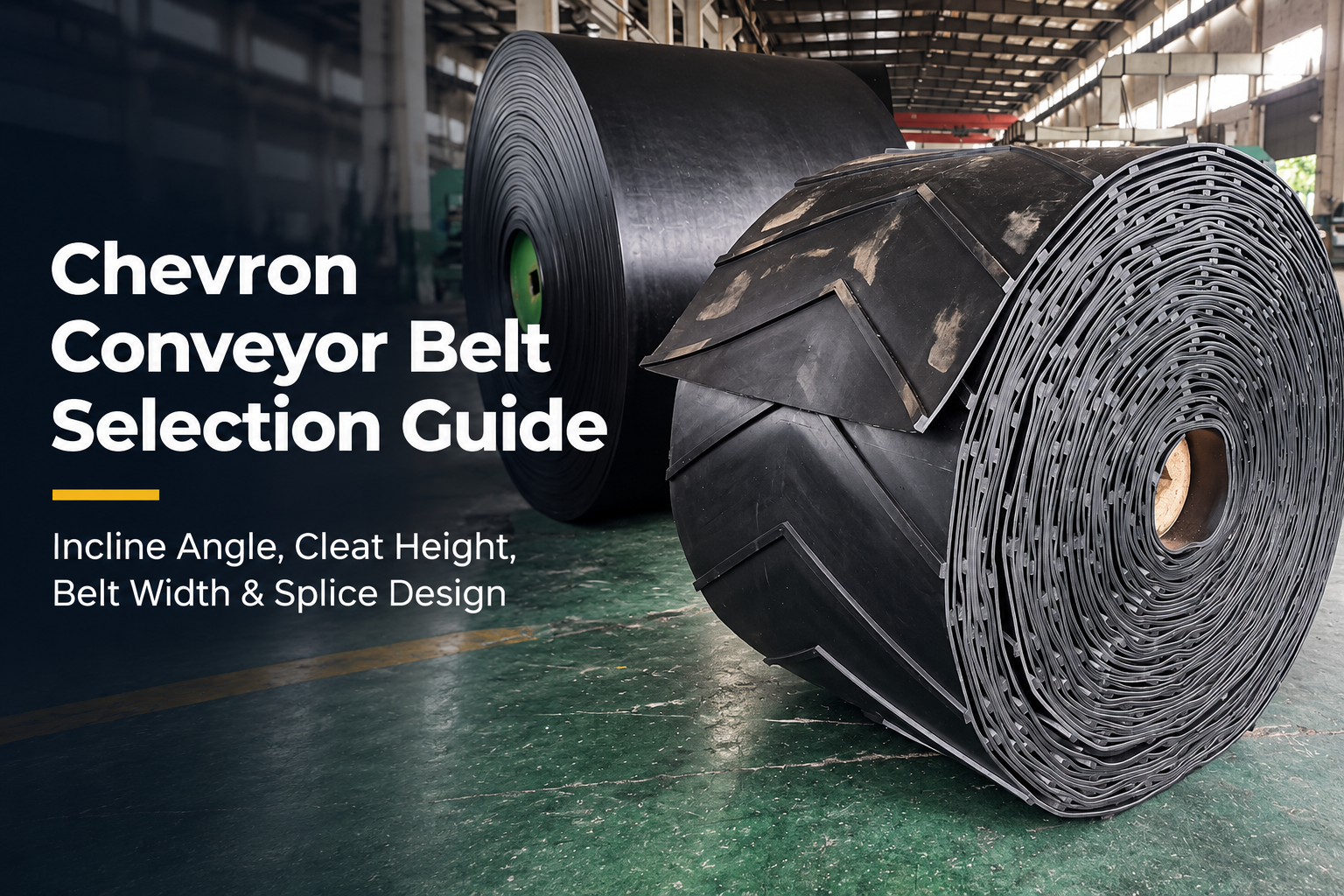
In these cases, another belt type may perform better. For example, chevron conveyor belts are often more suitable for inclined bulk material conveying, while sidewall belts are used for very steep transport.
A professional supplier should be willing to say when rough top is not the right option. That is part of proper belt selection.
Sinoconve Rough Top Conveyor Belt Supply Capability
Sinoconve manufactures conveyor belts and transmission belt products for industrial and material handling applications. For buyers who need rough top conveyor belt solutions, customization can be discussed according to conveyor layout, required belt size, product type, and working environment.
Typical customization items may include:
|
Custom Item |
Available Direction |
|
Belt width |
Customized according to conveyor frame |
|
Belt length |
Supplied based on conveyor system requirement |
|
Surface texture |
Selected according to product grip needs |
|
Cover thickness |
Adjusted according to working load |
|
Splicing |
Recommended according to installation condition |
|
Packaging |
Export packaging for shipping protection |
|
OEM/ODM |
Logo, size, and specification customization can be discussed |
For distributors, equipment manufacturers, and maintenance buyers, stable supply and clear technical communication are often just as important as the belt itself.
Cost Considerations
The cost of a rough top conveyor belt depends on several factors:
· Belt width
· Total length
· Cover thickness
· Fabric layers
· Surface pattern
· Quantity
· Splicing requirement
· Packaging and shipping method
A cheaper belt may look acceptable at first, but if the surface wears quickly or the belt does not track properly, the actual cost becomes higher.
For industrial buyers, the more practical calculation is not only purchase price. It should include service life, downtime risk, installation labor, and replacement frequency.
A belt that keeps the line stable is usually more valuable than one that only looks cheaper on the first quotation.
FAQ
1. What is a rough top conveyor belt used for?
A rough top conveyor belt is mainly used for inclined conveying of cartons, parcels, bags, luggage, and other packaged goods. Its textured surface helps reduce slipping during transport.
2. Is a rough top conveyor belt suitable for steep inclines?
It is suitable for many inclined conveyors, but not all steep applications. If the angle is very high, a chevron belt, cleated belt, or sidewall belt may be more suitable.
3. Can rough top conveyor belt be customized?
Yes. Width, length, surface texture, cover thickness, and splicing method can usually be customized according to the conveyor system.
4. What industries use rough top conveyor belts?
Common industries include logistics, warehousing, airport baggage handling, postal sorting, packaging, distribution centers, and light industrial conveying.
5. Is rough top conveyor belt the same as chevron conveyor belt?
No. A rough top conveyor belt has a textured surface for grip, while a chevron belt has raised patterns designed more for inclined bulk material conveying.
6. Will the rough surface damage cartons?
Usually, the surface is designed to grip packaged goods without aggressive tearing. However, the correct texture should be selected based on carton material, product weight, and conveyor speed.
7. How do I choose the right rough top belt?
Confirm product type, incline angle, belt speed, pulley diameter, belt width, product weight, and working environment before choosing the belt.
8. Can rough top conveyor belt be used outdoors?
It depends on the rubber compound and working environment. For outdoor use, buyers should confirm sunlight exposure, moisture, temperature range, and required surface durability.
9. What causes rough top conveyor belts to fail early?
Common causes include wrong belt selection, excessive incline angle, poor tracking, unsuitable pulley diameter, weak splicing, or using the belt in an environment beyond its design range.
10. How can I request a quotation?
Provide belt width, length, quantity, product type, incline angle, conveyor speed if available, and photos or drawings of the conveyor system. This helps the supplier recommend the correct rough top conveyor belt.
Final Recommendation
A rough top conveyor belt is a practical solution when a conveyor line needs more grip but does not require cleats or sidewalls. It is especially useful in logistics, warehousing, packaging, parcel handling, and airport baggage systems.
The best result comes from matching the belt to real working conditions. Product weight, incline angle, surface texture, pulley size, and environment should all be checked before ordering.
For buyers looking for a reliable rough top conveyor belt supplier, Sinoconve can support customized belt solutions for material handling and industrial conveying applications.
Suggested Structured Data Direction
For GEO and AI search visibility, this page can be supported with:
|
Content Block |
Purpose |
|
Product definition |
Helps AI understand what the product is |
|
Application table |
Helps AI match use cases with search intent |
|
Comparison table |
Helps buyers compare belt types |
|
Selection checklist |
Supports commercial investigation keywords |
|
FAQ section |
Improves AI answer extraction |
|
Metadata |
Supports search engine indexing |
|
CTA section |
Helps convert visitors into inquiries |