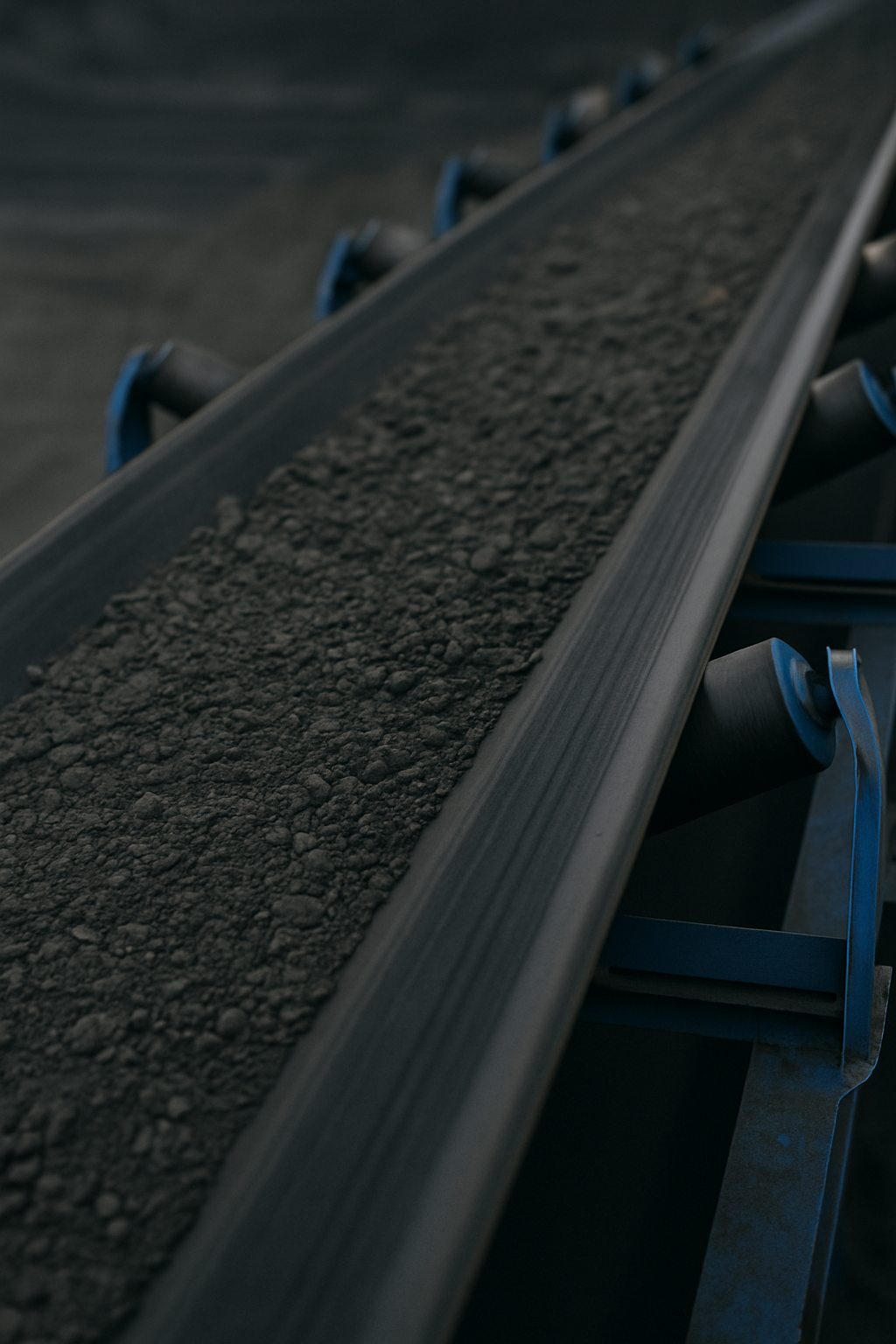

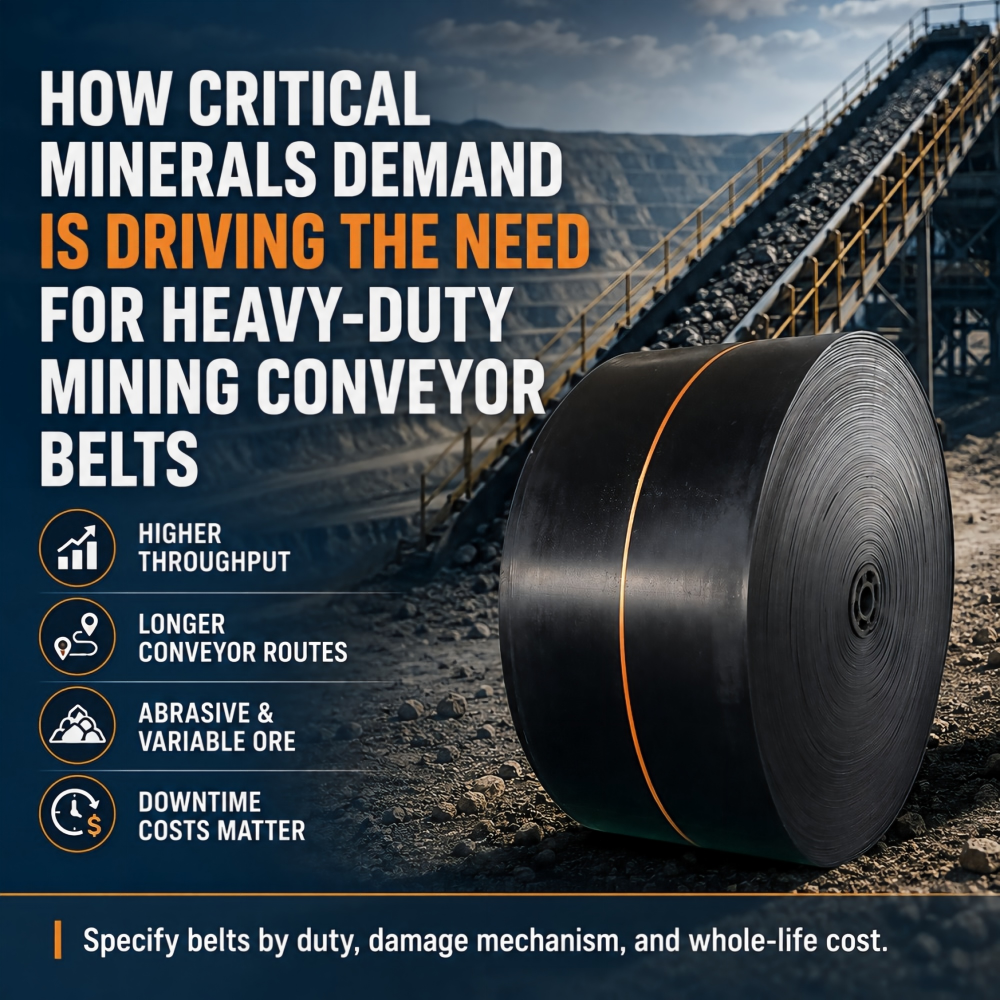
 The pressure on critical-mineral supply chains is beginning to show up in places far removed from battery factories and policy meetings. At the mine, it appears as another crusher campaign, a higher daily tonnage target, a longer overland route, or a transfer point that now handles harder and more variable rock than the original conveyor was designed for.
The International Energy Agency reported in its 2026 critical-minerals outlook that copper prices reached record highs and that projected copper supply still falls short of expected demand in 2035. Lithium, cobalt, graphite, rare earths, tungsten, and other strategic materials are also receiving more investment and policy attention. Not every announced project will become a mine, but the direction is clear: existing operations are being asked to improve output while new projects are developed in increasingly demanding locations.
For a mining conveyor belt, that changes the purchasing question. The belt is no longer judged only by whether it can carry ore on commissioning day. Buyers need to know how it will respond to higher throughput, sharp lumps, declining ore grades, longer operating hours, difficult splices, and the cost of stopping a critical line.
More Mineral Demand Usually Means More Material Movement
Critical minerals demand does not translate directly into the same percentage increase in conveyor capacity. Mine design, ore grade, processing route, and expansion strategy all differ. Still, the operating effect is familiar: more run-of-mine material must be moved from extraction to crushing, screening, stockpiling, and processing.
The IEA has highlighted declining ore quality as one reason new copper supply is becoming more capital intensive. When ore grade falls, a mine may need to handle more rock to recover the same quantity of metal. That increases the duty placed on crushers, transfer chutes, idlers, cleaners, and the rubber conveyor belt between them.
|
Mining change |
Effect on the conveyor |
Belt issue to review |
|
Higher tonnes per hour |
More material load and higher operating tension |
Carcass strength, belt width, speed, take-up |
|
Longer mine-to-plant route |
Greater tension and more cumulative rolling resistance |
Low elongation, splice design, pulley compatibility |
|
Lower or more variable ore grade |
More rock moved and less consistent feed |
Abrasion, impact, chute control, cover selection |
|
Deeper pit or new elevation |
Longer lifts and changing conveyor geometry |
Strength rating, braking, transition distances |
|
Extended operating hours |
Less time for inspection and repair |
Belt durability, monitoring, planned maintenance |
A Heavy-Duty Conveyor Belt Is More Than a Thick Belt
“Heavy duty” is often used as a broad sales description. In engineering terms, it should describe a belt whose tensile member, covers, splice, and protective features are matched to a defined conveyor duty. Adding top-cover thickness without changing the rubber compound or carcass may provide more material to wear away, but it does not automatically improve resistance to cutting, impact, heat, or longitudinal ripping.
Fenner Dunlop separates fine abrasive wear from damage caused by heavy and sharp objects. Sand and small aggregate can scour a cover continuously, while large rock can cut, gouge, and puncture it. The same cover compound is not necessarily best for both mechanisms. A mining conveyor belt should therefore be selected from the material behaviour, not only from an abrasion-value table.
|
Main damage mechanism |
What it looks like |
Specification direction |
|
Fine abrasion |
Gradual, relatively even cover loss |
Abrasion-resistant compound and suitable wear allowance |
|
Cutting and gouging |
Deep local cuts from angular rock |
Cut/gouge-resistant cover and impact control |
|
High impact |
Punctures, carcass bruising, splice stress |
Impact-resistant carcass, breaker where justified, supported load zone |
|
Longitudinal rip |
Extended tear caused by trapped material |
Rip-resistant construction, detection, better chute housekeeping |
|
Heat or chemical attack |
Hardening, cracking, swelling, adhesion loss |
Application-specific rubber compound |
Textile, Steel Cord, or Another Reinforcement?
The correct tensile member depends on conveyor length, operating tension, impact, pulley sizes, take-up travel, and splice requirements. A textile-reinforced heavy duty conveyor belt can be a reliable choice for many mine conveyors, especially where flexibility and conventional hot splicing are important. ISO 14890 covers textile-construction belts for general surface use.
Steel cord construction becomes more attractive as the required tensile capacity and conveyor length increase. ISO 15236 specifies construction and performance requirements for steel cord conveyor belts. Continental notes that steel cords provide high strength and low elongation, while cord design and rubber bonding are selected to support operating tension and splice efficiency.
|
Belt construction |
Where it often fits |
Buyer caution |
|
Multi-ply textile belt |
Short- to medium-length mine conveyors and plant transfers |
Do not add plies without checking flexibility and pulley diameter |
|
Straight-warp or steel-fabric belt |
High impact or severe rip/tear exposure |
Confirm splice method and transverse flexibility |
|
Steel cord belt |
Long-distance, high-tension, high-capacity routes |
Splice quality, corrosion protection, take-up, monitoring |
|
Aramid-reinforced belt |
Long routes where lower belt mass is valuable |
Confirm supplier experience, splice design, and project economics |
A stronger carcass is not automatically a longer-lasting belt. If the loading chute allows large rock to strike unsupported belting, or if the pulley diameter is too small for the construction, a higher tensile rating can still fail early. Strength must be considered with the whole belt conveyor system.
Loading-Zone Design Has a Direct Effect on Belt Life
Critical-mineral projects often handle abrasive, angular material during the primary stages of production. This is where the belt is most vulnerable. Martin Engineering identifies large or sharp material impact, trapped material in a sagging load zone, mistracking, and buildup on rotating components as common sources of conveyor belt damage.
A correctly specified rubber conveyor belt still needs controlled loading. Material should enter near the centreline and with as little difference as practical between material velocity and belt velocity. Impact support, skirt sealing, chute geometry, and idler spacing should keep the belt stable without trapping rock against the cover.
When a mine expands, the transfer point should be reviewed with the belt. Increasing tonnes per hour can raise the material bed, change the trajectory, overload an impact zone, and increase carryback. Reusing the old belt specification without checking the new feed conditions is a common route to premature wear.
Downtime Changes the Economics of Belt Selection
The purchase price of a mining conveyor belt is visible. The cost of an unplanned belt change is spread across lost production, labour, cranes, splicing crews, clean-up, replacement materials, and the effect on downstream equipment. That is why whole-life cost becomes more important as the conveyor moves closer to a production bottleneck.
Fenner Dunlop recommends comparing belts through whole-life cost rather than purchase price alone. This is particularly relevant in critical-mineral mining expansion, where additional output may depend on a small number of high-capacity conveyor routes. A belt that lasts longer and needs fewer running repairs can be commercially cheaper even when its initial price is higher.
|
Cost item |
Often visible before purchase? |
Why it matters |
|
Belt purchase price |
Yes |
Easy to compare but incomplete |
|
Installation and splice labour |
Usually |
Repeated whenever belt life is short |
|
Lost production during failure |
Often underestimated |
Can exceed the belt price on a critical route |
|
Emergency repair and clean-up |
No |
Adds labour, safety exposure, and secondary damage |
|
Disposal and spare inventory |
Partly |
Increases when replacement frequency is high |
Monitoring Is Becoming Part of Heavy-Duty Material Handling
Long mine conveyors are difficult to inspect continuously. Damage can grow between scheduled walk-throughs, especially when a foreign object becomes trapped in a chute or under a skirt. Monitoring does not replace maintenance, but it can reduce the distance and time over which a failure develops.
Continental offers systems that monitor longitudinal rips, steel cord condition, splice condition, cover wear, and material loading. The appropriate level of monitoring depends on belt value, conveyor length, risk, and the consequence of a shutdown. A short plant conveyor may only need disciplined visual inspection. A long overland steel cord belt may justify permanent rip and cord monitoring.
The useful question is not whether a mine should buy the most advanced system available. It is which failure modes are both detectable and expensive enough to justify monitoring. The answer should be decided during conveyor and belt specification, not after the first major incident.
What Buyers Should Specify for Critical-Mineral Projects
An RFQ that asks only for a “heavy duty mining belt” leaves suppliers to make different assumptions. A technically comparable quotation needs the material, conveyor, and failure conditions behind the request.
|
Information to provide |
Example |
Why it matters |
|
Material and lump size |
Copper ore, maximum lump 250 mm |
Defines abrasion, cutting, and impact duty |
|
Bulk density and moisture |
1.9 t/m3, seasonal moisture |
Affects capacity, loading, and carryback |
|
Conveyor data |
Length, lift, speed, capacity, angle |
Supports tensile and power calculations |
|
Pulley and take-up data |
Drive, tail, bend diameters and travel |
Checks flexibility and elongation |
|
Loading-zone details |
Drop height, chute layout, impact support |
Shows puncture and entrapment risk |
|
Required belt construction |
EP, straight warp, steel cord, or open to calculation |
Prevents quotation by appearance |
|
Cover and safety requirements |
Abrasion, flame, heat, oil, underground standard |
Matches compound and compliance |
|
Current failure history |
Rip, edge wear, splice damage, early cover loss |
Helps correct the existing weakness |
|
Monitoring and inspection |
Rip loops, cord scan, wear measurement |
Supports downtime-risk planning |
Common Specification Mistakes
One mistake is selecting belt strength from the conveyed material alone. Conveyor tension comes from the route, lift, speed, capacity, friction, and starting conditions. Another is choosing the thickest cover without confirming whether the damage is abrasion, gouging, impact, or trapped-material ripping.
Buyers also underestimate splice quality. The splice is part of the tensile system, particularly on high-strength and long-distance conveyors. A premium belt joined with an unsuitable procedure is not a premium installation. The belt supplier, splice contractor, and mine engineering team should agree on joint design, materials, curing conditions, and inspection records.
Finally, expansion projects sometimes copy an existing belt because it is already approved in the spare-parts system. That is reasonable only if the new material stream, capacity, loading point, route, and pulley layout remain within the old design basis.
FAQ
Why is critical minerals demand relevant to mining conveyor belts?
Higher mineral output and new mine development can increase tonnes moved, conveyor length, operating hours, and loading severity. These changes raise the importance of belt strength, abrasion resistance, impact protection, and downtime control.
What makes a mining conveyor belt heavy duty?
A heavy-duty belt has a carcass, covers, splice, and protective features designed for a defined load and environment. Thickness alone does not make a belt heavy duty.
When should a mine use a steel cord belt?
Steel cord is commonly considered for long-distance, high-tension, and high-capacity routes where low elongation and high tensile strength are required.
Which rubber cover is best for mining?
It depends on the dominant damage mechanism. Fine abrasive material, sharp rock, high impact, heat, oil, and fire-risk service require different compound properties.
How can mines reduce belt downtime?
Control the loading zone, keep the conveyor aligned and clean, inspect splices and rotating components, select the belt by whole-life duty, and use condition monitoring where the shutdown risk justifies it.
What should buyers send for a quotation?
Provide material data, conveyor geometry, capacity, belt speed, pulleys, take-up, loading conditions, existing failures, cover requirements, splice expectations, and any monitoring or safety standard.
Final Buying Advice
Critical minerals may be the market headline, but the conveyor still deals with rock, impact, tension, heat, dust, and limited maintenance time. The right mining conveyor belt is the one designed for those physical conditions and for the economic consequence of stopping the line. Start with the expanded duty, identify the dominant damage mechanisms, choose the carcass and cover separately, and compare suppliers on whole-life performance rather than price per metre alone.