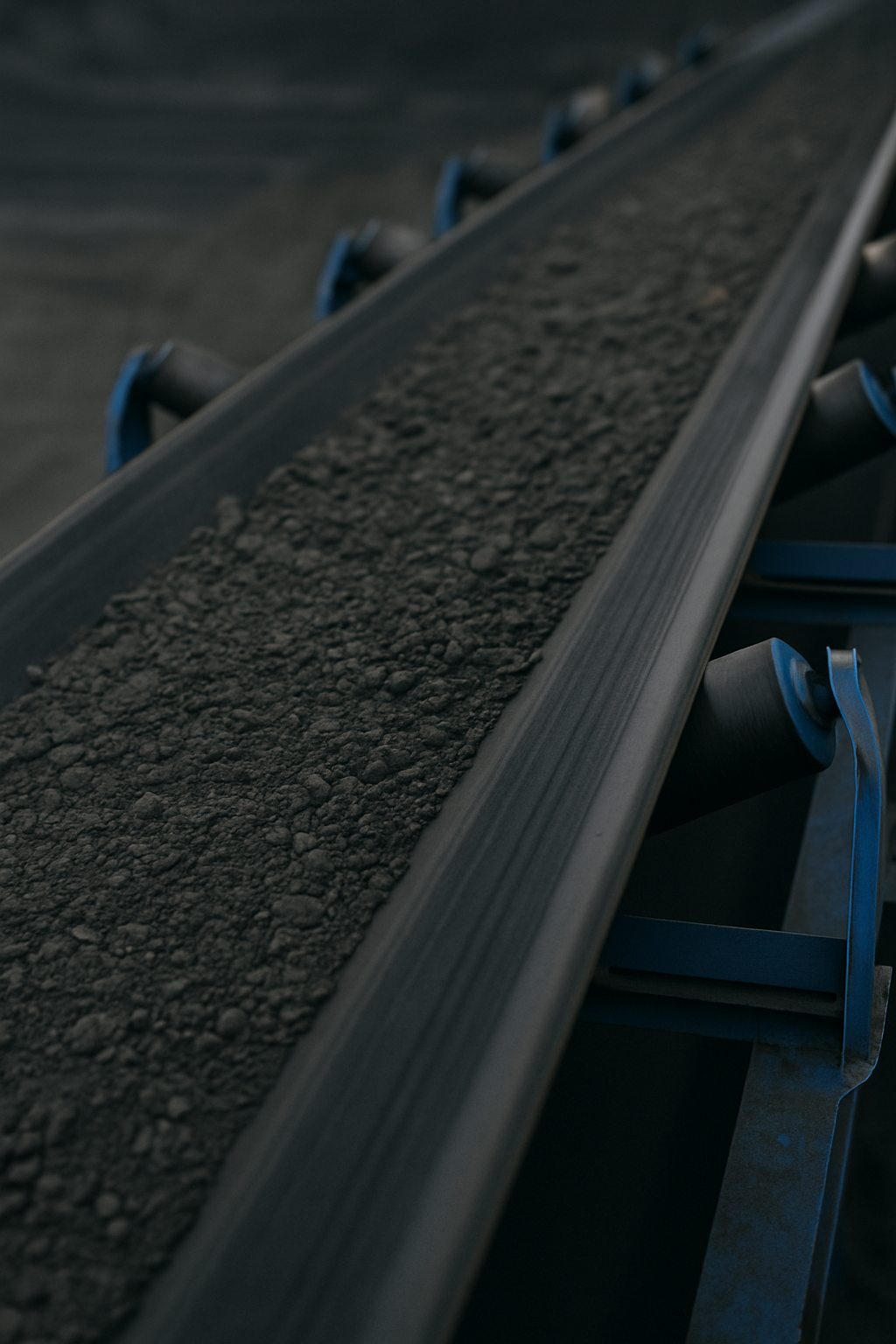

We get the same three phone calls at our plant every week. A maintenance supervisor wants to know how many meters are left on a partially used roll. A purchasing lead needs a length estimate before a new belt is cut, with enough extra for splicing. And somebody with a motor and a pulley wants to know what size V-belt will fit the center distance they have. None of those calls needs a full design review. Each one needs a quick, reliable estimate — the kind you can do on a notepad at the tail pulley while the line is down.
SINOCONVE has built conveyor belting for more than 35 years, and as a conveyor belt manufacturer we have learned that most ordering mistakes start with arithmetic, not quality. A roll that comes up short, a splice allowance nobody added, a drive belt ordered on the wrong measuring system — these are the expensive, avoidable errors. This guide is the reference we hand our own sales engineers before they quote.
Need help turning your conveyor data into a belt spec?
Send us your roll dimensions, pulley speeds and centre distance — our engineers will check your numbers and quote the right belt and V-belt drives.
What follows is a pocket-calculator manual, not a textbook. Each formula is a practical estimate that works in the field, and every one comes with a fully worked example so you can follow the arithmetic. Where a number should be treated as a rule of thumb, we say so. Where the drawing or the factory must confirm, we say that too. Estimate first, confirm second, cut third.
We focus on fabric-carcass conveyor belting — EP and NN constructions — because that is what most plants run, and we touch on steel-cord belts where their behavior differs. Because many conveyors, crushers, and screens are driven through V-belts, we also cover the classic two-pulley length calculation that drive designers use every day.
If belt construction is new territory for you, here is the ten-second version: a rubber conveyor belt is a woven carcass or a set of steel cords wrapped in rubber covers. The carcass decides strength and stretch. The covers decide wear, cut resistance, and how the belt behaves with the material on it. Most of the numbers below come back to those two layers and to one property that rarely gets enough attention: how much the belt stretches once it is tensioned.
One habit saves more mistakes than any formula: keep the units consistent inside each equation. We work in metric because every drawing we ship is metric. Mixing millimeters and meters in one calculation is the fastest way to be wrong by a factor of ten, and we have watched it happen more times than we can count.
01Estimating the Length Left in a Roll of Conveyor Belt
This is the question we hear most: how much belt is still on that roll? You can measure the roll and the core with a tape, and the geometry does the rest. For a roll of uniform total thickness, the classic estimate is:
L = π (D² − d²) / (4t)
where L is the belt length, D is the outside diameter of the roll, d is the outside diameter of the core or spindle, and t is the total belt thickness. All four numbers must use the same unit. If D and d are in meters, t must be in meters too, and the result comes out in meters.
Worked example: full roll of heavy fabric belting
Say you receive a roll with an outside diameter of 1.2 m, wound on a 0.3 m core, and the belt itself is 16 mm (0.016 m) thick — a common range for a heavy-duty EP belt with thick covers. Steps:
D = 1.2 m, soD² = 1.44 m²d = 0.3 m, sod² = 0.09 m²D² − d² = 1.44 − 0.09 = 1.35 m²4t = 4 × 0.016 = 0.064 mL = π × 1.35 / 0.064 ≈ 3.1416 × 1.35 / 0.064 ≈ 4.241 / 0.064 ≈ 66.3 m
So a roll that measures about 1.2 m across holds roughly 66 m of that belt. We use "roughly" on purpose: real rolls compress under their own weight, the core can oval slightly, and cover thickness varies a little along the length. Treat the result as an estimate within a few percent — more than accurate enough to plan a splice, size a truck, or catch a receiving error before the forklift leaves.
Cross-check with the average-wrap method
If you prefer to think in wraps, the same roll has about (D − d) / (2t) = 0.9 / 0.032 ≈ 28 complete wraps. The average wrap diameter is (D + d) / 2 = 0.75 m, and π × 0.75 × 28 ≈ 66 m. Two different routes to the same answer — a good sign the arithmetic is right, and a handy way to sanity-check when you are doing it on a phone calculator.
Worked example: what is left on a partially used roll
Same idea applies when the roll has been running for weeks. Suppose the roll now measures 0.75 m outside diameter on the same 0.3 m core, and this belt is 12 mm thick (0.012 m):
D² = 0.5625 m²,d² = 0.09 m², difference =0.4725 m²4t = 4 × 0.012 = 0.048 mL = π × 0.4725 / 0.048 ≈ 1.485 / 0.048 ≈ 30.9 m
Call it about 31 m left. If your conveyor needs a 40 m belt, do not start cutting — order the replacement before the splice station gets set up.
When you are buying wholesale conveyor belts by the roll, this formula also works backwards: tell a supplier the length you need and the belt thickness, and they can tell you what roll diameter to plan storage space for. Just remember the tape measure wins on delivery day. The formula plans the job; the inspection report and the meter count on the invoice settle it.
02Turning Pulley RPM into Belt Speed
Belt speed is the number underneath almost everything else: it sets throughput, it drives power demand, and it decides whether a load sits still or scoots on the loading zone. If you know the drive pulley diameter and its rotational speed, speed is one line of math:
v = π · D · n / 60
where v is belt speed in m/s, D is the drive pulley diameter in meters, and n is the pulley speed in revolutions per minute.The /60 just converts minutes to seconds; the π · D is the pulley circumference, which is how far the belt travels in one turn.
Worked example: drum rpm to belt speed
Take an industrial conveyor belt running on an 0.8 m diameter drive pulley at 250 rpm:
π · D = 3.1416 × 0.8 ≈ 2.513 mper revolution2.513 × 250 = 628.3 mper minute628.3 / 60 ≈ 10.5 m/s
So the belt surface is moving at about 10.5 m/s. For reference, that is a brisk pace — typical for long overland lines moving abrasive rock at high tonnage. Most in-plant fabric belts run far slower, often between 1 and 4 m/s, but the arithmetic does not care about the application.
Worked example: the other direction
More often you already know the speed you want and need the rpm to set on the gearbox or variable drive. Flip the formula: n = 60 · v / (π · D). Suppose you want 2.5 m/s on a 0.63 m drive pulley:
60 · v = 60 × 2.5 = 150π · D = 3.1416 × 0.63 ≈ 1.979 mn = 150 / 1.979 ≈ 75.8 rpm
Set the drive for about 76 rpm and you will land close to 2.5 m/s.Speed checks like this catch real problems: a pulley that was re-shelled to a larger diameter without anyone touching the drive will quietly raise belt speed, increase wear on the loading zone, and pull more current — and the only clue is a number that no longer matches the nameplate.
A quick word on throughput, kept deliberately rough
People often ask us to turn belt speed into tons per hour. The honest answer: volumetric throughput equals the loaded cross-section area of the material on the belt times the speed times the bulk density — and the cross-section area depends on belt width, trough angle, surcharge angle of the material, and how the chute loads it. That is a chart job, not a napkin job. Still, a napkin number helps you sense-check a proposal. As an illustration only: imagine a moderately loaded 1.2 m wide belt carrying material with an effective cross-section of about 0.05 m², at 2.5 m/s, with a bulk density around 1.6 t/m³. The arithmetic is 0.05 × 2.5 = 0.125 m³/s, times 1.6 gives about 0.2 t/s, which is roughly 720 t/h. Real designs need the proper CEMA or ISO cross-section data — treat anything like this as a ballpark to catch an order-of-magnitude error, nothing more.
03Working Elongation, Splice Allowance, and Take-up: What to Add Before You Cut
A new belt is not the same length after its first week of running as it was on the day it was spliced. Rubber and textile constructions settle, the carcass seats itself, and the belt grows. If nobody planned for that growth, the take-up runs out of travel and the belt starts slipping on the drive pulley, usually on a Friday afternoon. The numbers below are typical published ranges for new-belt behavior. They vary with carcass design, covers, and splice quality, so treat them as planning values — actual figures come from the factory test report or the belt data sheet.
| Carcass construction | Typical strength ratings you will meet | Typical elongation range for a new belt | What it means for take-up planning |
|---|---|---|---|
| EP (polyester warp, nylon weft) | EP100 up to EP600 in standard fabric lines | About 1–2% | Standard screw or gravity take-up normally handles it; keep 1–2% of belt length as usable take-up travel where possible |
| NN (nylon warp and weft) | NN100 up to NN300 class fabrics | About 1.5–2.5% | Highest growth of the fabric group; allow more take-up travel and plan a re-tension visit after the first week |
| Steel cord (ST) | ST500 up to ST7500 in heavy overland lines | About 0.1–0.3% | Very stable once installed; take-up mostly covers start-up alignment and small creep, not big growth |
Read the ranges as guidance, not guarantees. Two EP500 belts from different builds can stretch differently, and a high-grade low-stretch construction narrows the spread. The honest planning rule: confirm elongation against the factory data for the exact belt you are buying.
Why a splice allowance exists
Every endless belt needs a splice, and the splice consumes belt length beyond the measured center-to-center loop. A vulcanized step splice on a multi-ply fabric belt overlaps and steps the carcass plies over a length that often lands somewhere around 1 to 1.5 m per splice, depending on ply count, belt rating, and the splice drawing. Mechanical fasteners take less. The mistake we see most: the loop length is measured perfectly, and the splice allowance is simply forgotten, so the splicers arrive and the belt comes up half a meter short.The fix is a line item. When you estimate an order, add the splice allowance for every joint on the belt — one for a new endless belt, one per field splice if you are joining several rolls into one line.
Here is how it plays out in practice. A plant wants a 200 m endless EP belt with one factory vulcanized splice and one field splice. The maintenance plan allows about 1.2 m of belt per vulcanized joint, so roughly 2.4 m of allowance before anyone starts cutting. Order the belt at about 202.5 m if the supplier cuts to the splice drawing, or confirm the total with your splicer first. If you buy through a conveyor belt distributor, ask them to include the splice allowance in the quoted length and to put the joint count on the order. It is a standard question, and any experienced distributor has heard it a thousand times.
Belt growth on the take-up: the 200 m example again
That same 200 m EP belt, at a typical 1.5% total elongation over its working life, grows about 3 m — 200 × 0.015 = 3. Not all of it shows up at once. Part of the growth is elastic and comes back when tension drops; part is permanent constructional stretch that appears mostly in the first weeks of running. The take-up has to swallow the permanent part, plus a little room for the tensioning system to do its job.If your conveyor has a screw take-up with limited travel, that 3 m number tells you whether the design has room or whether the belt will start slipping before it has properly run in. This is also why we recommend gravity take-ups on long, heavily loaded fabric belts whenever the layout allows.
The belt-sag tension check
Field tension checks do not need a dynamometer. Common field practice on fabric belts: tension the belt until the slack span between two idlers sags about 1/64 of the span length — deflection ≈ span / 64 — where you press on the belt. For a typical top run with 2.5 m between idlers, that means roughly 2500 / 64 ≈ 39 mm of deflection at mid-span under a modest hand or tool pressure. It is crude, but it is repeatable, and it keeps the belt from running either baggy or brutally tight. The same practice, adjusted for the heavier pressure the job requires, is how many installers set the first tension before the motor ever starts.
New belts also need a second visit. After the first few hours and again after the first week, re-check tension and re-tension as needed. A brand-new fabric rubber conveyor belt stretches most in its first days of service, and the take-up travel you saved for exactly that moment is what keeps the drive gripping while the belt seats in. Put the re-tension on the schedule as a task, not a hope.
What to send the factory when you order
When you do place the order, the fastest way to get a correct belt is to send the numbers this guide produces. Give the supplier the belt type and strength (say EP500/4), the width, the total required length including splice allowance, the cover grades, and the elongation data you are designing around. Any serious conveyor belt supplier will confirm the loop length and splice layout back to you on a drawing before production cuts anything. If the factory confirms a different length than your estimate, trust the drawing — but ask why, because the answer usually teaches you something about the belt you are buying.
04Sizing V-Belt Drives on Conveyors and Transfer Equipment
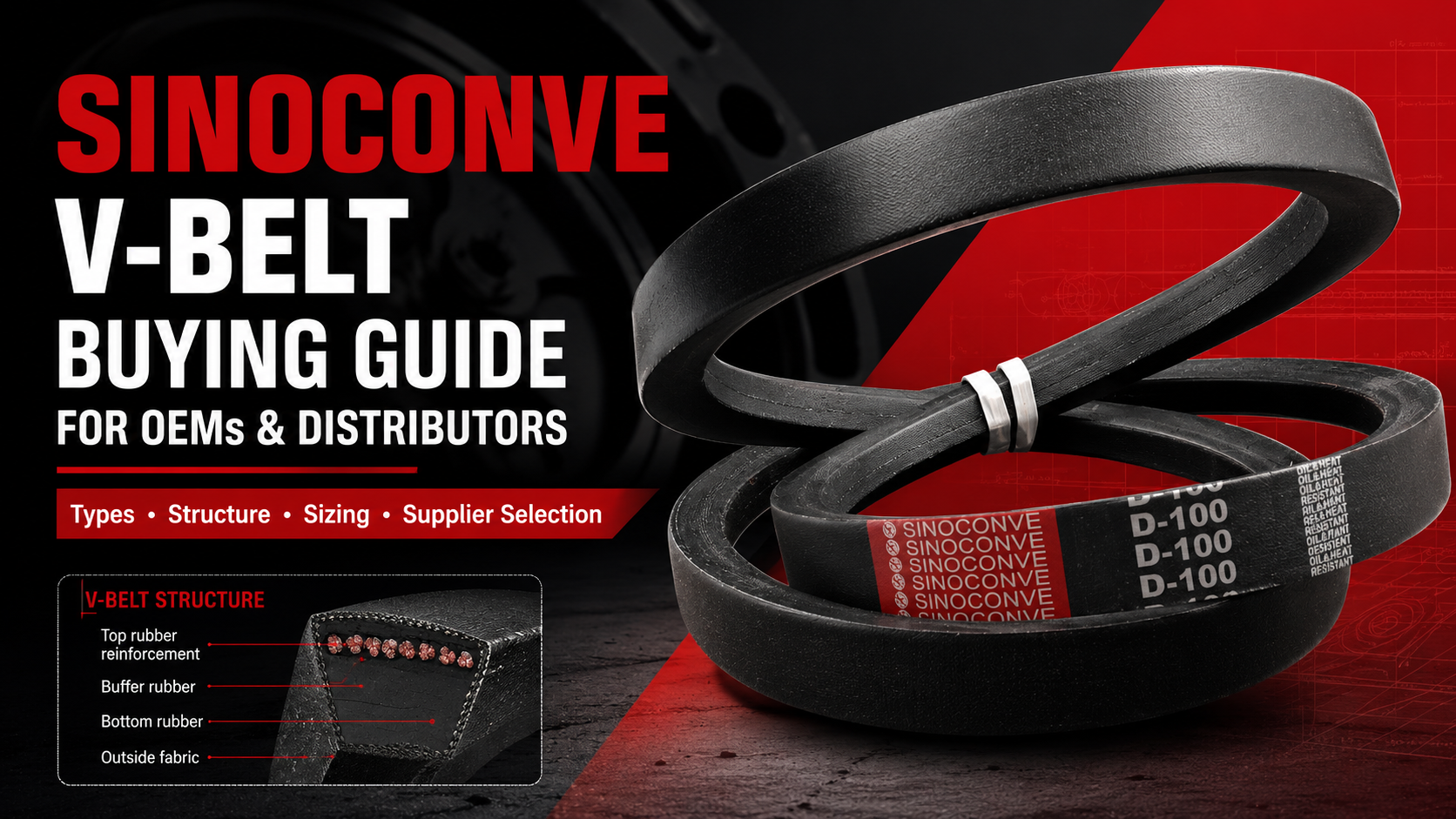
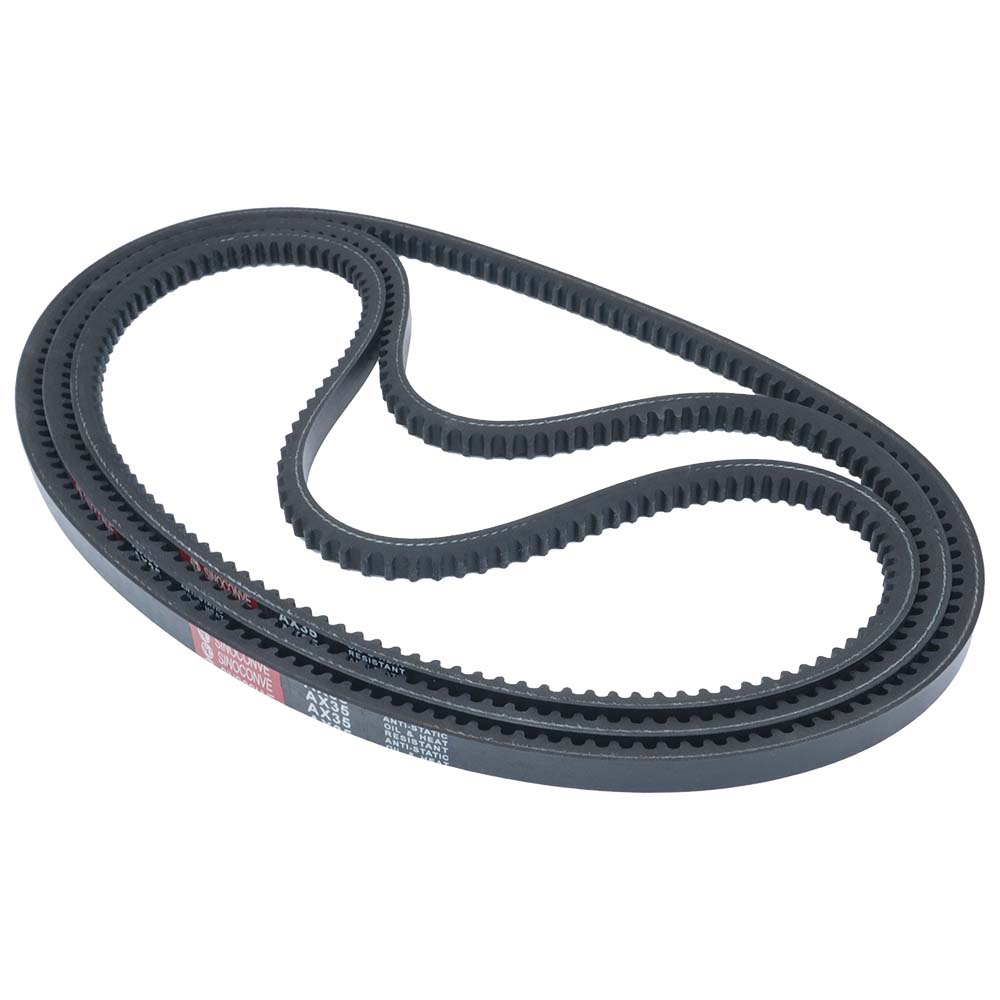
Conveyor people sometimes forget that they live in a V-belt world too. The head pulley may be direct-driven, but the crusher feeding the belt, the screen above the bin, the transfer conveyor's gearmotor, and the engine-driven hydraulic pumps on mobile plants all lean on V-belts. When a drive belt fails, the whole line stops with it, so the same estimating discipline applies. As a V-belt manufacturer, we see the classic mistake on the drive side too: someone orders a belt by the number printed on the old one without knowing which measuring system that number uses, and the new belt is either too short to install or too long to tension.
Two pulleys and a belt: the classic length formula
For two pulleys on fixed centers, the standard approximate belt length is:
L ≈ 2C + 1.57(D + d) + (D − d)² / (4C)
where C is the center distance between the two shafts, D is the datum (reference) diameter of the larger pulley, and d is the datum diameter of the smaller pulley — all in the same unit. The 1.57 is close to π/2, which is the contribution of the two half-wraps. The last term corrects for the difference in pulley sizes and is small when the pulleys are nearly equal. For equal pulleys it drops out entirely: L ≈ 2C + πD.
Worked example: fixed-center drive, SPB section
A screen drive runs on two fixed centers 900 mm apart, with a 315 mm datum diameter driven pulley and a 140 mm datum diameter motor pulley. Step by step:
2C = 2 × 900 = 1800 mmD + d = 315 + 140 = 455 mm, so1.57 × 455 ≈ 714.4 mmD − d = 315 − 140 = 175 mm; squared, that is30,6254C = 4 × 900 = 3600 mm, so the correction is30,625 / 3600 ≈ 8.5 mmL ≈ 1800 + 714.4 + 8.5 ≈ 2523 mm
So the belt measures about 2523 mm on the datum line. Datum lengths come in a standard series, so you would normally pick the nearest catalog value — commonly 2500 mm for this section — and confirm that the centers can be adjusted by the small difference, or shift the motor base to suit. If the centers are fixed and locked, recalculate with the actual installed belt and check the tensioning range before ordering; a 23 mm mismatch is easy to absorb with a sliding motor base and impossible to absorb without one.
Reading the marking on a V-belt
Here is where the ordering traps live. Different belt families measure length on different lines of the cross-section, and the difference is not cosmetic. Classic sections (A, B, C, D) are frequently labeled in inches by one convention, while narrow SP sections are usually labeled in millimeters by datum length — and some imported belts print yet another value on the side. Add the fact that the same physical belt has an outside circumference, an inside circumference, and a datum length that all differ, and you see why "the number on the old belt" is a weak specification on its own.
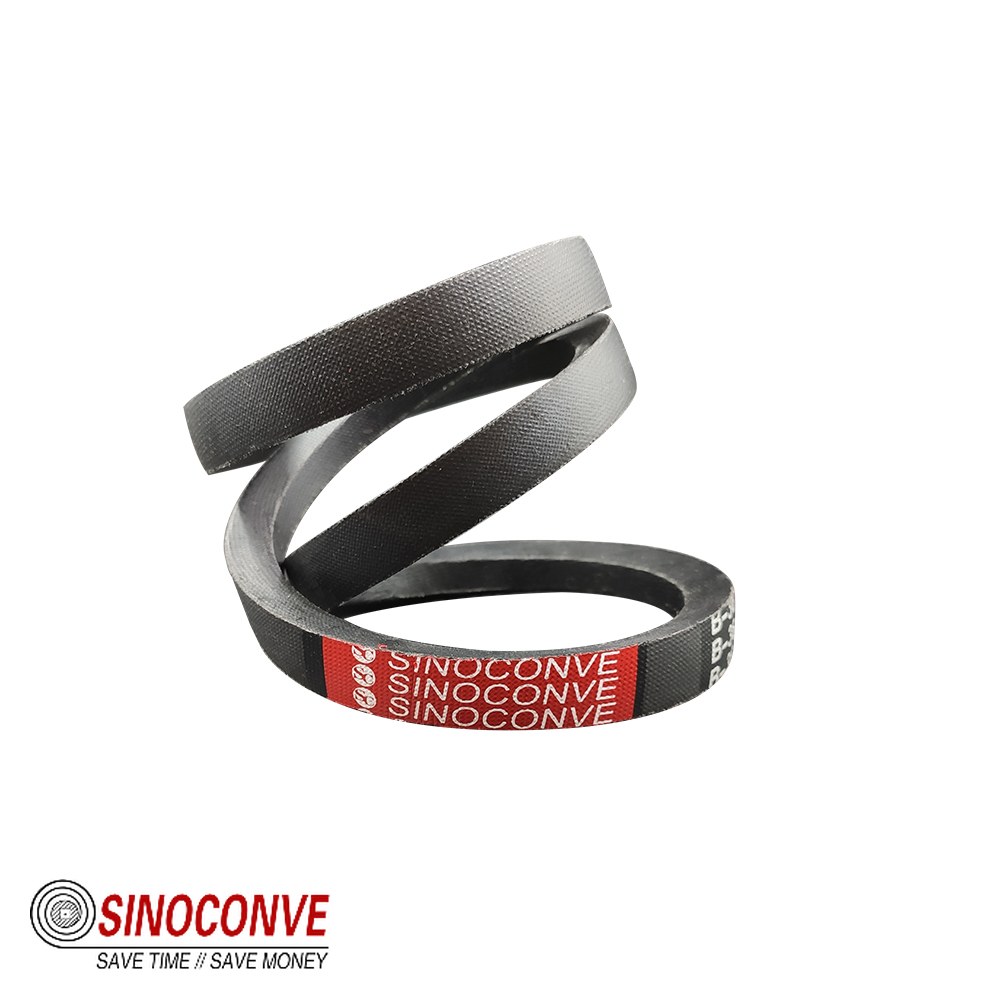
A practical rule: match the measuring system, not just the number. If the old belt reads "SPB 2500," confirm whether that 2500 is datum length in millimeters or something else before you order a stack. If it is a classic A or B section marked in inches, keep everything in that convention and do not mix it into a metric datum calculation. When in doubt, measure the center distance and pulley diameters, run the formula above, and let the arithmetic arbitrate. This is one of those quiet details that separates a smooth change-out from a return shipment, and it is exactly the kind of thing to confirm with your transmission belt manufacturer before the PO goes out.
Cross-section shapes at a glance
| Section | Approx.datum width (mm) | Nominal top width (mm) | Nominal height (mm) | Where you usually see it |
|---|---|---|---|---|
| Z (10) | about 8.5 | 10 | 6 | Small fans, pumps, light machinery |
| A (13) | about 11 | 13 | 8 | Light conveyor accessories, small drives |
| B (17) | about 14 | 17 | 11 | Crushers, screens,medium conveyors |
| C (22) | about 19 | 22 | 14 | Heavier drives, larger crushers |
| SPZ | about 8.5 | 10 | 8 | Narrow-section drives where Z is under-powered |
| SPA | about 11 | 13 | 10 | Higher-power replacements for A-section spacing |
| SPB | about 14 | 17 | 14 | The workhorse of screen and crusher drives |
| SPC | about 19 | 22 | 18 | High-power, short-center drives |
Take the table as a visual aid, not a design manual. Datum width, groove angle, and pulley groove profile all have to match the belt section — a belt that sits too deep or too proud in the groove wears fast and loses grip. If you are swapping sections or re-grooving pulleys, verify the groove geometry against the belt maker's data sheet first.
Where these drives actually run
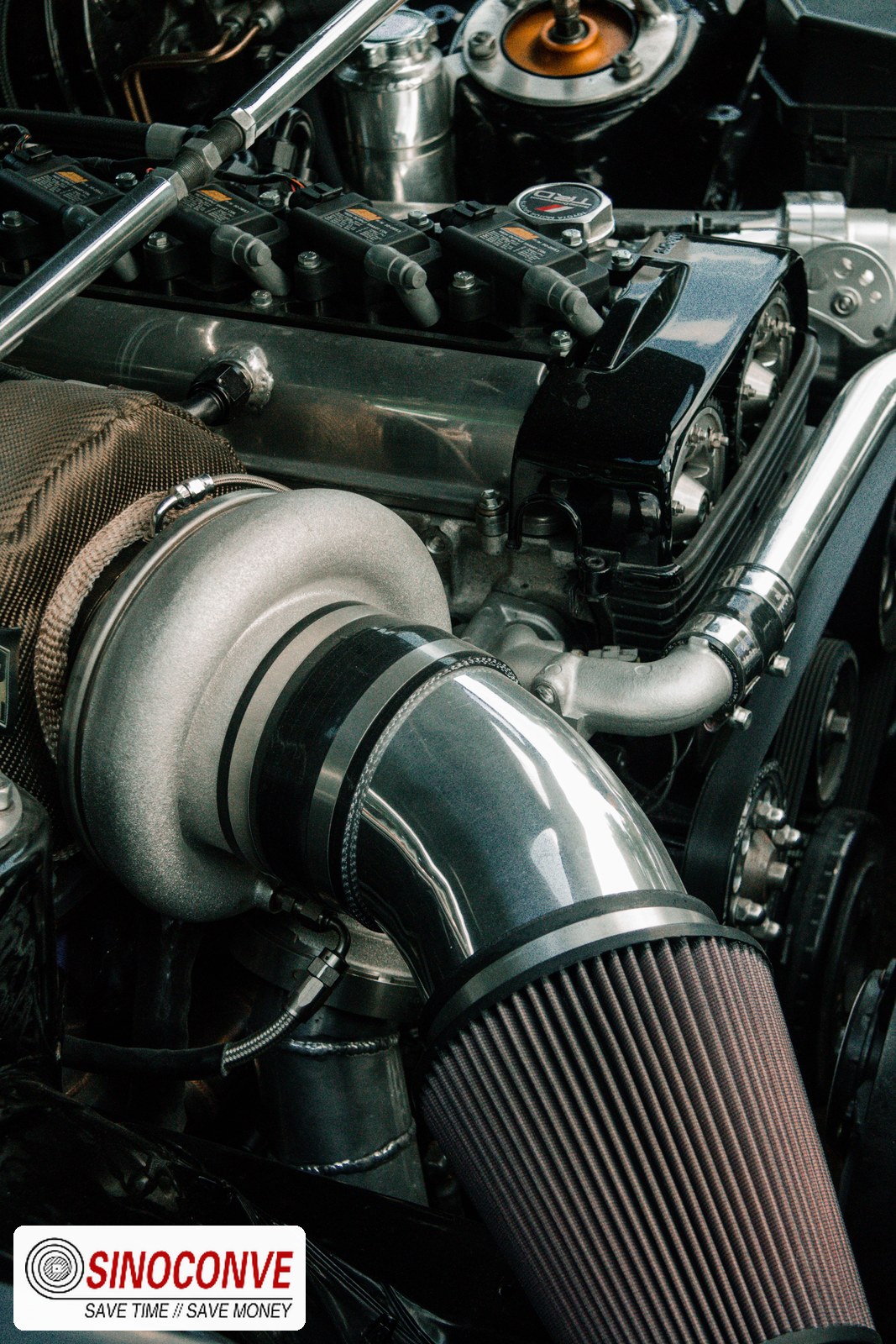
The scene above is more common than most maintenance budgets like to admit: a diesel engine bay on a mobile crusher or screen plant, where one belt drives the cooling fan and another runs the hydraulic pump that feeds the conveyor circuits. V-belts absorb the shock of engine speed changes, they slip a little under overload instead of shearing a shaft, and they are cheap to replace — provided the spare in the toolbox is the right length and section. On fixed plant, the same logic applies to the belt between an electric motor and a gearbox on a short transfer conveyor. Keep a spare for every section you run, label it with the datum length and section, and your downtime math changes completely.Our own guidance on choosing profiles and decoding size codes is in our V-belt buying guide, written for exactly these change-out decisions.
If you are setting up a new drive rather than replacing a belt, the supplier relationship matters as much as the arithmetic. A V-belt manufacturer with a complete mold range can supply the common market sections without long waits or minimum-order drama, which matters when you stock spares for a dozen different machines. We keep molds for the standard profiles above, run market-common sizes as stock items, and can do custom logo printing and OEM packaging for machine builders who put their own brand on the belt.
05Ordering Conveyor Belt with These Numbers in Hand
Estimates earn their keep at the purchase order stage. When you order from a conveyor belt factory like ours, the engineering conversation usually starts with four figures: belt type and rated strength, width, total length including splice allowance, and cover specification.Add the elongation data you plan around and the take-up travel available, and the factory can tell you in one reply whether your design has margin or is running on the edge. That is the exchange we have with maintenance teams and procurement people every day, and it is why our sales engineers are trained to answer with numbers, not adjectives.
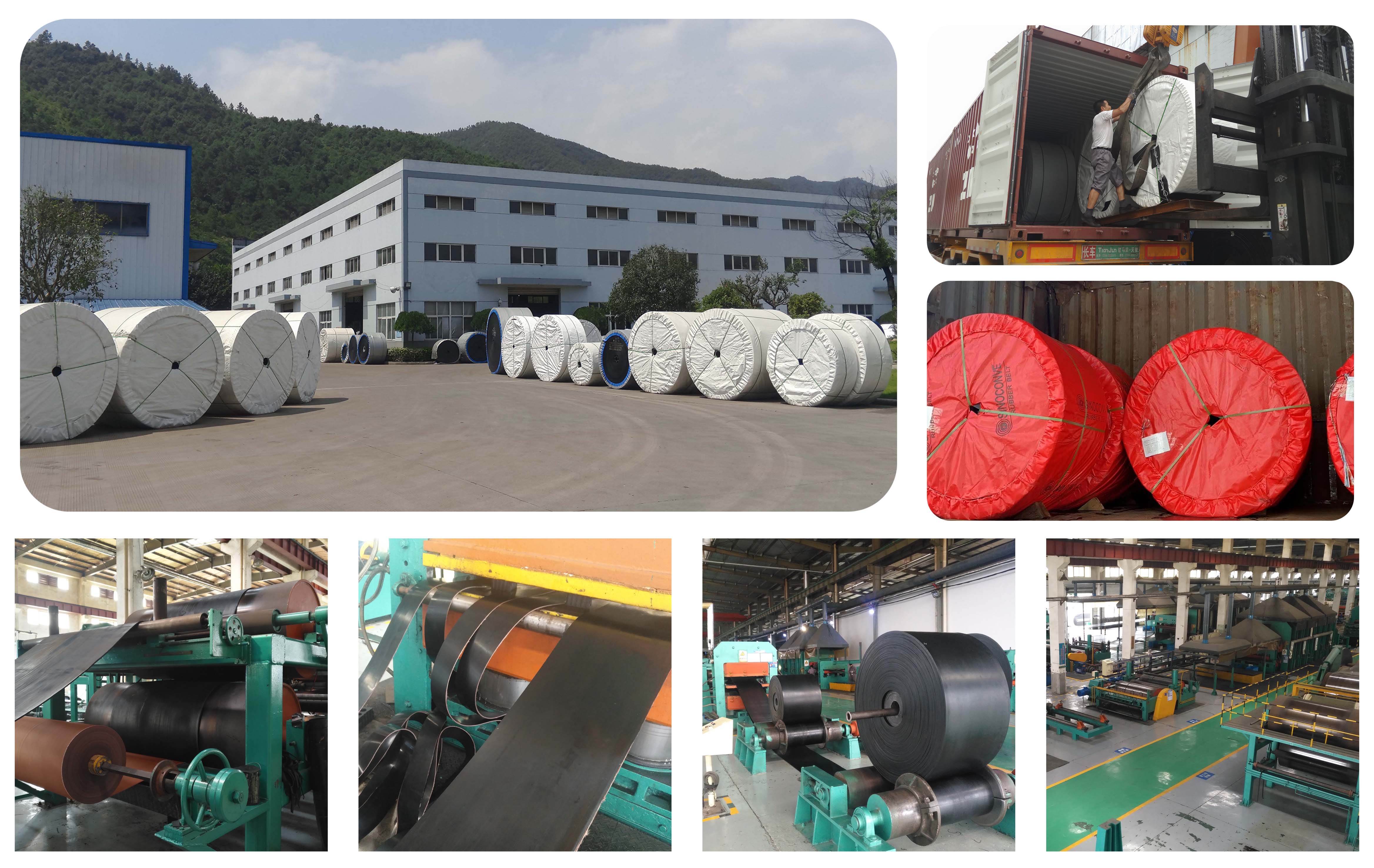
What you can expect from us on the manufacturing side, stated plainly. SINOCONVE runs ten production lines and about 200 employees, serving more than 1,500 customers worldwide. We hold ISO 9001 certification and can build to DIN 22102, ISO, or RMA specifications depending on your market. Fabric belts range from EP100 through EP600, in widths from 100 mm up to 3,000 mm and total thicknesses from 3 mm to 100 mm. For the heavy end of the market we also produce steel-cord belts from ST500 up to ST7500. Every shipment leaves the plant with an inspection report, and we mark and package rolls for export handling rather than treating them as an afterthought.

Picture a packing line for agricultural produce — the gentle, slow-moving belt above that carries fruit or vegetables between sorting stations.That application uses the same estimating logic as a quarry belt, just at a smaller scale and a slower speed: the roll-length formula tells the plant how many meters they bought, the speed formula tells them how fast the graders have to work, and the elongation table tells them when to expect the take-up to settle. Different product, identical arithmetic. We have supplied belts for produce handling, recycling lines, logistics sortation, and mining alike, and the questions from each industry converge on the same few numbers.
Why short runs and quick samples matter more than buyers expect
Industrial procurement has changed in one practical way: nobody wants to carry three months of inventory for a belt they might use twice a year. That is why we keep the commercial side flexible. For conveyor belting our minimum order is 50 meters per specification, and V-belts can be ordered in low quantities of roughly 30 to 50 pieces per profile — small enough to stock spares without committing to a pallet. Samples ship in 2 to 5 days, so a trial roll or a prototype belt is a short conversation rather than a project. Standard production runs about 30 days, and we have compressed urgent orders to 15 to 20 days when the schedule allows. OEM and ODM work is routine: custom logos, private labeling, and bespoke packaging for machine builders and distributors who sell under their own brand.
That combination — short minimums, fast samples, and documented production — is what a maintenance supervisor actually needs when the take-up is nearly bottomed out and the belt decision cannot wait for next quarter's budget. If you want to see how these numbers translate into cost before you call, our guide on what to compare beyond unit price walks through the line items that separate a cheap quote from a cheap belt: what buyers should compare beyond price per meter.
06Closing Thoughts: Carry These Numbers with You
Strip away the machinery and every story in this guide has the same shape. Someone measured something wrong, or estimated from memory, or trusted a label that meant something else, and the belt — conveyor or drive — did not fit when it mattered. The fix was never a fancier machine. It was a tape measure, two diameters, and one formula done on purpose.
That is the whole discipline, so here it is in one table. Print it, tape it inside the toolbox lid, and let it do the arguing for you:
| What you need | Formula or rule | Unit warning |
|---|---|---|
| Belt length wound in a roll | L = π(D² − d²)/(4t) |
D, d, t in the same unit, or the answer is off by 1,000 |
| Belt speed from pulley rpm | v = π·D·n/60 |
D in meters, n in rpm,answer in m/s |
| Drive rpm for a target speed | n = 60·v/(π·D) |
flip the same formula, same units |
| Two-pulley V-belt length | L ≈ 2C + 1.57(D+d) + (D−d)²/(4C) |
measure C, D, d on the same line — datum for datum |
| Field tension by sag | deflection ≈ span / 64 | span and deflection in the same unit |
Every number in the table is a practical estimate, and we have labeled it that way all the way through because the distinction protects you. Estimates catch gross errors, plan purchases, and set expectations. Drawings, factory data sheets, and confirmed test reports are what you cut steel and rubber by. When the two disagree, stop and ask — that question is cheaper than the reorder.
After 35 years in this business, we can tell you the arithmetic is rarely the hard part. The hard part is knowing which number to trust, and that is a habit, not a talent. Measure twice, estimate once, confirm before you cut. Your belt will last longer, your splices will go in on the first try, and your drive belts will fit the first time you open the box.
07Frequently Asked Questions
How much extra belt should I order to cover splicing?
For a multi-ply fabric belt with vulcanized step splices, a common planning figure is about 1 to 1.5 m of extra belt per splice, and the exact number depends on ply count, belt rating, and the splice layout on the drawing. Mechanical fasteners need far less. Add the allowance for every joint on the belt — the factory splice and each field splice — before you finalize the order length. If you are not sure, ask the supplier to confirm the loop length and splice allowance on a drawing; that confirmation is worth more than any rule of thumb.
What does a designation like EP500/4 actually tell me?
The letters name the carcass family: EP means polyester warp with nylon weft, NN means nylon in both directions, and ST means steel cord. The number and ply count describe strength, but read them carefully because conventions differ.Under the common per-ply convention, EP500/4 means four plies rated at 500 N/mm each; under other labeling systems the number states the total. The shorthand gets you in the right neighborhood, the data sheet gets you the specification. If a quote and a data sheet disagree on what EP500/4 stands for, the data sheet wins.
How can I tell what length is left on a roll without unwinding it?
Measure the outside diameter of the roll, the outside diameter of the core, and the belt thickness, then run L = π(D² − d²)/(4t) with all three in the same unit. A roll measuring 0.75 m on a 0.3 m core with 12 mm belt, from the earlier example, holds about 31 m. Take the diameter reading in two or three places, because an oval roll will lie to you if you measure only once. The method is an estimate, so keep a few percent of margin before you cut a splice based on it.
Why does a brand-new belt stretch, and when should I re-tension it?
New belts grow because the carcass seats, the rubber compresses around the plies or cords, and the construction takes a permanent set under tension. Typical planning ranges are about 1–2% for EP fabric belts, 1.5–2.5% for NN, and only 0.1–0.3% for steel cord. Most of the permanent growth shows up in the first days or weeks of running. Re-check tension after the first few hours and again after the first week, and re-tension as needed.If your take-up runs out of travel during run-in, stop and talk to the installer or the factory rather than letting the belt slip until it damages the covers.
For V-belts, what is the difference between datum length and outside length?
A V-belt has an outside circumference, an inside circumference, and a reference (datum) length measured at a defined line inside the cross-section — and they are all different numbers for the same belt. SP-section belts are usually marked by datum length in millimeters, while classic A, B, and C section belts are commonly labeled in inches by a different convention. Ordering by the number printed on the old belt works only when you match the measuring system it came from. When in doubt, measure center distance and pulley diameters, run the two-pulley formula, and confirm the marking convention with the supplier before you commit.
What are SINOCONVE's minimum order quantities, samples, and lead times?
For conveyor belting, our minimum is 50 m per specification; for V-belts, low quantities of roughly 30 to 50 pieces per profile are enough to stock spares sensibly. Samples leave the plant within 2 to 5 days. Standard production runs about 30 days, with urgent orders compressed to 15 to 20 days when the schedule allows. OEM and ODM work — custom logos, private labels, special packaging — is routine, and every shipment includes an inspection report. If you have a belt specification or a drawing, send it to sales@sinoconve.com and our engineers will confirm the numbers before you commit to anything.
Order conveyor belt and V-belts with your numbers in hand
We build both conveyor belts and V-belts under one roof, with fast samples and a quality test report on every order.
Related Products You May Need
| Rubber Conveyor Belt Multi-ply EP/NN fabric belts up to 3,000 mm wide |
EP Conveyor Belt Dimensionally stable carcass for long, high-tension lines |
| V-Belt Classical, cogged and banded V-belts |
Timing Belt Synchronous belts for precision drives |
| Conveyor Roller Idlers and rollers matched to your belt |
Full Product Catalog Browse the complete SINOCONVE range |
Related Blog Posts
- V-Belt Buying Guide: Profiles and Sizes — how to read V-belt markings
- Conveyor Belt Price Guide 2026 — what to compare beyond unit price
- Conveyor Belt Jointing Methods Guide — vulcanized vs mechanical splicing
- Rubber Conveyor Belt Cover Grades — how cover grade changes belt life