
A cleat PVC conveyor belt usually gets considered after a flat belt has already caused trouble. Boxes slide back on a short incline. Small parts gather at the bottom of a loading point. Bags shift sideways before they reach the next machine. The belt itself may still be running, but the material is not moving the way the line needs it to move.
That is the real reason cleats are added. They are not decoration on the belt surface. They create physical stops across the carrying side, giving loose or unstable products something to push against while the conveyor belt moves forward.
PVC is a common choice for lighter industrial handling because it is relatively easy to clean, flexible, and suitable for many indoor conveyor layouts. It is not the same as a heavy rubber belt used in mining or stone handling. A PVC conveyor belt is normally selected for packaged goods, light parts, food-related handling where the grade allows it, small inclined conveyors, sorting lines, and workshop transfer systems.
A cleat PVC conveyor belt sits between two needs: better control than a flat PVC belt, but less bulk than a sidewall or heavy rubber belt. When the application fits, it can make a small conveyor section far more predictable.
What the Cleats Actually Change
On a flat belt, the product depends mostly on surface friction. That works on horizontal sections. It becomes less reliable as the angle increases, especially when the item has a smooth base, rounded shape, or uneven weight.
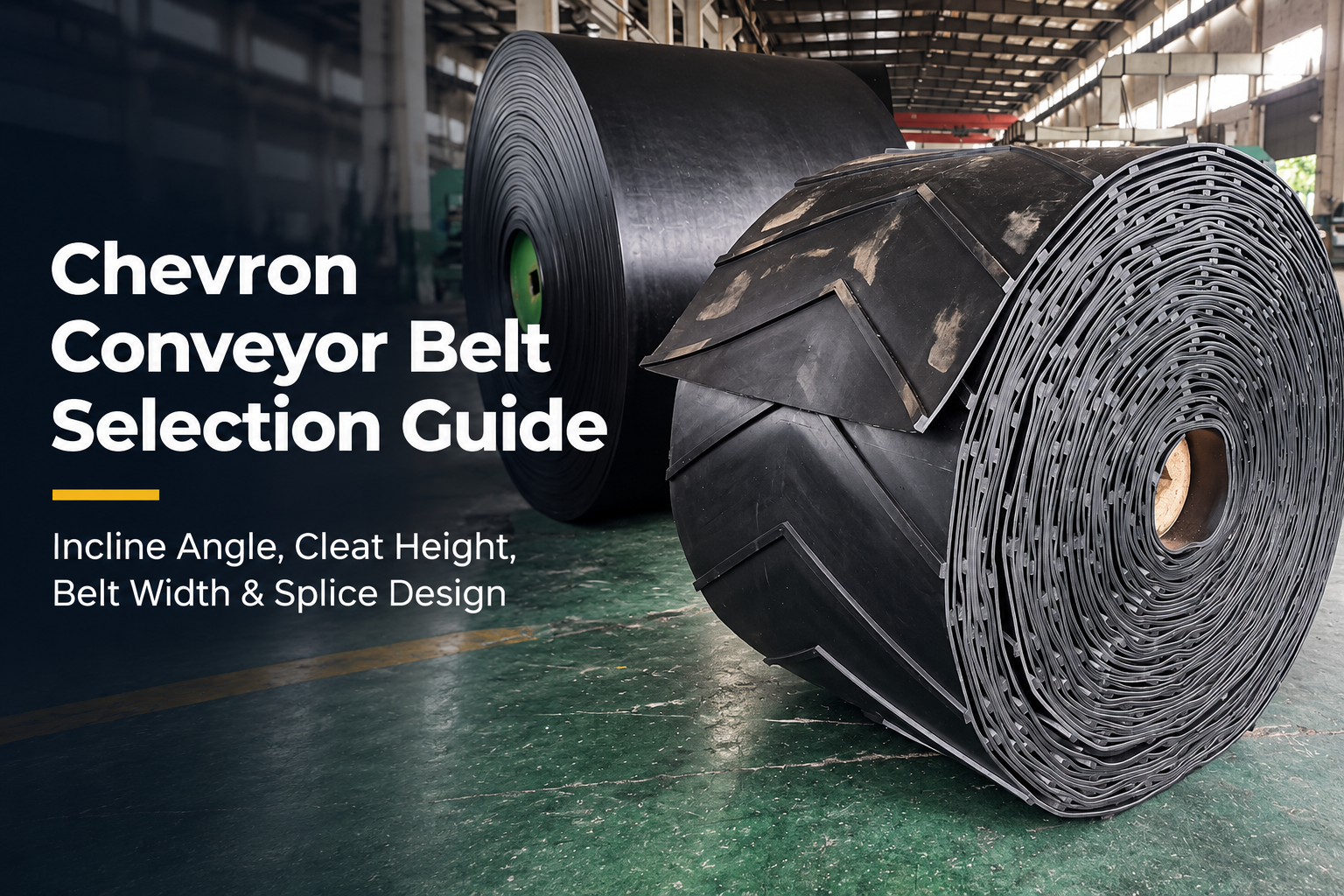
Cleats change the contact behavior. Instead of asking the product to stay in place only through friction, the belt gives it a raised barrier. The product rests against the cleat as the conveyor moves. This is useful on incline conveyors, short feeding sections, counting lines, light bulk handling, and small packaging systems.
The cleat height and spacing matter. Too low, and the product may still roll or slide. Too high, and transfer at the discharge end becomes rough. Too close together, and cleaning takes longer. Too far apart, and small items may shift between cleats.
Where a Cleat PVC Conveyor Belt Makes Sense
|
Application |
Why cleats help |
What to check first |
|
Inclined packaging line |
Stops boxes or bags sliding back |
Incline angle, product base, discharge point |
|
Small parts transfer |
Keeps parts separated during movement |
Part size, cleat spacing, side guides |
|
Light bulk feeding |
Moves loose material in small batches |
Cleat height, leakage at sides, cleaning access |
|
Food or clean handling |
Improves control on short lifts |
Food-grade requirement, washing method |
|
Warehouse sorting |
Helps unstable parcels stay positioned |
Transfer smoothness and belt speed |
The point is not to use cleats everywhere. A flat PVC conveyor belt is still better when goods need a smooth transfer, easy side movement, or frequent manual picking. Cleats are more useful when the belt angle, product shape, or feeding pattern causes movement problems.
PVC Belt Construction: What Buyers Should Look At
Most buyers first ask for belt width and length. That is necessary, but not enough. A PVC conveyor belt also needs the right number of fabric plies, suitable cover thickness, correct cleat welding, and a surface that matches the product.
For light packaging, a thinner belt may be enough. For repeated loading, heavier bags, or longer running hours, the carcass and joint quality become more important. If the cleats are welded poorly, they can lift at the edges long before the belt body wears out.
The bottom side should also be checked. Some conveyor frames require low-friction running surfaces. Others use support rollers. A belt that runs well on one frame can heat up or track badly on another if the underside does not match the conveyor design.
Cleat Shape, Height, and Spacing
There is no universal cleat layout. A small inclined packaging conveyor does not need the same cleat as a light bulk feeding conveyor.
|
Design point |
What it affects |
Practical note |
|
Cleat height |
Holding ability |
Higher is not always better |
|
Cleat spacing |
Product separation |
Match it to product length |
|
Cleat angle |
Discharge behavior |
Straight cleats are not the only option |
|
Belt width |
Side stability |
Leave enough edge clearance |
|
Joint method |
Running smoothness |
Check if the joint passes pulleys cleanly |
If the belt carries loose material, the side leakage risk should also be checked. In some layouts, cleats alone are not enough. Sidewalls may be needed. In other cases, side guides on the conveyor frame solve the problem more simply than adding a complicated belt structure.
Installation Problems That Shorten Belt Life
Many cleated belts fail for ordinary reasons. The belt is too tight. The pulley diameter is too small for the cleat base. The discharge scraper catches the cleat. The belt tracks to one side and the cleat edge rubs against the frame.
None of these problems are dramatic at first. A little rubbing. A little noise. A small edge lift on one cleat. Then, after several weeks, the same area starts tearing.
Before ordering a cleat PVC conveyor belt, it helps to send the supplier a photo or drawing of the conveyor frame, especially the head pulley, tail pulley, side guides, and transfer point. A simple mistake in clearance can turn a good belt into a maintenance problem.
PVC Conveyor Belt vs Rubber Conveyor Belt for Cleated Use
|
Item |
PVC conveyor belt |
Rubber conveyor belt |
|
Typical use |
Indoor, light to medium handling |
Heavy-duty or abrasive handling |
|
Cleaning |
Generally easier |
Depends on compound and surface |
|
Weight |
Usually lighter |
Usually heavier |
|
Heat resistance |
Limited by PVC grade |
Special heat-resistant grades available |
|
Best fit |
Packages, parts, light bulk |
Stone, ore, outdoor bulk material |
If the material is sharp, hot, or abrasive, PVC may not be the right answer. A rubber conveyor belt or another compound may be more suitable. If the load is clean, moderate, and indoor, PVC often gives a cleaner and lighter solution.
Information to Send Before Asking for a Quote
A quotation is much more accurate when the supplier sees the operating conditions instead of only receiving a belt size.
|
Information |
Why it matters |
|
Belt width and total length |
Basic production size |
|
Incline angle |
Cleat height and spacing decision |
|
Product size and weight |
Load and spacing check |
|
Pulley diameter |
Belt flexibility and cleat clearance |
|
Working environment |
PVC grade and surface choice |
|
Photos or drawing |
Prevents clearance and tracking mistakes |
|
Quantity and packaging |
Quotation and shipping planning |
For repeat orders, the old belt code is useful, but it should not be the only reference. Belts stretch, markings fade, and previous replacements are not always correct. A photo of the old belt and the conveyor frame often prevents a wrong remake.
Maintenance Notes
Cleaning is usually the main maintenance issue with cleated PVC belts. Dust, powder, small food pieces, or packaging debris can collect at the cleat base. If the belt is used in food-related handling, the cleaning method and belt grade should be confirmed before production.
Watch the cleat edges during early operation. If one side starts lifting, the cause may be tracking, pulley clearance, scraper contact, or poor welding. Replacing the same belt without fixing the cause usually repeats the failure.
FAQ
What is a cleat PVC conveyor belt used for?
It is used when products need help staying in position on an incline or feeding section. Common uses include packaging lines, small parts handling, light bulk transfer, sorting systems, and indoor material handling.
Is a cleat PVC conveyor belt suitable for heavy materials?
Only within its design range. For sharp stone, hot material, or heavy abrasive loads, rubber or other belt materials are usually a safer choice.
Can the cleat size be customized?
Yes. Cleat height, spacing, angle, belt width, length, joint style, and sometimes sidewalls can be customized according to the conveyor layout.
What causes cleats to come loose?
Common causes include poor welding, scraper contact, small pulley diameter, excessive tension, side rubbing, and using the belt beyond its load or temperature range.
Practical Buying Advice
A cleated belt should be selected from the conveyor layout backward. Start with the incline angle, product size, loading point, discharge point, pulley diameter, and cleaning needs. Then choose the belt material, surface, cleat design, and joint method.
A cleat PVC conveyor belt can solve slipping and feeding problems, but it should not be treated as a universal upgrade. Used in the right place, it saves adjustment time and keeps products moving. Used in the wrong place, it only adds another wear point to the conveyor belt system.