A practical selection, inspection, and sourcing guide for automotive accessory drives
When a newly fitted PK belt starts chirping, the belt is usually the first part blamed. In the workshop, that is not always where the fault begins. A weak tensioner can let the belt wander. A damaged pulley can cut one rib. Oil mist can polish the running surface. A belt that was never seated fully in the grooves may fail within days even though the printed code looked correct.
That is why an automotive PK belt should be bought as part of a drive system, not as an isolated rubber loop. The belt has several narrow ribs running lengthwise, and those ribs grip matching pulley grooves by friction. ISO 9981:2020 covers the dimensional relationship between automotive PK-profile belts and pulley grooves. In practical terms, the profile is standardized, but the complete belt still has to match the vehicle, rib count, length, materials, tensioning arrangement, and duty cycle.
For distributors, OEM buyers, and repair chains, the risk is repetitive: wrong samples, noise complaints, early rib wear, and second replacements because the pulley system was never checked.
1. What the PK Profile Is Designed to Do
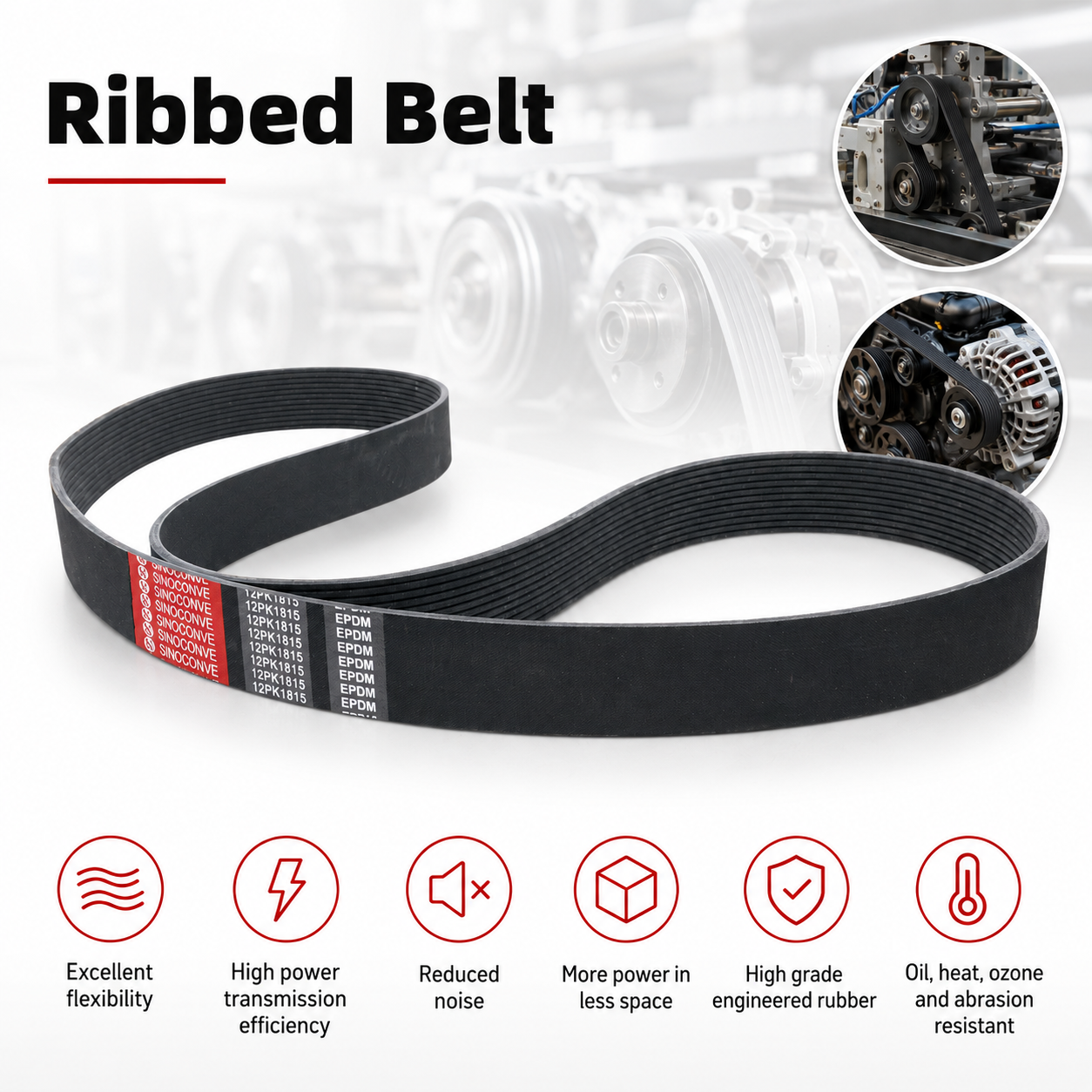
A PK belt is a V-ribbed belt used predominantly in automotive accessory drives. The many small ribs provide a broad friction contact area without the thickness of a classical single V-belt. That makes the belt suitable for compact layouts, relatively small pulley diameters, high belt speeds, and routes that may include idlers or back-side bending.
The belt does not provide positive tooth engagement. It can slip if the tension, wrap angle, pulley condition, or surface friction is wrong. This point matters because PK belts are sometimes discussed as though the ribs lock into the pulley. They do not. The pulley groove geometry controls contact, but power still moves through friction.
On a modern accessory drive, one multi-rib belt may run the alternator, air-conditioning compressor, water pump, power-steering pump, or other accessories depending on the vehicle design. The compact routing is useful, but it also means one damaged tensioner or idler can affect the entire drive.
2. PK Belt, Poly V Belt, Ribbed Belt, and Serpentine Belt
|
Term |
How it is commonly used |
Buyer caution |
|
Automotive PK belt |
A PK-profile V-ribbed belt for vehicle accessory drives |
Profile, rib count, length, and vehicle reference must agree |
|
Poly V belt |
Broad trade term for a multi-rib friction belt |
May include profiles other than PK |
|
Ribbed belt / multi V-belt |
General description of the longitudinal rib construction |
The name alone does not identify the exact profile |
|
Serpentine belt |
A belt routed around several accessories and idlers |
Describes the drive layout more than the complete specification |
|
Stretch belt |
An elastic accessory belt fitted without a conventional tensioner |
Do not replace it with a standard PK belt unless the application specifies it |
These terms overlap, but they are not automatically interchangeable. “PK belt” alone is not enough for a dependable quotation.
3. Read the Belt Code, Then Check Beyond It
A marking such as 6PK1735 is commonly read as six ribs, PK profile, and an effective length of about 1735 mm. That is a useful starting point, not a complete approval record. Two belts carrying the same nominal code may differ in compound, tensile member, backing design, manufacturing tolerance, branding, batch control, and application coverage.
For replacement work, the code should be checked against the vehicle or machine reference and the actual pulley system. If the original drive has been modified, an old belt code may no longer represent the correct operating length. If the old belt failed early, copying the code without checking the tensioner, idlers, and pulley faces can simply repeat the same failure.
|
Code element |
What it usually tells the buyer |
What still needs checking |
|
Rib count |
How many ribs engage the pulley grooves |
Whether every pulley has the same usable groove count |
|
PK profile |
Automotive V-ribbed groove family |
Pulley wear, contamination, and groove damage |
|
Effective length |
Nominal belt length used for identification |
Vehicle reference, tensioner range, and route |
|
Brand / batch marking |
Traceability and product identity |
Compound, cord, quality consistency, and packaging requirements |
4. Construction: What Buyers Can Confirm and What They Should Not Guess
EPDM is widely used in current automotive multi V-belts because the compound can be formulated for heat, flexing, abrasion, ozone, and long service in engine-bay conditions. Continental, for example, describes its automotive multi V-belts as using advanced EPDM compounds and a treated polyester tension member. That does not mean every black PK belt uses the same material package.
The reinforcement is hidden inside the belt, so cord type and elongation control cannot be judged from a photograph. The same applies to rib geometry, backing thickness, rubber hardness, and adhesion. If these details matter to an OEM project or private-label order, they should appear in the technical agreement or approved sample rather than being inferred from appearance.
5. Where an Automotive PK Belt Fits Best
The PK profile is mainly associated with automotive accessory drives. Similar multi-rib systems also appear in compressors, fans, pumps, HVAC assemblies, and compact equipment.
That does not make the belt universal. A timing function that cannot tolerate slip belongs to a synchronous belt system. A stretch-belt application needs an elastic construction and the correct installation method. A heavy industrial drive may require a different rib profile or a belt designed for much greater duty.
6. Early Failure Is Often a Drive-System Problem
Dayco’s technical guidance identifies several reasons a serpentine belt may fail soon after installation: incomplete seating in a pulley, worn pulley bearings that allow the belt to walk, a damaged pulley that cuts the belt, or a malfunctioning tensioner that creates misalignment. Those are useful checks because they move the investigation away from the belt alone.
Noise also needs interpretation. A chirp that repeats with belt rotation often points toward alignment or pulley runout. A squeal under load may involve insufficient tension or slip. A polished rib surface can come from contamination or prolonged slipping. Replacing the belt without addressing the cause may create a second complaint.
|
Symptom |
Likely points to inspect |
Practical response |
|
Chirp or rhythmic noise |
Pulley alignment, runout, damaged rib, belt seating |
Check the full route before fitting another belt |
|
Squeal during acceleration or accessory load |
Low tension, weak tensioner, contamination, insufficient wrap |
Inspect tensioner movement and clean pulley grooves |
|
One edge or one rib wears faster |
Misalignment, bent bracket, damaged pulley flange |
Measure alignment and inspect mounts |
|
Belt walks off the pulley |
Bearing play, tensioner fault, pulley offset |
Replace the failed drive component, not only the belt |
|
Cracks or missing rib material |
Heat aging, flex fatigue, debris, incorrect pulley geometry |
Confirm belt route, pulley size, and environment |
|
New belt breaks quickly |
Not fully seated, cut by pulley, bearing failure, tensioner malfunction |
Stop repeated replacement and diagnose the system |
7. Procurement Checklist for Replacement, OEM, and Private-Label Orders
A quotation based on one photograph creates unnecessary risk. For replacement distribution, the most useful information is the complete belt code and vehicle or machine reference. For OEM or private-label work, the supplier may also need drawings, performance targets, packaging specifications, label language, and an approved sample process.
SINOCONVE’s Save Time, Save Money principle is practical here: the fastest order is the one that does not return as a fitment complaint. Complete application data reduces repeated sampling, wrong packaging, and disputes over whether the problem came from the belt or from the drive system.
|
Information to send |
Why it matters |
|
Complete printed belt code |
Confirms rib count, profile, and nominal length |
|
Vehicle, engine, or machine reference |
Checks application compatibility |
|
Old belt photos: ribs, back, edges, marking |
Shows wear pattern, contamination, and identification |
|
Pulley and tensioner photos |
Helps identify misalignment, damage, or incorrect route |
|
Current complaint |
Separates fitment, noise, wear, and tension issues |
|
Order quantity and packaging |
Supports stock planning, export packing, and private label |
|
Required tests or standards |
Clarifies project acceptance criteria |
|
Sample approval process |
Reduces batch and fitment disputes before volume production |
8. Common Buying Mistakes
Buying by approximate length is the obvious error, but not the only one. Some buyers confirm the code and ignore the pulley grooves. Others replace a standard tensioned belt with a stretch belt, or the reverse, because the products look similar when removed from the vehicle.
Price-only comparison can hide differences in rib finish, compound consistency, cord control, marking, packaging, and batch traceability. Those differences appear later as fitment complaints.
|
Mistake |
What may happen |
|
Choosing a “close” length |
Tensioner operates outside its intended range |
|
Ignoring pulley and tensioner condition |
Noise or early wear returns with the new belt |
|
Assuming all PK belts use the same construction |
Heat, noise, or durability performance differs by application |
|
Confusing standard and stretch belts |
Incorrect installation or loss of tension |
|
Approving only from a photo |
Profile, rib count, and length mismatch remain unnoticed |
|
Mixing suppliers without batch control |
Fitment and branding consistency become harder to manage |
9. Inspection Notes for Maintenance Teams
Modern EPDM belts may not show the large, obvious cracking associated with older compounds. Continental notes that advanced EPDM serpentine belts can wear before visible damage clearly signals replacement. A wear gauge, route inspection, and pulley check can therefore be more useful than waiting for a dramatic crack.
With the belt removed, rotate idlers and accessory pulleys by hand. Roughness, resistance, runout, or bearing play should be addressed before the replacement belt goes on. Confirm that every rib is seated, then observe the tensioner and tracking with the system running.
FAQ
Is a PK belt the same as every poly V belt?
No. PK is one specific V-ribbed profile used predominantly in automotive accessory drives. Poly V belt is a broader trade term that may include other profiles.
Can I order an automotive PK belt from the printed size only?
The code is the starting point. Vehicle or machine reference, rib count, pulley system, tensioner type, and the previous failure should also be checked.
Why does a new belt squeal?
Possible causes include insufficient tension, contamination, a weak tensioner, poor pulley alignment, low wrap angle, or a belt that is not seated correctly.
Does EPDM automatically mean the belt is suitable for every engine bay?
No. EPDM is common, but compound design, reinforcement, routing, temperature, contamination, and accessory load still affect suitability.
Should the tensioner be replaced with the belt?
Not automatically in every case, but it should be inspected. Noise, sticking, loss of tension, runout, or poor tracking can damage a new belt quickly.
What should a distributor send for a private-label quotation?
Send the size list, vehicle or machine references, annual quantities, sample requirements, marking, packaging language, barcode needs, and any required test or standard references.
Final Buying Note
An automotive PK belt is a small component with a system-level job. The correct profile and length matter, but so do the pulleys, tensioner, routing, operating temperature, contamination, and accessory load. That is why a technically correct replacement process begins with the complete drive, not with the belt photo.
For sourcing teams, the practical sequence is straightforward: identify the application, verify the full code and rib count, inspect the previous failure, confirm the drive components, then approve the construction and packaging. It takes slightly longer than buying by appearance. It usually takes far less time than handling the same complaint twice.