
How to Choose Conveyor Belt: Rubber Belt Solutions
Wrong belt selection is one of the more expensive mistakes in bulk material handling — premature wear, tracking problems, and unplanned downtime all trace back to a specification that did not match the application. Knowing how to choose a conveyor belt starts with understanding which variables actually matter: material type, operating environment, incline angle, load volume, and cover grade. This guide works through each factor and maps them to the right rubber conveyor belt construction.
Why Belt Selection Fails — and What to Do Differently
Most belt selection mistakes fall into one of three categories. The first is specifying by price rather than application — the cheapest belt for a hard rock aggregate operation will wear through the cover in months. The second is assuming the belt that worked in one application will transfer to another — a food-grade flat belt and a mining belt can have identical dimensions and completely different compound grades. The third is overlooking the operating environment: moisture, temperature, chemical exposure, and incline angle all affect which belt construction survives long-term.
Knowing how to choose a rubber conveyor belt means starting with the application data, not the catalog. The catalog is where you end up; the application is where you start.
The Key Variables in Belt Selection
1. What is being conveyed
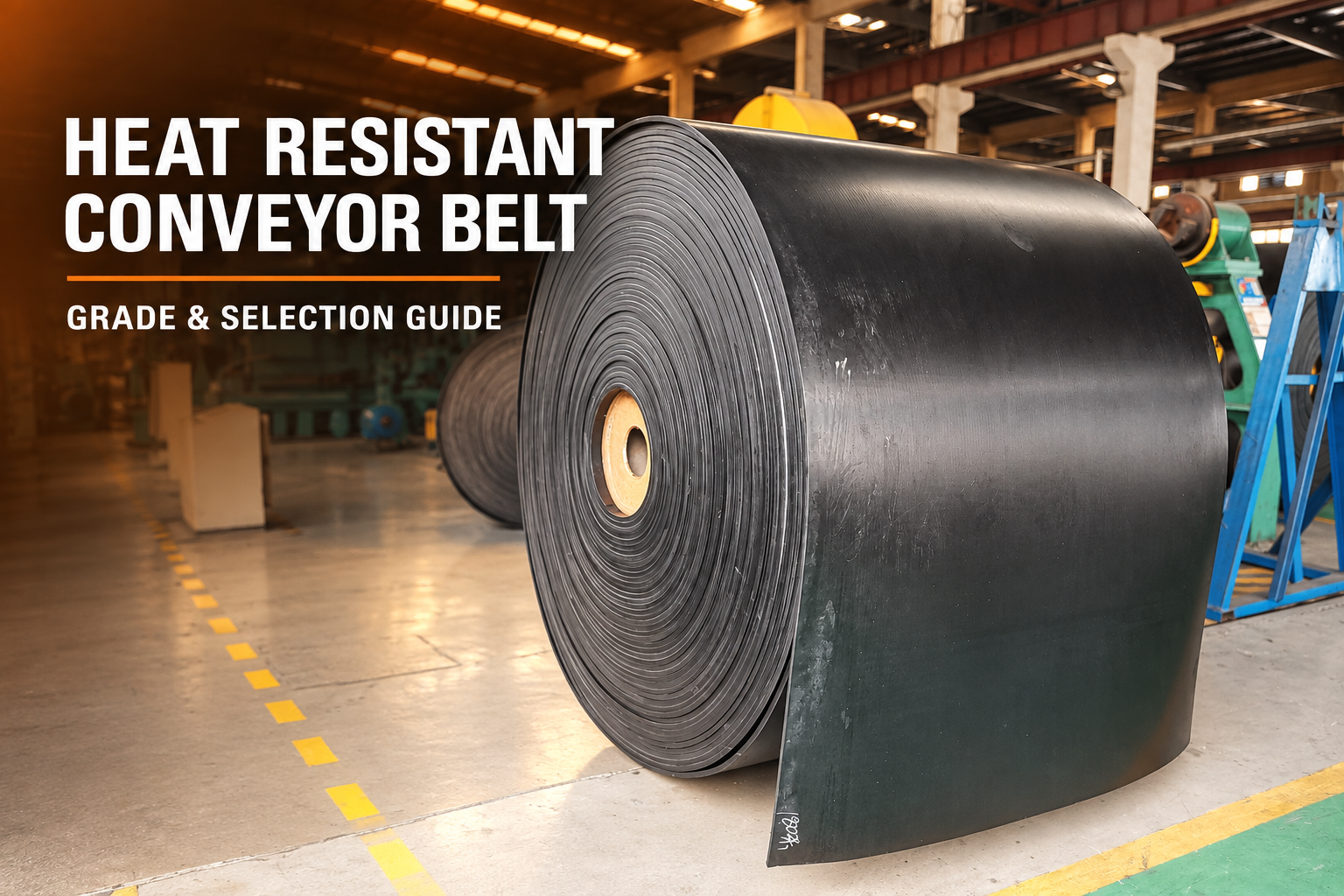
Material type determines cover compound grade and, in many cases, belt construction. Sharp, abrasive materials — crushed ore, granite, clinker — require abrasion-resistant cover rubber formulated to resist cutting and gouging. Soft or packaged goods allow standard compound grades. Hot material requires heat-resistant compounds. Chemically reactive material (oils, acids, fertilizers) requires compound grades that resist absorption and degradation.
Lump size affects belt width selection. As a general rule, belt width should be at least three times the maximum lump size to avoid concentrated edge loading. A belt that is too narrow for the material stream creates problems at the edges that look like tracking issues but are actually structural overload.
2. Conveyor layout and incline angle
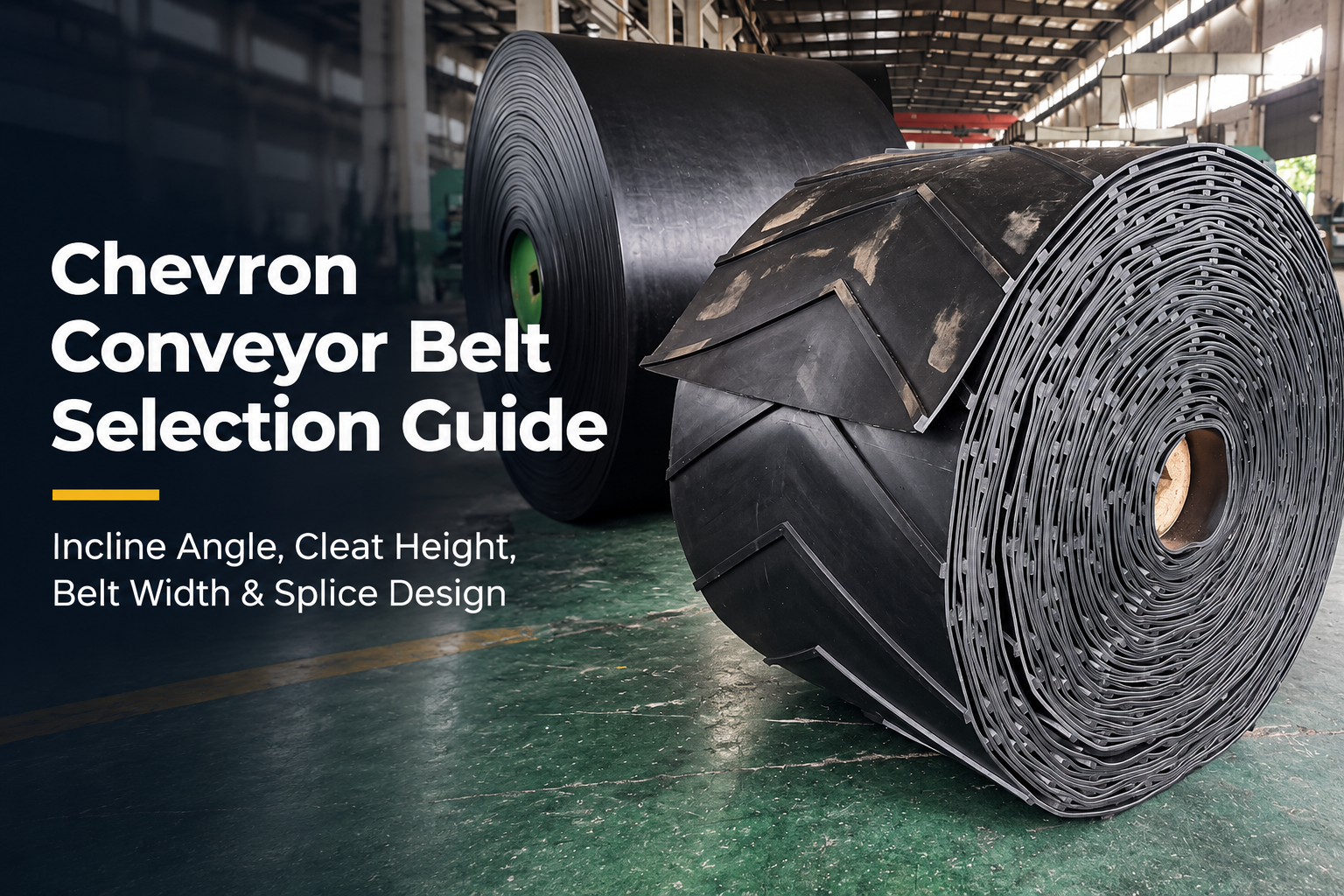
Flat and shallow-incline conveying — up to around 18 to 20 degrees — works with standard flat rubber conveyor belt construction. The belt relies on surface friction and trough geometry to contain material. Past that angle, friction alone is not sufficient for most bulk materials. Chevron or cleated belt profiles add mechanical grip for inclines up to around 35 to 40 degrees. Steeper angles require sidewall construction with enclosed pockets.
Conveyor length drives carcass selection. Short to medium runs with moderate loads work with EP fabric-ply carcass construction. Long-distance conveying — several hundred meters or more — typically requires steel cord carcass for the tensile strength and low elongation that fabric construction cannot match at scale.
3. Operating environment
Underground mining environments require flame-resistant and anti-static rubber conveyor belts as a baseline compliance requirement — not a performance upgrade. Coastal and outdoor installations with high moisture exposure benefit from corrosion-resistant hardware and compound grades that resist moisture absorption. High-temperature environments require heat-resistant cover compounds; standard rubber hardens and cracks under sustained heat.
4. Load volume and throughput
Belt width and speed determine throughput capacity. Wider belts at higher speeds move more material, but both parameters have practical limits set by the drive system, pulley diameter, and structural frame. Cover thickness — particularly on the carrying side — needs to account for the impact load at the loading point, not just the steady-state transport load.
Belt Selection Reference: Application to Specification
|
Application |
Incline |
Recommended Belt Type |
Key Spec Priority |
|
Mining — surface |
Flat to moderate |
Abrasion-resistant rubber conveyor belt, EP or steel cord |
DIN abrasion rating, cover thickness |
|
Mining — underground coal |
Flat to moderate |
Flame-resistant, anti-static rubber belt |
ISO 284 / DIN 22103 compliance |
|
Cement / aggregate plant |
Flat to steep |
Heat-resistant or abrasion-resistant rubber belt |
Temperature rating, abrasion grade |
|
Agriculture / grain |
Inclined 20–35° |
Chevron rubber conveyor belt |
Chevron profile height, material grip |
|
Port / bulk terminal |
Flat, long distance |
Steel cord rubber conveyor belt |
Tensile rating, low elongation |
|
Recycling / waste |
Inclined 25–40° |
Cleated or sidewall rubber belt |
Cleat height, material containment |
|
Food processing |
Flat to mild incline |
Food-grade flat rubber or PVC belt |
Compound compliance, surface cleanability |
How to Choose a Rubber Conveyor Belt: Compound and Carcass
Once the application parameters are defined, belt selection narrows to two decisions: cover compound and carcass construction. These are independent specifications that together determine whether the belt is right for the job.
Cover compound sets the belt's performance envelope against the operating environment. Abrasion-resistant grades (DIN Y, DIN X, DIN W) are ranked by the volume of rubber lost under the standard abrasion test — the lower the number, the harder the compound and the longer it lasts under abrasive material contact. Heat-resistant grades (T1, T2, T3) are rated by the material contact temperature they sustain without degrading. Flame-resistant and anti-static grades must meet defined test standards, not just carry a description.
Carcass construction sets the belt's structural limits. EP fabric-ply in ratings from EP250 to EP600 covers the majority of medium-duty applications. Steel cord in ratings from ST500 to ST7500 covers long-distance and high-tension applications. The carcass tensile rating must be calculated against actual drive tension in the conveyor system — undersized carcass will elongate and eventually fail; oversized carcass adds cost without benefit.
Cover Thickness: Top and Bottom
Top cover thickness is determined by the impact load at the loading point and the abrasiveness of the material being conveyed. Heavier, sharper material and higher drop heights require more rubber between the material and the carcass. Common top cover thicknesses for mining and aggregate run from 6 mm to 12 mm; lighter-duty applications use 3 to 6 mm.
Bottom cover contacts rollers and pulleys under lower stress and wears more slowly. It is typically specified at 2 to 4 mm for most applications — enough to protect the carcass without adding unnecessary weight to the belt.
FAQ: How to Choose Conveyor Belt
What is the most important factor when choosing a conveyor belt?
Material type and operating environment together drive most of the specification. What is being conveyed determines cover compound grade. The environment — temperature, moisture, chemical exposure, underground fire risk — sets any additional compound requirements. Everything else follows from those two inputs.
How do I choose a rubber conveyor belt for an inclined conveyor?
Up to about 18–20 degrees, a standard flat rubber conveyor belt with correct trough geometry works for most materials. Between 20 and 35 degrees, chevron or cleated profiles add grip to prevent rollback. Above 35–40 degrees, sidewall belt construction with enclosed pockets is the reliable solution. Material characteristics — lump size, bulk density, moisture content — affect where these thresholds sit in practice.
When should I use steel cord instead of EP fabric carcass?
When the conveyor run is long enough that EP fabric elongation would require excessive take-up travel, or when the drive tension calculation exceeds EP600 capacity. Also when low elongation is required for precise belt tracking on long systems. Steel cord is standard for overland mining conveyors and high-capacity port installations.
Can the same rubber conveyor belt be used for food and mining applications?
No. Food-contact applications require compound grades that meet food safety regulations — standard mining belt rubber is not formulated for those requirements and is not appropriate for direct product contact. The compound grade and surface finish are completely different between the two application categories.
What does DIN abrasion rating mean when choosing a belt?
DIN abrasion loss measures how much rubber volume is removed under a standard test — lower mm³ loss means better abrasion resistance. DIN Y grade (≤120 mm³) is the premium grade for highly abrasive applications. DIN X (≤150 mm³) suits most mining and aggregate conveying. DIN W (≤200 mm³) covers lighter-duty abrasive conditions. Selecting the wrong grade for a hard rock application is one of the most common causes of premature belt failure.
Sinoconve Belt Range for Industrial Applications
Ningbo Sinoconve Belt Co., Ltd. manufactures rubber conveyor belts across abrasion-resistant, heat-resistant, flame-resistant, steel cord, chevron, cleated, and sidewall constructions for mining, cement, port handling, agriculture, and processing applications. EP carcass ratings from EP250 to EP600 and steel cord from ST500 to ST7500 cover the range of industrial load requirements.
All products are manufactured to DIN, RMA, and AS standards with test reports available per production lot. Belt widths from 100 mm to 3,000 mm, cover thicknesses from 3 mm to 100 mm, and custom compound formulations are available for specific application requirements. MOQ 50 meters, lead time 30 days standard. Contact: sales@sinoconve.com.