
Aramid Fiber PU Timing Belt vs Steel Cord PU Timing Belt: Which Reinforcement Fits the Drive?
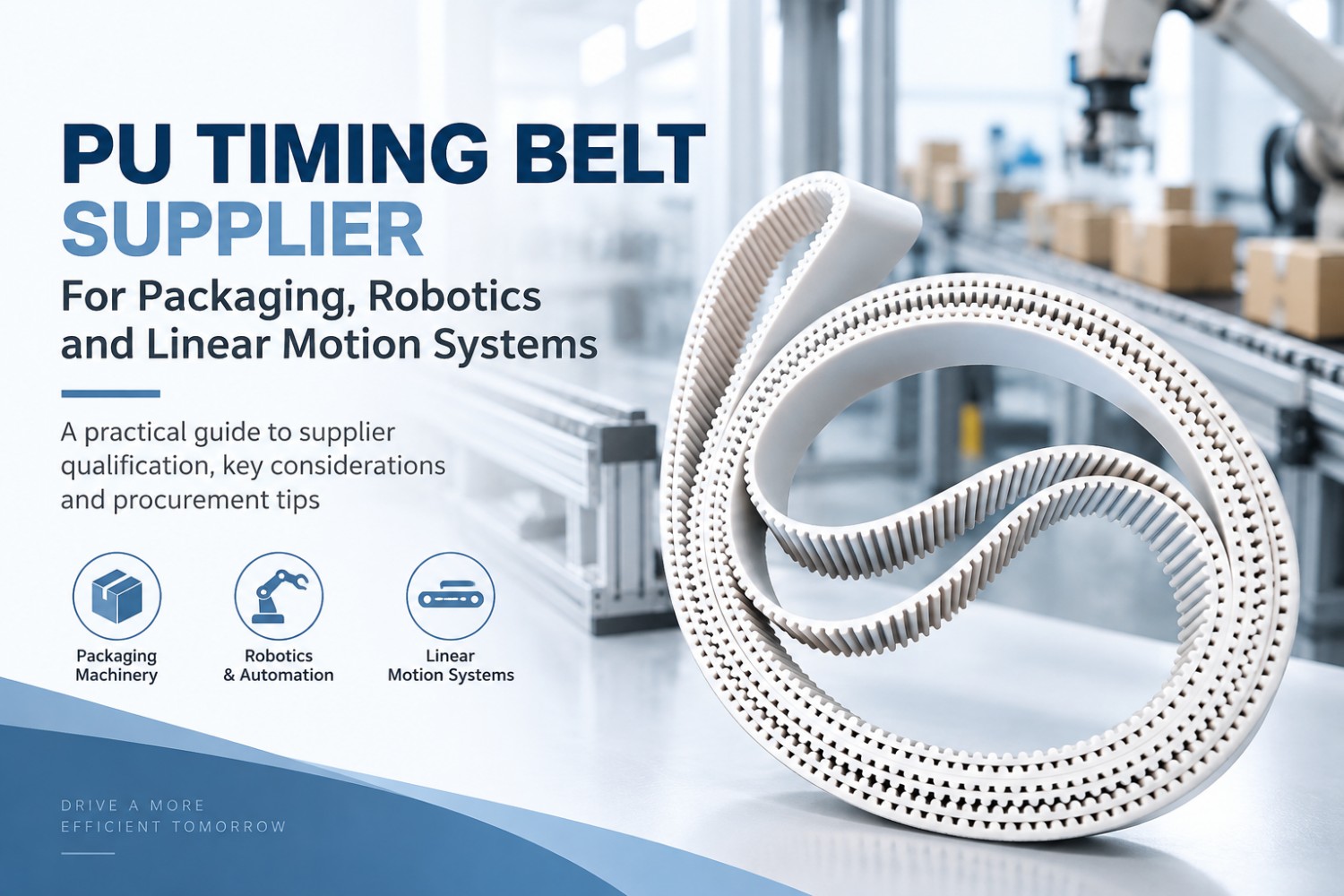
A PU timing belt can look simple from the outside: molded teeth, a polyurethane body, maybe a smooth or coated back. The reinforcement inside is easier to miss, but it often decides how the belt behaves once the machine starts running.
Two belts with the same pitch and width may not behave the same under tension. One may bend more easily around a small pulley. Another may hold length better on a long linear axis. One may be quieter in a fast packaging line; another may be safer where the drive cannot tolerate stretch. That is why the comparison between an Aramid fiber PU timing belt and a Steel Cord PU Timing Belt is not just a material question. It is a drive-design question.
For buyers replacing an existing PU timing belt, the safest starting point is still the old belt code, pulley layout, and actual working condition. Material names help, but they do not replace machine data.
What the Reinforcement Actually Does
The polyurethane part of the belt forms the teeth and the outer body. It handles wear, contact with pulleys, and in some cases contact with transported products. The tensile member inside the belt does a different job. It controls stretch.
When tension rises, the belt body wants to elongate. The cord resists that movement. If the reinforcement is not matched to the load, the belt may still run for a while, but positioning starts to drift, tension needs repeated adjustment, and tooth engagement becomes less consistent.
This is where reinforcement choice becomes important. Aramid fiber and steel cord both strengthen a PU timing belt, but they change the belt in different ways.
Aramid Fiber PU Timing Belt: Where Flexibility Matters
An Aramid fiber PU timing belt uses aramid cords as the tensile member. In many drive layouts, the attraction is clear: low weight, good flexibility, and stable strength without making the belt feel overly stiff.
That matters on compact machines. A belt running around smaller pulleys, frequent direction changes, or a light-duty positioning system may benefit from a reinforcement that bends cleanly without adding unnecessary mass. Less belt weight can also be useful in fast start-stop movement, especially where the drive is not carrying heavy tension.
Aramid does not make a belt universal. If the system has very high working tension or a long axis where stretch control is the main concern, the buyer should compare it carefully against steel cord. But for packaging equipment, light automation, printing machinery, labeling systems, and some custom conveying belts, an Aramid fiber PU timing belt is often the more practical option.
Steel Cord PU Timing Belt: Where Tension Control Takes Priority
A Steel Cord PU Timing Belt uses steel wires inside the polyurethane body. The result is a belt with stronger resistance to elongation under load. On a long linear drive or a heavier transmission system, that reduced stretch can be more valuable than extra flexibility.
The trade-off is stiffness. Steel cord can make the belt less forgiving around small pulley diameters, and it may not be the first choice when the drive path is tight or highly dynamic. The pulley diameter, tooth pitch, and bending cycle matter here. A belt that is strong on paper can still be wrong if the machine forces it around a pulley it was not built to handle.
Steel cord is usually considered when the application needs firm length stability, higher tension capacity, or better control on longer travel. For some automated positioning systems, heavy linear units, and high-load transport drives, a Steel Cord PU Timing Belt can reduce the need for frequent tension correction.
Aramid Fiber vs Steel Cord in a PU Timing Belt
|
Point to Compare |
Aramid Fiber PU Timing Belt |
Steel Cord PU Timing Belt |
|
Main behavior |
Light, flexible, easier bending |
Higher tensile stability, lower stretch |
|
Best fit |
Compact drives, light automation, frequent bending |
Longer axes, heavier loads, higher tension |
|
Pulley concern |
Usually more forgiving on smaller pulleys |
Pulley diameter must be checked carefully |
|
Noise and vibration |
Often used where smoother flex is helpful |
Can be stable under load, but less flexible |
|
Ordering risk |
Under-sizing for tension |
Using it on too small a pulley |
This table is a guide, not a final specification. A real selection still depends on pitch, belt width, tooth profile, pulley diameter, center distance, speed, load pattern, and environment.
Where Each Belt Type Makes Sense
A packaging machine does not ask the belt to behave like a mining conveyor. A labeling line does not load the belt like a long linear actuator. This is why one PU timing belt reinforcement cannot be called better in every case.
|
Application |
Reinforcement Usually Considered |
Reason |
|
Packaging or light conveying |
Aramid fiber |
Lower weight and smoother bending are useful |
|
Printing and labeling equipment |
Aramid fiber |
Stable motion with frequent cycles |
|
Long linear positioning axis |
Steel cord |
Stretch control becomes more important |
|
Heavy transfer or higher-tension drive |
Steel cord |
Better resistance to elongation |
|
Custom belt with holes or backing |
Depends on layout |
Hole position, back contact, and pulley size must be checked |
What Buyers Should Confirm Before Ordering
A supplier cannot choose the right PU timing belt from the phrase ‘strong belt’ alone. The useful information is much more specific.
|
Information to Send |
Why It Matters |
|
Pitch and tooth profile |
Must match the pulley exactly |
|
Belt width and total length |
Affects tension capacity and fit |
|
Pulley diameter |
Especially important for steel cord bending |
|
Load and speed |
Shows whether stretch or flexibility is more critical |
|
Drive layout photo or drawing |
Helps identify bending direction and back-side contact |
|
Need for coating, holes, or profiles |
Changes belt construction and processing method |
|
Working environment |
Oil, dust, moisture, cleaning agents, or temperature exposure |
When the belt is used for replacement, photos of the old belt marking and the pulley set usually save time. That fits the SINOCONVE approach: Save Time, Save Money. Fewer uncertain details mean fewer wrong samples, less back-and-forth, and a better chance of getting the correct belt on the first order.
Failure Signs That Point Back to Reinforcement Choice
Some belt problems are blamed on the polyurethane surface when the real issue is inside the belt or in the drive layout. If the belt needs tension adjustment again and again, the reinforcement may not be controlling stretch well enough for the load. If cracks appear after running around a small pulley, the belt may be too stiff for that bend radius. If tooth wear appears together with positioning error, pulley engagement and belt tension should both be checked.
Edge wear tells a different story. It often points to misalignment, flange contact, or uneven loading rather than cord material alone. A good supplier will ask for these details before recommending an Aramid fiber PU timing belt or a Steel Cord PU Timing Belt.
How SINOCONVE Supports PU Timing Belt Selection
SINOCONVE supplies industrial belts for conveying and power transmission applications, including PU timing belt options for customized machine use. For buyers comparing aramid fiber and steel cord reinforcement, the useful discussion is not only ‘which one is stronger.’ The better question is which belt will hold accuracy, bend properly, and survive the actual duty cycle.
Customization can be discussed based on drawings, samples, part numbers, pitch, width, backing, perforation, coating, and packaging needs. For distributors and equipment manufacturers, clear technical confirmation before production is often the difference between a smooth reorder and a belt that looks right but does not run right.
FAQ
Is an Aramid fiber PU timing belt stronger than a normal PU timing belt?
It usually offers better tensile support than a basic belt without the same reinforcement, but the final result still depends on pitch, width, cord layout, and working load.
Is a Steel Cord PU Timing Belt always better?
No. Steel cord is useful for higher tension and lower elongation, but it can be too stiff for some compact pulley layouts.
Can both belt types be customized?
Yes. Coating, backing, perforation, profile processing, and special lengths can be discussed after the drive layout is confirmed.
What should I send for a quotation?
Send belt pitch, width, length, tooth profile, pulley diameter, machine use, working environment, quantity, and photos or drawings if available.
Final Note
An Aramid fiber PU timing belt and a Steel Cord PU Timing Belt solve different problems. Aramid is often selected when lighter weight and flexibility matter. Steel cord is usually considered when tension control and length stability matter more. For a PU timing belt order, the best choice starts with the machine, not the material name.