
Why the V Belt Application in Car Still Matters
The phrase V belt application in car sounds simple, but it points to a small part that can decide whether a belt-driven system runs quietly or starts slipping under load. In automotive use, a V belt is part of the drive system that transfers rotational power between pulleys. That sounds ordinary until the belt ages, hardens, or loses tension and suddenly the alternator, water pump, or other accessory drive starts behaving badly.
For engineers, sourcing managers, and maintenance teams, the real question is not whether a V belt works in principle. It is which belt profile, construction, and duty level fits the vehicle or equipment it serves. The wrong choice can bring unnecessary noise, poor efficiency, or premature replacement. The right one is often invisible when things are going well, which is exactly how a transmission belt should behave.
What a V Belt Does in a Vehicle
A V belt runs in matching pulley grooves and uses its wedge shape to grip the drive surfaces. That wedging action is why a V belt can transmit power effectively without needing excessive tension. In car applications, belt drives historically supported accessory systems, and in many equipment platforms the same principle still appears wherever compact power transfer is needed.
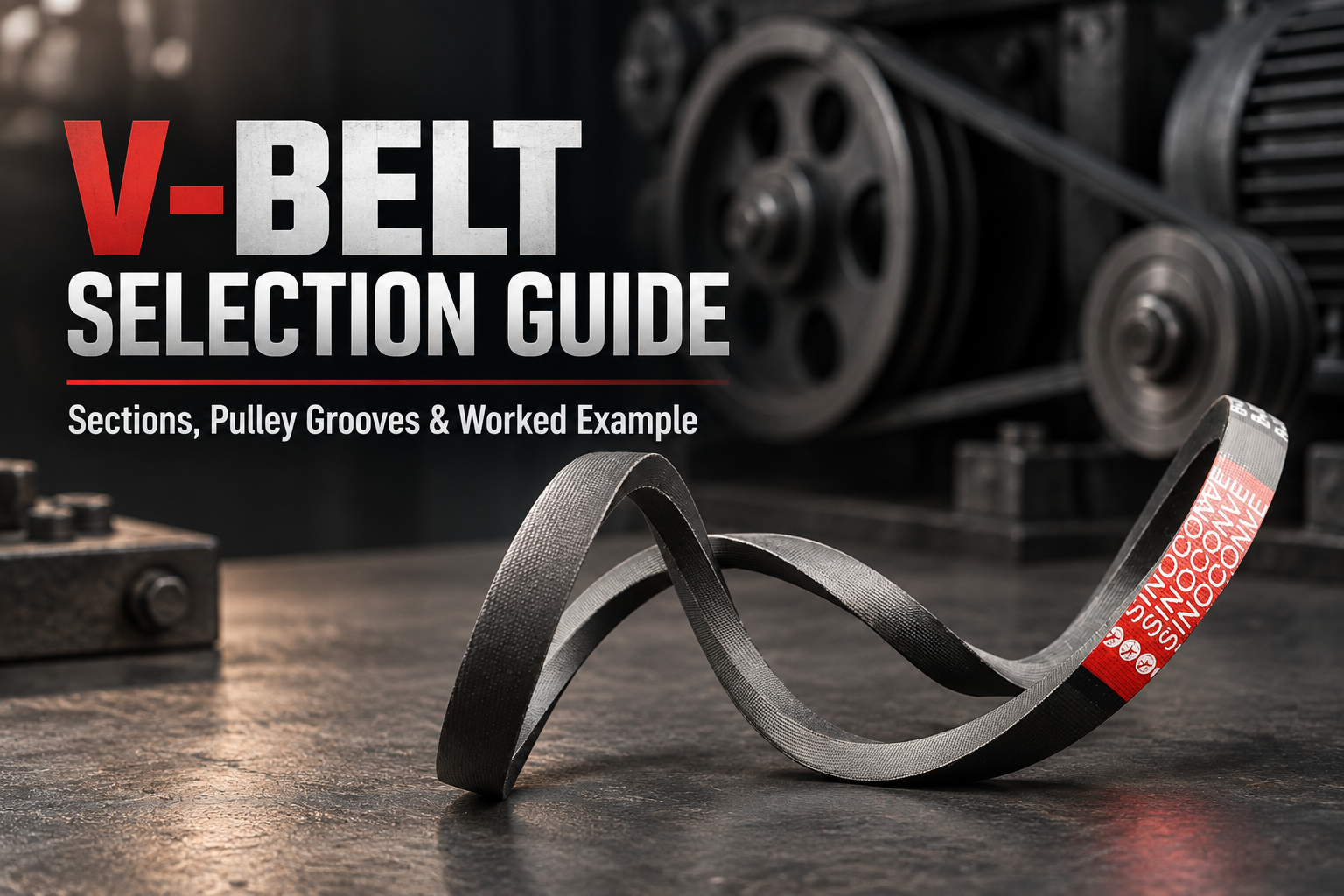
The belt itself is usually a continuous loop with rubber-like outer material and reinforcing layers inside. In industrial products, that structure may be wrapped, cogged, or built with a smooth inner running surface depending on the duty. The product details also show a black belt body with printed identification, which is typical of standardized replacement belts.
Common Places Where the Same Belt Logic Appears
|
Area |
What the Belt Is Doing |
What Buyers Should Check |
|
Accessory drive |
Turns a driven pulley from the crank or motor side |
Profile, length, tension method |
|
Pumps and fans |
Keeps rotation steady under changing load |
Pulley wear, heat, dust |
|
HVAC or compressors |
Handles repeated starts and belt bending |
Small pulley diameter, belt flexibility |
|
Agricultural or workshop machines |
Transfers power in rougher service |
Shock load, dirt, maintenance access |
Plain V Belt Versus Cogged V Belt
Not every drive belt is built the same way. A plain V belt presents a solid profile and is often used where the drive path is straightforward. A cogged V belt, sometimes called a notched V belt, has internal cuts on the inner side. Those notches help the belt flex around smaller pulleys and can reduce heat buildup in demanding service.
That matters in crowded engine bays and compact drive layouts, but it also matters in industrial systems that borrow automotive-style belt logic. If a drive has tight pulley diameters, higher cycling, or a need for smoother flexing, the cogged construction is often the better practical choice. Still, a buyer should not assume more flexible automatically means better. The pulley geometry and operating load have to match the belt design.
|
Drive Condition |
Plain V Belt |
Cogged V Belt |
|
Straightforward pulley path |
Usually enough |
May be unnecessary |
|
Small pulley diameter |
Can run hotter |
Often flexes better |
|
Higher cycling or tighter layout |
Check carefully |
Often a better starting point |
|
Simple replacement on older equipment |
Common choice |
Use only if pulley profile matches |
Key Factors That Influence Belt Selection
Pulley Geometry
The belt must seat properly in the pulley groove. If the profile is off, the belt can ride too high, slip, or wear unevenly. This is one of the most common mistakes in replacement work, especially when a part is ordered by appearance rather than by specification.
Drive Load and Speed
A car accessory drive and an industrial transmission belt may both look like just a belt, but the duty can be very different. Load, speed, and service conditions all influence whether a standard V belt or a cogged design makes more sense. Printed sizing is useful for replacement work, but exact load ratings should not be guessed.
Environment and Maintenance Access
Heat, dust, oil mist, and limited access change the real-world performance picture. A belt that is easy to fit but hard to inspect can become a hidden maintenance item. Buyers should think about replacement frequency, not just initial fit.
What the Visible Product Details Tell Us
The supplied belt descriptions show a black rubber or rubber-composite construction, a continuous loop form, and printed identification markings. One product appears to be a cogged V-belt with a size code similar to 13X900LI, though the full marking is not completely readable. The side marking, fabric cover, and notched inner surface all suggest a standardized drive belt intended for pulley-based power transmission.
Those features line up with common uses in motors, pumps, HVAC units, compressors, agricultural equipment, and machine tools. In other words, the same basic design family serves both automotive and industrial roles, even if the exact specification changes.
Common Buyer Mistakes
The biggest mistake is treating belt replacement as a visual purchase. Another is assuming all V belts share the same cross-section. They do not. Matching the old belt by color or approximate length is risky, especially when the pulley set is already worn.
A second common problem is ignoring the pulleys themselves. If pulley grooves are glazed, misaligned, or damaged, a new belt will not solve the underlying issue for long. That is a nuisance no one wants to discover after the system is back in service.
Replacement Information Worth Sending to a Supplier
|
Information |
Why It Helps |
|
Printed belt code |
Fastest way to identify the original belt |
|
Old belt photo |
Useful when the code is partly worn |
|
Top width and length |
Prevents close-but-wrong replacement |
|
Pulley groove photo |
Shows wear, profile, and possible mismatch |
|
Machine or vehicle model |
Helps cross-check application |
|
Working environment |
Heat, oil mist, dust, outdoor exposure |
Practical Advice for Sourcing Teams and Maintenance Buyers
Ask for the full belt designation, confirm the drive layout, and verify whether the application needs a plain profile or a cogged profile. If the belt is a replacement part, compare the old belt printed code with the machine documentation before ordering. When the specification is unclear, it is better to pause and confirm than to ship the wrong loop of rubber and hope for the best.
For mixed fleets or equipment families, keeping a clear belt identification record saves time later. That is especially useful when the belt marking is partially worn, as in many real workshop conditions.
FAQ
Is a V belt still used in car systems?
Yes, especially in accessory drives and related pulley-driven equipment. Many modern vehicles also use multi-rib belts, so the actual drive layout should be checked before ordering.
Is a cogged V belt the same as a timing belt?
No. The notches on a cogged V belt help flexibility. They do not create synchronous timing engagement like a timing belt tooth profile.
What is the safest way to order a replacement belt?
Start with the printed code if it is readable, then confirm width, length, pulley groove, and working environment. A photo of the old belt and pulley usually saves time.
Next Step
If you are evaluating a V belt application in car systems or related pulley-driven machinery, start with the drive geometry, then the belt profile, then the duty conditions. If you need a replacement industrial drive belt, a clearly marked standard code is the safest route to a correct match. A good belt decision is usually quiet, uneventful, and easy to forget - which is exactly the point.