
When the Belt Material Starts to Matter
A timing belt is easy to describe on paper: teeth on the belt match teeth on the pulley, and the drive moves without slip. In a real machine, the choice gets less tidy. Oil mist, cleaning chemicals, small pulley diameters, high start-stop cycles, and dust around the drive can change how long the belt keeps its shape.
That is why buyers often search for pu timing belt compare rubber timing belt before replacing a belt or building a new drive. The question is not whether PU is always better than rubber. It is where each material behaves more predictably.
Both belt types can transmit motion accurately when pitch, pulley profile, width, and tension are right. The difference usually appears after months of running: tooth wear, noise, stretch, or backing damage.
Where a PU Timing Belt Usually Makes Sense
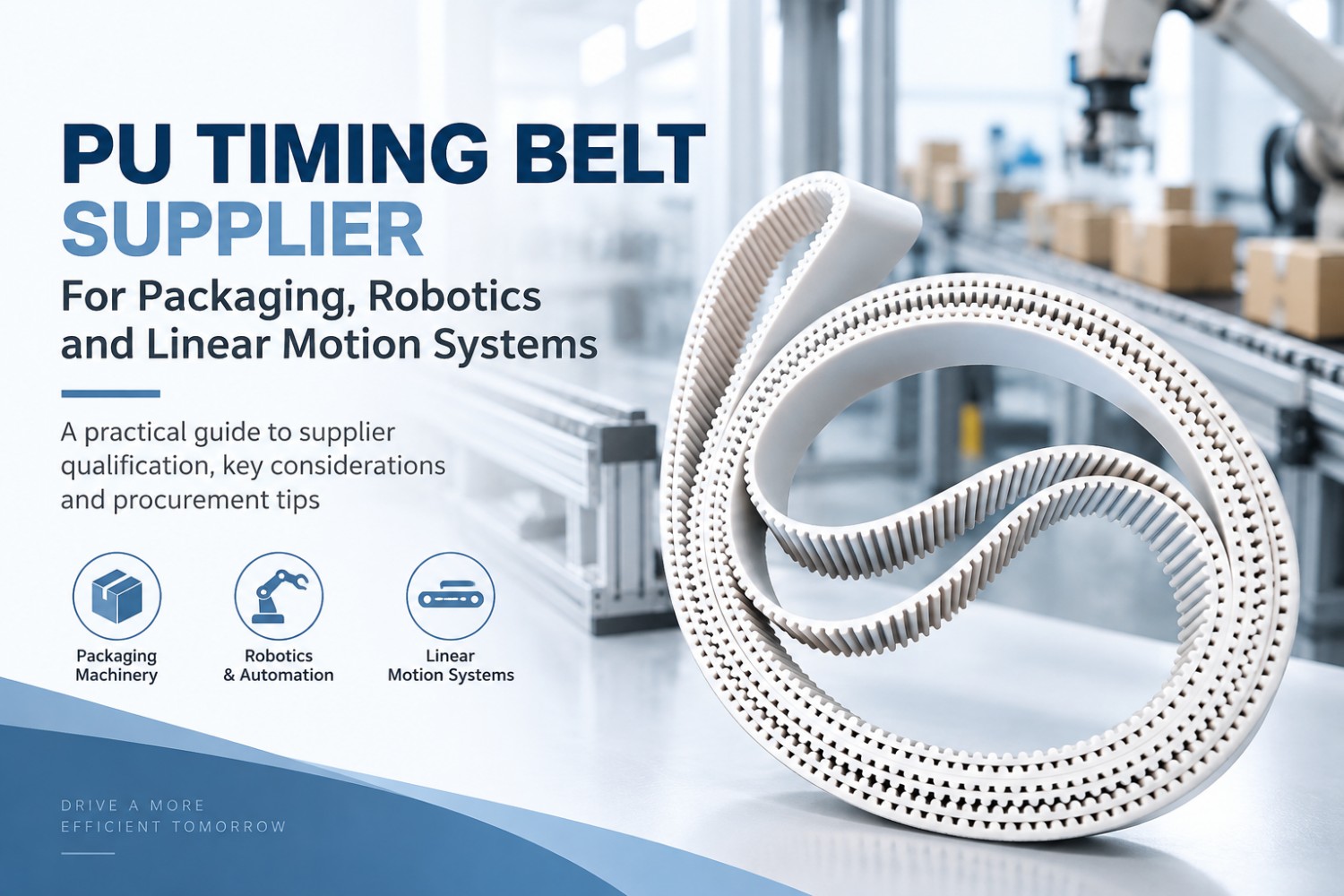
A pu timing belt is often chosen for automation equipment, packaging lines, light conveying drives, linear positioning systems, and machinery that needs clean running with stable tooth engagement. Polyurethane has good wear resistance, and it usually handles oil exposure better than many general rubber compounds.
The material also holds tooth detail well. On a short indexing drive, small tooth deformation can turn into positioning error. The drive still runs, but not quite where the controller expects it.
Many PU belts use steel or aramid cords. Cord choice affects stretch, bending behavior, and load capacity. A stiff cord helps positioning; too much stiffness on a small pulley can shorten belt life.
Why Rubber Timing Belts Still Stay in Use
Rubber timing belts have not disappeared for a reason. In automotive and many industrial drives, rubber compounds can absorb vibration and run quietly. They also handle repeated flexing well in many pulley layouts.
A rubber timing belt is often built with fiberglass, aramid, or other tensile reinforcement. The rubber body carries the tooth shape and backing flexibility, while the cord limits stretch. For engines, compressors, agricultural equipment, and general machinery, that balance is still useful.
Rubber is not automatically the lower-grade option. Compound matters. When heat, pulley alignment, and load fluctuation are the main issues, a good rubber belt may be the practical choice.
PU Timing Belt Compare Rubber Timing Belt: Practical Differences
The table below keeps the comparison simple. It is not a universal rule, but it helps narrow the first choice before checking drawings or samples.
PU Timing Belt vs Rubber Timing Belt
|
Item |
PU Timing Belt |
Rubber Timing Belt |
|
Typical use |
Automation, packaging, positioning, light conveying |
Automotive drives, compressors, fans, general machinery |
|
Main strength |
Wear resistance and stable tooth detail |
Flexing comfort, noise control, vibration absorption |
|
Environment |
Often good with oil and clean industrial areas |
Depends heavily on rubber compound and heat exposure |
|
Watch point |
Cord stiffness, pulley size, possible over-specification |
Compound quality, heat aging, pulley alignment |
|
Best decision rule |
Use when accuracy and clean running matter |
Use when flexing, noise, and load variation matter |
Choosing by Application, Not by Material Name
The phrase pu timing belt compare rubber timing belt is useful as a search term, but the final answer should come from the drive itself. A belt running in a clean packaging machine has different needs from one working near an engine block or in dusty agricultural equipment.
Start with the mechanical data: pitch, width, tooth profile, pulley diameter, center distance, speed, load pattern, and working temperature. Then look at the environment. Is there oil? Is the line washed down? Does the belt run around a small pulley? Does it need quiet running, or is positioning accuracy more important?
For replacement buyers, the old belt code helps, but it is not enough. If the last belt failed early, check alignment, tension, pulley wear, and contamination before blaming the material.
What Buyers Should Confirm Before Ordering
Before asking for a quotation, prepare the belt length, pitch, width, tooth profile, application, quantity, and any old part number. A photo of the pulley and the used belt also helps, especially when the printed code is partly worn away.
For OEM or distributor orders, sample approval is worth doing before volume production. Appearance cannot confirm tooth accuracy, cord placement, or batch consistency.
SINOCONVE Supply Note
SINOCONVE supplies timing belt options for industrial and automotive-related applications, including PU and rubber belt constructions. For a pu timing belt, rubber timing belt, or matched replacement project, the safest quotation starts with the real working condition rather than only the belt name.
If the request is simply pu timing belt compare rubber timing belt, the supplier will still need the drive details. Tooth profile, reinforcement, pulley match, and environment decide whether the belt will run cleanly.
FAQ
Is a PU timing belt better than a rubber timing belt?
Not automatically. PU is often better for clean automation and wear resistance. Rubber can be better where vibration, noise, and repeated flexing are stronger concerns.
Can PU timing belts replace rubber timing belts directly?
Only when the pitch, tooth profile, width, pulley size, tension, and working conditions match. A material swap without checking the drive is risky.
What information is needed for a timing belt quotation?
Belt length, pitch, width, tooth profile, application, quantity, old part number if available, and photos or drawings of the pulley system.