
PK belt vs PJ belt: why the difference matters before you order
A pk belt and a PJ belt can look similar at a glance, especially to buyers who are matching a replacement from a worn sample. Both are ribbed power transmission belts, both run on pulleys, and both are used where the drive needs to be compact and flexible. But they are not interchangeable by default. The profile, rib geometry, and size designation affect how the belt seats in the pulley grooves, how it carries load, and how quietly the system runs.
That matters because a belt that is “close enough” on paper can still slip, ride high in the pulley, wear the ribs unevenly, or make the whole drive noisy. In plant maintenance, automotive sourcing, or OEM design, the real decision is not just which belt exists. It is which belt fits the pulley system you actually have, and which material will survive the environment around it.
Quick comparison: PK belt and PJ belt at a glance
In practical terms, PK and PJ are both ribbed transmission belt families, but they are commonly used in different groove proportions and applications. A PK belt typically refers to a PK-profile multi-rib belt, while a PJ belt refers to a PJ-profile ribbed belt. The visible product markings in the supplied information show examples such as 8PK820 and 10PJ 940PJ, which is exactly the kind of code buyers use to verify replacement compatibility.
What you can safely read from those markings is the belt family and the nominal size designation. What you should not assume is that a PK belt and PJ belt are “close enough” because the number of ribs looks similar. The pulley groove shape and pitch are what decide the match.
When a PK belt tends to be the better fit
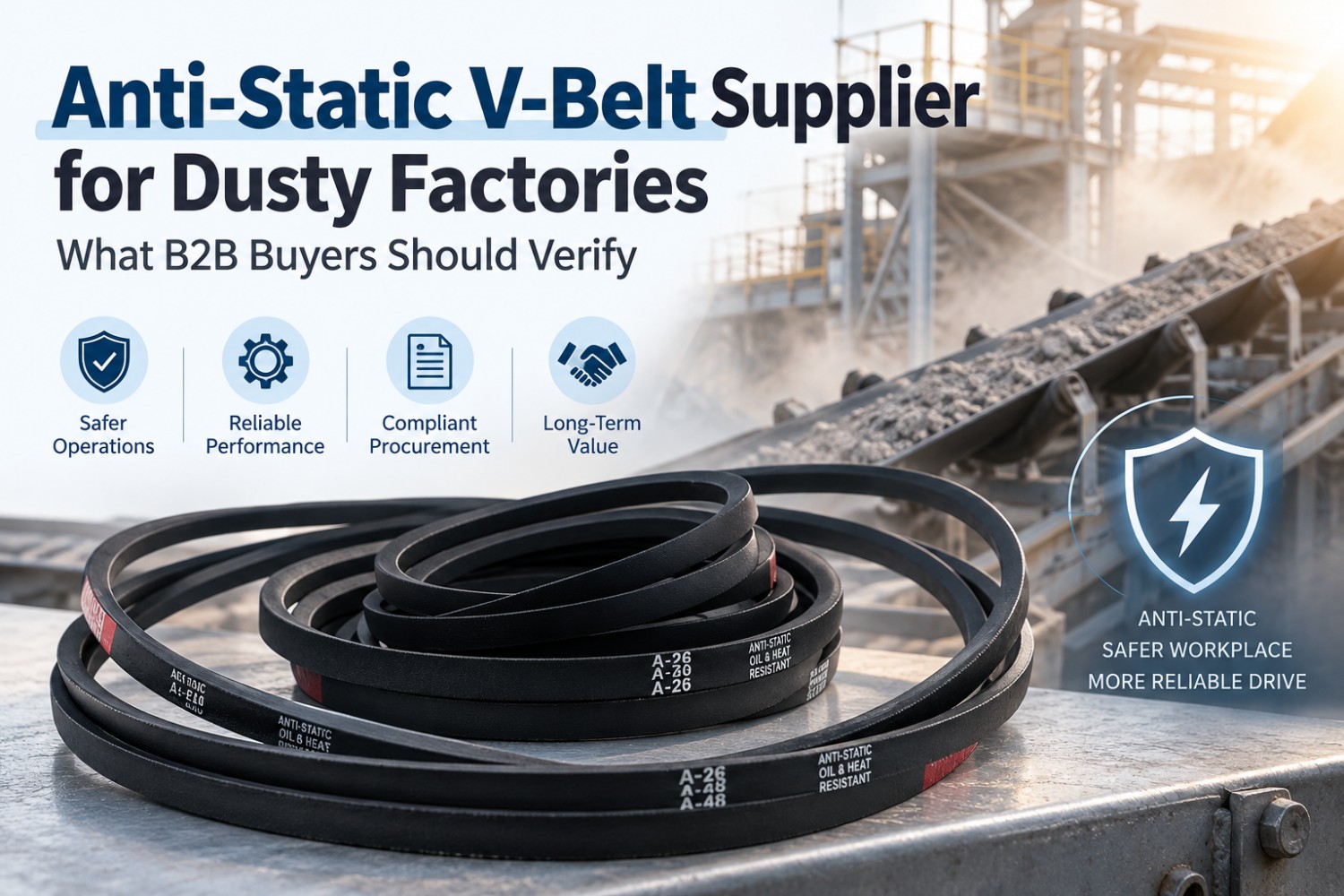
PK-style belts are commonly used in compact drive systems where multiple ribs are needed to transmit power efficiently in a narrow envelope. They are often seen in accessory drives, small engines, compressors, generators, and light industrial equipment. The supplied product data also shows a belt printed with ANTI-STATIC, OIL RESISTANT, and HEAT RESISTANT, which are useful clues for buyers thinking about harsher operating conditions.
When a PJ belt may be the right choice
PJ belts are also ribbed drive belts, but the profile is different and should be matched to the pulley. The supplied example marked EPDM suggests a rubber compound often chosen for durability in belt drives, especially where heat resistance and stable performance matter. EPDM is a common industrial belt material, but the exact formulation, reinforcement, and service limits still need to be confirmed with the maker.
What the visible markings tell a buyer
Markings on the belt are not decoration. They are the first line of identification in the warehouse, on the line, or in the field. From the information provided, the visible codes and claims include 8PK820, 10PJ, 940PJ, EPDM, and performance text such as ANTI-STATIC and OIL & HEAT RESISTANT.
Those markings help in three ways. First, they narrow the size family. Second, they hint at the compound and application environment. Third, they reduce the risk of ordering a generic “ribbed belt” that does not actually belong in the drive. That last mistake is common enough to deserve a caution: if the code on the old belt is worn off, measure and verify rather than guessing from appearance alone.
Comparison and contrast: what changes between profiles, materials, and applications
A belt buyer usually has to compare more than one variable. Profile is one. Material is another. Application is the third, and it is often the one that gets ignored.
For example, a black rubber or rubber-like elastomer belt with a ribbed inner surface is designed to flex around pulleys while keeping traction. The supplied details suggest a molded or extruded belt body with reinforcement cords, then formed into an endless loop. That is a standard construction approach for many transmission belts, but the exact internal build cannot be confirmed from the image alone.
From a buyer’s point of view, a PK belt may be chosen where the pulley set is already designed around PK grooves and where the belt must fit a compact drive path. A PJ belt may be preferred in systems built around that profile, especially when the machine builder has standardized the entire drive package. The wrong profile is not a minor mismatch. It changes the contact pattern between belt and pulley.
Selection criteria that actually matter on the shop floor
If you are sourcing replacement belts, start with the code printed on the belt and the pulley geometry. After that, check the environment. Heat, oil exposure, and static buildup are not theoretical concerns in many workshops and engine bays. The printed claims on the supplied belts point to those exact concerns, which is useful, but still not a substitute for confirming the duty cycle and machine conditions.
For OEM buyers, the better question is not “Which belt is stronger?” but “Which belt is specified for this drive, and what compound gives enough margin without overbuying?” In some machines, EPDM is a sensible choice. In others, a different construction may be more appropriate. The point is to match the belt to the system, not to the loudest marketing claim on the sleeve.
Common mistakes when replacing a ribbed transmission belt
The first mistake is mixing up PK and PJ because both are ribbed. The second is reading only the nominal length and ignoring the profile. The third is assuming that an oil-resistant or heat-resistant belt automatically means it is suitable for every high-temperature or oily environment. Real machines are less tidy than product labels.
A smaller but frequent error is buying by visual count alone. An 8-rib belt and a 10-rib belt are not the same solution, even if the old belt looks flattened or stretched. Count the ribs, read the code, and confirm the pulley set. It saves time later.
Buyer advice for procurement and maintenance teams
If you are building a sourcing spec, keep the language precise: belt family, profile code, size designation, and stated material if known. If the belt is being replaced in the field, record the printed code and photograph the pulleys before removal. That may sound basic, but it prevents a lot of avoidable rework.
For maintenance teams, a ribbed belt should be checked not only for cracks and glazing but also for edge wear, rib damage, and tracking problems. If the drive is noisy after replacement, the answer is not always “tighten it more.” Sometimes the belt profile or pulley condition is wrong.
FAQ: short answers buyers usually need
Can a PK belt replace a PJ belt? Not automatically. The profiles are different and should be matched to the pulley system.
Is EPDM always better? Not always. It is a useful belt material for many applications, but the machine environment and design requirements still decide the best choice.
What does the code on the belt mean? It usually identifies the belt family and size designation, but the exact interpretation should be verified with the manufacturer or standard for that belt type.
Next step for a safer purchase
Before ordering, compare the printed code on your old belt with the pulley profile on the machine. If you are choosing between a PK belt and a PJ belt, do not rely on appearance alone. Confirm the belt family, rib count, length marking, and operating environment, then request the exact replacement specification from your supplier. That is the shortest path to a belt that fits, runs quietly, and stays in service longer than the cheap alternative.