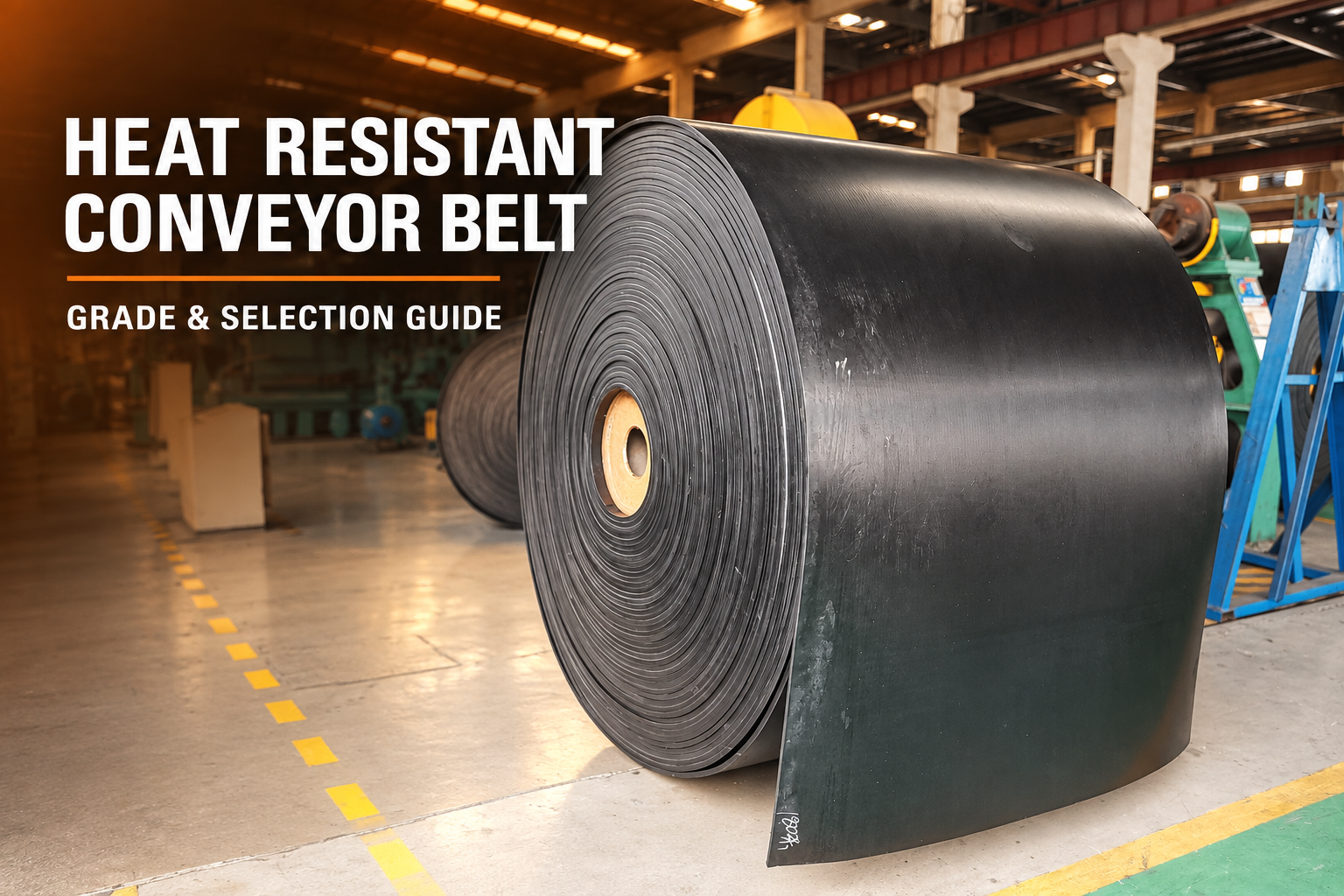

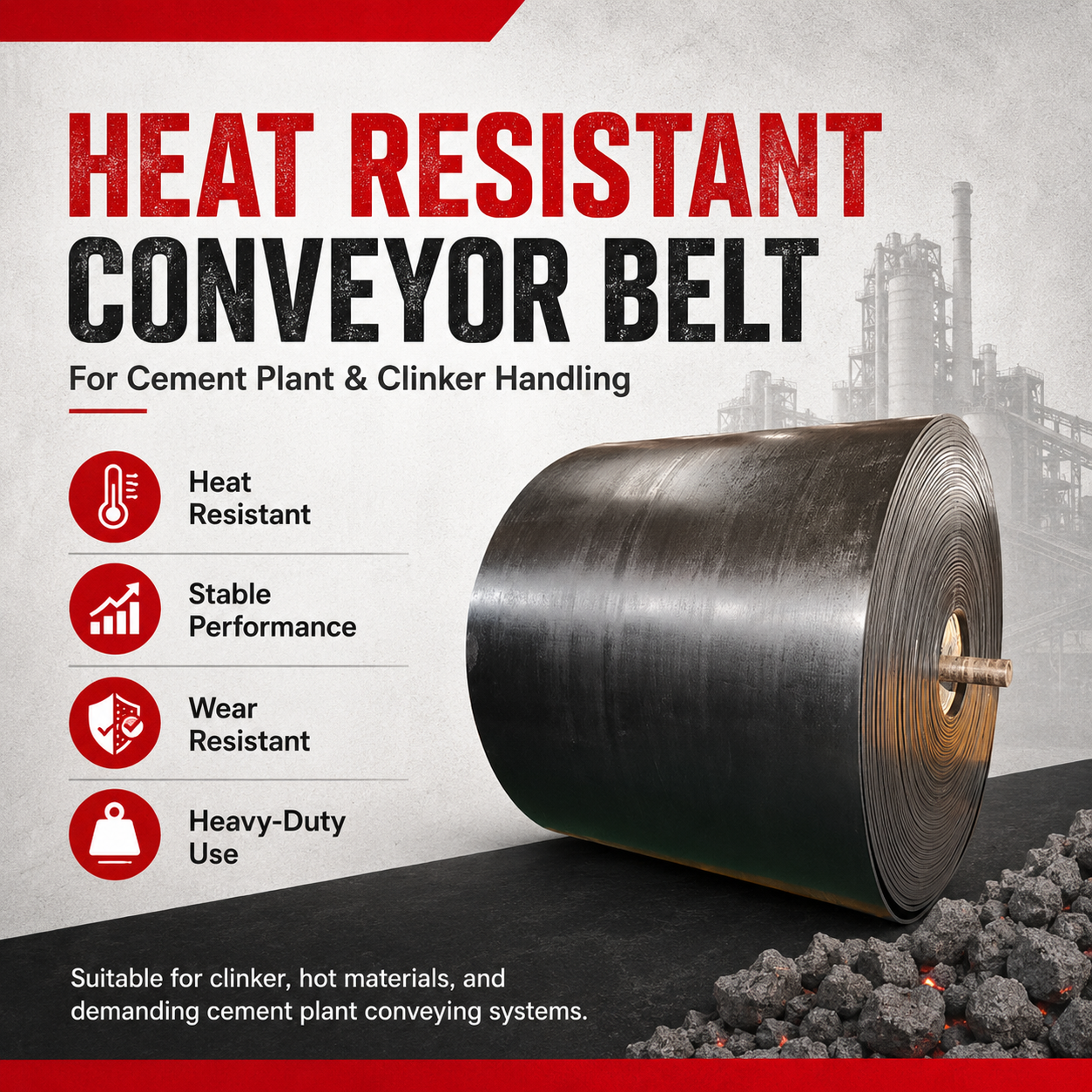
● Clinker is hot and abrasive — a standard belt fails from both directions at once.
● Heat resistance and abrasion resistance must be specified together, not separately.
● T1/T2/T3 grades define operating temperature range; cover abrasion grade defines wear life.
● Most failures in cement plant service trace back to under-specification, not defective belts.
Why Clinker Is a Harder Application Than It Looks
Clinker comes out of the kiln hot and stays hot long enough to matter. By the time it reaches the conveyor, the material temperature at the loading point can be well above what a standard rubber belt is compounded to handle. The rubber starts to soften, the cover loses its abrasion resistance, and the compound oxidizes faster than it would at ambient temperature. None of this is immediately visible — it happens gradually, showing up as cracking, hardening, and premature surface wear.
Add the abrasion profile of clinker — dense, angular, high unit weight — and the problem compounds. Hot material is more damaging to a rubber surface than the same material at ambient temperature, because the rubber compound is already running outside its optimal range. A cement plant clinker belt that is not correctly specified for both heat and abrasion will underperform against almost any other industrial conveyor application.
The conveyor system around the belt matters too. Transfer points where clinker drops onto the belt, areas with poor chute control, and loading zones with high drop height all create localized impact stress on top of the sustained thermal load. A heat resistant conveyor belt specified correctly for temperature but without adequate cover thickness for the impact conditions will still fail ahead of schedule — just at the loading zone rather than along the run.
Temperature Grades: What T1, T2, and T3 Actually Mean
Heat resistant conveyor belts are graded by the material contact temperature the cover compound can sustain without degrading. The grading follows DIN 22102 and equivalent standards.
|
Grade |
Max Material Temp. |
Typical Applications |
Notes |
|
T1 |
60°C |
Warm material from dryers, mild heat exposure |
Entry-level heat resistance; not suited for clinker |
|
T2 |
100°C |
Clinker after cooling, hot aggregate, coke |
Suitable for most cement plant downstream conveying |
|
T3 |
150–200°C |
Clinker direct from cooler, hot foundry material |
Required where belt sees primary clinker discharge |
The temperature grade applies to the material contact temperature at the belt surface — not the ambient temperature in the facility, and not the material temperature at the kiln exit. Clinker loses heat during cooler residence time, so the belt specification depends on where in the process the conveyor sits. A belt feeding directly from the cooler discharge sees higher temperatures than one handling cooled clinker further downstream.
Heat Resistance and Abrasion Resistance Together
Specifying thermal grade without specifying abrasion grade is one of the more common oversights in cement plant belt procurement. The two are separate compound properties and need to be addressed together.
Clinker abrasion is aggressive. The DIN abrasion test measures rubber volume loss in mm³ — lower is better. For clinker and cement raw material handling, DIN Y grade (≤120 mm³) is the appropriate specification for the top cover. DIN X (≤150 mm³) may be acceptable for less abrasive positions in the same plant. Using a general-purpose belt compound in clinker service produces measurably faster cover wear even when the temperature rating is correct.
A heat resistant conveyor belt combining T2 or T3 thermal grade with DIN Y abrasion resistance is what most cement plant clinker positions actually require. Belts specified to one grade without the other may pass incoming inspection and fail in service within a fraction of their expected service life.
Carcass Selection for Cement Plant Service
EP fabric-ply carcass covers most cement plant conveyor applications. EP250 to EP400 handles most in-plant transfer conveyors; longer kiln feed and finished product conveyors may require EP500 to EP600 depending on load and run length. The heat-resistant compound is applied as the cover layer over a standard EP carcass — the carcass itself is not typically modified for thermal service.
Steel cord carcass is specified for cement plant applications where conveyor length or system tension exceeds EP capacity — main clinker transport lines or overland belts connecting kiln and dispatch areas. The selection logic is the same as for any heavy industrial application: calculate system tension, confirm carcass rating provides adequate safety factor, and verify minimum pulley diameter compatibility.
Where Heat Resistant Belts Are Used in Cement Plants
Clinker cooler discharge
The highest-temperature position in most cement plants. Material exits the cooler at temperatures that may still exceed 150°C depending on cooler efficiency and throughput. T3 grade is the baseline specification. Impact resistance at the loading point is critical — clinker drops from the cooler outlet at significant force and the loading zone takes concentrated wear.
Clinker transport to silo or dispatch
Material has cooled further but remains elevated — typically 80 to 120°C depending on distance from cooler and storage time. T2 grade suits most of these positions. Abrasion grade remains important; cooled clinker is still angular and dense.
Raw material handling
Limestone, clay, and additives are conveyed at ambient or near-ambient temperatures. Heat resistance is not the specification driver here — abrasion resistance and, on longer runs, carcass tensile rating are the primary considerations. Standard abrasion-resistant belts are appropriate.
Coal and alternative fuel handling
Fuel conveying in cement plants may require anti-static or flame-resistant compound in addition to abrasion resistance, depending on plant layout and safety classification. These are separate compound requirements from heat resistance and need to be confirmed against the applicable local regulation.
Installation and Operational Factors
Heat can accelerate every other weakness in the conveyor system. Misaligned pulleys create edge wear faster on a hot belt than on the same belt at ambient temperature, because the rubber compound is operating closer to its softening range. Splice quality is more critical in high-temperature service for the same reason — a marginal splice that would last two years in standard service may fail in six months at elevated temperature.
Tensioning affects thermal performance in a less obvious way. An over-tensioned heat resistant conveyor belt running in cement plant service carries more stress through the carcass and splice than the design accounts for, which combines with thermal softening to accelerate fatigue. Tension should be set to specification rather than tightened as a tracking correction.
Storage before installation matters more for heat-resistant compounds than for standard belts. Extended storage in direct sunlight or near heat sources accelerates compound aging before the belt has turned a single revolution. Store horizontally in a cool, covered location.
FAQ
What temperature grade is required for cement plant clinker handling?
T3 (up to 150–200°C) for primary cooler discharge positions. T2 (up to 100°C) for downstream clinker transport where material has cooled further. Confirm the actual material contact temperature at the loading point — the grade selection depends on where in the process the belt operates, not a single plant-wide standard.
Can a standard abrasion-resistant belt be used for hot clinker if it is thick enough?
No. Thickness adds wear life, but it does not change the compound's thermal behavior. A thick general-purpose belt in a clinker position will still soften, harden, and crack at elevated temperatures — just slightly later. The compound formulation determines thermal performance; thickness determines wear life independently.
Is a heat resistant conveyor belt also suitable for coal handling?
Depends on the plant layout and safety requirements. Coal handling in cement plants may require anti-static or flame-resistant compounds independently of heat resistance. Check whether the belt position is classified as requiring those properties under the applicable plant safety standard before specifying heat resistance only.
How does clinker abrasion compare to other bulk materials?
Clinker is among the more abrasive materials in industrial conveying. It is denser than most aggregates, has irregular angular surfaces, and is handled at elevated temperature — all of which accelerate rubber wear. DIN Y grade (≤120 mm³) is the appropriate minimum specification for direct clinker contact. Softer compound grades that would be adequate for limestone or coal will wear significantly faster on clinker.
What is the expected service life of a correctly specified belt in clinker service?
Service life varies by operating conditions, but a correctly specified T2/T3 + DIN Y belt in a well-maintained clinker conveyor typically lasts significantly longer than a general-purpose or under-specified belt in the same position. Providing a specific number requires knowing the actual duty cycle, material temperature, cover thickness, and maintenance standard — ask your supplier for a comparable installation reference.
Sinoconve Heat Resistant Belt Production
Ningbo Sinoconve Belt Co., Ltd. manufactures heat resistant conveyor belts in T1, T2, and T3 grades to DIN, RMA, and AS standards for cement plant, clinker handling, foundry, and bulk material transport applications. Cover compound options combine heat-resistant formulation with abrasion-resistant grades to address the dual requirements of high-temperature abrasive service.
EP carcass from EP250 to EP600 and steel cord from ST500 to ST7500 are available across belt widths from 400 mm to 2,400 mm. Top cover thickness from 4 mm to 12 mm and bottom cover from 2 mm to 6 mm are configurable to application load and impact conditions. Production test reports per lot. MOQ 50 meters; standard lead time 30 days. Contact: sales@sinoconve.com.