
 Endless Conveyor Belt: Optimize Your Workflow
Many buyers ask for an endless conveyor belt because they want “no joint problem.” That is a reasonable starting point, but it is not the whole selection logic. A belt can be endless and still fail early if the pulley is too small, the frame is difficult to open, the surface pattern traps material, or the application actually needs a quick field joint rather than a factory-made loop.
For industrial buyers, the useful question is more specific: where does the joint create trouble today? Is it catching on a scraper? Clicking over a small pulley? Marking the product? Opening before the belt body wears out? Those answers decide whether a rubber endless belt is worth ordering, and what type of endless rubber conveyor belt should be made.
What “Endless” Really Means in a Conveyor Belt
An endless belt is supplied as a continuous loop. In some products, the belt is produced without a visible seam. In many rubber conveyor applications, the belt is joined into a loop by controlled vulcanization or factory splicing before shipment. The point is the same from the user side: the belt arrives ready to run without an on-site mechanical fastener.
That can be useful. Mechanical joints may be practical for emergency repair, but they can also create a raised area, noise over pulleys, cleaner interference, or a place where small products catch. A properly made endless conveyor belt removes that fastener area. The running surface becomes smoother, and the belt can pass through compact equipment with less disturbance.
Still, “endless” is not automatically better. If the conveyor frame cannot be opened, if the belt path is buried inside the machine, or if the line needs fast field replacement, an endless loop may be inconvenient. The installation path matters as much as the belt specification.
Where an Endless Conveyor Belt Usually Makes Sense
|
Application area |
Why endless construction may help |
What still needs checking |
|
Packaging transfer line |
No metal fastener to mark cartons, pouches, or wrapped goods. |
Product contact surface, pulley diameter, and splice thickness. |
|
Small machinery or compact conveyor |
Smooth running over short pulley centers and small transfer points. |
Whether the machine frame can be opened for installation. |
|
Agricultural handling line |
Less catching at the joint when moving grain, feed, or light crop material. |
Residue buildup, moisture, and return-side cleaning. |
|
Light aggregate or sand transfer |
Factory-made loop can reduce joint lifting where impact is moderate. |
Cover grade, loading point impact, and joint method. |
|
Inclined conveying with chevron or cleats |
Continuous loop avoids mechanical fastener interference on the return path. |
Pattern height, pulley diameter, and return clearance. |
The pattern here is simple. Endless construction is most useful when the joint itself is the weak point or when product contact must stay smooth. It is less useful when access is poor or when the belt will be repaired repeatedly in the field.
Rubber Endless Belt vs Standard Jointed Belt
A rubber endless belt is often selected for repeated bending, clean transfer, or equipment where fasteners create a problem. A standard open belt with mechanical fasteners can still be the better choice when repair speed matters more than smoothness. A hot vulcanized joint can sit between the two: stronger and smoother than many mechanical joints, but still dependent on field skill and working conditions if made on site.
|
Belt option |
Best fit |
Main risk if chosen wrongly |
|
Rubber endless belt |
Compact machines, smooth transfer, fixed equipment, repeated running over pulleys. |
Installation may be difficult if the frame cannot open. |
|
Endless rubber conveyor belt with chevron |
Inclined conveying where rollback is the main issue. |
Chevron pattern may trap residue or require larger pulley clearance. |
|
Mechanical-fastened belt |
Emergency repair, temporary operation, conveyors that cannot be disassembled easily. |
Fastener may catch cleaners, mark products, or create impact over pulleys. |
|
Field-vulcanized joint belt |
Heavy-duty rubber belt where a smooth joint is needed on site. |
Quality depends on surface preparation, materials, temperature, pressure, and technician skill. |
Four Problems an Endless Belt Can Solve — and One It Cannot
1. Joint lifting on small pulleys
When a belt passes over a small pulley many times per hour, the joint area bends more sharply than the rest of the belt. If the joint is stiff or poorly prepared, the edge may start to lift. Once that happens, the belt can click, vibrate, or tear at the joint. An endless conveyor belt can reduce this problem when the loop is made with a smoother, more flexible splice design. But the pulley diameter still has to match the belt construction. A thick belt forced around a small pulley will not become flexible just because it is endless.
2. Product catching on fasteners
Small bags, cartons, soft packages, and loose light goods may catch on a raised mechanical fastener. That is more than a cosmetic issue. It can disturb spacing, affect sensors, or create jams at transfer points. A rubber endless belt removes the metal joint from the carrying surface, which is why it is common in lines where product contact matters.
3. Cleaner interference
On bulk handling conveyors, the cleaner or scraper can strike the joint area each time it passes. If the fastener sits too high, it may chatter against the blade. The result can be cleaner wear, belt cover damage, or joint fatigue. An endless rubber conveyor belt can help here, but only if the belt cover, scraper pressure, and material carryback are also controlled.
4. Repeated tension adjustment
A weak or uneven joint can make operators keep adjusting tension. Too loose, and the belt slips. Too tight, and bearings, pulleys, and the splice take extra stress. Endless construction can make tension behavior more stable, but it will not fix a bent frame, dirty pulley face, or wrong take-up setting.
What endless construction cannot fix
It cannot correct a bad conveyor layout. If material is dropped too high, if the return path is packed with residue, if the belt is too wide for the frame, or if the pulley is badly worn, the same failure may return. The old belt should be studied before the new one is ordered.
When a Chevron Endless Conveyor Belt Is the Right Direction
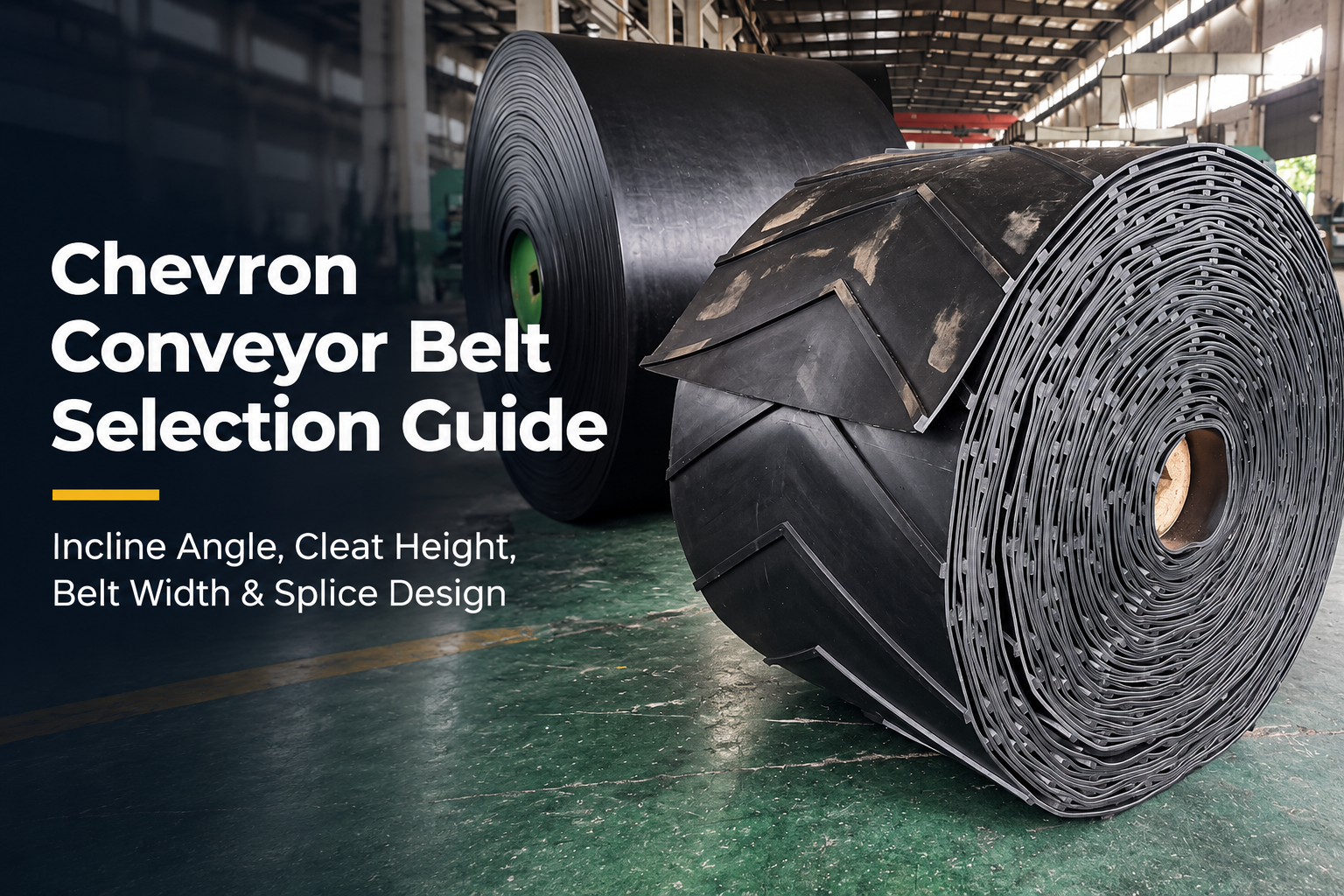
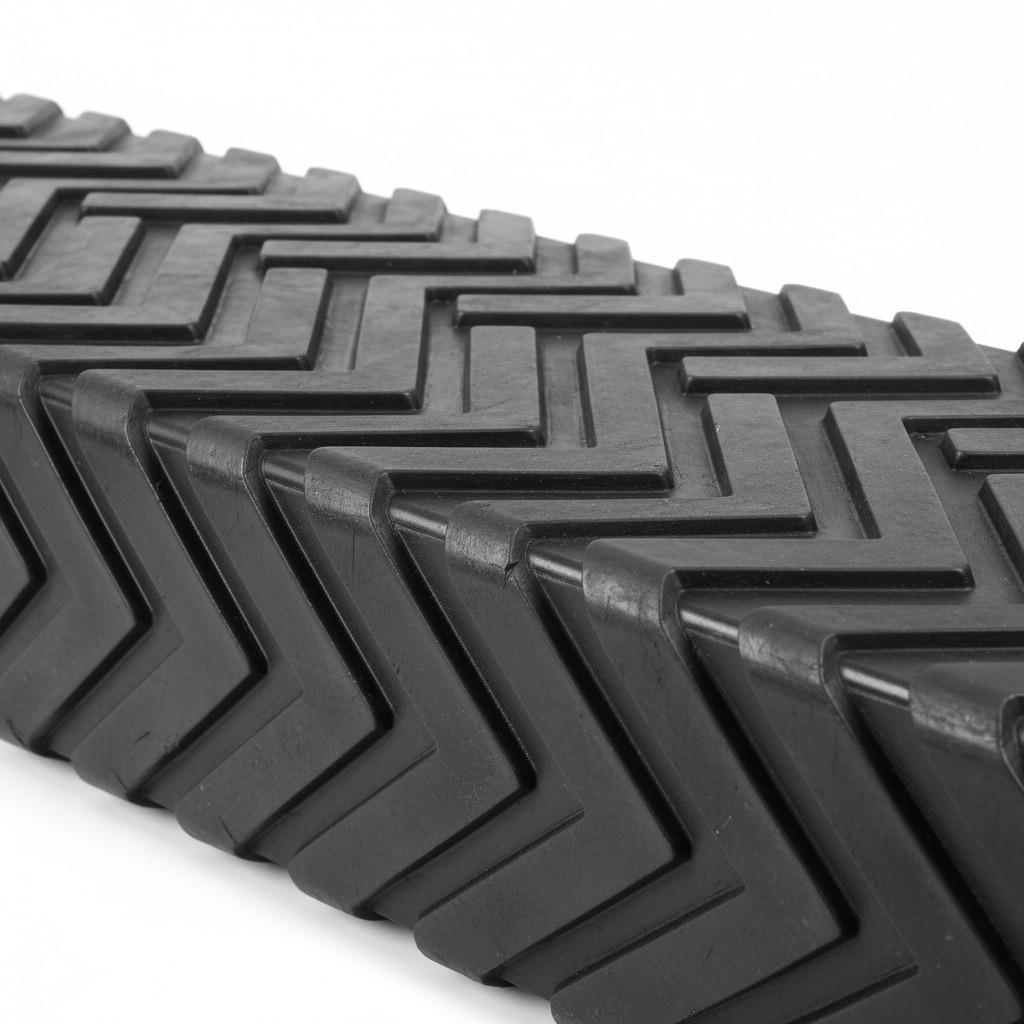
Some buyers ask for an endless rubber conveyor belt and a chevron pattern in the same order. That can make sense, especially when material moves uphill and the conveyor does not have room for material rollback. But chevron is not a decoration. The profile height, spacing, and rubber grade affect how the belt bends, cleans, and releases material.
For grain, light fertilizer, sand, wood chips, or similar loose materials, a chevron surface may help the material stay on the belt. For sticky or wet material, the raised pattern may hold residue. In that case, cleaning access becomes more important than grip alone. The belt should be matched to the material behavior, not only the incline angle.
|
Material / condition |
Possible belt direction |
Buyer note |
|
Cartons or packed goods |
Smooth or light textured endless belt. |
Avoid over-gripping if discharge needs clean release. |
|
Grain, feed, light fertilizer |
Chevron rubber endless belt may help on incline. |
Check residue and return-path cleaning. |
|
Sand or light aggregate |
Rubber endless belt with abrasion-resistant cover. |
Loading impact may matter more than the splice. |
|
Sticky wet material |
Surface must balance grip and release. |
Chevron can collect residue if cleaning is weak. |
|
Small pulleys / compact frame |
Flexible endless belt construction. |
Confirm minimum pulley diameter before production. |
Information Buyers Should Send Before Ordering
A useful inquiry for an endless conveyor belt should describe how the belt will be installed and what failed before. Width and length are necessary, but they do not explain the job. A supplier also needs to know whether the belt will pass through a closed frame, what material it carries, whether the product touches the joint area, and whether the previous belt failed at the splice, edge, cover, or return side.
|
Information to send |
Why it matters |
|
Belt width, length, and thickness |
Basic production size and loop dimension. |
|
Open frame or closed frame installation |
Decides whether an endless loop can be installed easily. |
|
Pulley diameter and conveyor layout photos |
Checks bending stress and clearance. |
|
Material handled |
Helps select cover rubber, surface, and pattern. |
|
Incline angle and belt speed |
Affects need for chevron, cleats, or rough surface. |
|
Old belt failure photos |
Shows whether the issue was joint, cover, tracking, or residue. |
|
Splice or surface requirement |
Clarifies whether smooth running, grip, release, or containment matters most. |
|
Quantity, packing, and labeling needs |
Supports OEM supply, repeat orders, and export packaging. |
Common Mistakes with Endless Conveyor Belts
The first mistake is treating endless construction as a stronger version of every belt. It is not. It solves joint-related problems, but it does not replace correct cover grade, belt strength, pulley fit, or tracking control.
The second mistake is ordering an endless loop before checking installation access. If the conveyor frame cannot open, the belt may be correct on paper and still impossible to install without extra work.
The third mistake is mixing surface features without considering bending. A chevron endless belt, cleated endless belt, or thick rubber endless belt may need more pulley clearance than a plain flat belt. A design that works on one conveyor may fail on another with a smaller head pulley.
The fourth mistake is ignoring the previous failure mark. If the old joint opened because the pulley was too small, repeating the same belt construction in endless form may only delay the problem. The failure mark is part of the specification.
How SINOCONVE Approaches Endless Rubber Belt Matching
For SINOCONVE, endless belt matching starts with the application, not just the product name. A packaging machine may need a smooth joint and clean product transfer. A farm conveyor may need a chevron surface and good return clearance. A light aggregate line may need better cover rubber and a joint that does not open under repeated bending.
SINOCONVE supports conveyor belts, rubber belts, transmission belts, timing belts, V belts, and conveyor rollers, with OEM and customized production available based on drawings, samples, belt codes, logo requirements, colors, and packaging needs. For an endless rubber conveyor belt, the useful work happens before production: confirming the loop length, pulley layout, surface pattern, splice method, and working condition.
That is also where Save Time, Save Money fits. A clear inquiry reduces repeated confirmation. A belt made for the real conveyor reduces sample mistakes. A correct endless construction can save installation time and avoid early joint-related downtime.
FAQ
What is an endless conveyor belt used for?
It is used where a continuous loop is preferred, especially when mechanical fasteners may catch products, create noise, interfere with cleaners, or fail early on small pulleys.
Is a rubber endless belt always better than a jointed belt?
No. It is better when joint smoothness and continuous running matter. A mechanical-fastened belt may still be more practical for emergency repair or conveyors that are hard to disassemble.
Can an endless rubber conveyor belt have chevron patterns?
Yes, but chevron height, pulley diameter, return clearance, and cleaning access should be checked before production.
Why does an endless belt still fail early?
Common reasons include small pulley diameter, wrong cover grade, poor tracking, material buildup, excessive tension, or a belt surface that does not match the material.
What should I send for a quotation?
Send belt size, pulley layout photos, conveyor installation access, material handled, incline angle, old belt photos, failure marks, surface requirement, quantity, and packaging needs.
Final Note for Industrial Buyers
An endless conveyor belt is not only a loop without a visible fastener. It is a choice about installation access, joint behavior, product contact, pulley bending, and long-term maintenance. For buyers comparing rubber endless belt and endless rubber conveyor belt options, the safest route is to start with the conveyor layout and the old belt failure marks. Once those are clear, the supplier can recommend a belt that solves the right problem rather than simply quoting the nearest standard loop.