
Discover the Efficiency of Cleated Conveyor Belts
Flat conveyor belts move material efficiently on level ground. Add an incline and the problem becomes obvious within seconds: material slides back, throughput drops, and cleanup starts. The steeper the angle, the worse it gets.
A cleated conveyor belt solves this by changing the belt surface itself. Rather than relying on friction between material and rubber, the cleats create physical barriers that hold material in place as the belt climbs. The result is reliable incline conveying that a smooth belt simply cannot replicate, regardless of rubber compound or belt speed.
What Is a Cleated Conveyor Belt?
A cleated conveyor belt is a rubber belt with raised profiles — the cleats — vulcanized directly onto the carrying surface at regular intervals. The cleats act as barriers perpendicular to belt travel, creating pockets that support material against gravity as the belt moves upward.
Cleat height, shape, and spacing are not fixed. They are selected based on the material being conveyed and the incline angle. Fine powders need shallower, more closely spaced cleats to prevent sifting through the gaps. Large, irregular bulk material needs taller cleats with wider spacing to accommodate lump size. Getting the cleat geometry wrong — undersized cleats on steep inclines, oversized cleats on shallow ones — reduces the belt's effectiveness and can create conveying problems that look like belt tracking or drive issues.
The cleats themselves are the same rubber compound as the belt body, vulcanized during manufacture rather than bonded after. That integral construction is what gives the cleat its attachment strength — a cleat that is bonded on after curing will eventually peel under load, particularly in applications with impact or vibration at the loading point.
Cleat Profiles and What Drives the Choice
T-cleats are the most common profile for general bulk material handling. The T-shape provides a wide base footprint bonded to the belt surface and a vertical face that stops material from rolling back. They work across a range of incline angles and material types, which is why they appear in mining, aggregate, and recycling applications as the default choice.
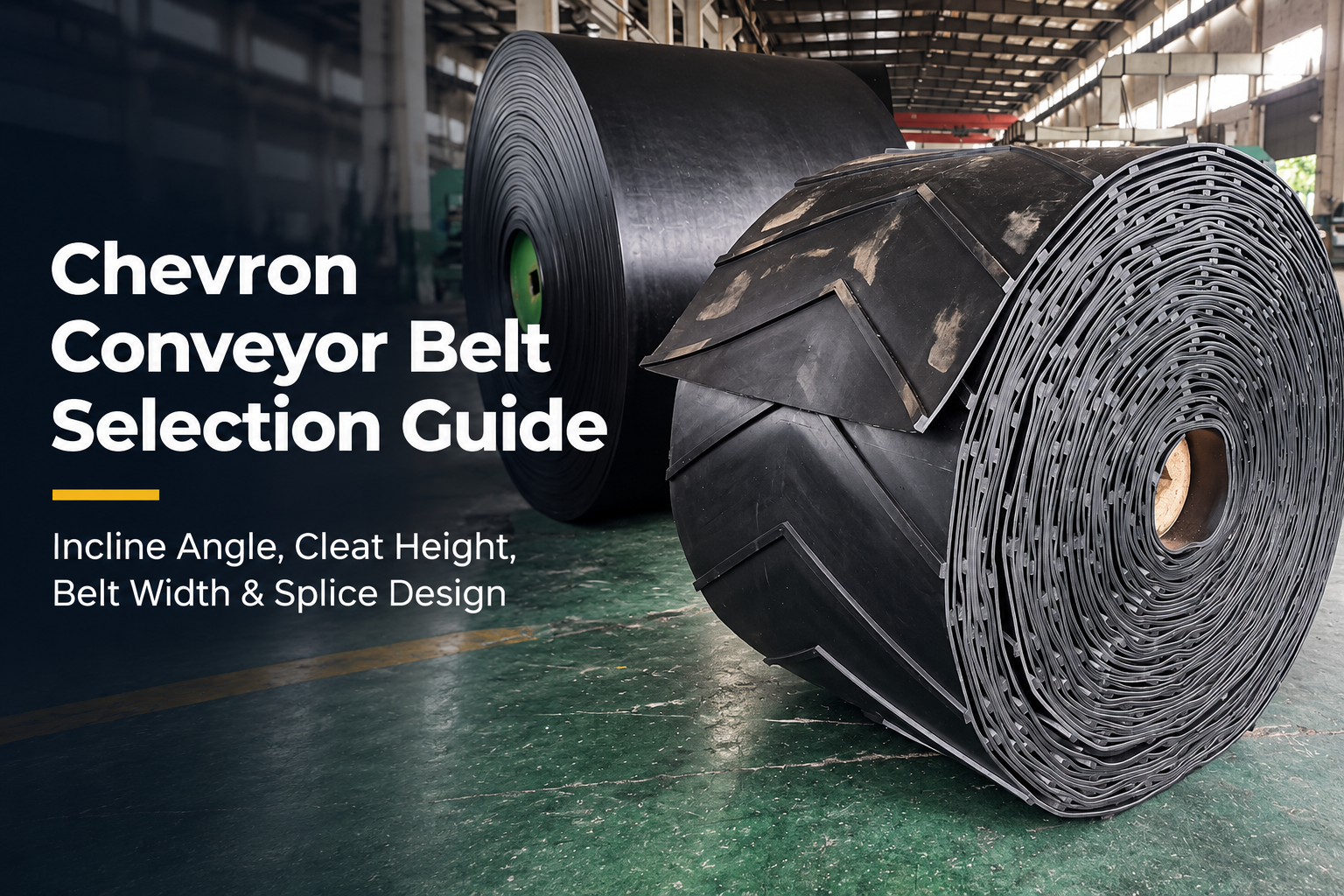
Chevron cleats — V-shaped across the belt width — do two things simultaneously: they grip material on inclines and channel it toward the belt center, which reduces side spillage. This makes chevron profiles particularly effective for loose, mobile materials like grain, sand, and coal where edge spillage on a straight cleat belt would be a secondary problem. The V-geometry also gives the belt additional traction even on shallower inclines where a straight cleat might be over-specified.
C-cleats and custom profiles serve specialized applications — food processing lines where the cleat shape affects cleanability, gentle conveying where material needs to stay separated between cleats, or applications where the cleat needs to flex around small-diameter pulleys without cracking. Cleat flexibility is a design constraint that limits how tall a cleat can be for a given belt thickness and pulley diameter.
Endless Construction and Why It Matters
A cleated conveyor belt can be manufactured as a spliced loop or as a seamless endless belt. The splice is the weakest point in any conveyor belt — stress concentrates at the joint, and cleat belts add additional complexity because the cleat spacing needs to be maintained through the splice region.
Endless construction eliminates the splice entirely. The belt is manufactured as a closed loop from the start, with consistent cleat spacing around the full circumference. The practical benefit is longer service life and more predictable behavior — no splice to inspect, no joint to fail, and consistent belt weight distribution that reduces vibration in the return path.
The trade-off is that endless belts require the conveyor to be designed around a fixed belt length. Spliced belts can be cut to any length on site and re-joined, which suits retrofit or field-assembled conveyor installations. For dedicated conveyors in fixed installations, endless construction is the better long-term choice.
Incline Angles and Operating Limits
A cleated conveyor belt handles incline angles that would cause complete material rollback on a flat belt. Depending on cleat height and material characteristics, usable angles range from around 25 degrees up to 40 degrees for most bulk applications. Beyond that, sidewall construction with enclosed pockets is typically needed to contain material through steeper sections.
The incline angle limit is not purely a function of cleat height. Material properties matter significantly. A wet or slippery material behaves differently than dry aggregate at the same angle. Fine material with a low angle of repose — flour, fine coal dust, wet sand — will flow between cleats or over them at angles that coarser material handles without issue. Specifying the incline angle without considering material behavior is an incomplete specification.
Space efficiency is the direct operational benefit of steeper incline capability. A cleated belt running at 35 degrees covers the same vertical elevation in roughly half the horizontal distance of a flat belt running at 18 degrees. On constrained sites — processing plants, underground operations, logistics facilities with limited floor space — that geometry difference changes what layouts are actually possible.
Industries and Applications
Agriculture uses cleated belts for grain, feed, and root vegetables — materials that need to move uphill without bruising or loss. The cleat geometry is selected to support the product without damaging it, which is a different design priority than bulk mineral conveying.
Recycling and waste processing rely on cleated conveyor belts to move shredded material, sorted fractions, and mixed bulk streams between sorting, processing, and baling stages. The material is often irregular, abrasive, and variable in density — conditions where cleat geometry needs to accommodate a wide range of piece sizes.
Logistics and parcel handling use cleated belts for loading and unloading operations where packaged goods need to move between ground level and vehicle loading height. The cleat profile here is typically lower — enough to prevent sliding, not so aggressive that it damages packaging.
Mining and quarrying are the highest-stress applications: abrasive bulk material, continuous operation, often outdoor exposure. Cleat compound selection and cleat height are more critical here than in lighter-duty applications because the consequences of premature cleat wear are immediate — material rollback and spillage at the incline.
Sinoconve Cleated Belt Range
Ningbo Sinoconve Belt Co., Ltd. manufactures cleated conveyor belts with T, chevron, and C-cleat profiles across a range of cleat heights and spacings for bulk material handling, agricultural, recycling, and logistics applications. Belts are produced to DIN, RMA, and ISO standards with abrasion-resistant, heat-resistant, and general-purpose rubber compound options.
Belt widths from 100 mm to 3,000 mm are available, with cleat geometry configured to application requirements. Custom cleat profiles, endless construction, and OEM production with client branding are supported. Standard lead time is 30 days; expedited production at 15 to 20 days is available for urgent requirements. MOQ is 50 meters. Contact: sales@sinoconve.com.