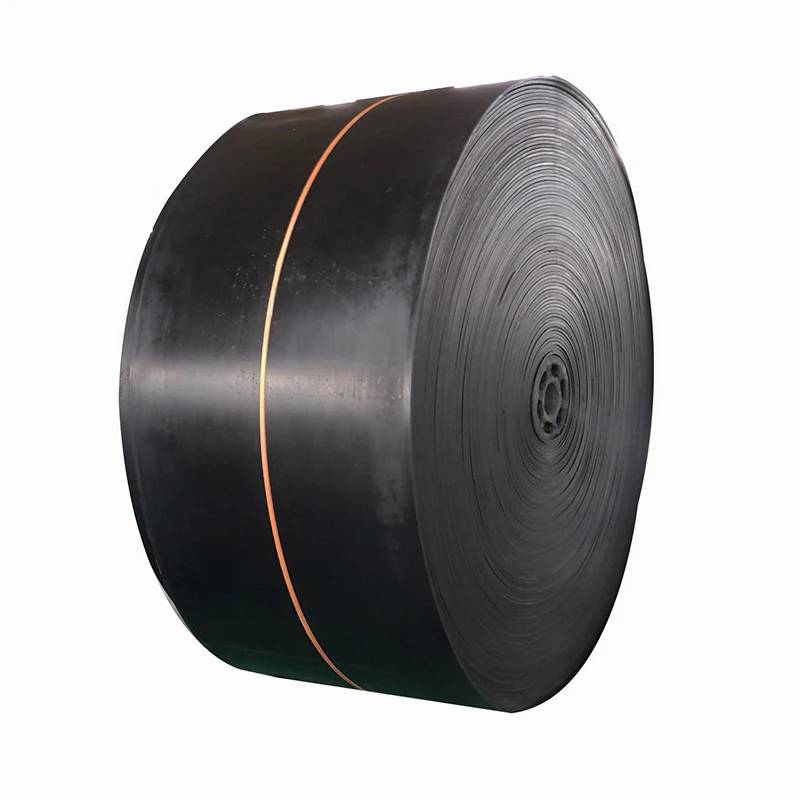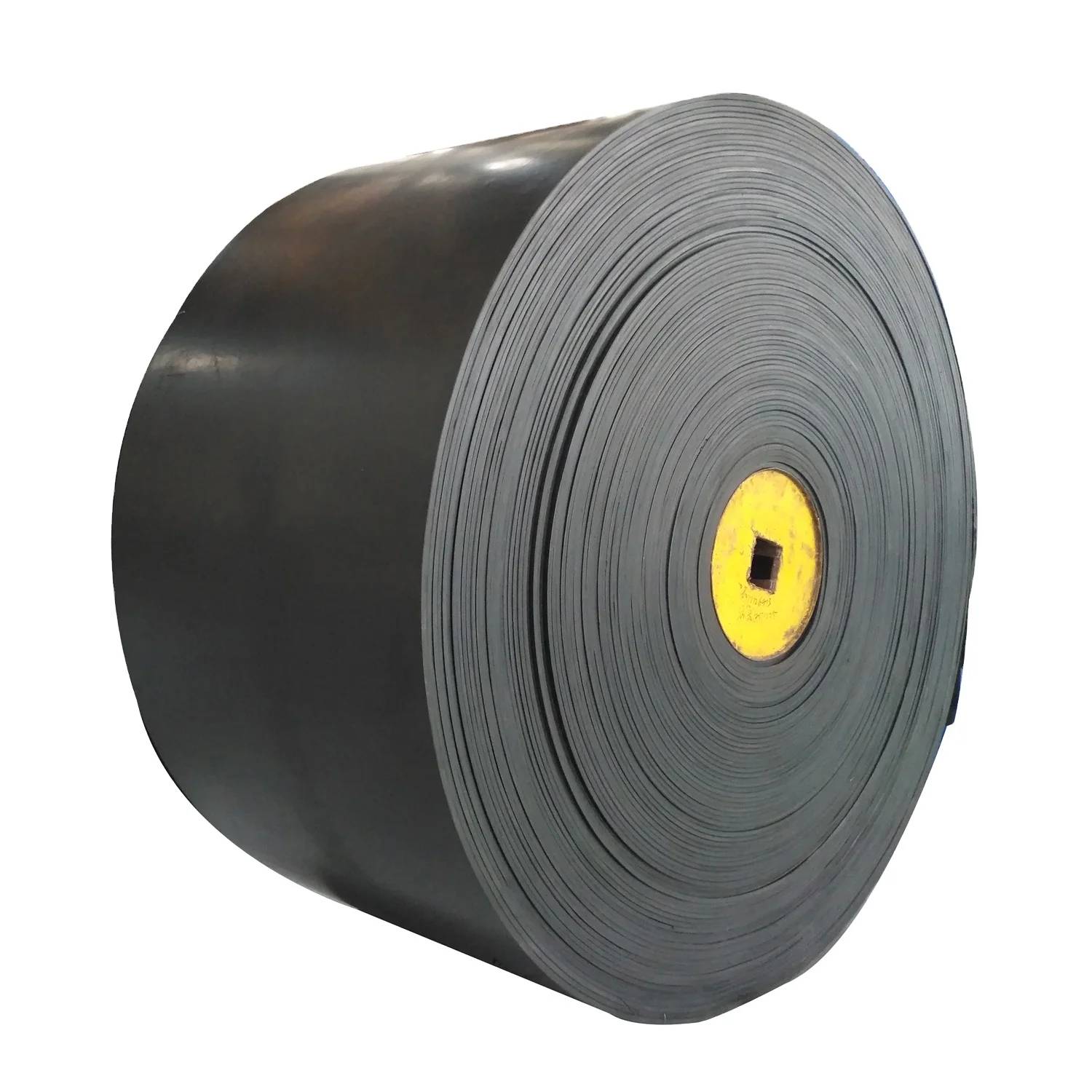



Heat-Resistant Conveyor Belt for Cement Plant & Stone Crusher
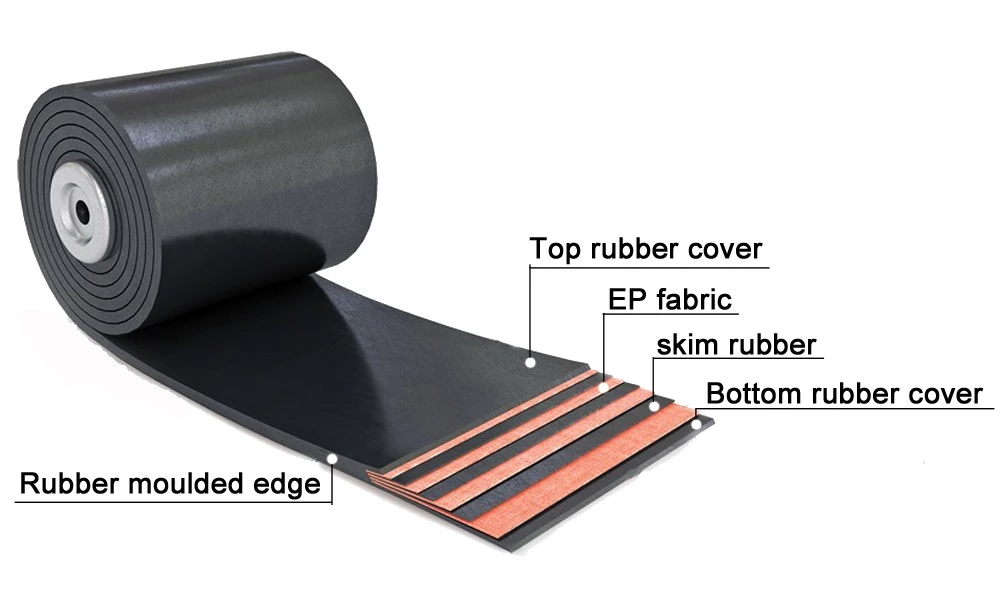
This is a heat-resistant rubber conveyor belt for cement plant and stone crusher applications, combining an EP fabric carcass with a T1 or T2 heat-resistant cover compound to handle the elevated material temperatures and continuous abrasion typical of clinker transport, cement kiln feed, and crusher discharge conveying.
Cement plant conveyors face two simultaneous challenges: abrasive materials that wear through the belt surface, and elevated material temperatures (particularly at the clinker cooler discharge) that degrade standard rubber compounds. A heat-resistant EP belt addresses both by combining the tensile strength and dimensional stability of EP fabric with a cover compound that maintains its mechanical properties and carcass adhesion at temperatures up to T1 (~120°C) or T2 (~150°C) ratings.
Stone crusher output belts typically carry cooler material but with high-impact sharp rock at the crusher discharge — making cover thickness and abrasion resistance the dominant selection criteria, with moderate heat tolerance added where the stone is warm from the crushing process. Send us your material temperature and conveyor data and we will confirm the right combination of heat resistance and abrasion performance for your application.
Get a faster, more accurate quote
Click Inquiry Now and include the application (cement plant / stone crusher), material type (clinker / limestone / crushed stone), material temperature at the loading point (continuous and peak), belt width, center-to-center length, and quantity.
Application-specific configuration guide
| Application | Material | Typical temp. at loading | Recommended cover grade |
| Cement — clinker cooler discharge | Clinker (after cooler) | 80–150°C typical | T1 (≤120°C continuous) or T2 (≤150°C) — confirm actual temperature |
| Cement — raw mill / kiln feed | Limestone, clay, shale | Ambient to ~60°C | Standard abrasion-resistant (check if heat-resistant needed) |
| Cement — finish mill / silo feed | Cement, gypsum | Ambient to ~80°C | Standard or T1 — confirm temperature and abrasion level |
| Stone crusher — primary discharge | Limestone, granite, basalt, aggregate | Ambient (stone not heated) | Heavy abrasion-resistant — heat-resistant grade if rock is warm from blasting |
| Stone crusher — secondary / tertiary | Crushed aggregate, sand | Ambient | Standard abrasion-resistant — heat-resistant not typically required |
The table above provides guidance only. Material temperature at the loading point must be measured or confirmed by the buyer; the recommended cover grade is based on that measured temperature, not on the application category alone.
Material and application note
Heat-resistant cover grade selection requires the measured material temperature at the loading point — not an estimate from the application type. Do not assume that a cement plant belt always requires T2: if the clinker has been cooled below 80°C before it reaches the belt, a standard compound may be appropriate. Confirm the actual temperature range before specifying the grade.
Why matching cover grade to temperature matters for cost
Under-specifying causes premature belt failure
Using a standard compound on material consistently above 80°C causes the cover rubber to soften, blister, and delaminate within weeks or months. The short service life and emergency replacement cost far exceed the price premium of a correctly specified heat-resistant compound. Using the right grade from the start is the economical choice.
Over-specifying adds unnecessary cost
T2 compounds cost more than T1, and T1 costs more than standard compounds. If your material temperature is consistently below 80°C — common in secondary cement conveying and stone crusher transfer belts — a standard abrasion-resistant compound delivers equivalent performance at a lower price. We will confirm the appropriate grade based on your actual temperature data, not on a maximum-grade default.
EP carcass — the right foundation for cement and crusher belts
The EP carcass provides low elongation (important for the take-up travel on long cement plant conveyors), low moisture absorption (valuable in cement dust environments), and good flex fatigue life (important on high-cycle crusher discharge belts). Combined with the correct heat-resistant cover, EP is the established standard carcass choice for these two application categories.
Application details we check
- Application type (cement plant location in process / stone crusher stage) — helps us identify the likely temperature range and abrasion severity.
- Measured or estimated material temperature at the belt loading point — continuous and peak values — the primary input for cover grade selection.
- Material type (clinker / limestone / aggregate / other) and maximum lump size.
- Belt width, center-to-center length, incline angle, and drive/tail pulley diameters.
- Belt speed and daily operating hours.
- EP grade preference or required belt strength — or share the calculated effective tension and we will select the EP grade.
- Quantity and delivery destination.
Customization discussion
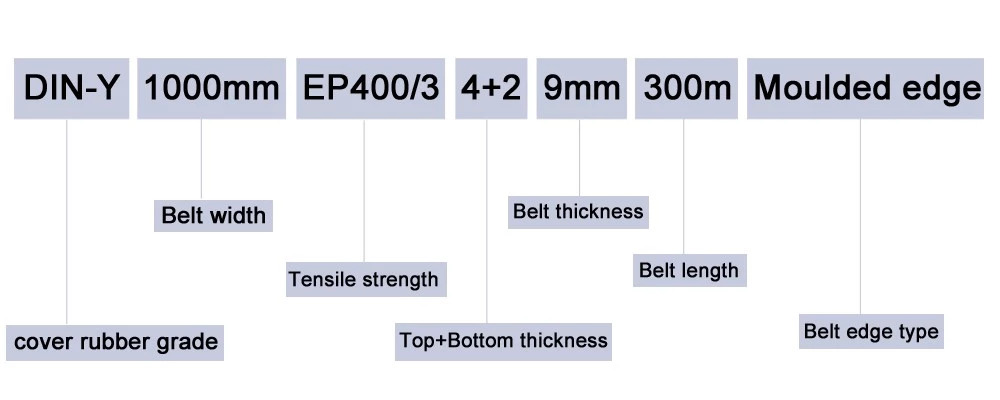
Cover compound (standard abrasion, T1, T2, T3), EP grade (EP100–EP500), ply count, belt width, belt length, top and bottom cover thickness, and splice preparation can all be discussed. For project orders replacing an existing belt in an operating plant, sharing the existing belt's tag data (if legible) helps us match the specification accurately.
Get a technical recommendation and quote
Click Inquiry Now and send your application data and conveyor dimensions.
Suggested inquiry: "Please quote a heat-resistant EP conveyor belt for our [cement plant — clinker cooler / stone crusher discharge] — belt width [ ] mm, length [ ] m, material temperature at loading: continuous [ ]°C / peak [ ]°C, material [clinker / limestone / other], quantity [ ] meters."
Frequently asked questions
How do I know if my clinker belt needs T1 or T2?
Measure the surface temperature of the clinker at the point it drops onto the belt. If it is consistently below 120°C with brief peaks below 150°C, T1 is appropriate. If the continuous temperature reaches 120–150°C, T2 is required. Providing both continuous and peak temperatures in your inquiry allows us to confirm the correct grade.
Is the stone crusher belt the same as the cement belt?
The carcass type (EP) is often the same, but the cover compound differs. Crusher discharge belts handling cool stone at ambient temperature use a heavy abrasion-resistant compound optimized for wear life — not heat resistance. Cement clinker belts require heat-resistant compound as the priority. A belt specified for one application is not automatically optimal for the other.
Can I get a competitive price on a bulk production order?
Yes. Factory-direct pricing improves with quantity. Share your annual consumption or project quantity in the inquiry and we will quote accordingly. Long-term supply agreements with forecast quantities can also be discussed for ongoing plant requirements.
How do I submit an inquiry?
Use the Inquiry Now link to open our contact page at https://sinoconve.com/contact-us and include your application, material temperature, belt dimensions, and quantity.